2 mark 10 pfennig gold= 1/2 dollar 1923
About This Note
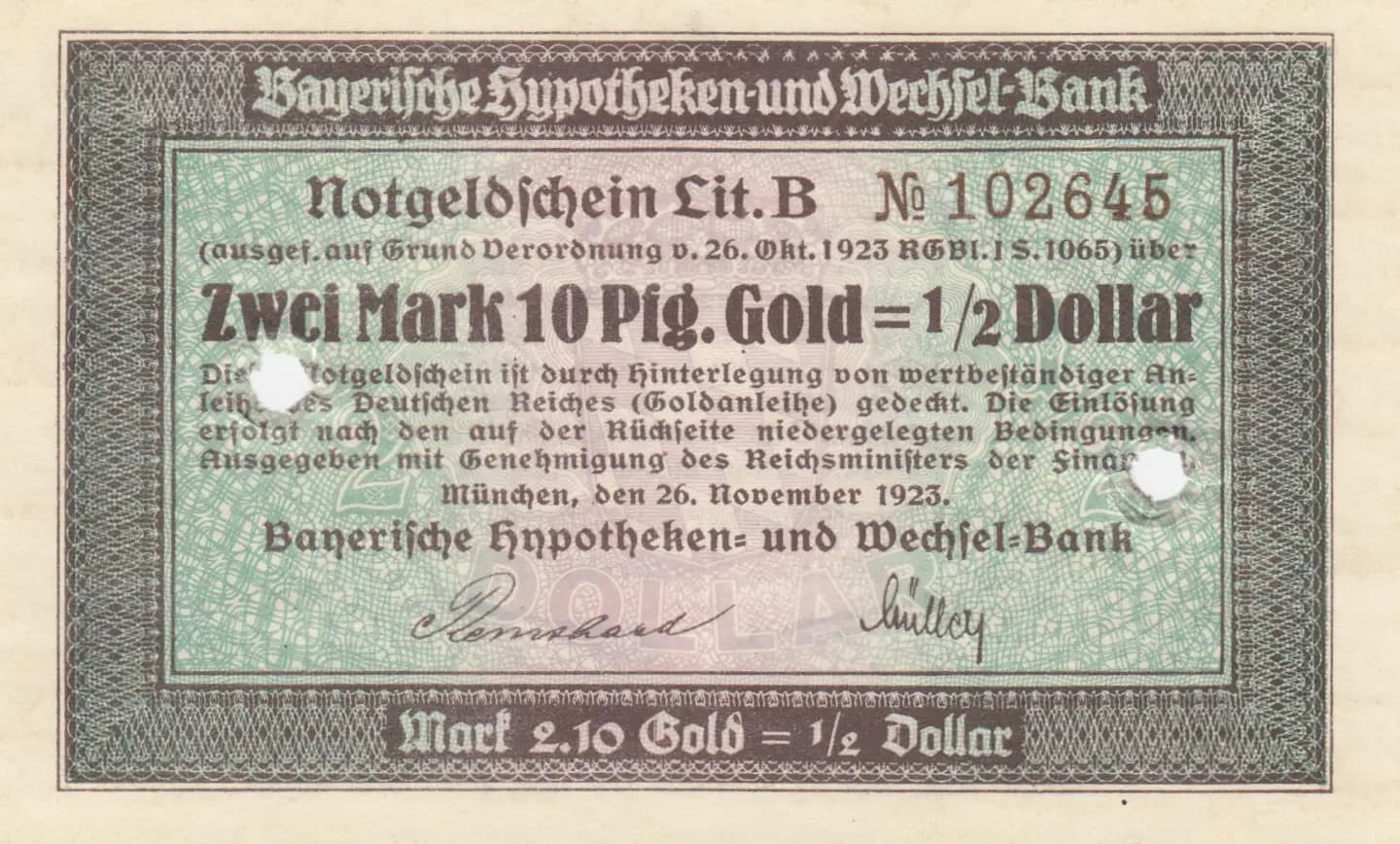
A striking example of German Notgeldschein (emergency currency) issued by the Bayerische Hypotheken- und Wechsel-Bank in November 1923, during the hyperinflation crisis. This 2 Mark 10 Pfennig note features elegant ornate borders and is backed by German Reich gold loan securities. The UNC condition specimen displays characteristic period aging with foxing and circular stamp marks, presenting an excellent snapshot of Weimar-era financial desperation and creative monetary solutions.
Common. While this is an unlisted Pick number (indicating it may not be catalogued in the standard Pick reference), Notgeldscheine from the 1923 hyperinflation period were issued in substantial quantities by numerous German institutions, including regional banks. The Bayerische Hypotheken- und Wechsel-Bank was a significant Munich-based institution with substantial reach. The UNC condition combined with the specific date (November 26, 1923) may be moderately desirable to Weimar specialists, but the note type itself was produced in sufficient quantities that it remains common in the collector market. The lack of a Pick listing suggests limited international circulation and catalog recognition rather than extreme scarcity.
This emergency note was issued under the authorization of October 26, 1923, as Germany grappled with catastrophic hyperinflation in the final months of the Weimar Republic. The Bavarian Mortgage and Exchange Bank issued these notes backed by gold loan securities (Goldanleihe) to maintain confidence in local currency when the Reichsmark had become essentially worthless. The November 26, 1923 date places this note at the very peak of the crisis, just weeks before the currency stabilization that would follow the introduction of the Rentenmark in December.
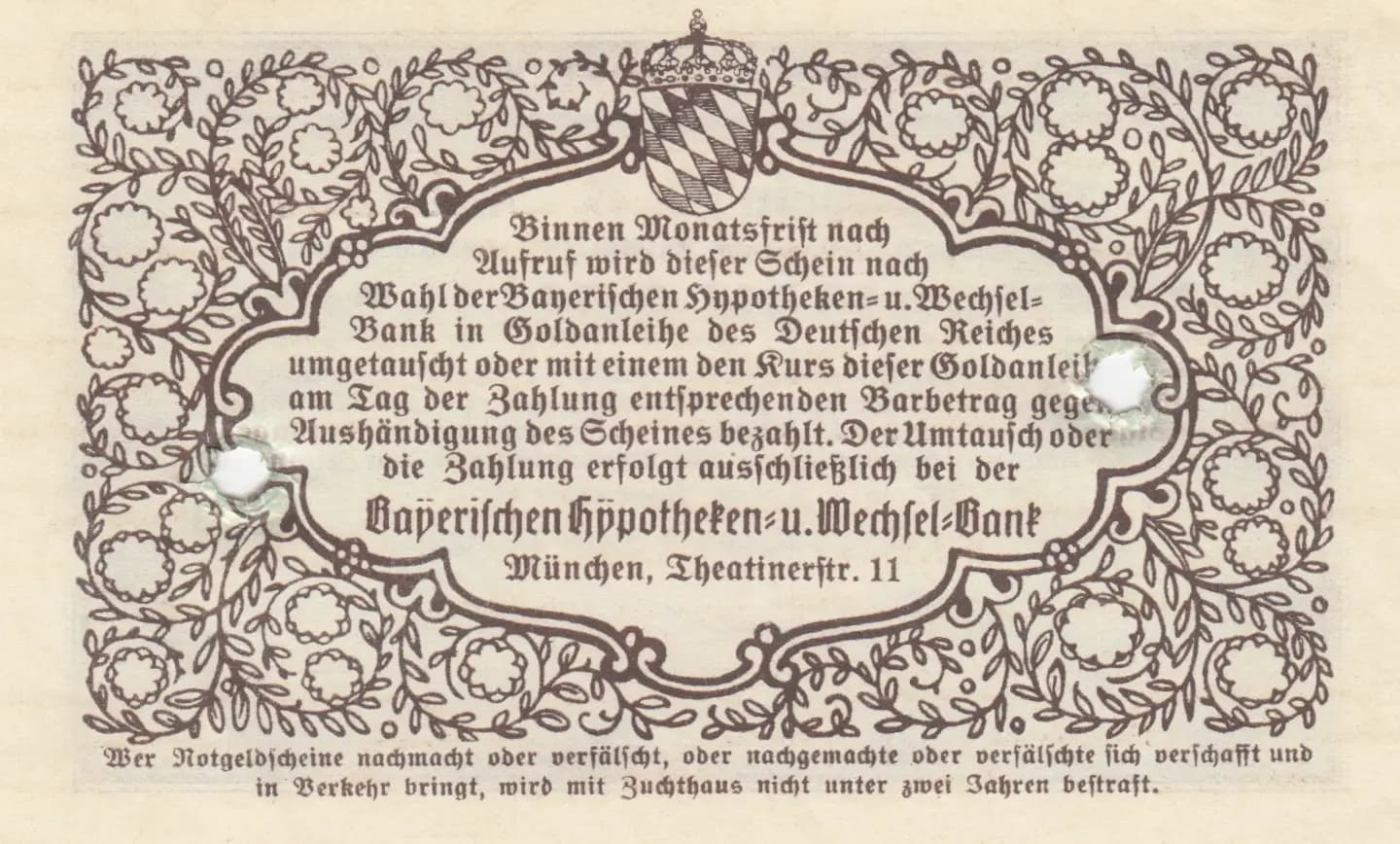
The note features a classical Notgeldschein design characteristic of Bavarian 1923 emergency issues. The front displays a light green background with a cream-colored central text field, surrounded by an ornate decorative border frame executed in brown ink. Two circular stamp/seal marks appear in the upper right and lower left positions, serving both as design elements and administrative marks. The reverse side showcases more elaborate ornamentation, featuring a central cartouche containing the Bavarian coat of arms with crown at the top, surrounded by a repeating pattern of floral and botanical motifs in brown ink on a cream background. The design reflects the high standards of the Bavarian banking institution, utilizing classical engraving techniques to create complex security patterns throughout. No portraits are depicted; instead, heraldic symbols and ornamental security printing serve to establish legitimacy and deter counterfeiting. The text is densely printed in a formal German typeface appropriate to official financial documents of the era.
FRONT SIDE: 'Bayerische Hypotheken-und Wechsel-Bank' (Bavarian Mortgage and Exchange Bank) | 'Notgeldschein Lit.B' (Emergency Currency Note Type B) | 'No 102645' (Serial Number 102645) | '(ausgeg. auf Grund Verordnung v.26. Okt.1923 RGBl. I S.1065)' (issued under order of October 26, 1923 RGBl. I p.1065) | 'Zwei Mark 10 Pfg. Gold = 1/2 Dollar' (Two Mark 10 Pfennig Gold = 1/2 Dollar) | 'Die Notgeldschein tit durch Hinterlegung von wertbeständiger Aneichcs des Deutschen Reiches (Goldanleihe) gedeckt. Die Einlösung erfolgt nach den auf der Rückseite niedergelegten Bedingungen. Ausgegeben mit Genehmigung des Reichsministers der Finanzen München, den 26. November 1923.' (This emergency currency note is backed by deposit of valuable securities of the German Reich (gold loan). Redemption takes place according to the conditions stated on the reverse. Issued with permission of the Reich Minister of Finance Munich, November 26, 1923.) | Signatures: 'Armsland' and 'Müller' | 'Mark 2.10 Gold = 1/2 Dollar' (Mark 2.10 Gold = 1/2 Dollar) | BACK SIDE: 'Binnen Monatsfrist nach Aufruft wird dieser Schein nach Wahl der Bayerischen Hypotheken-u. Wechsel-Bank in Goldanleihe des Deutschen Reiches umgetauscht oder mit einem ben Kurs dieser Goldanleihe am Tag der Zahlung entsprechenden Barbetrag gegen Aushändigung des Scheines bezahlt. Der Umtausch oder die Zahlung erfolgt ausschließlich bei der Bayerischen Hypotheken-u. Wechsel-Bank München, Theatinerstr. 11' (Within one month from the call, this note will be exchanged at the choice of the Bavarian Mortgage and Exchange Bank in German Reich gold loan or paid with a cash amount corresponding to the rate of this gold loan on the day of payment against surrender of the note. Exchange or payment takes place exclusively at the Bavarian Mortgage and Exchange Bank Munich, Theatinerstr. 11) | 'Wer Notgeldscheine nachmacht oder verfälscht, oder nachgemachte oder verfälschte sich verschafft und in Verkehr bringt, wird mit Zuchthaus nicht unter zwei Jahren bestraft.' (Anyone who counterfeits or falsifies emergency currency notes, or obtains counterfeit or falsified notes and puts them into circulation, will be punished with hard labor for not less than two years.)
Intaglio engraving on paper, typical of German bank note production of the 1920s. The complex ornate borders, fine crosshatch background patterns, detailed floral motifs, and crisp text impressions indicate professional security printing by an established German printer. The ornamental border serves as a primary security measure alongside the detailed engraving work. The circular stamp impressions suggest the use of hand or mechanical stamping applied after printing. The quality and complexity of the design indicates this was produced by a skilled security printer capable of executing the intricate patterns visible in both the ornamental borders and background security features.
This specimen is identified as Notgeldschein Type B (Lit.B) with serial number 102645. The note is dated November 26, 1923 (Munich). Signatures visible are 'Armsland' and 'Müller'. The denomination is specifically stated as '2 Mark 10 Pfennig Gold = 1/2 Dollar', which establishes a gold backing equivalence. Variations of this issue may exist with different type designations, serial number ranges, or signature combinations, but without access to a comprehensive catalog of Bayerische Hypotheken- und Wechsel-Bank issues, specific variety classification beyond Type B cannot be definitively established. The gold equivalence denomination (equating to a dollar half) suggests this may be part of a series designed to facilitate international commerce during the transition period.