100 000 000 mark 1923
Market Prices
3 salesAbout This Note
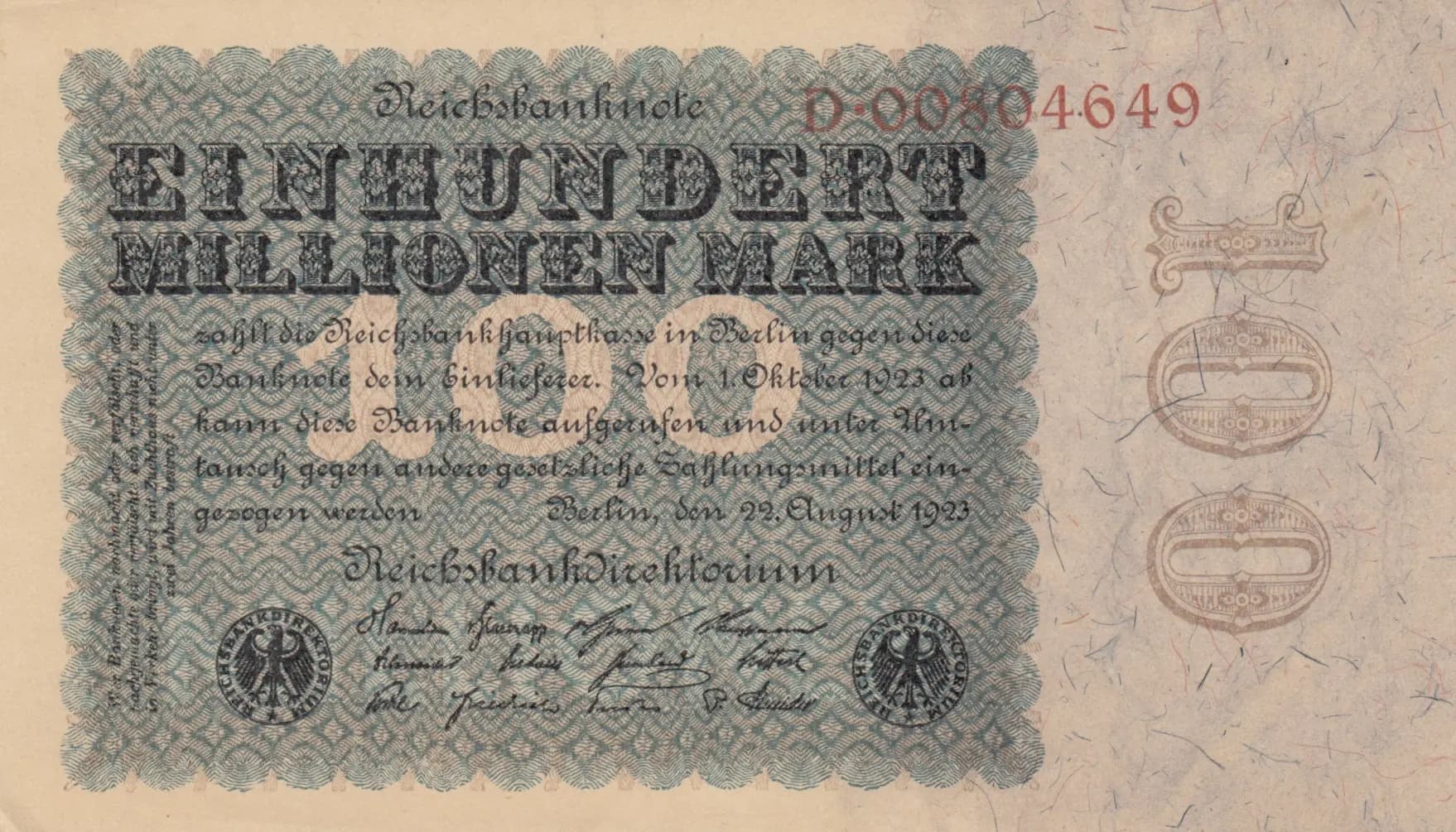
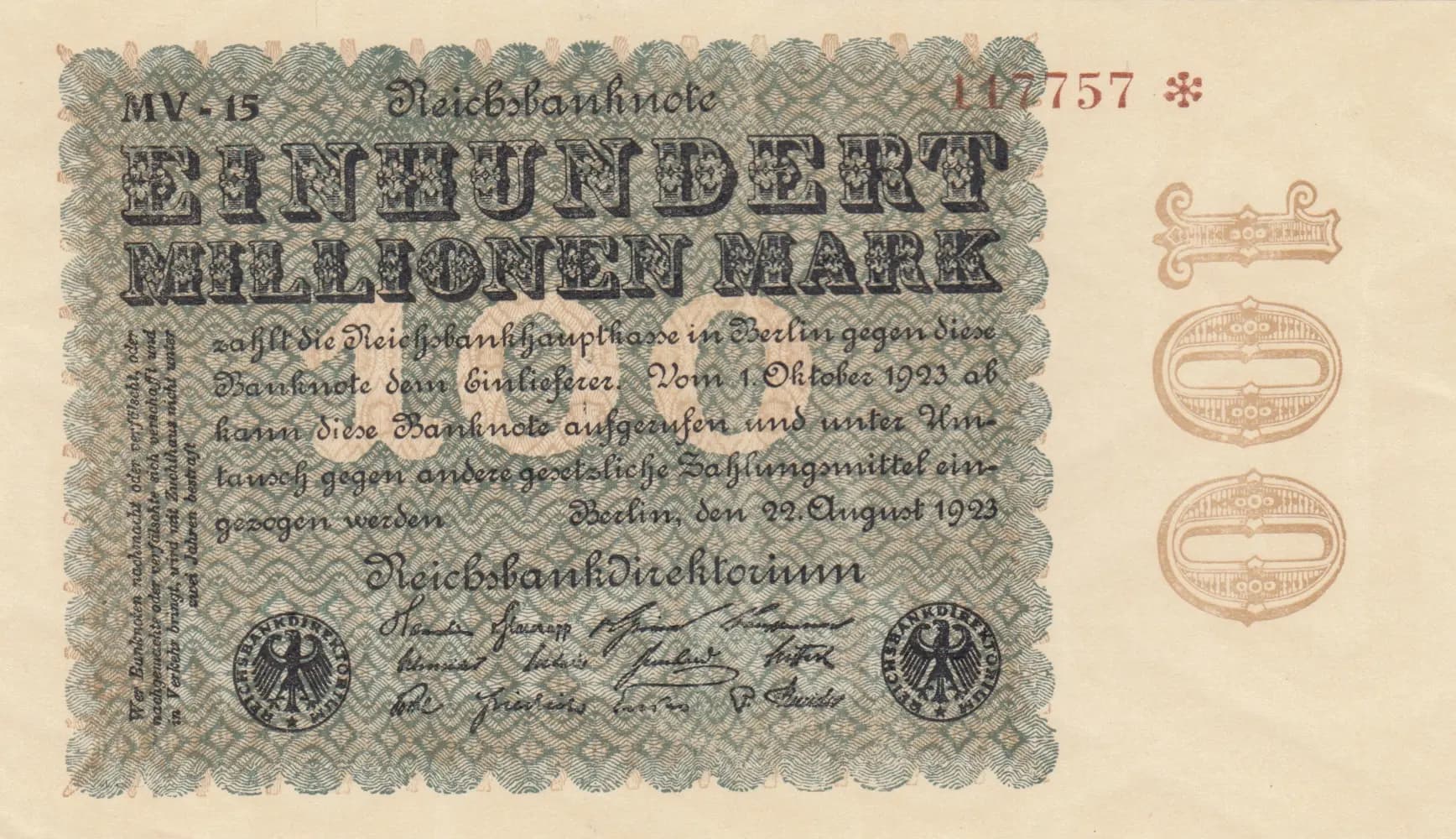
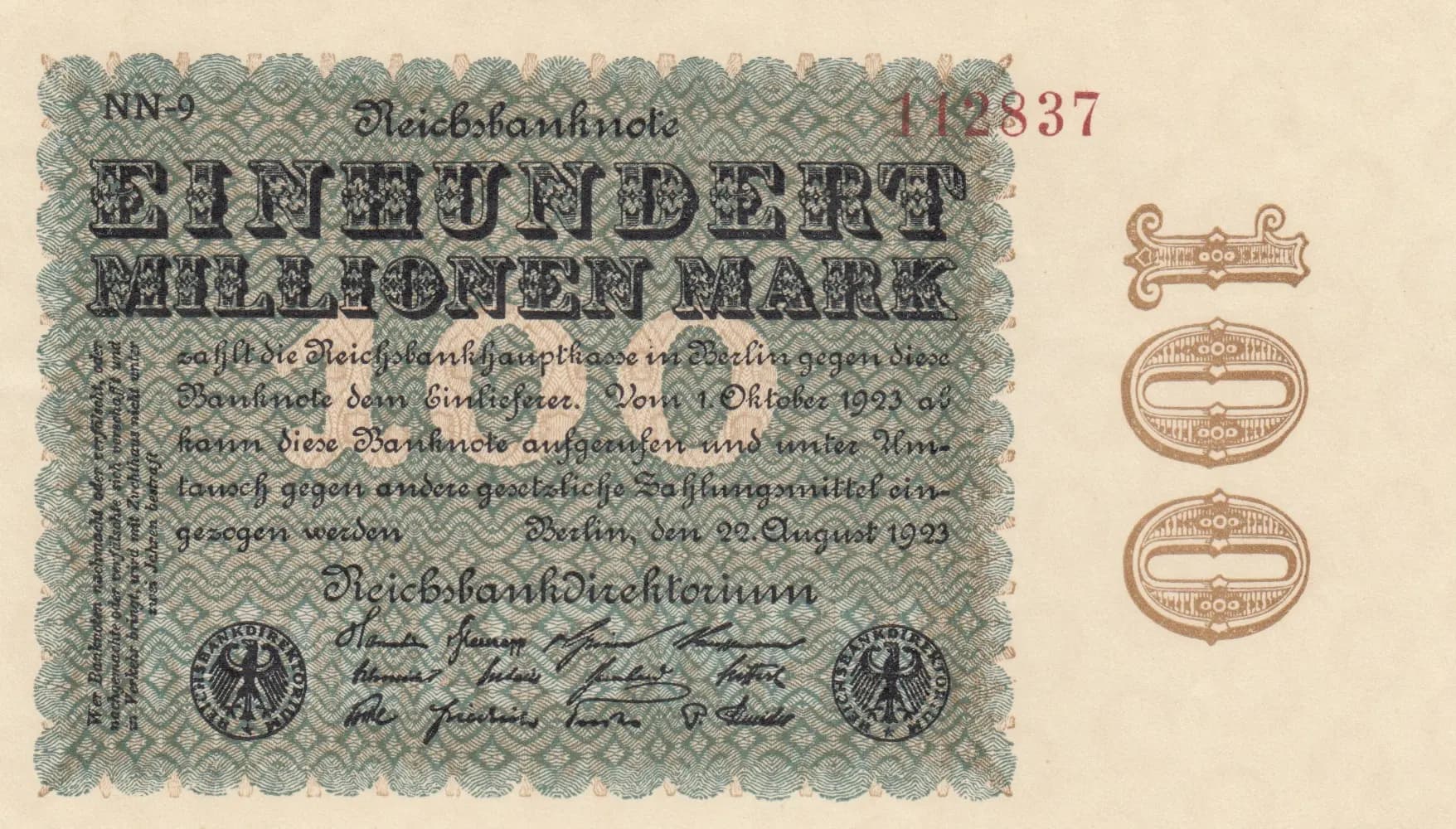
This German 100 Million Mark note from August 1923 represents a quintessential hyperinflation-era banknote, issued during the peak of Germany's economic crisis. The note displays excellent condition (AU grade) with sharp, clear printing showing minimal wear, faint aging spots, and vibrant green/teal and brown color scheme. The uniface design features prominent Fraktur script, imperial eagle seals, and three ornamental oval emblems with architectural motifs, making it an attractive example of emergency currency from this historically significant period.
Common. The eBay market data provided shows these notes trading at very modest prices ($1.29 to $37 depending on condition and grading service), with catalog values from 2016 ranging from $4 (VG) to $20 (UNC). The high volumes of hyperinflation currency issued in 1923 and the survival of numerous examples in various conditions confirm this as a commonly available note among collectors. While hyperinflation-era notes are historically significant, they were produced in vast quantities and remain affordable and accessible to most collectors.
Issued on August 22, 1923, at the height of German hyperinflation, this note exemplifies the Reichsbank's desperate attempts to maintain currency supply as the Mark's value collapsed. The imperial eagle seals and formal 'Reichsbankdirektorium' signatures reflect the institutional authority attempting to stabilize the economy, while the astronomical denomination (100 million marks) underscores the severity of the crisis. The exchange clause dated October 1, 1923, indicates this was a temporary emergency issue, soon to be superseded by the Rentenmark in November 1923.
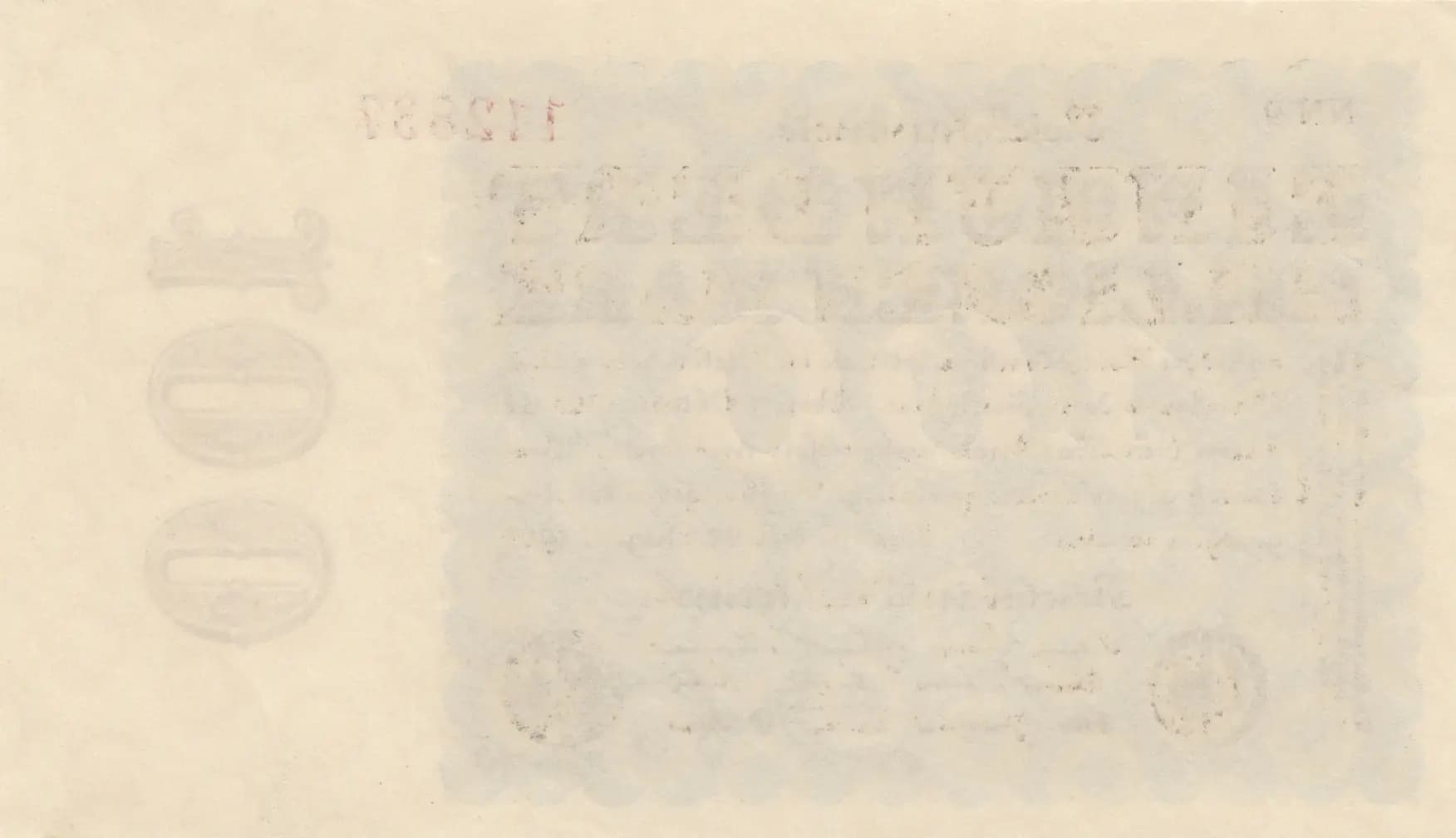
The front features a masterwork of German security printing for the period, with an intricate crosshatch pattern in green/teal covering the entire background as the primary anti-counterfeiting measure. The denomination text 'EINHUNDERT MILLIONEN MARK' dominates the center in large, bold Fraktur script. Two imperial German eagle seals, positioned at the bottom left and right corners, represent governmental authority and legitimacy. Three ornamental oval emblems arrayed vertically on the right margin contain architectural designs depicting institutional buildings—likely representing German financial or governmental institutions, reinforcing the note's official status. The serial number appears in red ink in the top right. The reverse side appears to be either blank or carry only minimal security features and watermark impressions, consistent with uniface printing common to emergency currency of this period. The decorative scalloped border and formal typography emphasize the note's official character despite its extraordinary denomination.
FRONT SIDE: 'EINHUNDERT MILLIONEN MARK' (One Hundred Million Mark) — main denomination text. 'Reichsbanknote' (Imperial Bank Note) — issuer identification. 'ANN-9' (Serial number prefix). '118837' (Serial number in red). 'Berlin, den 22.August 1923' (Berlin, August 22, 1923) — issue date. 'Reichsbankdirektorium' (Reichsbank Board of Directors). 'Laut Gesetz die Reichsbankhauptasse in Berlin gegen diese Banknote dem Einlieferer. Vom 1.Oktober 1923 ab kann diese Banknote aufgehoben und unter Umtausch gegen andere gesetzliche Zahlungsmittel ein gezogen werden' (According to law, the Reichsbank headquarters in Berlin will exchange this banknote against presentation by the bearer. From October 1, 1923 onwards, this banknote can be withdrawn and exchanged for other legal tender). BACK SIDE: Largely blank or very faintly printed; watermark impressions faintly visible.
Intaglio (engraved) printing, the standard security printing method for Reichsbank notes. The crisp, fine detail visible in the crosshatch background pattern, the sharp serifs in the Fraktur text, and the precise rendering of the eagle seals and architectural emblems are characteristic of intaglio work. The multi-color printing (green/teal, brown/tan, black, and red inks) was achieved through multiple passes on separate printing plates, a hallmark of high-security banknote production. The specific printer for P-107e would likely be one of Germany's established banknote printers contracted by the Reichsbank, such as the Reichsdruckerei (Imperial Printing Office) or a similar security printer, though catalog data does not specify the printer for this particular variant.
This example represents P-107e according to the Pick catalog number provided. The PMG population report notes that P-107b exists as a variant with Type D watermark, indicating watermark differences among varieties of this denomination. The visual analysis confirms the presence of small circle watermarks (described as 'L' type in the catalog reference), suggesting this note may be distinguished from P-107b by watermark type. The serial number prefix 'ANN-9' and the issue date of August 22, 1923, are consistent with regular issue characteristics. No overprints or additional marks suggesting special varieties (such as territorial or emergency bank variants) are visible.