3 rublei 1919
Market Prices
6 salesAbout This Note
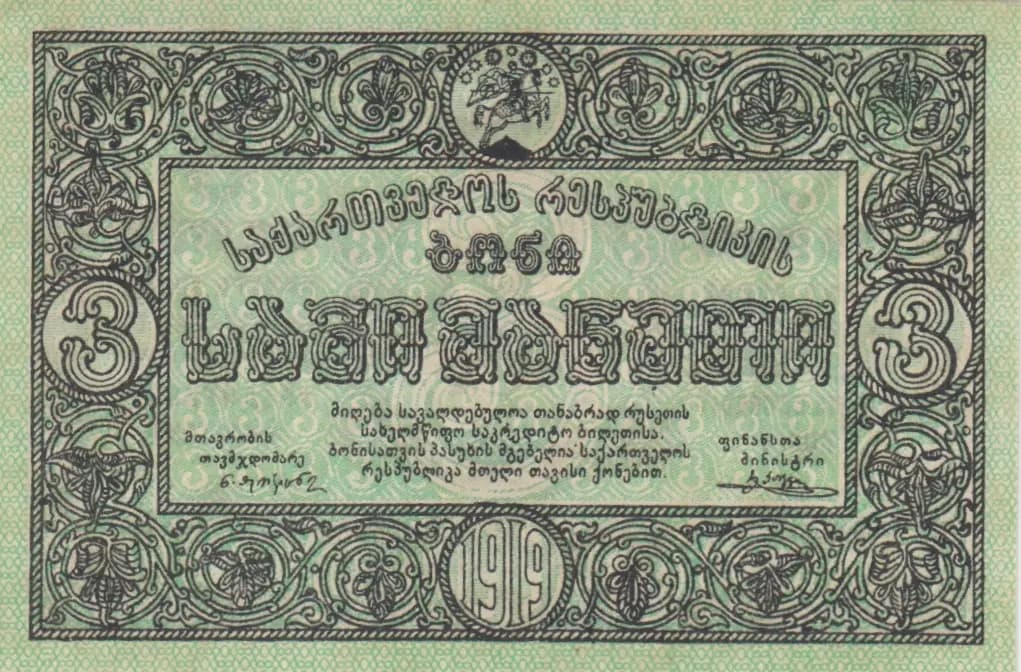
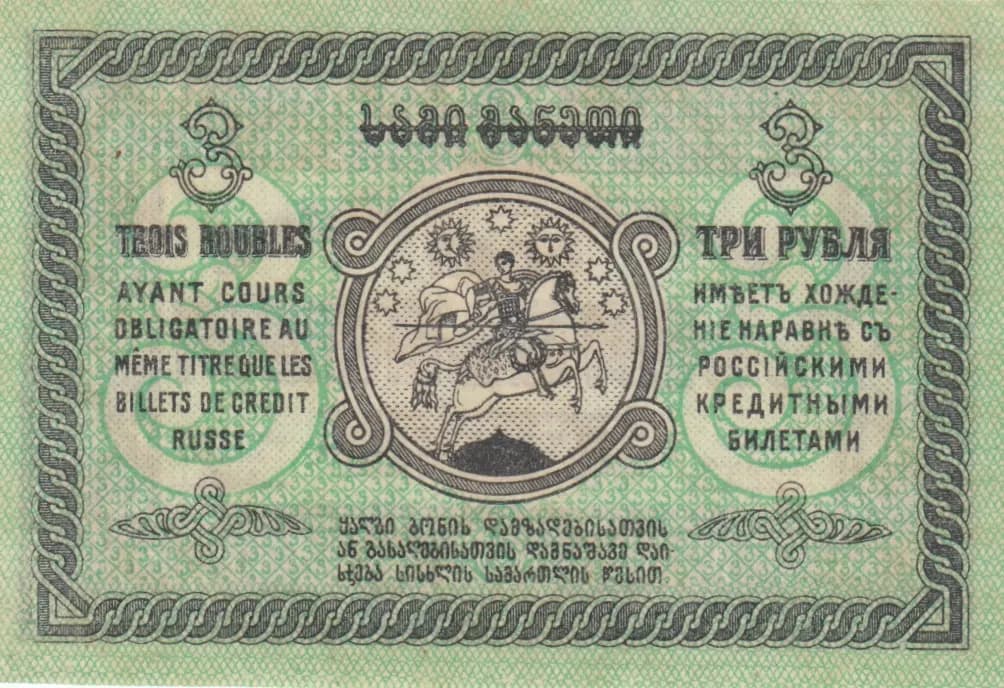
This is a Georgia 3 Rublei note from 1919 in uncirculated condition, representing the brief independent Georgian Republic's currency during the Russian Civil War period. The obverse features an ornate pale green design with elaborate floral and scrollwork borders and Georgian script text, while the reverse showcases a striking engraved medallion of St. George on horseback—Georgia's national symbol—surrounded by text in Georgian, Russian, and French declaring the note's legal tender status. The exceptional condition and fine engraving work make this an attractive example of early 20th-century Caucasian numismatics.
Common. Despite being from a short-lived issuing authority (Georgian Republic, 1919-1921), this note trades regularly on secondary markets with consistent eBay transaction history showing UNC examples selling in the $16-21 range (2018-2021) and catalog values at $10 UNC (2016 pricing). The regular circulation of examples across multiple condition grades and price points indicates a substantial original print run that remains readily available to collectors. The note is neither rare nor difficult to acquire, though as with all banknotes from this transitional period, condition significantly affects market value.
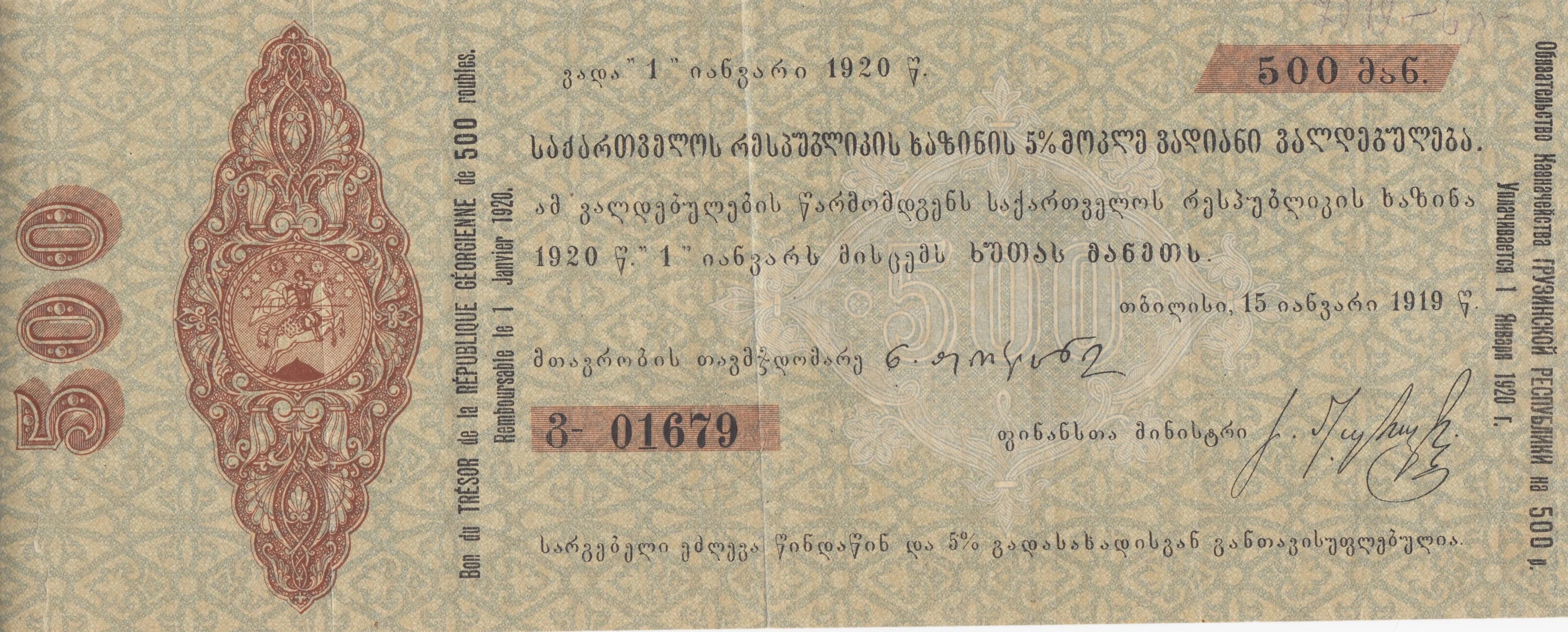
Issued by the Democratic Republic of Georgia in 1919 during a period of independence following the Russian Revolution, this note represents Georgia's brief window of sovereignty before Soviet incorporation in 1921. The prominent depiction of St. George on horseback reflects Georgia's national identity and Orthodox Christian heritage, a symbol that would remain central to Georgian iconography. The trilingual inscriptions in Georgian, Russian, and French underscore Georgia's precarious position as a new nation seeking international recognition while surrounded by Russian and Ottoman spheres of influence.
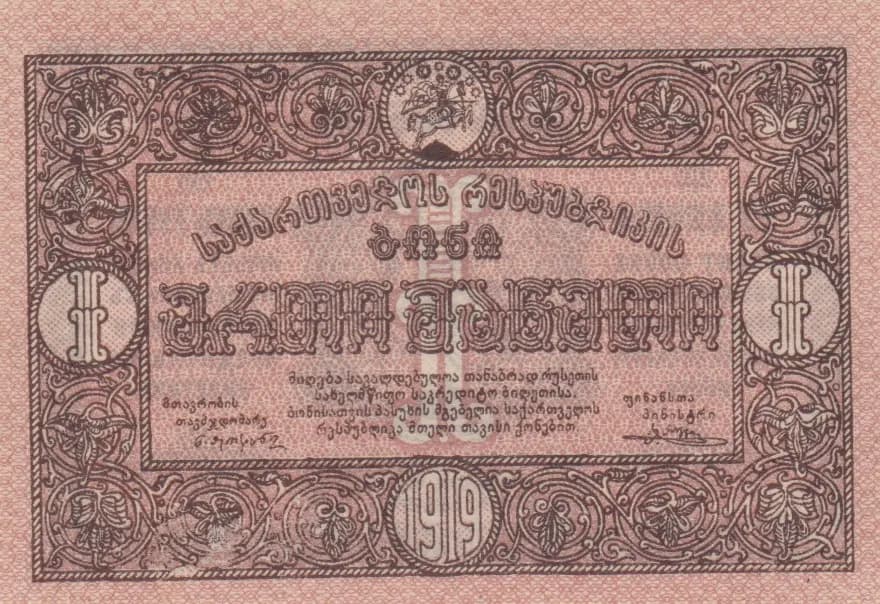
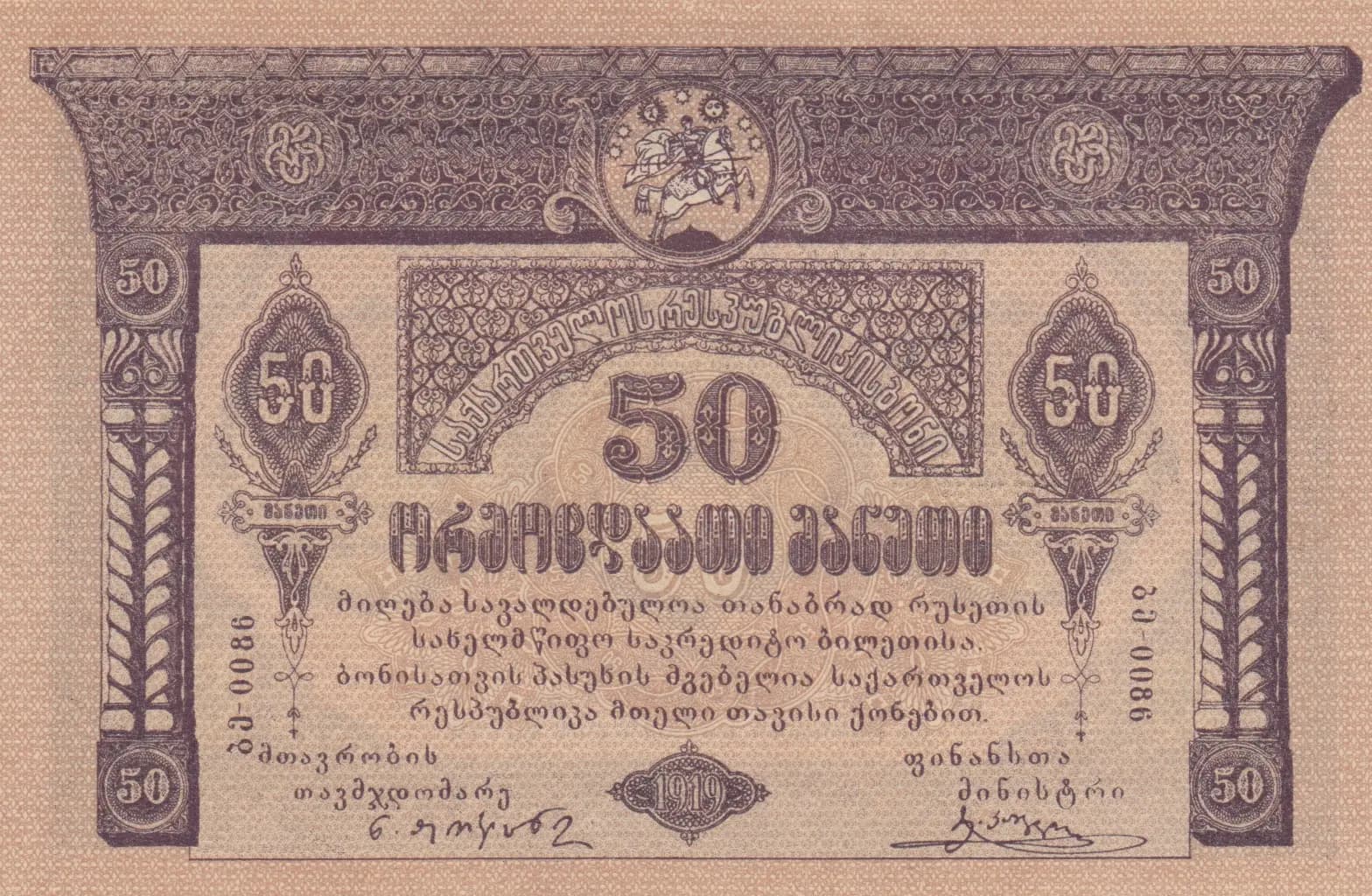
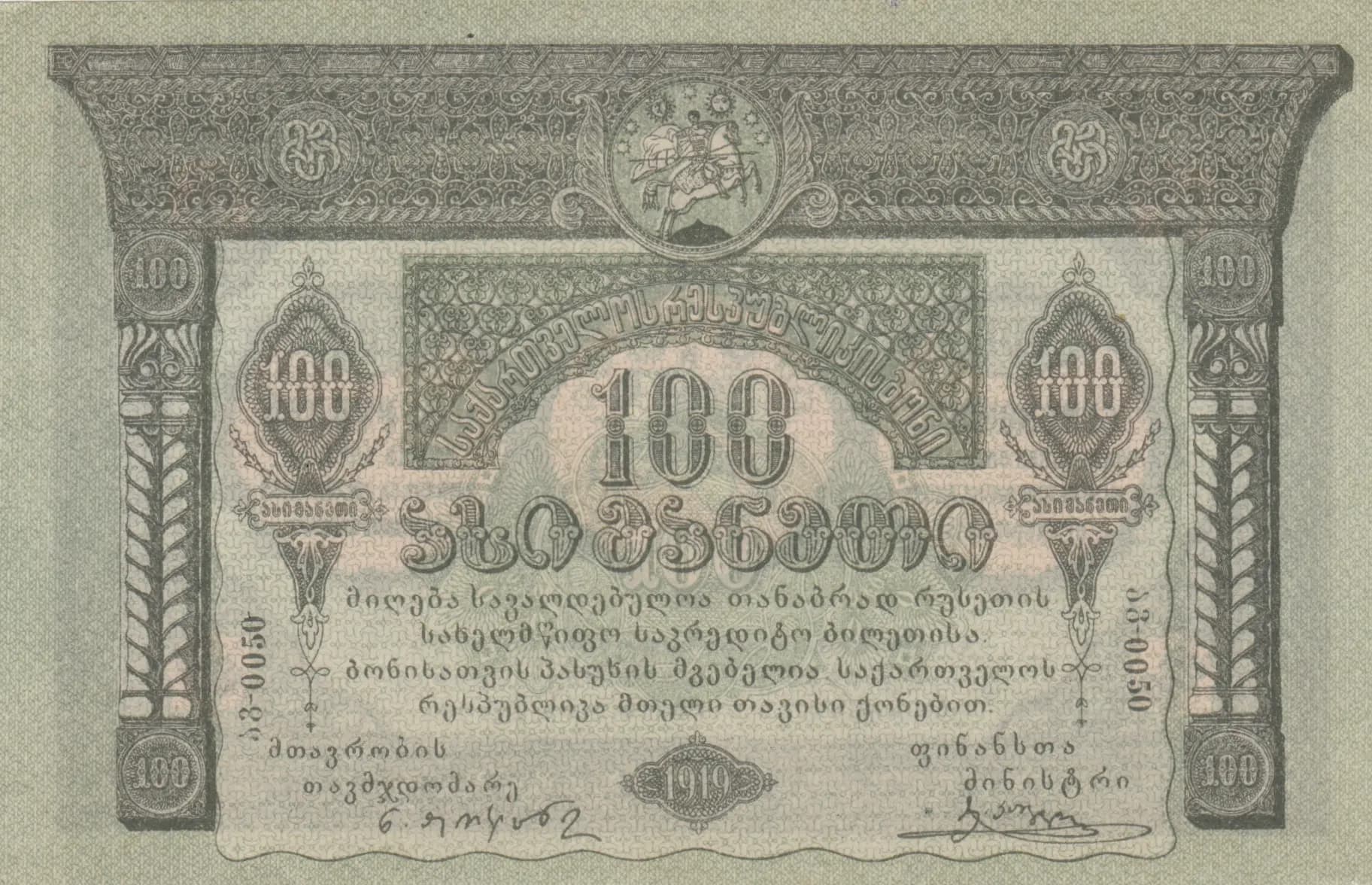
The obverse presents a classical banknote design with a pale mint-green background dominated by an ornate decorative border of intricate floral and scrollwork patterns rendered in black ink. The denomination '3' appears in circular medallions in the upper and lower left corners, with the year '1919' displayed prominently in an ornamental frame at the bottom center. All text is rendered in Georgian script. The reverse features a cream-colored central medallion containing a finely engraved image of St. George (Georgia's patron saint) mounted on horseback, depicted slaying a dragon or serpent below—a classical representation of this legendary saint that holds deep cultural significance for Georgia. The medallion is framed by a distinctive twisted rope-pattern border in black, with the denomination '3' repeated in ornamental shields in the upper corners. Multilingual text (Georgian, Russian, and French) surrounds the central image, emphasizing the note's legal tender status and parity with Russian Imperial credit notes.
FRONT: Georgian text 'სამი რუბელი' (Three rubles) and 'სამსახურის ფილიალი' (Branch office); numerals '3' and '1919'; longer Georgian inscription translates to 'Fictitious credit note in place of Russian credit notes in circulation; this note is obligatory only by standard.' BACK: Georgian 'სამი რუბელი' (Three rubles); French 'TROIS ROUBLES' (Three rubles), 'AYANT COURS' (In circulation), 'OBLIGATOIRE AU MÊME TITRE QUE LES BILLETS DE CREDIT RUSSE' (Obligatory at the same title as Russian credit bills); Russian 'ТРИ РУБЛИ' (Three rubles), 'ИМЕЕТ ХОЖДЕНИЕ' (In circulation), 'ИМЕЕТ ХОЖДЕНИЕ ОБЯЗАТЕЛЬНО НА РОССИЙСКИМИ КРЕДИТНЫМИ БИЛЕТАМИ' (Has circulation obligatory with Russian credit bills).
This note employs fine-line engraving techniques, evidenced by the intricate detail work visible in the ornamental borders, scrollwork patterns, and the central St. George medallion on the reverse. The twisted rope border pattern and the detailed equestrian figure demonstrate the precision characteristic of intaglio engraving. The consistent black ink rendering across decorative elements and text, combined with the pale green underprint, suggests a multi-pass printing process typical of 1919-era security printing. The specific printer for Georgian Republic notes of this period remains historically documented as the security printing facilities available to the nascent Georgian state during this brief independence period.
The Pick P-8 designation encompasses the standard issue of the 3 Rublei from 1919. Based on the visual analysis, this example shows the trilingual reverse (Georgian, Russian, French) standard for this issue. No specific overprints, signatures, or serial number variations are visible in the provided images. Serial number prefixes and signature varieties, if they exist for this note type, cannot be determined from the current imagery but would represent the primary distinguishing factors among examples of this denomination.