1 rubel 1919
Market Prices
6 salesAbout This Note
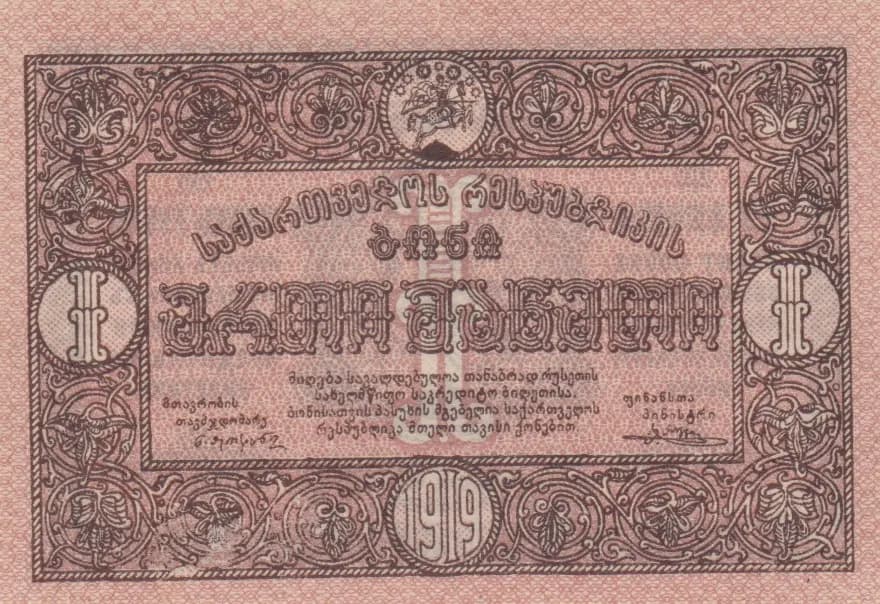
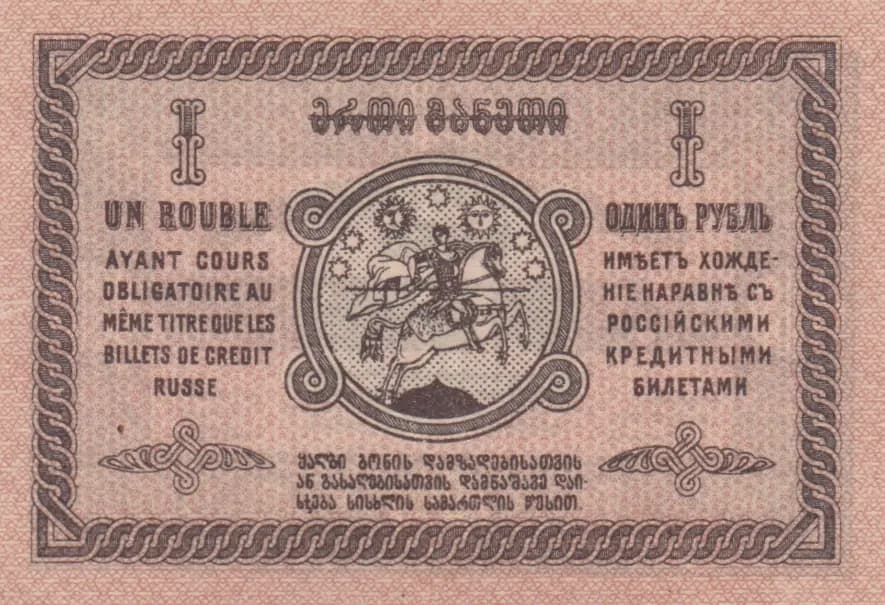
A superb uncirculated example of the 1919 Georgian 1 Ruble note (Pick P-7), featuring intricate engraved borders with floral and geometric patterns in brown and sepia tones on a light pink underprint. The obverse displays Georgian script inscriptions and ornamental medallions, while the reverse presents bilingual French and Russian text asserting equal circulation status with Russian credit notes, centered by a circular medallion containing a dragon or mythical creature. The note exhibits sharp print quality, even coloring, and the crisp appearance characteristic of UNC grade preservation, making it a desirable example of early Georgian monetary independence.
Common. The eBay market data provided shows consistent sales activity across multiple condition grades over recent years, with typical realized prices ranging from $2.25 (VG) to $42 (PMG 65 graded), and 2016 catalog values listing UNC at only $10. The regular appearance of this note in the secondary market, the relatively modest price points even for graded examples, and the fact that it was a regular-issue note of the Georgian Republic (not a short-lived emergency issue) all indicate this is a common date and denomination. While Georgian early independence-period notes have some collector appeal for world currency and early Soviet-era specialists, P-7 does not command the premiums associated with rare or scarce issues.
Issued during Georgia's brief period of independence (1918-1921) following the Russian Revolution, this 1919 Ruble note represents the Autonomous Republic of Georgia's assertion of monetary sovereignty while strategically maintaining compatibility with Russian ruble circulation. The multilingual design in Georgian, French, and Russian reflects the geopolitical complexities of the period, with the French and Russian inscriptions explicitly validating the note's legal tender status equivalent to Russian credit notes, a necessary measure for acceptance in territories where Russian currency still dominated trade.
The note features a symmetrical, classically-inspired design typical of early 20th-century Eastern European currency. The obverse is dominated by an ornate engraved border composed of repeating floral and geometric patterns in brown and sepia. At the center is a rectangular panel containing Georgian-language text identifying the issuer (Bank of Georgia) and denomination. Circular medallions with heraldic or floral motifs appear in the corners and along the borders, with two vertical ornamental bands featuring stylized scrollwork flanking the central text. The denomination numeral '1' appears in decorative circular frames positioned on both the left and right sides. The reverse maintains the same border treatment and denomination marking placement, but replaces the central Georgian text with bilingual French and Russian inscriptions. The centerpiece of the reverse is a circular medallion depicting a dragon or mythical creature in profile—likely a reference to Georgian heraldic tradition or the nation's historical symbols. Ornamental flourishes and decorative scrollwork appear below the central multilingual text. The overall color scheme of brown, sepia, and tan on a light pink/mauve underprint creates visual distinction while maintaining the serious, official appearance befitting state currency.
OBVERSE: 'საქართველოს ბანკი' (Bank of Georgia) / 'ერთი რუბელი' (One Ruble) / '1919' (date) / Additional Georgian administrative/legal text in smaller script. REVERSE: 'UN ROUBLE' (One Rouble - French) / 'AVANT COURS OBLIGATOIRE AU MÊME TITRE QUE LES BILLETS DE CRÉDIT RUSSE' (Has mandatory circulation at the same rate as Russian credit notes - French) / 'ОДИН РУБЛЬ' (One Ruble - Russian Cyrillic) / 'ИМЕТЬ ХОЖДЕНИЕ НАРАВНЕ С РОССИЙСКИМИ КРЕДИТНЫМИ БИЛЕТАМИ' (Has circulation equal to Russian credit notes - Russian) / Georgian administrative text at bottom.
Intaglio engraving (copperplate/steel engraving), evidenced by the intricate, fine-line border patterns, the crisp definition of the decorative medallions, and the precise rendering of both Cyrillic and Latin script. The consistent depth and clarity of the engraved elements throughout both sides, along with the subtle tonal variations in the sepia and brown inks, are characteristic of professional security printing typical of early 20th-century European currency production. The printer for Georgian issues of this period is not definitively established from standard references, though Georgian banknotes were produced by various European security printers contracted by the Georgian government during its independence period.
No significant varieties are documented for Pick P-7 in standard catalogs. The note should be examined for signature variants or serial number series prefixes that may distinguish early versus later printings within the 1919 issue, though such distinctions are not well-cataloged for Georgian rubles. The UNC grade specimen observed appears to be a standard example without notable overprints, date variations, or security printer marks that would constitute a distinct variety.