1 dalasi 1972
Market Prices
2 salesAbout This Note
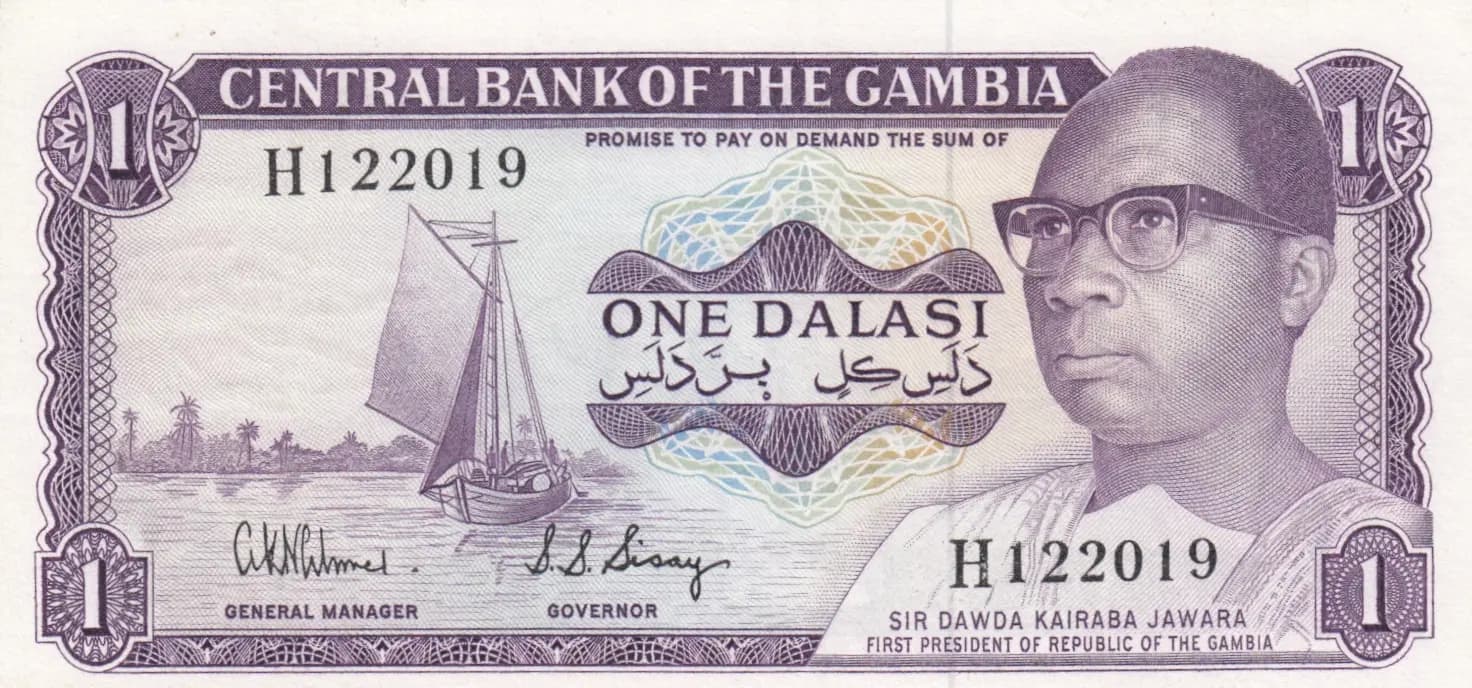
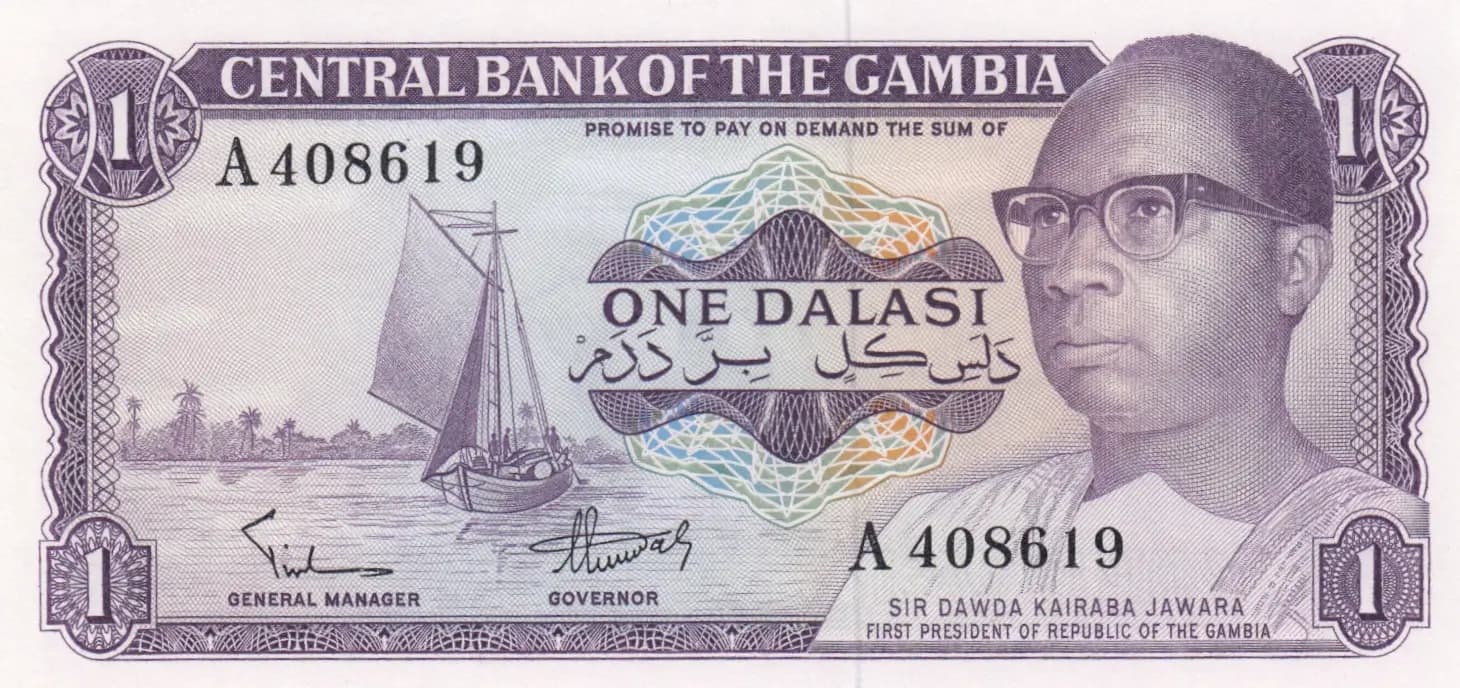
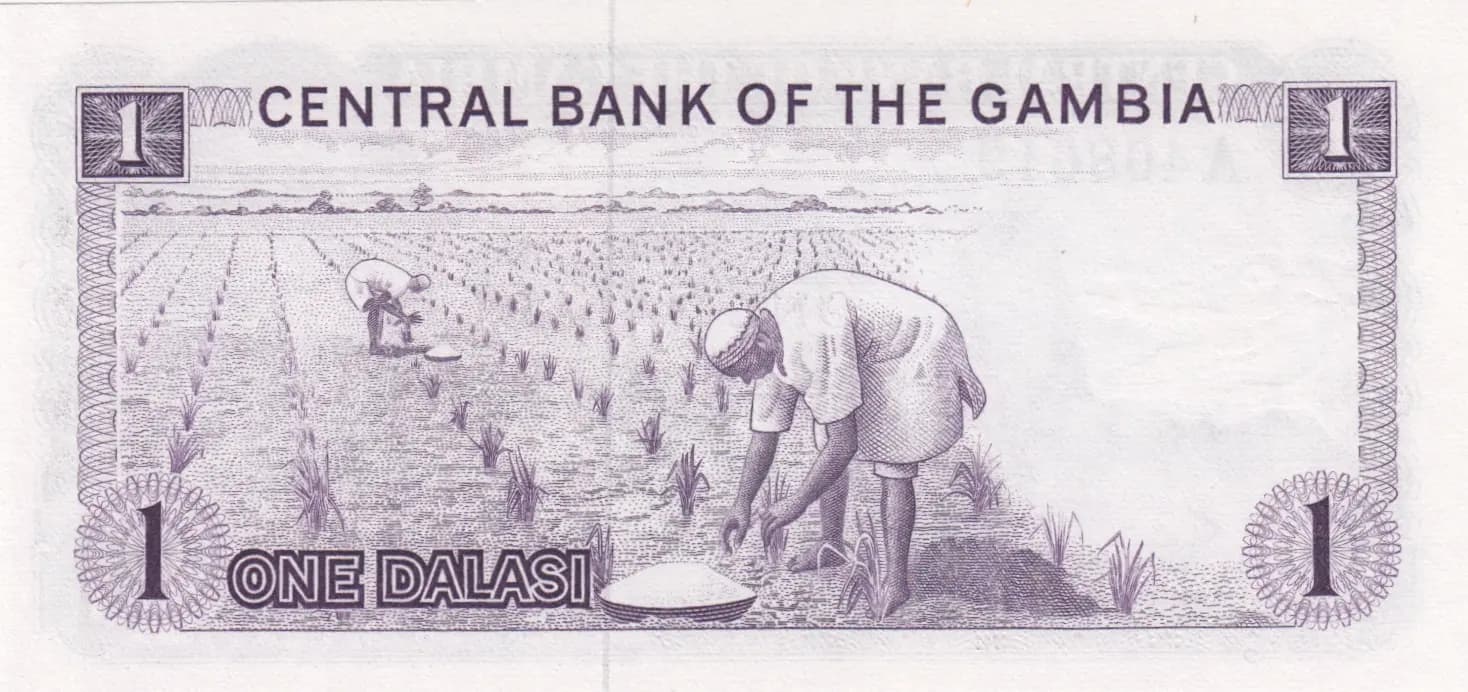
This is a 1972 Gambian 1 Dalasi note in Uncirculated condition, representing the first regular currency issue of the Central Bank of The Gambia following independence. The note features a striking purple and multicolor design with a portrait of President Sir Dawda Kairaba Jawara on the obverse and an agricultural scene of rice workers on the reverse, reflecting the nation's economic foundation. The crisp printing, intact borders, and absence of circulation marks confirm its exceptional preservation, making it a desirable example for collectors of West African currency.
Common. While this note is from the early years of The Gambia's independence (1972), the print run was substantial for a regular issue of this denomination. Market evidence from eBay sales shows UNC examples selling in the $30-$36 range in recent years, with 2019 catalog values at $85 for UNC being higher than realized prices. The denomination (1 Dalasi) as the lowest circulation note would have been printed in larger quantities. There are also 13+ recorded varieties of Pick 4, suggesting widespread circulation and retention of multiple variants.
Issued in 1972, this note commemorates The Gambia's early independence period under President Sir Dawda Kairaba Jawara, whose portrait prominently appears on the obverse. The reverse depicts rice cultivation workers in flooded paddies, symbolizing the agricultural economy that remained central to Gambian society. The bilingual inscriptions in English and Arabic reflect The Gambia's position as an English-speaking nation with significant Islamic cultural influence in West Africa.
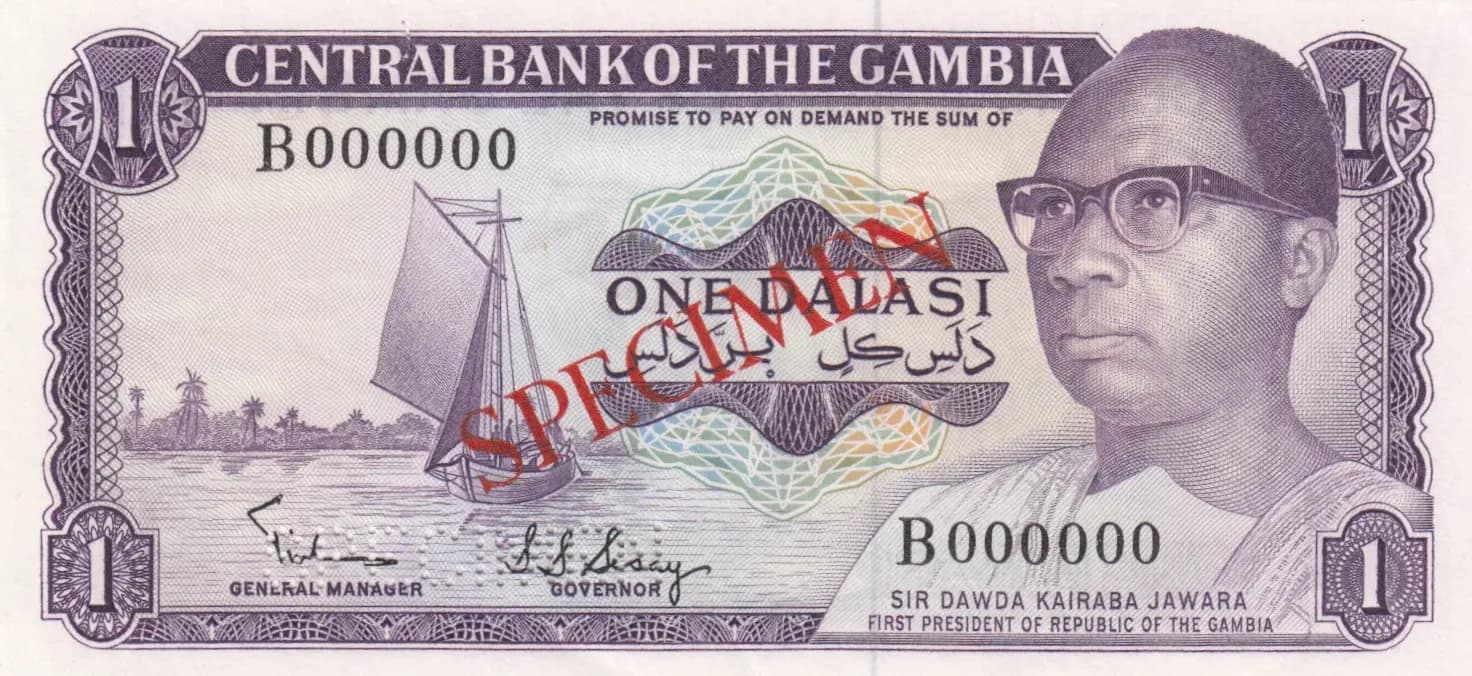
The obverse features President Sir Dawda Kairaba Jawara, the nation's founding president, depicted in three-quarter profile wearing round spectacles and a formal cap, positioned prominently on the right side. A traditional sailing dhow with full sails appears on the left, symbolizing The Gambia's maritime heritage and the historic importance of the Gambia River. The center contains an elaborate geometric emblem in blue, yellow, and gold. Ornamental corner designs with intricate geometric patterns frame the note, with '1' denominations in decorative circles at each corner. The reverse presents an agricultural scene showing two workers engaged in rice cultivation in flooded paddies, rendered in fine line engraving with cross-hatching for depth, with palm trees visible on the horizon. The color scheme throughout is predominantly purple/violet with cream and beige undertones, creating an elegant and distinguished appearance.
FRONT SIDE: 'Central Bank of The Gambia' (issuing authority); 'Promise to Pay on Demand the Sum of One Dalasi' (standard currency promise); 'One Dalasi' (denomination in English); 'داليسي واحد' (One Dalasi in Arabic); 'A408619' (serial number, repeated); 'Sir Dawda Kairaba Jawara' (presidential name); 'First President of Republic of The Gambia' (presidential title); 'Governor' and 'General Manager' (officer designations). BACK SIDE: 'Central Bank of The Gambia' (issuing authority); 'One Dalasi' (denomination); '1' (numeric denomination in corner circles).
Intaglio line engraving, evidenced by the fine detailed line work, intricate cross-hatching, and precise geometric patterns visible throughout both sides. The security features include sophisticated border designs and detailed portrait rendering. The printer for this specific Pick number (P-4a) is consistent with Central Bank of The Gambia's standard security printing practices of the early 1970s, though specific printer attribution is not definitively established in the catalog data provided.
This note is identified as Pick-4a with a crocodile's head watermark, representing one of the early varieties in the 1 Dalasi series. The serial number visible is A408619. The PMG population report indicates this is one of at least 13 variants catalogued for the base Pick number 4, with varieties distinguished by watermark, printer marks, and signature variations. The specific designation as 'P-4a' places this among the earliest regular issues of the series, issued during the 1972-1986 period, though the actual print date is 1971-1972.