5 francs 1942
Market Prices
13 salesAbout This Note
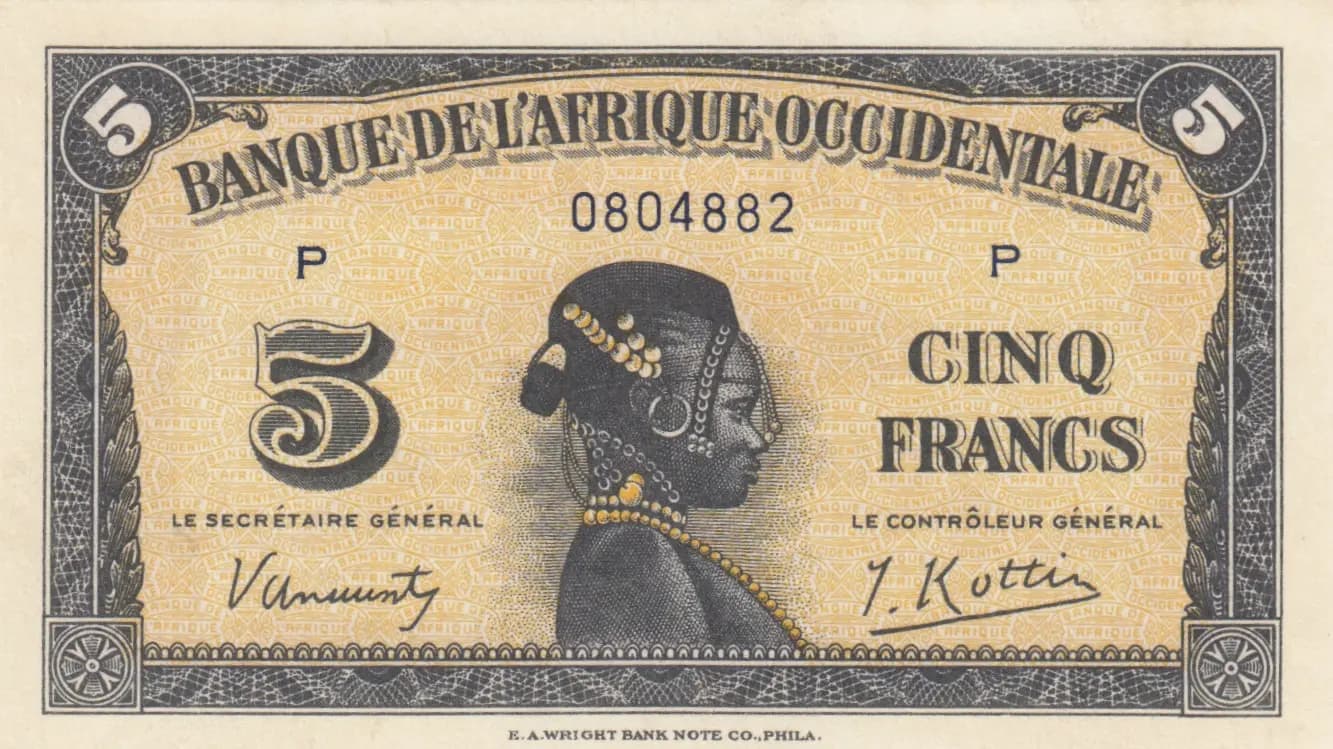
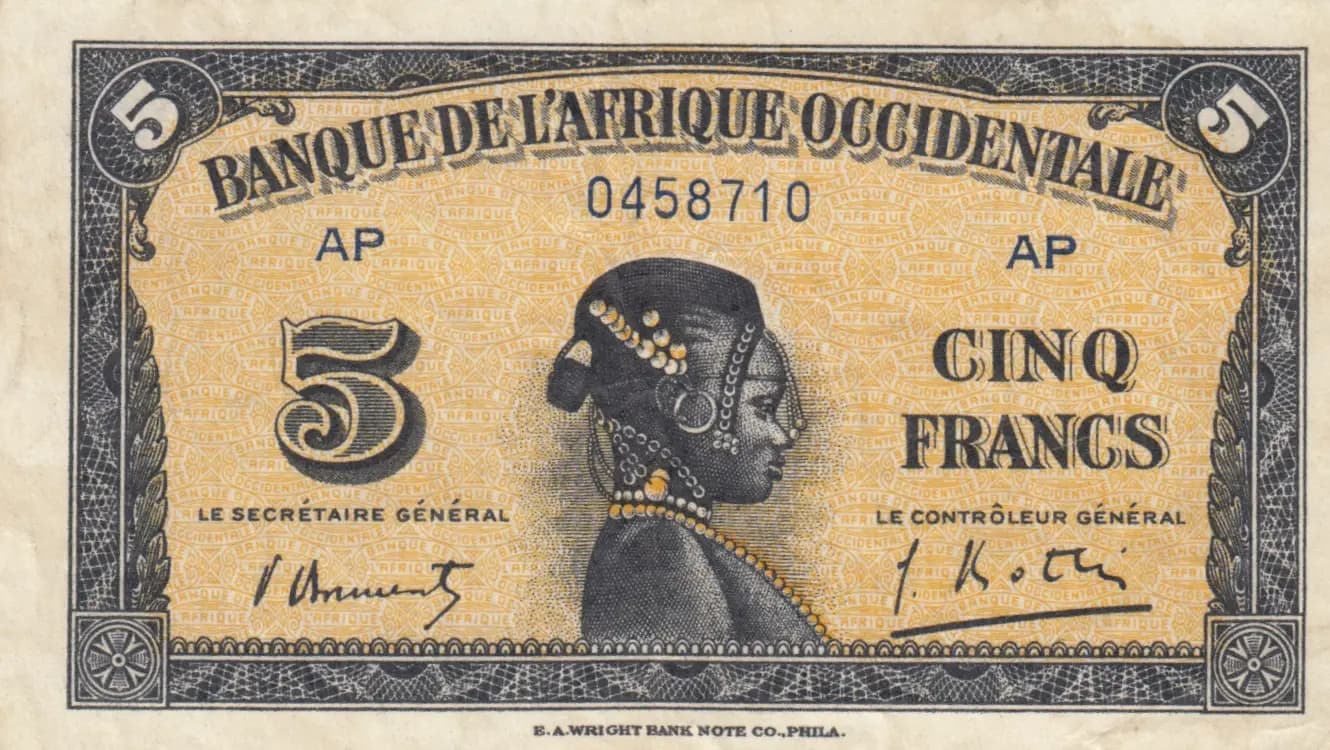
This 1942 French West Africa 5 Francs note (Pick P-28b) features an exquisite engraved portrait of an African woman in elaborate beaded jewelry on the obverse, set against a tan and gold underprint with ornamental corner designs. The note displays moderate circulation wear consistent with VF grade, including visible creasing, foxing, and age-related discoloration throughout, yet the fine line engraving and intricate background patterns remain clearly legible. The B.A. Wright printing is evident, and this particular example exhibits the narrow 'V' signature variety that distinguishes the P-28b from its P-28a counterpart.
Common. This note trades regularly on secondary markets with VF specimens consistently selling between $4.42 and $14.50 USD across multiple auction results spanning from 2010 to 2022, indicating robust collector availability. The 2016 catalog valuation of $7.50 for VF grade aligns with observed market prices, and the abundance of price realizations demonstrates sufficient supply to satisfy collector demand. No evidence of limited print runs, recalls, or scarcity factors elevates this beyond common circulation-issue status.
Issued on December 14, 1942, during the pivotal mid-point of World War II, this note represents the Banque de l'Afrique Occidentale's currency for French colonial West Africa during a period of significant political and military upheaval in France and its territories. The engraved portrait of an African woman adorned with traditional beaded jewelry and ornamental headdress reflects the artistic conventions of colonial-era currency design, which often romanticized and exoticized indigenous African imagery for metropolitan audiences. The Philadelphia-printed note demonstrates the continued reliance on American security printers for French colonial currency production even during wartime constraints.
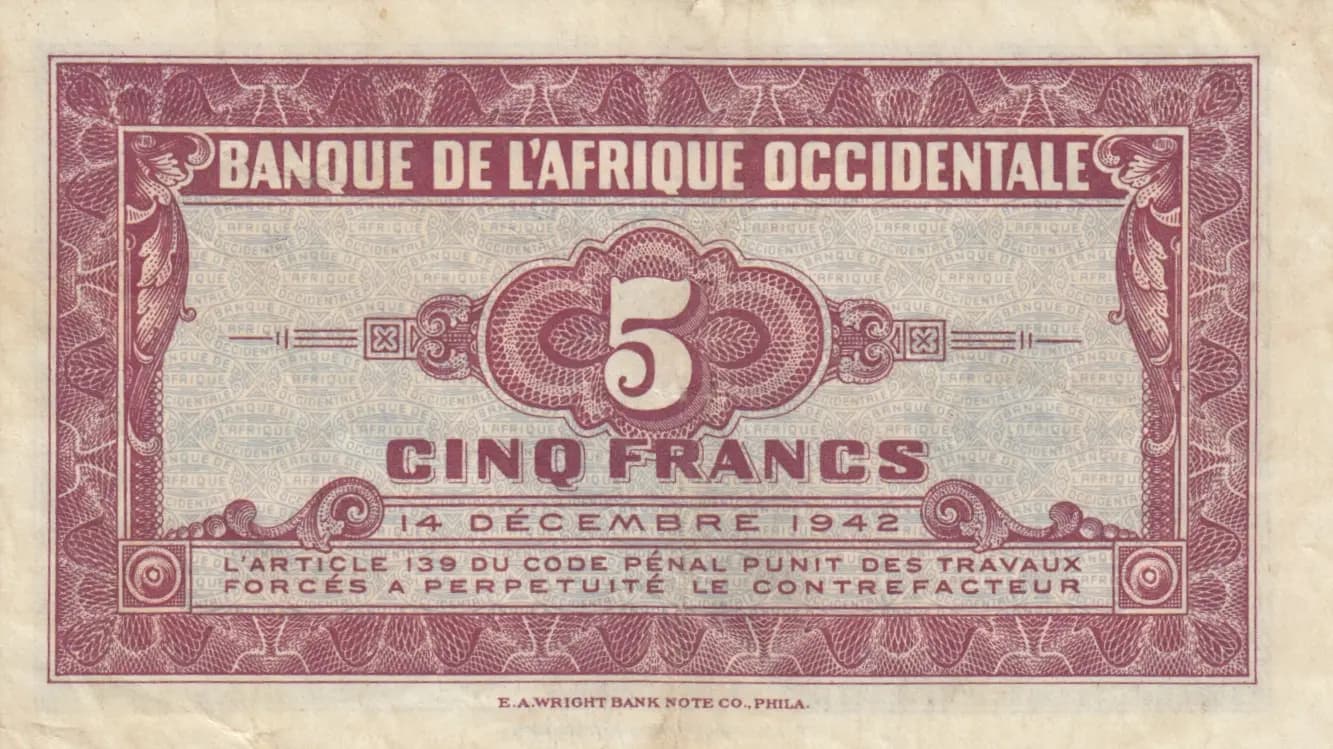
The obverse features a classical engraved portrait of an African woman shown in right-facing profile, the primary numismatic focal point, adorned with multiple strands of beaded necklaces, dangling earrings, and an ornamental beaded headdress characteristic of West African artisanal tradition. The portrait is centered within an ornate border of scrollwork and decorative elements, with circular medallions positioned in the top corners and Maltese cross-like symbols anchoring the bottom corners. The reverse abandons portraiture for a purely typographic and ornamental design centered on a large cartouche containing the numeral '5', flanked by circular decorative elements and framed by symmetrical flourishes and scrollwork. The tan/beige obverse contrasts markedly with the burgundy/maroon reverse, both employing fine background patterns and microprint typical of security engraving. The overall design exemplifies the Belle Époque commercial bank note aesthetic adapted for colonial currency.
FRONT SIDE: 'BANQUE DE L'AFRIQUE OCCIDENTALE' (Bank of West Africa) appears at the top; 'CINQ FRANCS' (Five Francs) is positioned on the right side of the portrait; 'LE SECRÉTAIRE GÉNÉRAL' (The General Secretary) and 'LE CONTRÔLEUR GÉNÉRAL' (The General Controller) appear as signature labels; 'B.A. WRIGHT BANK NOTE CO., PHILA.' (printer attribution); Serial number '0458710'; Denomination marker '5' appears on both sides. BACK SIDE: 'BANQUE DE L'AFRIQUE OCCIDENTALE' repeated; 'CINQ FRANCS' and denomination '5' in central cartouche; '14 DÉCEMBRE 1942' (14 December 1942 - date of issue); 'L'ARTICLE 139 DU CODE PÉNAL PUNIT DES TRAVAUX FORCÉS A PERPÉTUITÉ LE CONTREFACTEUR' (Article 139 of the Penal Code punishes counterfeiting with forced labor for life); 'B.A. WRIGHT BANK NOTE CO., PHILA.' (printer attribution repeated).
Intaglio engraving (line engraving) was the primary production method, as evidenced by the fine detail work, intricate background patterns, and crisp line work visible throughout both sides of the note. The security printer B.A. Wright Bank Note Company of Philadelphia employed advanced engraving techniques with micro-pattern backgrounds to deter counterfeiting. The use of multiple color plates (tan/gold on obverse; burgundy/maroon on reverse over cream base) indicates multi-pass printing typical of high-security currency production of the 1940s era.
This specimen is identified as Pick P-28b based on the narrow 'V' in the left signature (General Secretary's signature position), which distinguishes it from Pick P-28a (wide 'V'). The PMG Population Report recognizes six cataloged variants for this base Pick number: P-28a, P-28b, P-28c (no serial number), P-28p2, P-28s1, and P-28s2, indicating that signature width and serial number presence/absence create recognizable collecting distinctions. The present example displays a clear serial number (0458710) and exhibits the narrow 'V' characteristic definitively establishing its P-28b classification.