5 francs 1938
Market Prices
48 salesAbout This Note
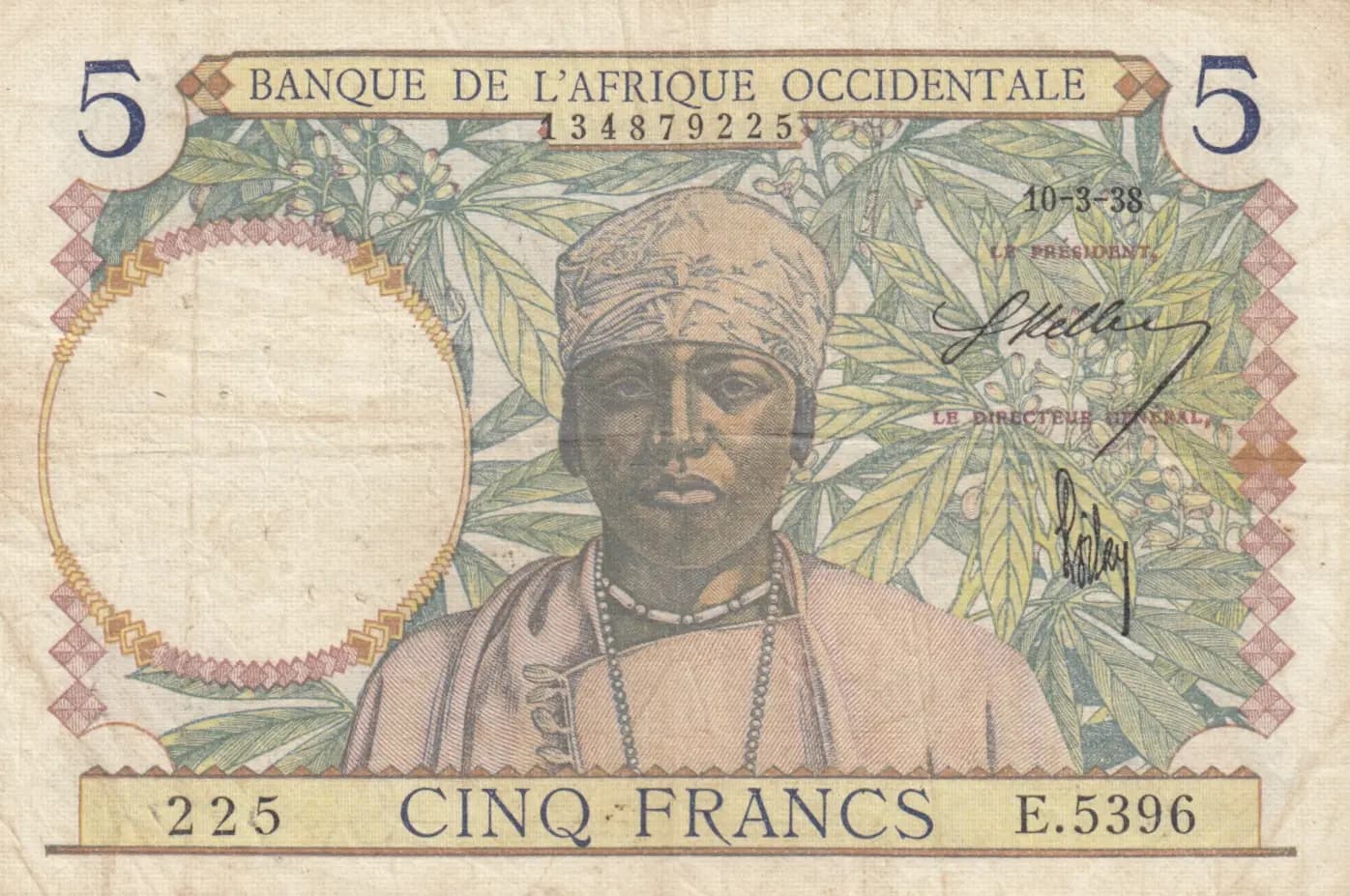
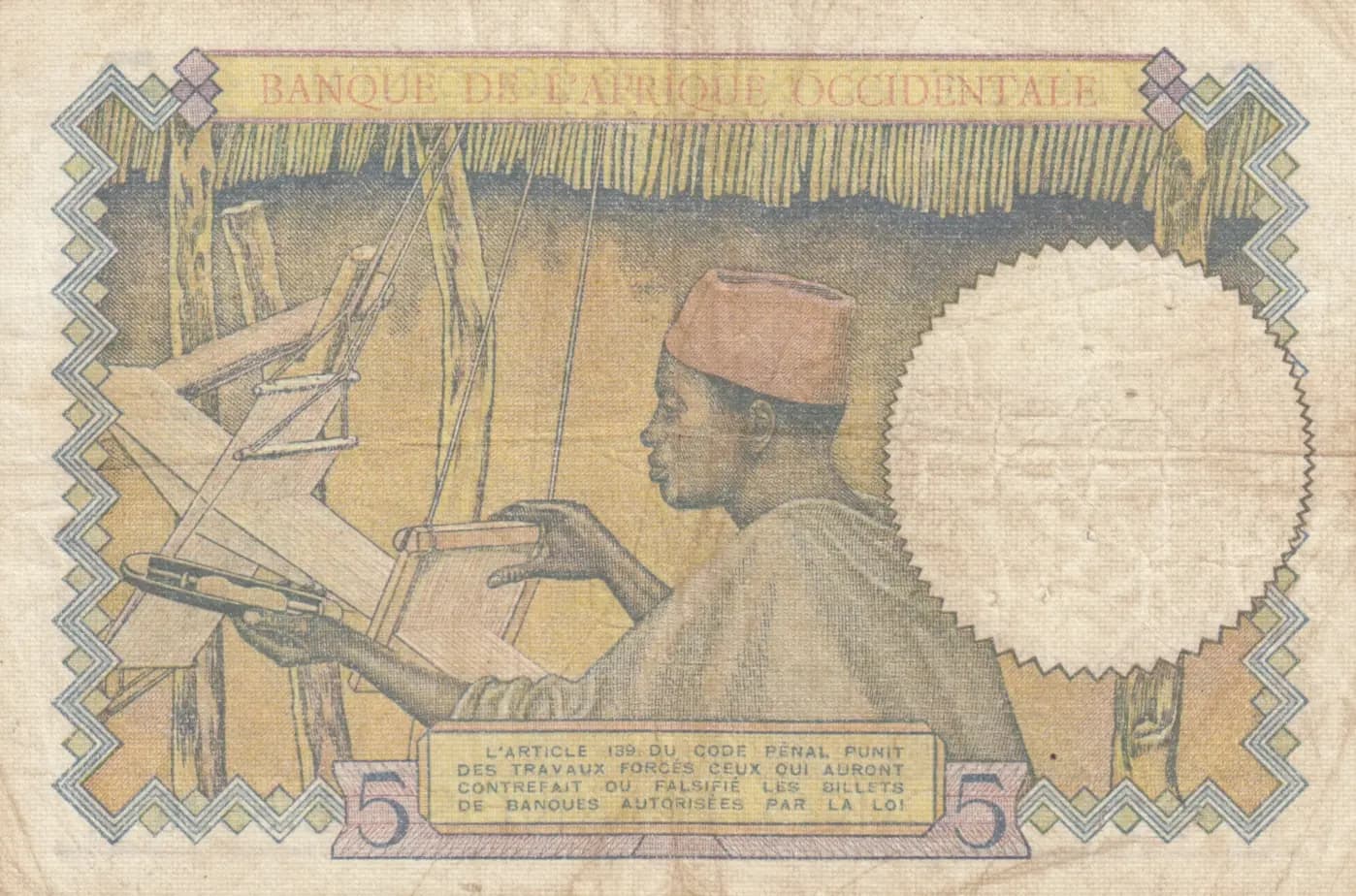
This French West Africa 5 francs note from 1938 presents a well-executed colonial-era design featuring an African man in traditional dress on the obverse and an artisan engaged in textile work on the reverse. The note exhibits moderate circulation wear with visible creasing, folds, and age-related discoloration consistent with its Fair condition grade, though the intricate engraved details remain legible and the decorative floral and geometric borders retain good definition.
Common. Market data from eBay sales spanning 2010-2025 shows consistent availability of this note in all condition grades, with Fair-grade examples regularly selling in the $3-$12 range. The 2016 catalog value for Fair grade was $5.50. Multiple sales annually across two decades indicate substantial print runs and stable market supply. This is a standard-issue banknote from a major colonial-era issuing institution, not a commemorative, error note, or limited release.
Issued by the Banque de l'Afrique Occidentale during the late colonial period, this note reflects France's administrative and economic control of West African territories. The imagery—depicting indigenous people engaged in traditional crafts and adorned in cultural dress—exemplifies the ethnographic aesthetic common in colonial-era currency design, simultaneously documenting and exoticizing African life for metropolitan French audiences during the height of the French colonial system in Africa.
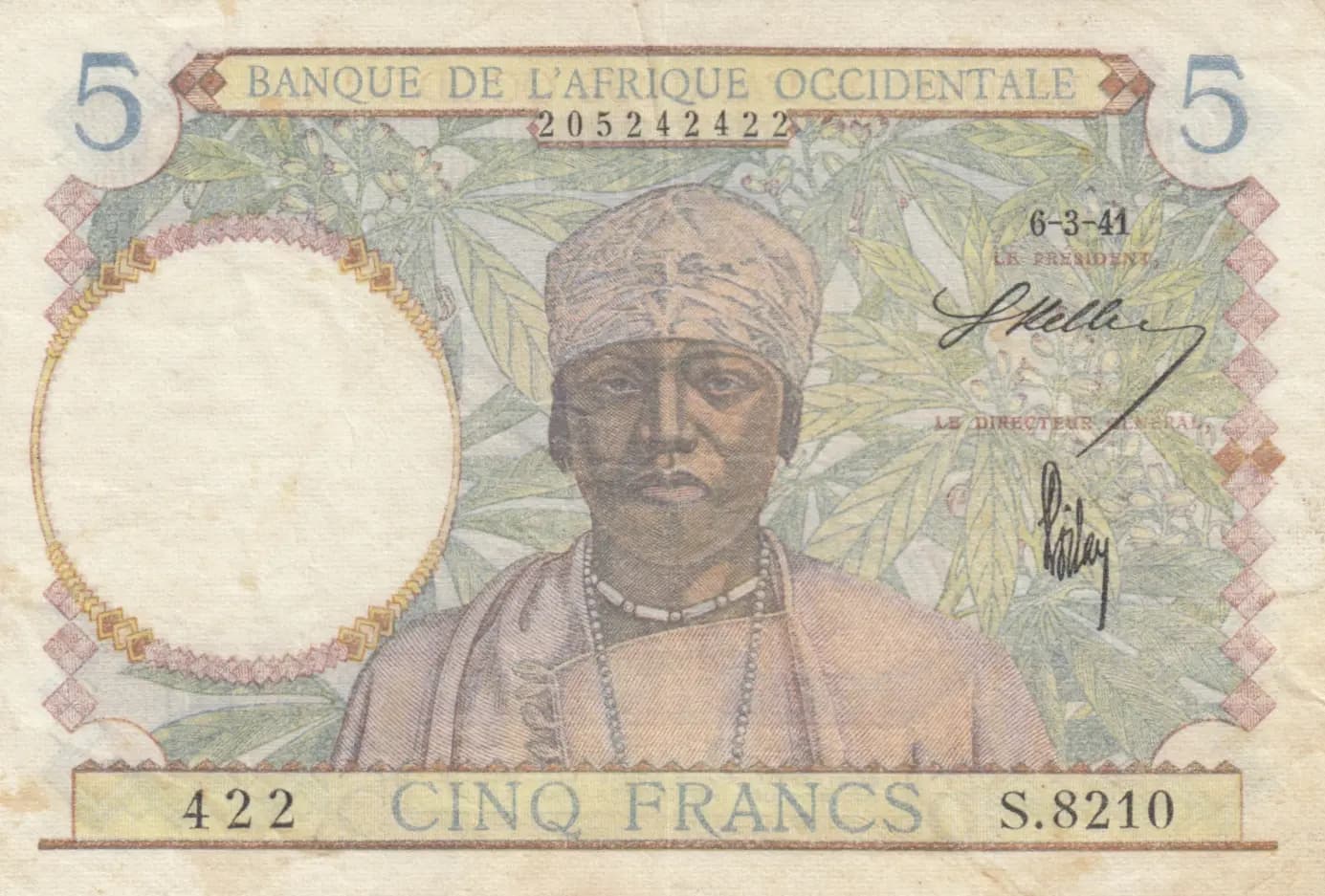
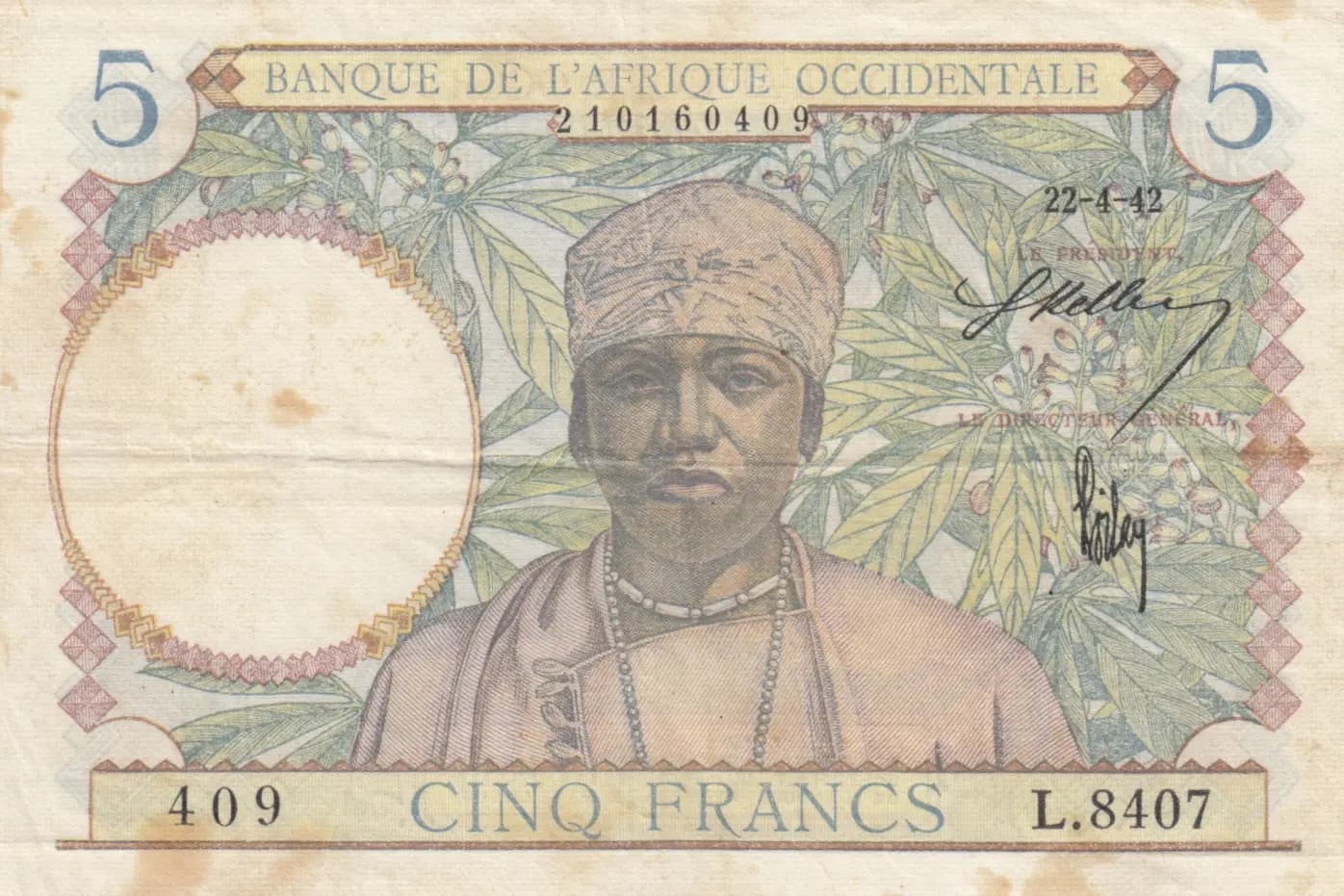
The obverse features a centered portrait of an African male subject wearing a traditional cloth headwrap (turban) and beaded necklace, rendered in classical engraved style. The portrait is framed by ornamental foliage including flowering plants in green and yellow tones, with an empty circular decorative cartouche positioned to the left. Diamond-pattern ornamental borders frame the composition. The reverse depicts an African artisan in profile, wearing traditional head covering, actively engaged at a weaving loom with hands positioned above the textile apparatus. A traditional thatched or woven roof structure forms the background. An empty circular frame appears on the right side. The entire design employs geometric border patterns with interlocking diamonds and zigzag motifs in the characteristic style of Banque de l'Afrique Occidentale issues. The color palette combines greens, yellows, browns, reds/pinks, and cream tones characteristic of the period's intaglio printing.
FRONT: 'BANQUE DE L'AFRIQUE OCCIDENTALE' (Bank of West Africa) | 'CINQ FRANCS' (Five francs) | '5' (denomination numeral) | 'LE DIRECTEUR GÉNÉRAL' (The General Director) | Date: '10-3-38' (10 March 1938) | Serial numbers: 'E.5396' and '3487922225' | Handwritten signatures of authorized officials | BACK: 'BANQUE DE L'AFRIQUE OCCIDENTALE' (Bank of West Africa) | '5' (denomination numerals, plural) | 'L'ARTICLE 189 DU CODE PÉNAL PUNIT DES TRAVAUX FORCÉS CEUX QUI AURONT CONTREFAIT OU FALSIFIÉ LES BILLETS DE BANQUES AUTORISÉES PAR LA LOI' (Article 189 of the Penal Code punishes with forced labor those who will have counterfeited or falsified banknotes authorized by law)
Intaglio engraving (line engraving/taille-douce), the standard security printing technique for banknotes of this era. The Banque de l'Afrique Occidentale's notes were produced by the Banque de France's printing facilities or commissioned European security printers; the intricate detail, fine line work, and dimensional quality visible in the engraved portraits and decorative elements are characteristic of professional banknote intaglio production of the 1930s.
This example represents the standard P-21 variety with watermark depicting a man's head (as confirmed by PMG population data noting the 'Wmk: Man's Head' characteristic). The note is dated 10 March 1938 with serial number E.5396 / 3487922225, placing it within the regular 1934-1938 production period. No apparent overprints or special markings suggesting specimen or special variety status. Standard signature lines present, though specific signatory identities cannot be determined from the faded handwriting.