25 francs 1939
Market Prices
23 salesAbout This Note
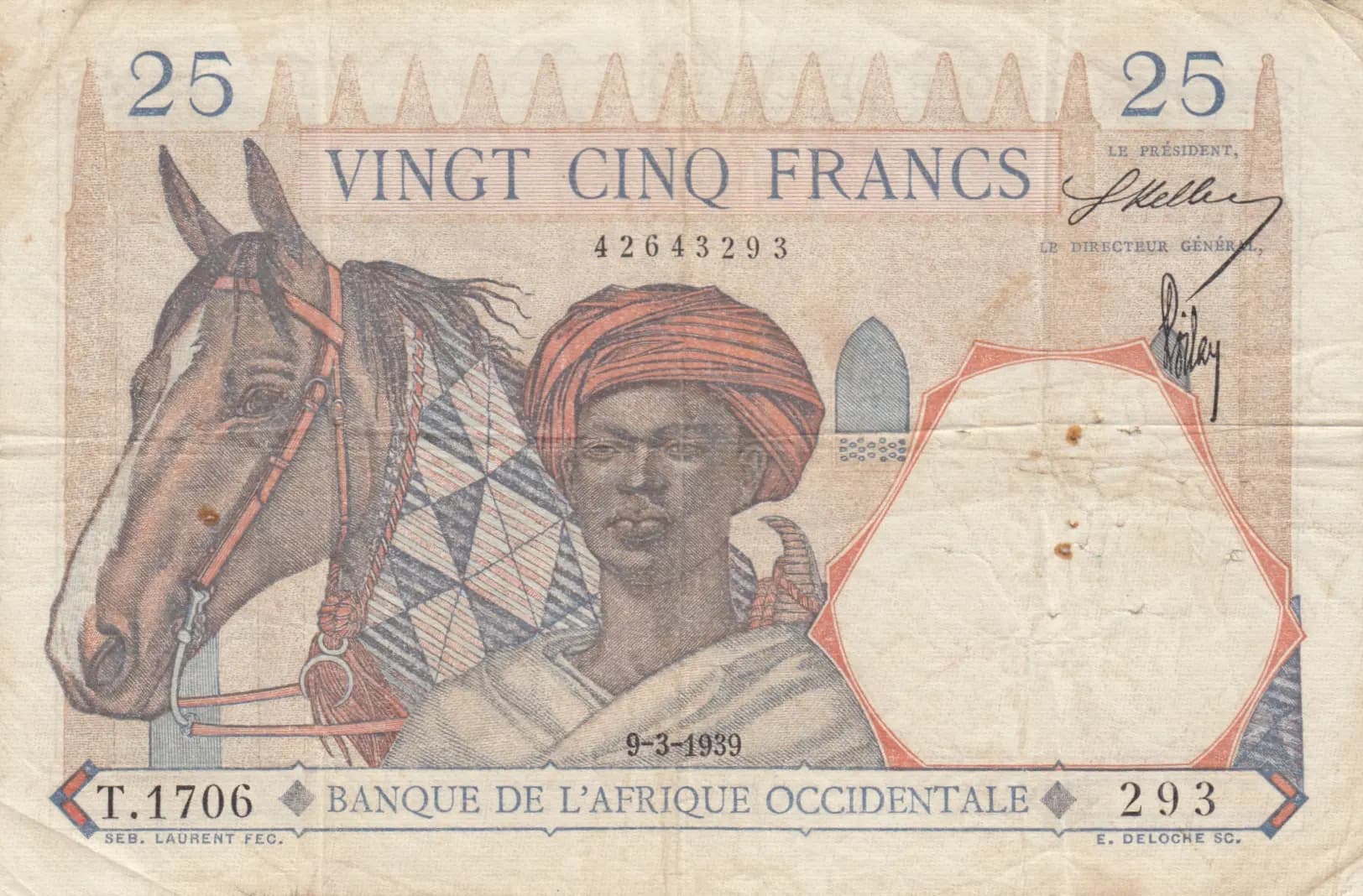
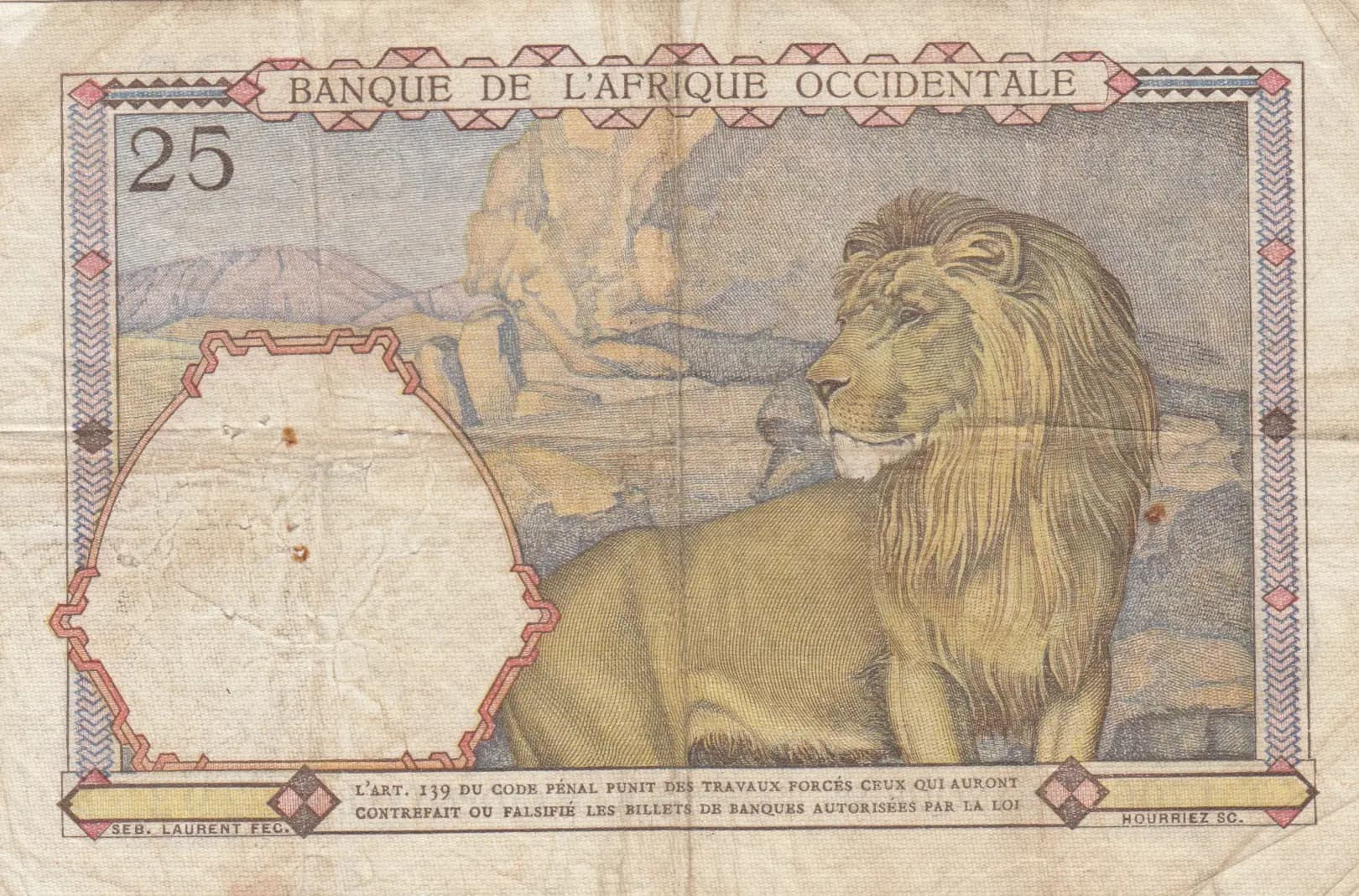
This is a French West Africa 25 francs note from 1939, issued by the Banque de l'Afrique Occidentale, displaying the classic colonial-era design featuring a North African man in traditional dress with a decorative horse head on the obverse and a striking golden lion's head on the reverse. The note exhibits typical circulated condition with visible foxing, fold creases, and yellowing consistent with its age, yet the artistic engraving and security printing details remain clearly visible. The dated March 9, 1939 issue date and serial number 42643293 help pinpoint this example in the note's production sequence.
Common. This Pick-22 note is a regular issue from 1936-1939 with substantial circulation, evidenced by the robust eBay sales history showing consistent trading in the $3–$27 range across multiple condition grades over the past decade. The Fine condition grade observed here aligns with typical market prices of $8–$10, indicating steady collector interest but no scarcity premium. Population data is available from PMG with multiple variants catalogued, further suggesting adequate surviving examples.
This note was issued during the French colonial period in West Africa, just months before the outbreak of World War II, and represents the monetary authority of the Banque de l'Afrique Occidentale in the region. The imagery—a North African figure in red turban and traditional clothing, along with the majestic lion—reflects the colonial aesthetic and the geographical scope of French West African territories. The engravers' signatures (Seb. Laurent and E. Deloche/Hourriez) indicate this was a professionally executed intaglio production by established European security printers serving French colonial interests.
The obverse features a left-facing profile portrait of a North African man wearing a distinctive red turban and traditional regional clothing, rendered with fine detail typical of colonial-era numismatic portraiture. To the left of the portrait is a finely engraved horse's head with red and blue decorative harness elements, symbolizing the equestrian traditions of North Africa. The reverse showcases a golden lion's head in profile facing right, positioned against a landscape background depicting mountains and sky, symbolizing strength and the natural wealth of the African continent. Both sides feature ornamental cartouches with red decorative borders (likely intended for manuscript signatures or stamps), surrounded by elaborate guilloche security patterns and geometric border designs executed in beige, brown, blue, and black inks. The overall composition exemplifies the Belle Époque aesthetic applied to colonial currency design.
FRONT SIDE: 'BANQUE DE L'AFRIQUE OCCIDENTALE' (Bank of West Africa); 'VINGT CINQ FRANCS' (Twenty-five francs); '25' (denomination); 'LE PRÉSIDENT' (The President); 'LE DIRECTEUR GÉNÉRAL' (The General Director); '9-3-1939' (Issue date: March 9, 1939); 'T.1706' and '293' (reference/series numbers); 'SEB. LAURENT FEC.' and 'E. DELOCHE SC.' (engraver attributions). BACK SIDE: 'BANQUE DE L'AFRIQUE OCCIDENTALE' (Bank of West Africa); '25' (denomination); 'L'ART. 139 DU CODE PÉNAL PUNIT DES TRAVAUX FORCÉS CEUX QUI AURONT CONTREFAIT OU FALSIFIÉ LES BILLETS DE BANQUES AUTORISÉES PAR LA LOI' (Article 139 of the Penal Code punishes with forced labor those who will have counterfeited or falsified banknotes authorized by law); 'SEB. LAURENT FEC.' and 'HOURRIEZ SC.' (engraver attributions).
This note was produced using intaglio (engraved) printing on security paper, as evidenced by the fine guilloche patterns, detailed portraiture, and the sophisticated geometric border designs visible throughout. The multi-color printing (beige, brown, red, blue, and black) indicates separate plate passes typical of premium security banknote production. The precision of the engraving work and the credit lines to engravers Seb. Laurent, E. Deloche, and Hourriez confirm professional security printer execution, consistent with early 20th-century French colonial banknote standards.
This example corresponds to Pick-22 (Woman's Head watermark variety). The specific variety can be further refined by: serial number prefix/range (42643293 in this case), signature combinations (noting the engravers present: Seb. Laurent and E. Deloche on front, Seb. Laurent and Hourriez on back), and issue date of March 9, 1939. PMG catalogs three variants for this base Pick number (P-22, P-22s, and P-22sp), with the watermark and signature combinations determining placement within the series. No overprints or special markings are visible on this example.