25 francs 1953
Market Prices
28 salesAbout This Note
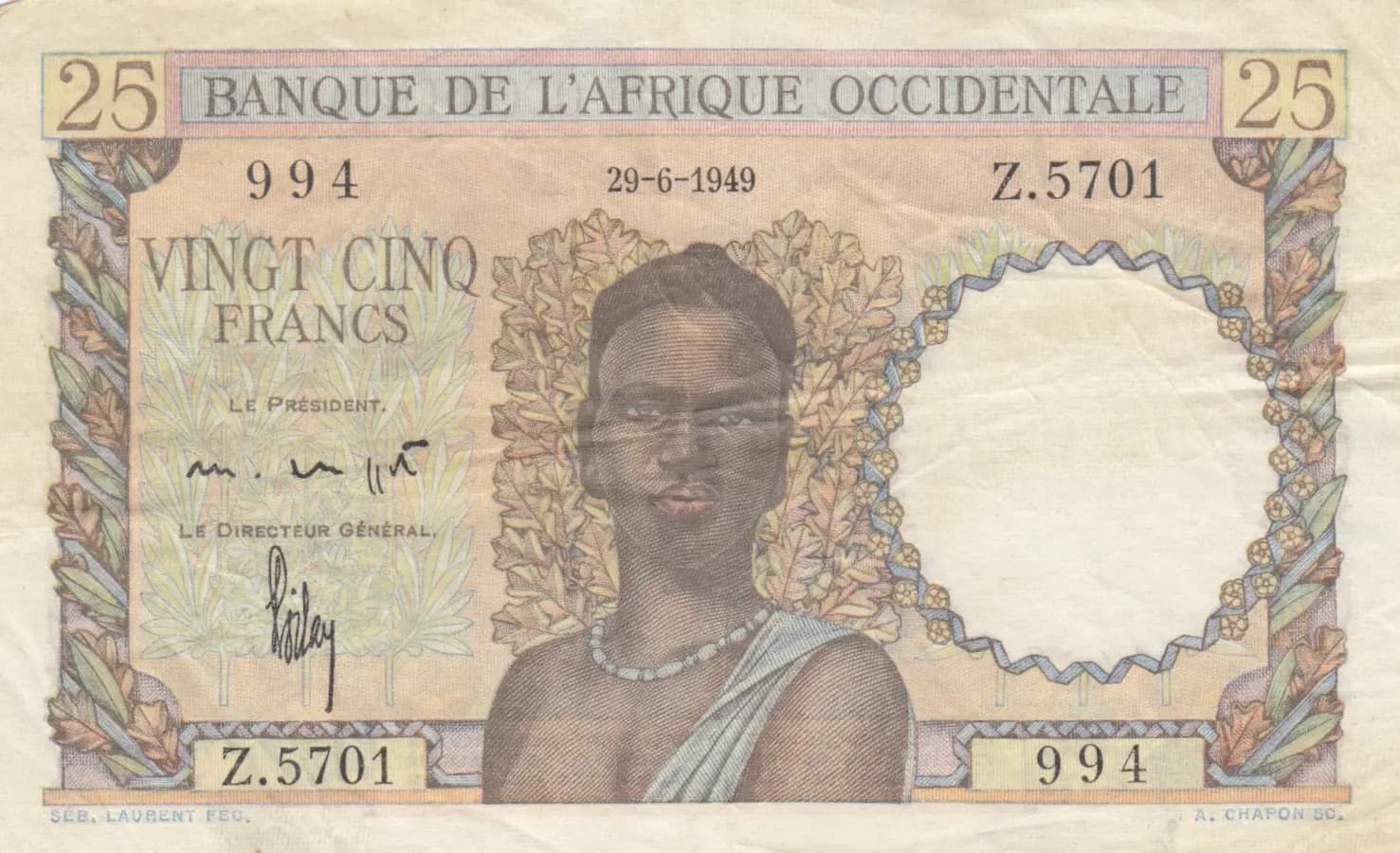
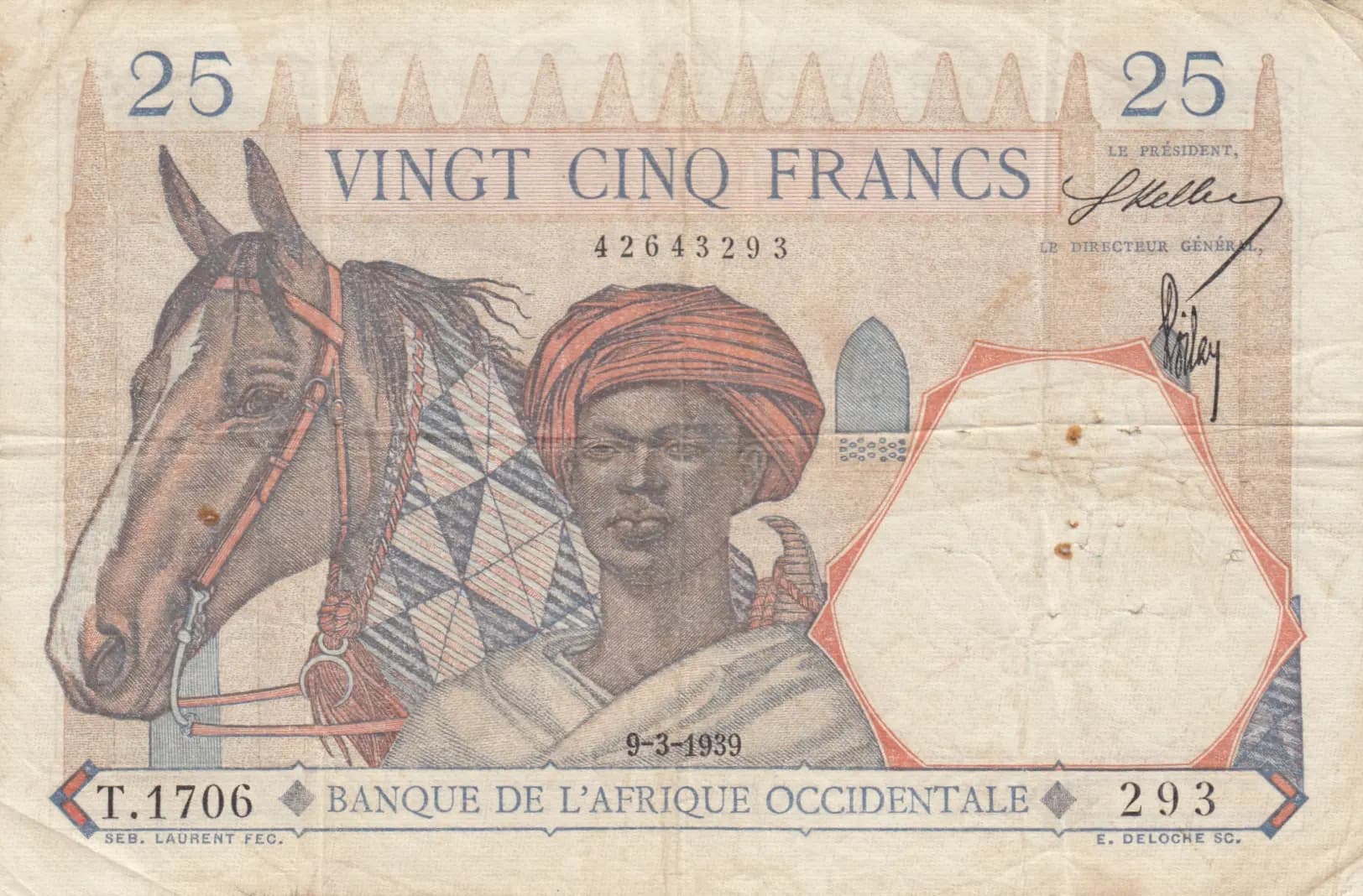
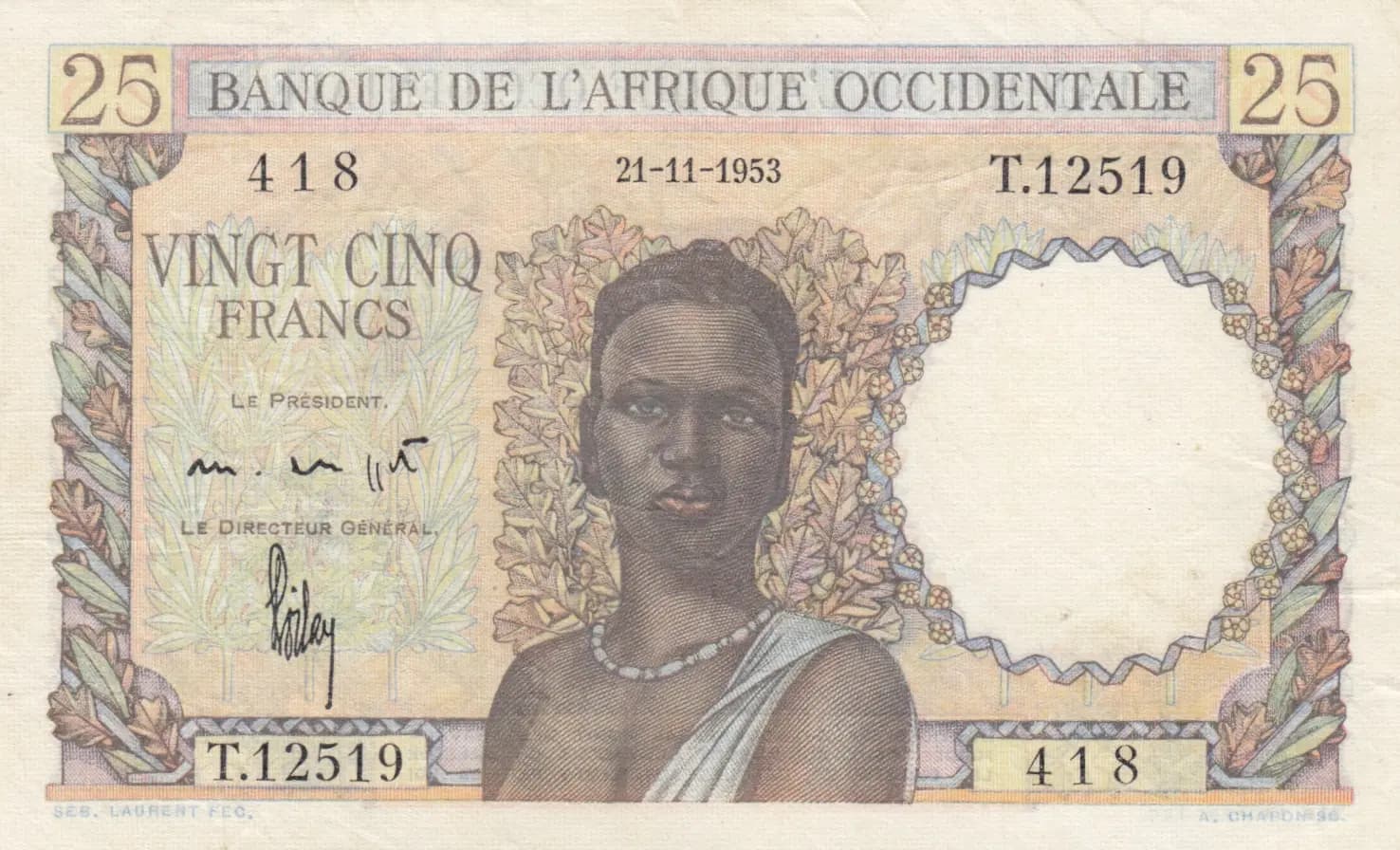
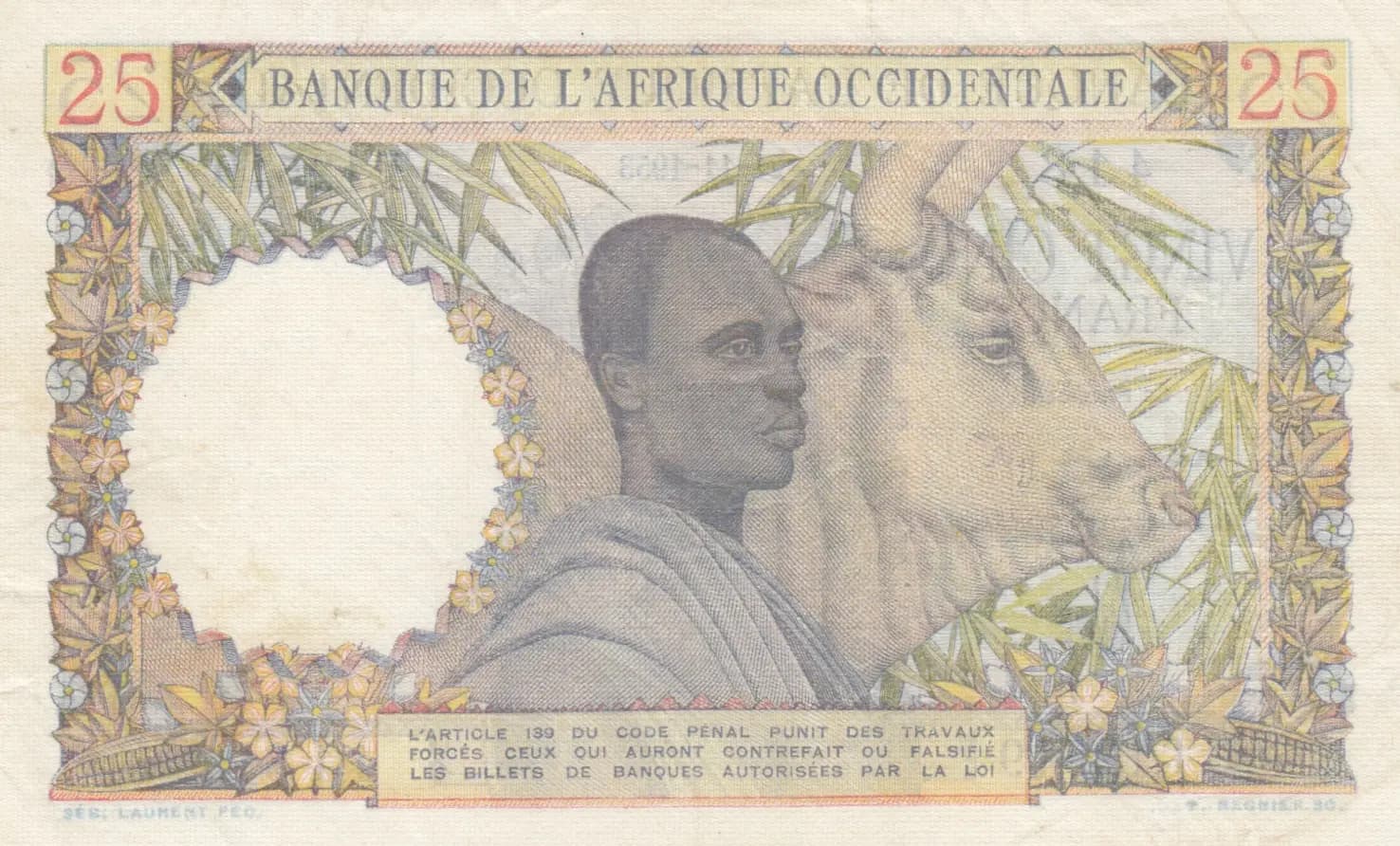
A handsome example of the 1953 Banque de l'Afrique Occidentale 25 francs note (Pick-38) in Very Fine condition, featuring excellent preservation of the fine engraving work by Laurent Feg. The obverse presents a striking profile portrait of an African man in traditional dress with beaded necklace set within ornamental borders, while the reverse showcases two figures amid decorative agricultural motifs including wheat stalks and floral elements in warm tones. This note represents an important piece of West African colonial currency history, with clear signatures and legible date of 21-11-1953, showing only age-appropriate patina with no major creasing or damage.
Common. This 25 francs note from 1953 is a regular issue of the Banque de l'Afrique Occidentale with substantial print runs. The eBay market data confirms its commonality: VF examples have sold consistently in the $10–$25 range over the past decade, with most examples in F condition trading for $5–$15. Even the 2016 catalog valuation places VF specimens at only $17.50. This widespread availability and modest pricing across all condition grades indicates robust production numbers and regular collector activity without premium demand. There are no indicators of scarcity, recall, or short-lived issue status.
The Banque de l'Afrique Occidentale issued this 25 francs note during the final years of French colonial administration in West Africa, as the region moved toward independence in the mid-1950s. The imagery reflects the Bank's attempt to incorporate local cultural elements—the portrait of an African man in traditional dress and the agricultural motifs (wheat and grain) symbolizing the economic foundation of the territory. The French language inscriptions and classical engraving style underscore the colonial institutional framework, while the depicted figures and harvest themes celebrate the region's cultural and economic identity.
The obverse features a left-facing profile portrait of an unidentified West African man wearing traditional dress with a prominent beaded necklace, rendered in fine line engraving. The portrait is surrounded by ornamental borders composed of interlocking leaf and floral patterns in pink/mauve and green tones against a cream background. The denomination '25' appears in brown/gold numerals at upper corners. The reverse displays a more complex allegorical composition featuring two male figures—one in clear profile on the left, another partially visible on the right—both in traditional dress, surrounded by an abundance of decorative agricultural elements, particularly wheat stalks and grain, with floral borders in gold, orange, blue, and green. The design emphasizes themes of agriculture and regional prosperity. The color palette combines cream/beige with warm earth tones and cooler accents, typical of mid-20th century colonial currency design.
FRONT SIDE: '25' (denomination in corners); 'BANQUE DE L'AFRIQUE OCCIDENTALE' (Bank of West Africa); 'VINGT CINQ FRANCS' (Twenty-five francs); '418' (likely note position/sheet number); '21-11-1953' (issue date); 'T.12519' (serial number prefix); 'LE PRÉSIDENT' (The President); 'LE DIRECTEUR GÉNÉRAL' (The General Director); 'GEB. LAURENT FEG.' (Engraved by Laurent Feg.); 'N. CHABOT'36' (Designer/engraver attribution). REVERSE SIDE: '25' (denomination); 'BANQUE DE L'AFRIQUE OCCIDENTALE' (Bank of West Africa); 'L'ARTICLE 199 DU CODE PÉNAL PUNIT DES TRAVAUX FORCÉS CELUI QUI AURONT CONTREFAIT OU FALSIFIÉ LES BILLETS DE BANQUES AUTORISÉES PAR LA LOI' (Article 199 of the Penal Code punishes with forced labor those who will have counterfeited or falsified banknotes authorized by law); 'GEB. LAURENT FEG.' (Engraved by Laurent Feg.).
Intaglio engraving (line engraving) executed on steel plates, evident from the fine, crisp detail visible in the portrait work, ornamental borders, and agricultural motifs. The signature of engraver Laurent Feg. and designer attribution to N. Chabot confirm the classical French engraving tradition. The precision of line work, particularly in the facial features and decorative elements, is characteristic of the Banque de France's security printing standards of the era. No evidence of photographic reproduction or lithographic elements is visible; this is pure intaglio work.
The observed note bears the serial number prefix 'T.12519' and issue date of 21-11-1953, identifying it as part of the standard 1953 emission. The PMG catalog notes two variants for Pick-38: the base P-38 and P-38s (likely indicating a specimen overprint variant). The examined note shows no specimen marks, indicating it is the standard circulation variety (P-38). Signatures appear to be hand-signed by the President and General Director in the designated areas, consistent with French colonial banking practice of the period. No overprints or exceptional markings are apparent.