10 francs 1954
Market Prices
38 salesAbout This Note
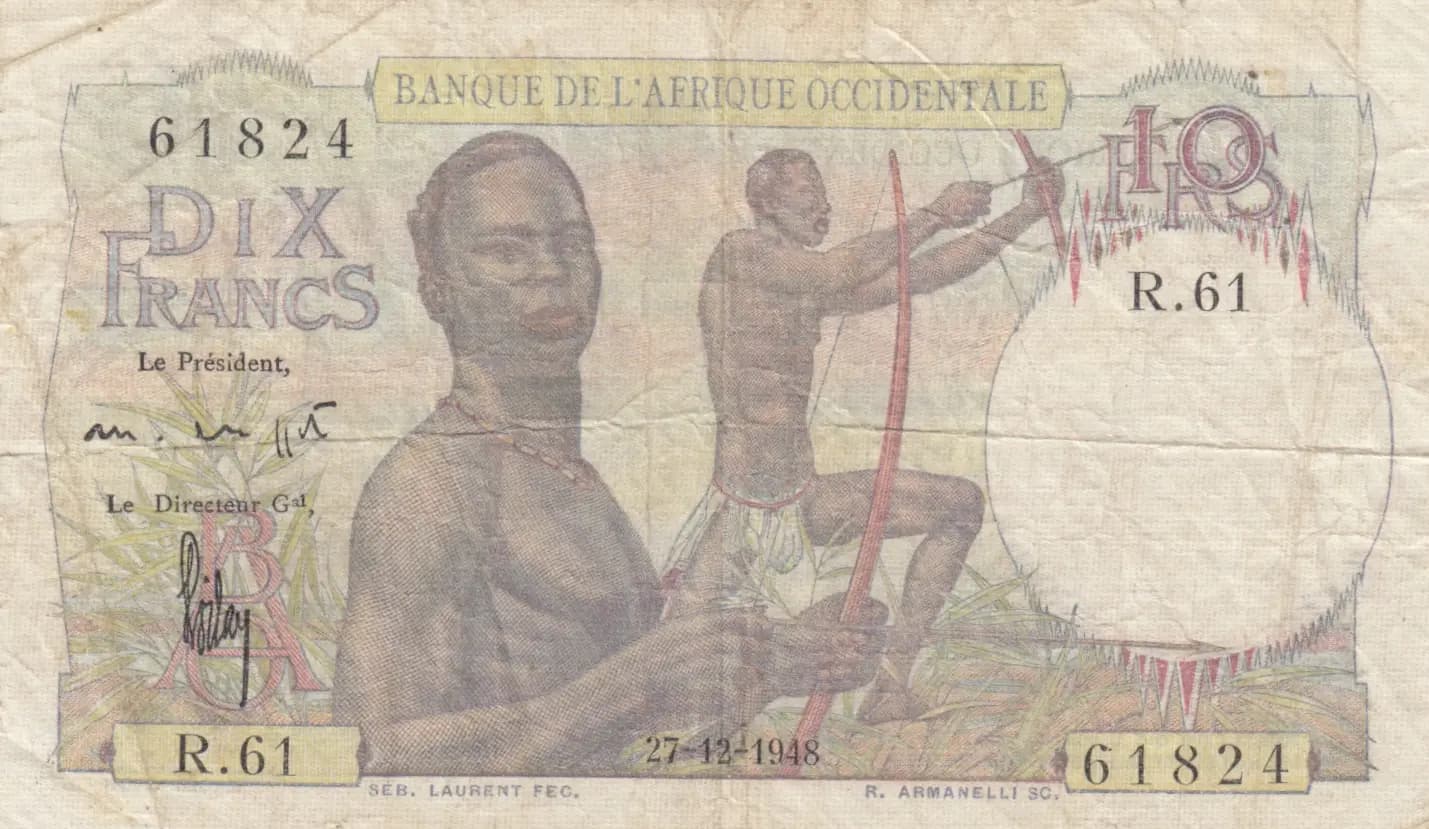
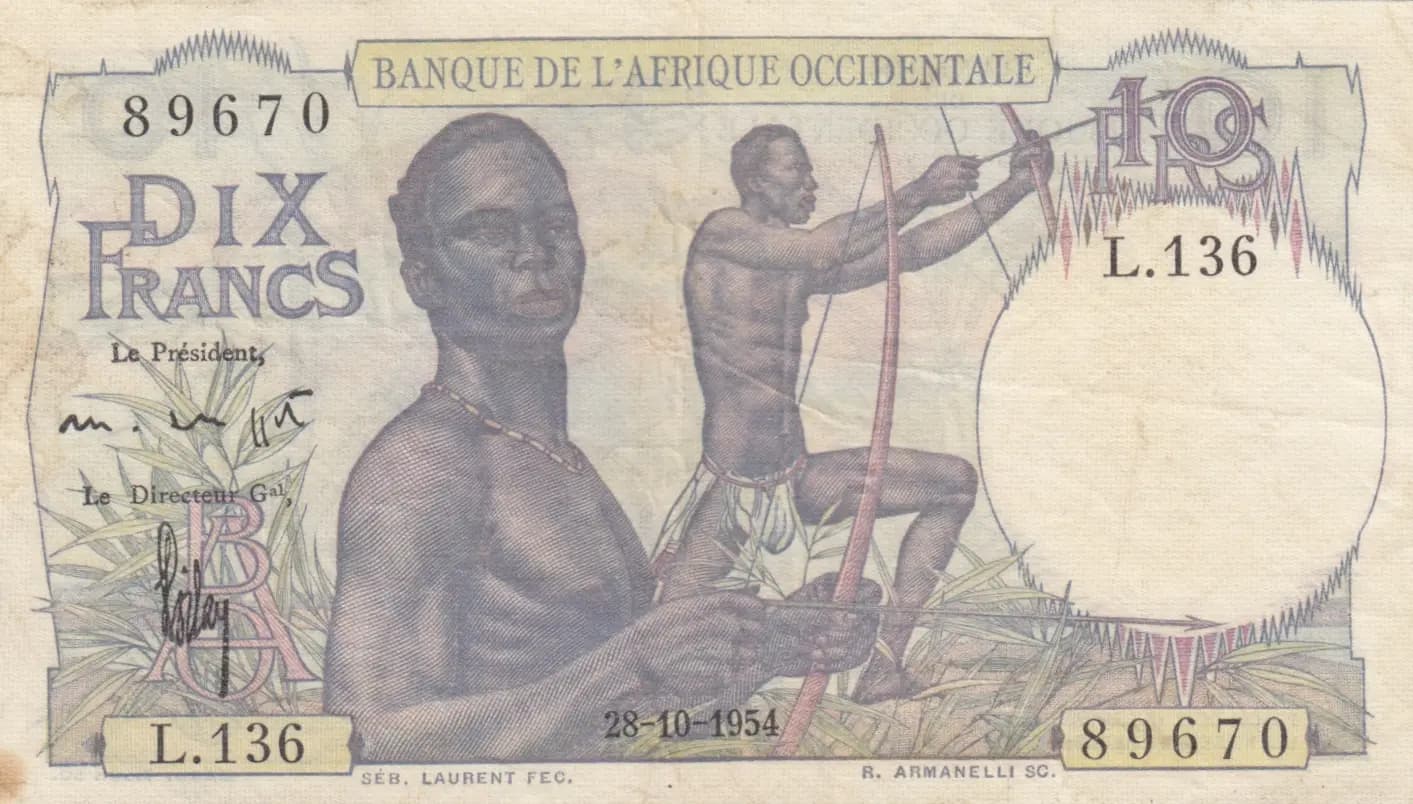
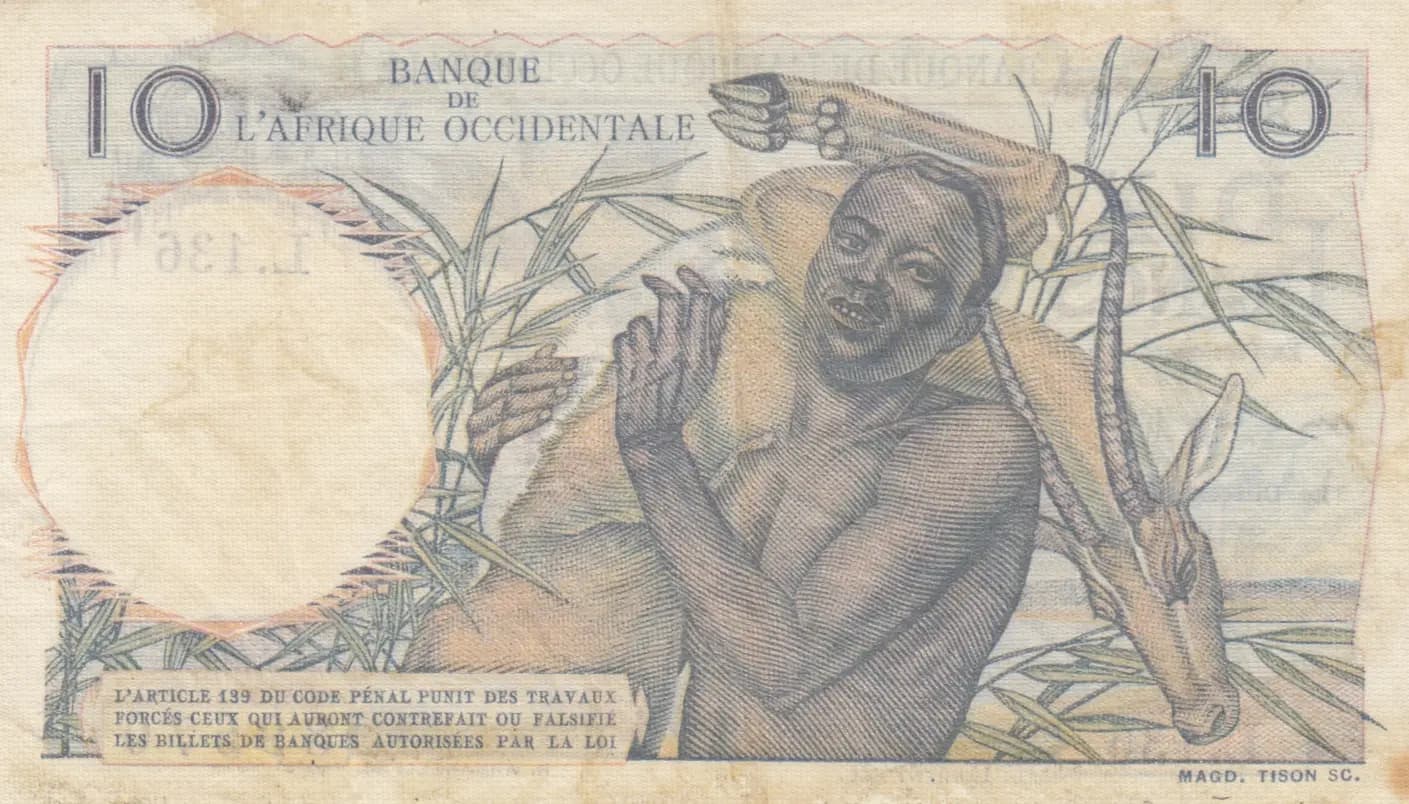
This is a VF-grade 10 Francs note from the Banque de l'Afrique Occidentale dated October 28, 1954, featuring characteristic colonial-era African imagery with two male portrait busts and stylized vegetation motifs rendered in fine intaglio engraving. The note exhibits moderate aging with visible yellowing and creasing consistent with circulation, though the engraved detail remains relatively clear and the denomination and inscriptions are well-preserved. This Pick-37 example represents a classic mid-20th century French West African colonial banknote with solid collector appeal.
Common. The eBay price history provided shows consistent sales in the $10–$35 range for VF-graded examples over a 15-year period, with VG examples regularly selling for under $12. The catalog values (2016) list VF at only $10, and UNC examples have sold for $100–$113, indicating this is a standard, readily available issue from a major colonial bank with substantial print runs. There is no evidence of scarcity or short supply in the marketplace.
Issued in 1954 during the twilight of French colonial rule in West Africa, this banknote reflects the Banque de l'Afrique Occidentale's authority over the region's currency. The iconography—featuring European and African male figures with spears and indigenous vegetation—exemplifies the paternalistic colonial aesthetic of the era, presenting European authority alongside romanticized depictions of African subjects and landscape. This 1954 date places the note just years before the wave of African independence movements that would reshape the continent's political and monetary landscape.
The obverse features a prominent left-facing male bust portrait in the left-center foreground, executed in detailed intaglio style, paired with a background figure of a partially nude African male holding a spear or staff—a romanticized colonial representation common to French West African currency of this period. The reverse displays a substantial chest-level portrait bust of a man facing right with an upward gaze, also rendered in high-quality engraved detail. Both sides incorporate stylized African vegetation including tall grasses, reeds, and botanical elements that frame the portraits and occupy the background spaces. Decorative guilloche patterns and ornamental borders typical of early-to-mid 20th century European banknote design frame the compositions. The color scheme employs purple-grey, cream, beige, and dark brown-black inks. Serial numbers appear in multiple corners, and official signature lines for the President and General Director are present on the obverse.
FRONT SIDE: 'BANQUE DE L'AFRIQUE OCCIDENTALE' (Bank of West Africa); 'DIX FRANCS' (Ten Francs); 'Le Président' (The President); 'le Directeur Gal' (the General Director); 'L.136' (Reference/catalog number); Serial number '89670'; '28-10-1954' (Date: October 28, 1954); 'SÉR. LAURENT FEC.' (Engraver credit: Laurent); 'R. ARMANELLI SC.' (Engraver credit: Armanelli). BACK SIDE: 'BANQUE DE L'AFRIQUE OCCIDENTALE' (Bank of West Africa); Denomination '10' (Ten); 'ARTICLE 193 DU CODE PÉNAL PUNIT DES TRAVAUX FORCÉS CEUX QUI AURAIENT CONTREFAIT OU FALSIFIÉ LES BILLETS DE BANQUES AUTORISÉS PAR LA LOI' (Article 193 of the Penal Code punishes with hard labor those who would have counterfeited or falsified banknotes authorized by law); 'MAGD. TISON SC.' (Engraver credit: Tison).
Intaglio engraving (line engraving), as evidenced by the fine detail work, cross-hatching, and subtle tonal gradations visible throughout the note. The engravers credited—Séraphin Laurent, R. Armanelli, and Magdeleine Tison—executed the design plates. This banknote was produced using traditional intaglio printing methods characteristic of high-security currency production by European security printers serving French colonial authorities.
This example is Pick-37, the standard 1946–1954 issue of the 10 Francs note from Banque de l'Afrique Occidentale. PMG has catalogued two variant designations for this base Pick number: P-37 and P-37s, both featuring a Man's Head watermark. The observed note (dated 1954) falls within the extended issue period for this design. Serial number 89670 and the October 28, 1954 date signature are consistent with later-period printings of this design. No overprints or unusual varieties are evident from the visual analysis.