1 franc 1944
Market Prices
11 salesAbout This Note
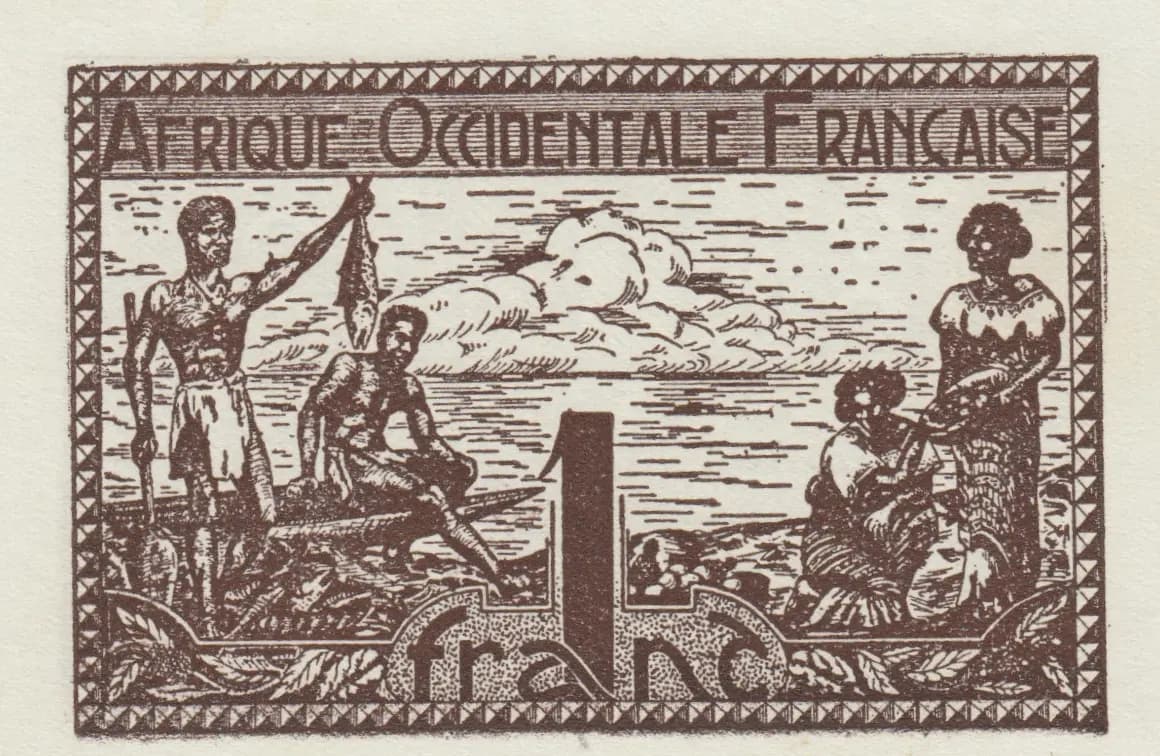
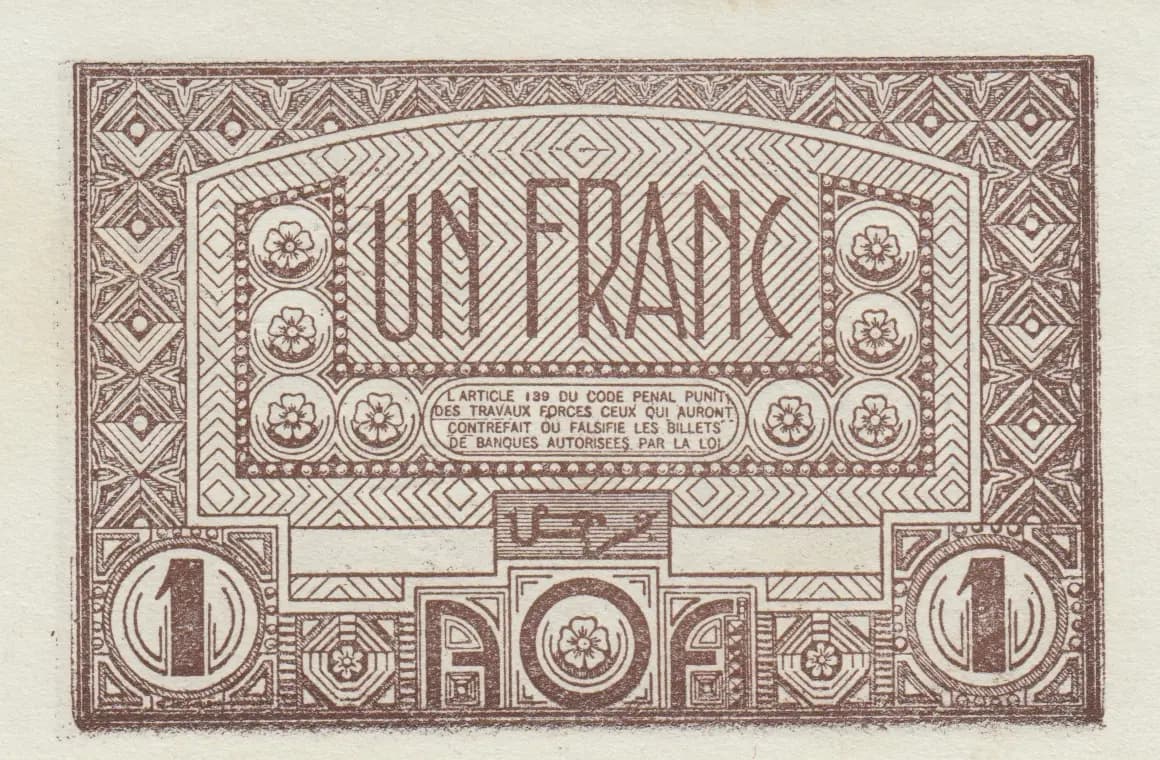
This is a 1944 French West Africa 1 franc note in uncirculated condition, featuring a distinctive ethnographic design depicting colonial-era figures in a sepia-brown engraving style. The front presents a scene with standing and seated figures rendered in fine line work characteristic of period security printing, while the reverse displays an ornate geometric border with diamond patterns and an oval cartouche containing a French penal code warning against counterfeiting. The note exemplifies the artistic and security standards of wartime French colonial currency.
Common. The eBay market data shows consistent sales activity across multiple condition grades from 2012-2024, with most examples selling between $5-$15 for circulated grades and around $20-$80 for premium grades (PMG 65-66). The 2016 catalog value for UNC grade was $20, which aligns with observed market pricing. The note was issued in significant quantities as regular circulating currency for French West Africa in 1944, and examples remain readily available to collectors. The denomination (1 franc) as a low-value circulating note would have been printed in large quantities.
Issued by the Afrique Occidentale Française during 1944, this banknote reflects the complex colonial relationship between France and its West African territories during the final year of World War II. The ethnographic imagery on the obverse—depicting local populations with standing and seated figures including women and children—represents typical colonial-era iconography used in French West African currency. The penal code warning on the reverse underscores the French authorities' efforts to maintain monetary security and control counterfeiting in colonial territories during wartime instability.
The obverse presents a colonial ethnographic scene within a geometric triangular border pattern, featuring five figures rendered in classical engraving style: a standing male figure on the left with raised arm (likely representing authority or leadership), smaller male figure in the center-left, a seated female figure in the center, a standing female figure on the right, and a child figure completing the composition on the right side. Clouds rendered with horizontal line shading occupy the upper center, with landscape elements suggested throughout. The reverse features an elaborate geometric border composed of interlocking diamonds and lattice patterns with symmetrically positioned floral medallions in circular frames, centering on a large oval cartouche containing horizontal line-work patterns. The denomination '1' appears in large numerals flanking the word 'FRANC' at the base. The entire design is rendered in brown/sepia tones on cream paper characteristic of the period.
{"front":{"issuer":"AFRIQUE OCCIDENTALE FRANÇAISE (French West Africa)"},"back":{"counterfeiting_warning":"L'ARTICLE 199 DU CODE PENAL PUNIT DES TRAVAUX FORCES CEUX QUI AURAIENT CONTREFAIT OU FALSIFIE LES BILLETS DE BANQUES AUTORISEES PAR LA LOI. (Article 199 of the Penal Code punishes with forced labor those who would have counterfeited or falsified banknotes authorized by law.)","denomination":"1 FRANC"}}
Intaglio engraving (also known as copperplate or steel engraving), the standard security printing method for banknotes of this era. The fine line work, intricate geometric patterns, and depth of detail visible in both the ethnographic composition and the geometric borders are characteristic of high-security intaglio production. The precision of the engraved lines and the subtle shading achieved through line density variations demonstrate professional security printer standards typical of French colonial banknote production.
PMG has identified two primary color varieties for Pick-34: P-34a (Dark Brown on Brown Paper) and P-34b (Light Brown on Yellow Paper). Based on the visual analysis describing a brown/sepia engraving on cream/off-white background, this example appears consistent with standard P-34a characteristics, though definitive variety identification would require examination of the paper base color and tone intensity under direct comparison. The UNC condition grade and absence of visible wear are consistent with undamaged examples of either variety. Serial numbers and specific signatures are not legible in the provided image analysis, so specific signature variety cannot be determined from the available information.