5 piastres 1936
Market Prices
17 salesAbout This Note
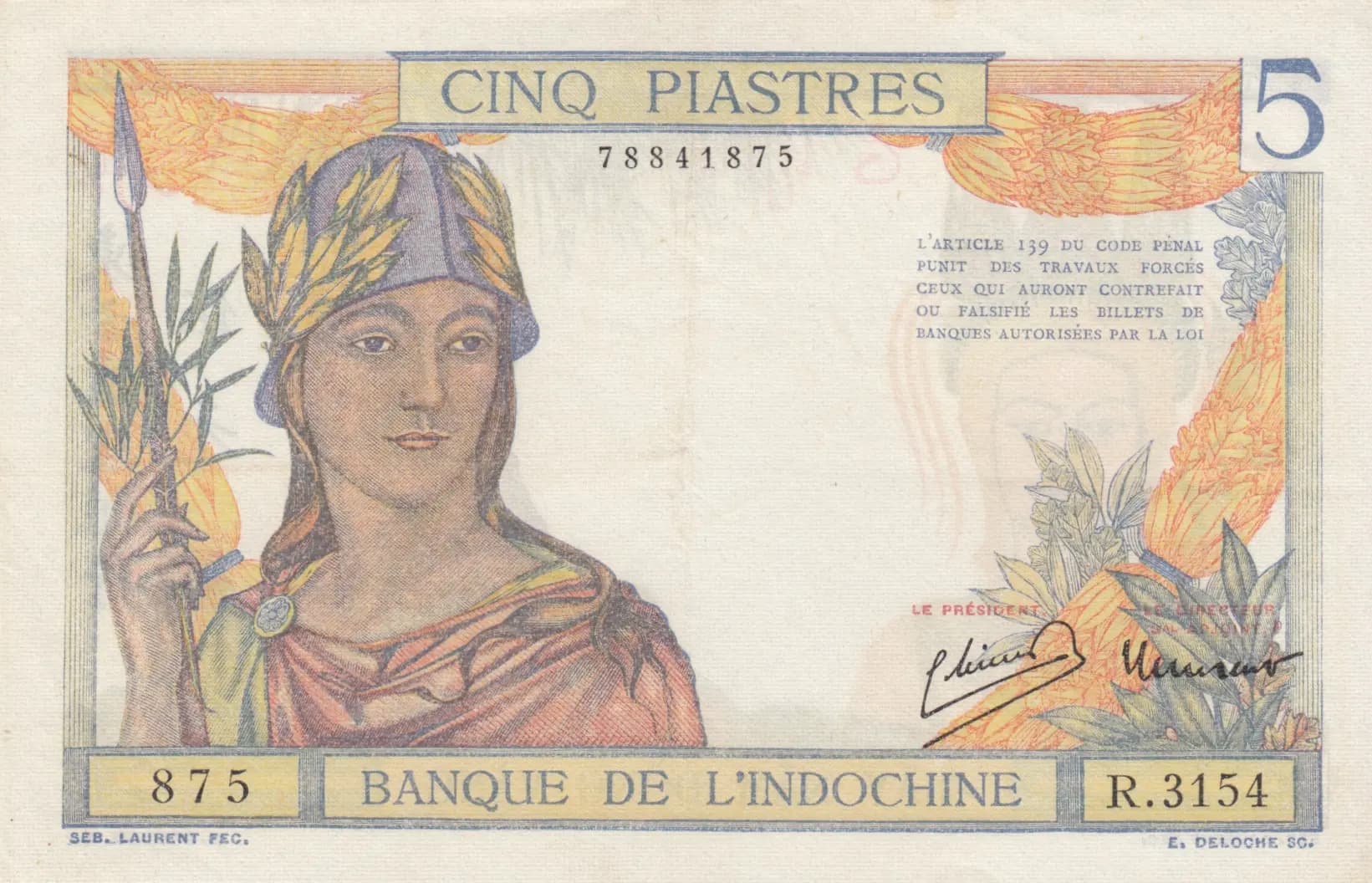
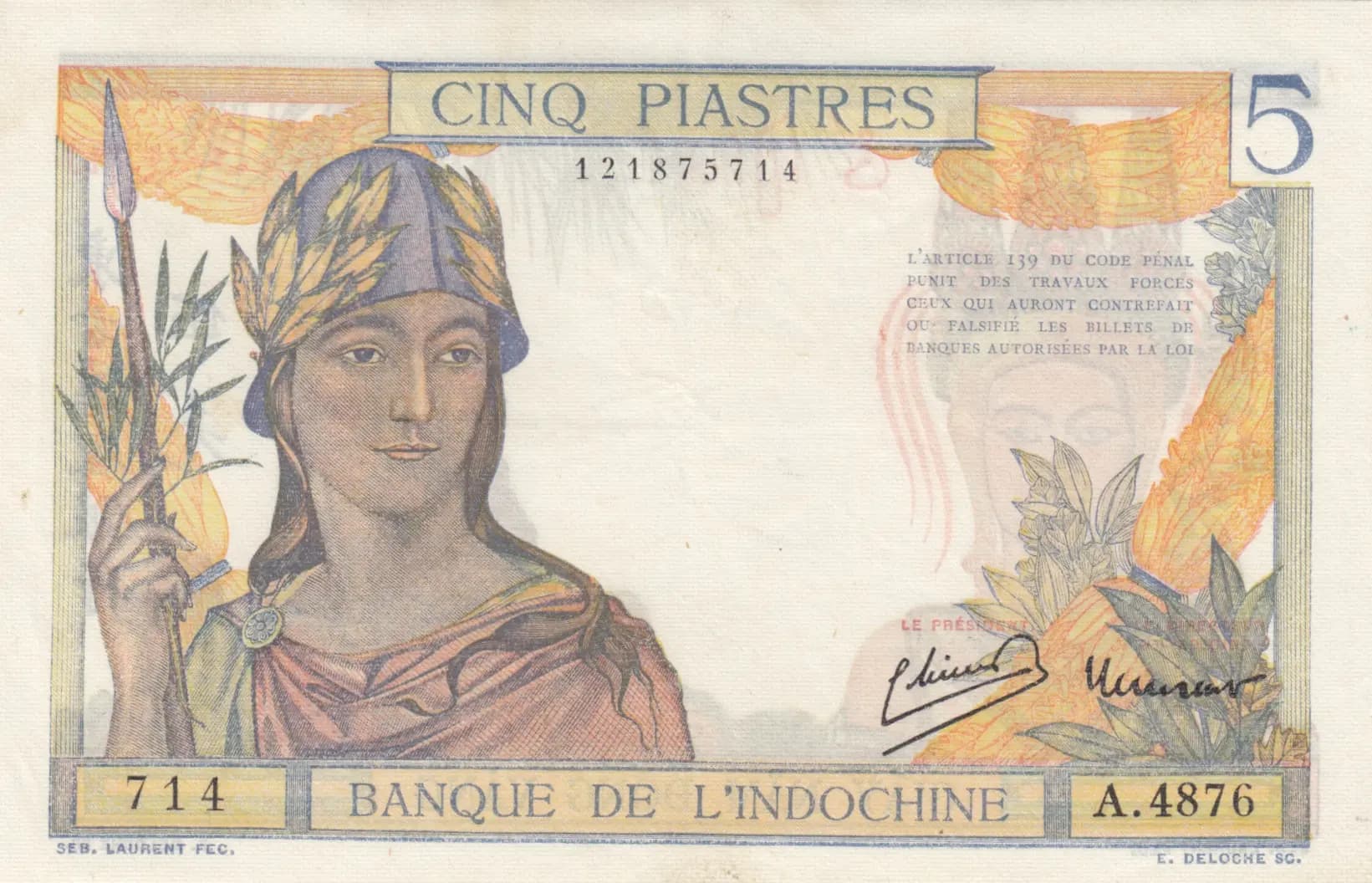
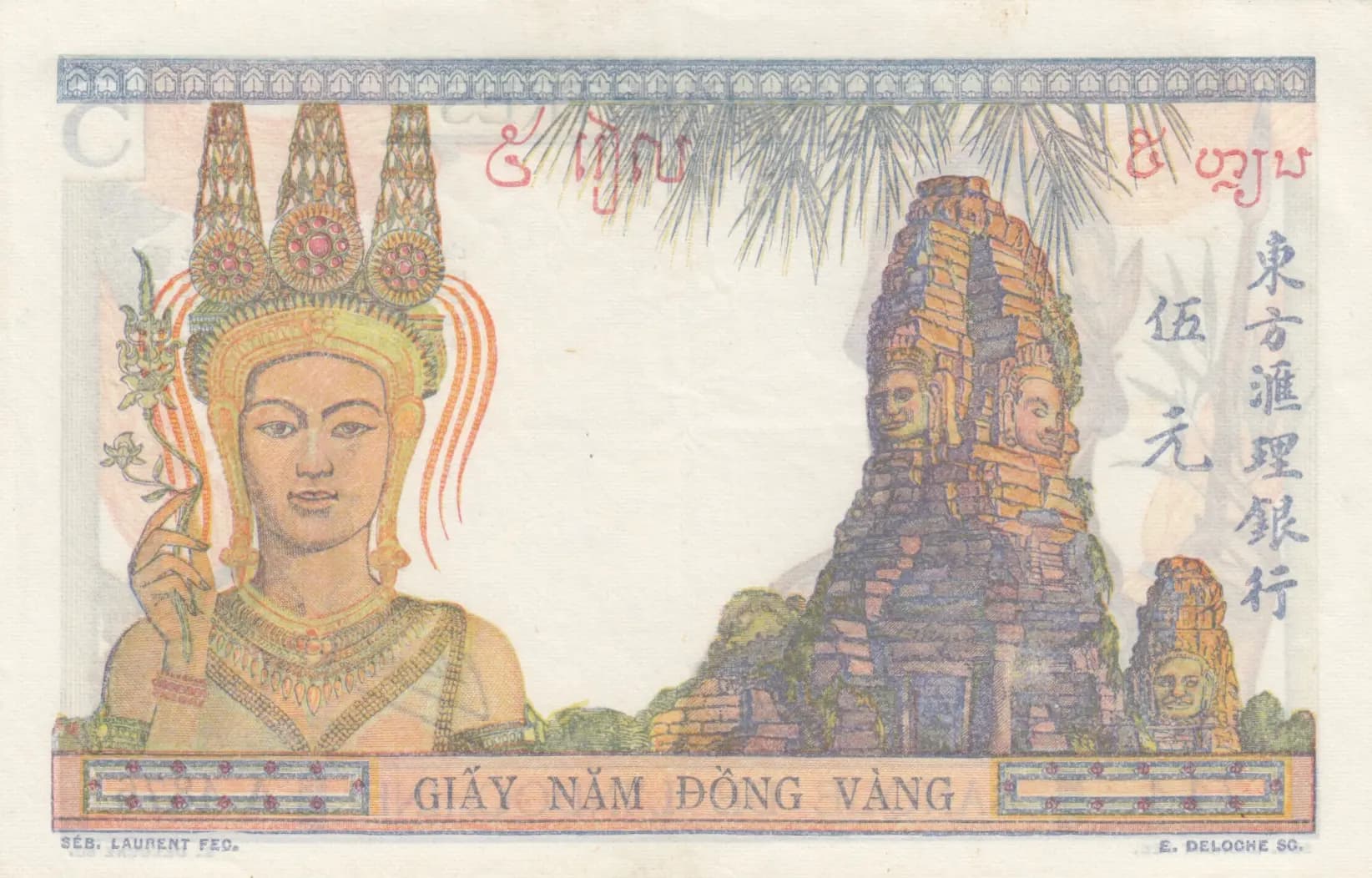
This is a French Indochina 5 Piastres note from 1936 (Pick P-55d) in Extremely Fine condition, featuring exquisite classical engraving with allegorical female figures representing French colonial themes. The obverse displays a contemplative female figure in blue drapery holding a palm frond against ornamental golden corner designs, while the reverse showcases an elaborate Southeast Asian-inspired female figure with a distinctive three-spired headdress alongside detailed temple architecture with carved stone faces. The note demonstrates exceptional preservation with minimal wear, clean margins, and crisp printing throughout, making it a desirable example of French Indochinese currency design.
Common. The eBay price tracking data demonstrates consistent market activity with numerous sales across multiple condition grades ranging from $0.99 to $121, with most sales in the $5–$25 range for circulated and uncirculated examples. The 2016 catalog values ($1 VG, $5 VF, $25 UNC) confirm standard affordability for collectors. Despite being issued in 1936 (catalog date shown as 1949 in the eBay reference, likely reflecting a reissue), this denomination and type remain widely available on the secondary market, indicating substantial original print runs and good survival rates.
Issued by the Banque de l'Indochine during the height of French colonial rule in Southeast Asia, this 1936 note reflects the colonial aesthetic that blended French classical allegorical imagery with romanticized representations of Southeast Asian culture and architecture. The dual presentation of a Western-styled allegorical woman on the obverse paired with Southeast Asian temple imagery and culturally-specific ornamentation on the reverse exemplifies the colonial-era practice of using currency design to project French cultural superiority while appropriating local cultural symbols. The engraver attributions to Sébastien Laurent and E. Deloche indicate the note's production by skilled European craftsmen, typical of high-denomination colonial currency during this period.
The obverse features Marianne or a similar allegorical female figure representing France, depicted in classical style wearing a blue-grey Phrygian cap or head covering with draped grey and muted-tone garments. She holds a golden palm frond in her left hand, symbolizing peace, victory, or colonial prosperity. The composition is balanced with ornamental golden-orange decorative elements in the upper corners and borders, creating a formal, dignified presentation typical of European banknote design of the era. The reverse showcases a highly romanticized female figure in Southeast Asian artistic style, wearing an elaborate three-tiered golden ceremonial headdress with spired ornamental sections, ornate golden jewelry including a prominent necklace, and minimal upper body drapery consistent with classical Southeast Asian sculptural traditions. Beside her stands a detailed rendering of Angkor Wat or a similar ancient Khmer temple complex, featuring multiple carved stone faces (likely representing celestial or divine beings), intricate architectural tiers, and surrounding tropical vegetation including palm fronds. This juxtaposition of French allegorical representation with Southeast Asian cultural icons exemplifies the colonial visual language, positioning France as the civilizing force bringing order to exotic lands.
FRONT SIDE: 'CINQ PIASTRES' (Five Piastres) — primary denomination text in French; '5' — numeral denomination; 'BANQUE DE L'INDOCHINE' (Bank of Indochina) — issuing institution; 'LE PRÉSIDENT' (The President) — signatory designation; 'L'ARTICLE 139 DU CODE PÉNAL PUNIT DES TRAVAUX FORCÉS CEUX QUI AURAIENT CONTREFAIT OU FALSIFIÉ LES BILLETS DE BANQUES AUTORISÉES PAR LA LOI' (Article 139 of the Penal Code punishes by forced labor those who counterfeit or falsify banknotes authorized by law) — anti-counterfeiting warning; 'SEB. LAURENT FEC.' and 'E. DELOCHE SC.' — engraver attributions (fecit = made by, sculpsit = engraved by); Serial numbers: '121875714' and 'A.4876'. REVERSE SIDE: 'GIẢY NĂM ĐÔNG VÀNG' (Vietnamese text, roughly 'Paper of the Eastern Gold Year' or similar ceremonial/official designation); Chinese/Vietnamese characters '東方選里銀行' (Bank of the East/Eastern Bank designation); '五' (Five in Chinese numerals) and '元' (monetary unit); Engraver marks repeated: 'SEB. LAURENT FEC.' and 'E. DELOCHE SC.'
Intaglio engraving (line engraving), the standard security printing method for banknotes of this era. The fine, precise line work visible throughout both sides, the detailed rendering of architectural elements on the reverse, and the ornamental border patterns are characteristic of steel engraving technique. The note was engraved by Sébastien Laurent and E. Deloche, whose names appear as 'FEC.' (fecit, maker) and 'SC.' (sculpsit, engraver) respectively. This represents high-quality European banknote production typical of colonial currency issued by established institutions like the Banque de l'Indochine.
This note is catalogued as Pick P-55d, indicating it is the 'd' variety of the 1936 5 Piastres type. The 'd' designation typically refers to a specific signature or date variety within the series; without access to comprehensive signature records for this issuer, the distinguishing feature of variety 'd' cannot be precisely identified from the visual analysis alone. The serial number format (letter 'A' followed by numerals, plus a separate number block '714') and the engraver attributions (Laurent and Deloche) are consistent across the observed note. Collectors should consult detailed Pick catalog references or specialized French Indochina references to identify signature combinations or other minor distinctions that define the 'd' variety specifically.