20 cents 1942
Market Prices
20 salesAbout This Note
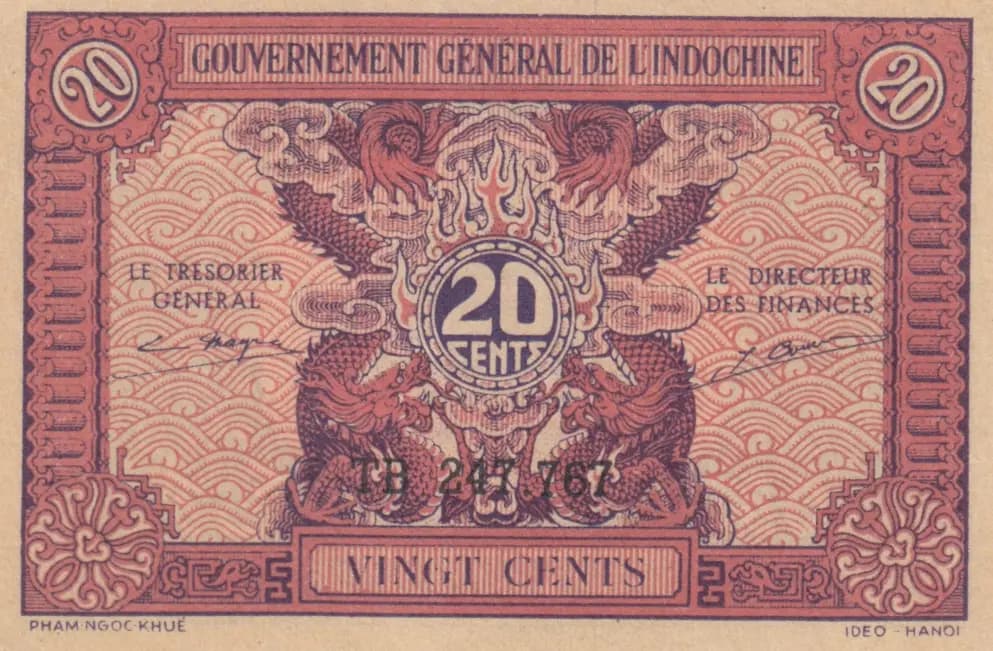
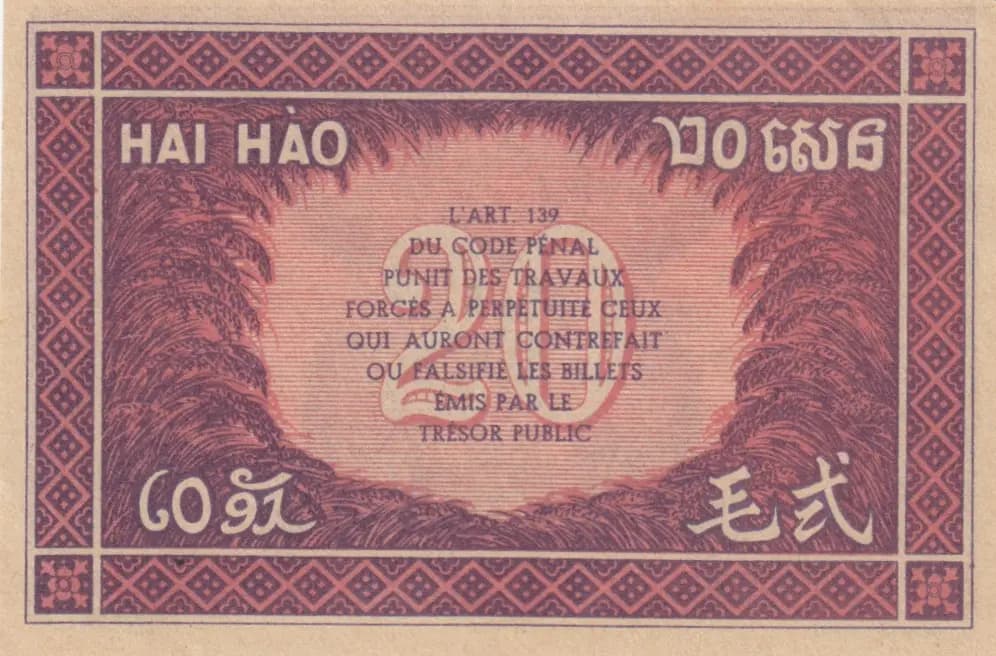
This 1942 French Indochina 20 Cents note (Pick P-90) presents in uncirculated condition with exceptional eye appeal. The obverse features an elegant red-violet and pinkish design centered on ornamental dragons with elaborate headdresses flanking a circular denomination badge, while the reverse displays a geometric border with palm trees and a prominent counterfeiting penalty clause. The uniform coloring, absence of wear, creases, or foxing, combined with the intricate fine-line engraving throughout, makes this an attractive example of colonial Indochinese currency.
Common. eBay market data shows this note in UNC condition consistently selling for $4-6.50 in recent years, with the most recent sale (March 2025) at $4.25. The note's catalog value in UNC condition is listed at $4 (2016), confirming modest pricing consistent with common issues. While PMG-graded examples command higher premiums ($28-40 for MS63/MS62), the ungraded UNC specimens demonstrate steady but unremarkable demand typical of commonly circulated colonial issues. The denomination, year, and issuer combination yields no special rarity factors.
Issued by the Gouvernement Général de l'Indochine in 1942, this note reflects the complex political landscape of French Indochina during World War II, when Japanese occupation coexisted with French administrative structures. The Vietnamese inscriptions (including the signature of Pham Ngoc Khue, the General Treasurer) and Chinese characters acknowledge the multilingual, multicultural nature of Indochinese governance, while the French text and dragon imagery represent the blending of colonial French authority with East Asian artistic traditions.
The obverse features a symmetrical composition dominated by two ornamental dragons with elaborate headdresses and decorative wave patterns, flanking a central circular badge containing '20 CENTS' in French and Vietnamese. The dragons represent traditional East Asian heraldic imagery adapted for colonial currency. Decorative corner medallions with circular designs frame the composition, while intricate wave patterns and fine-line borders create the background. The reverse employs a geometric diamond and cross pattern border with ornamental corner flourishes, depicting palm trees (emblematic of the tropical Indochinese landscape) flanking the central legal text warning. The color scheme of red-violet on a pinkish underprint creates a distinctive warm tone characteristic of this issue. All text is rendered in fine engraving with exceptional detail in the border work.
{"obverse":[{"original":"GOUVERNEMENT GÉNÉRAL DE L'INDOCHINE","translation":"General Government of Indochina"},{"original":"VINGT CENTS","translation":"Twenty Cents"},{"original":"LE TRÉSORIER GÉNÉRAL","translation":"The General Treasurer"},{"original":"LE DIRECTEUR DES FINANCES","translation":"The Director of Finances"},{"original":"PHAM NGOC KHUE","translation":"Pham Ngoc Khue (Vietnamese official signature)"},{"original":"IDEO - HANOI","translation":"IDEO - Hanoi (printing reference, likely Imprimerie de l'Indochine)"}],"reverse":[{"original":"HAI HAO","translation":"Two Hao (Vietnamese monetary denomination)"},{"original":"L'ART 139 DU CODE PÉNAL PUNIT DES TRAVAUX FORCÉS A PERPÉTUITÉ CEUX QUI AURAIENT CONTREFAIT OU FALSIFIÉ LES BILLETS ÉMIS PAR LE TRÉSOR PUBLIC","translation":"Article 139 of the Penal Code punishes with forced labor for life those who shall have counterfeited or falsified banknotes issued by the Public Treasury"},{"original":"毫式","translation":"Hao denomination/style (Chinese characters)"},{"original":"DO GGI","translation":"Reference/control marking (purpose unclear; likely printer or serial reference)"}]}
Intaglio engraving (steel plate engraving) with multicolor printing. The fine-line work visible in the borders, wave patterns, and decorative elements, combined with the sharp definition of the dragons and geometric patterns, is characteristic of high-quality intaglio production. The mark 'IDEO - HANOI' identifies the printer as Imprimerie de l'Indochine (Indochina Printing Works) located in Hanoi, which was a major security printer for French colonial currency in Southeast Asia.
The observed signature of Pham Ngoc Khue as General Treasurer is consistent with the standard 1942 issue. The printer mark 'IDEO - HANOI' with the reference number '60.97' on the reverse is a standard feature. No specific date variations or overprint varieties are evident from the visual analysis. This appears to be a standard printing of the regular issue for 1942 with no special varieties requiring notation.