100 piastres 1947
Market Prices
46 salesAbout This Note
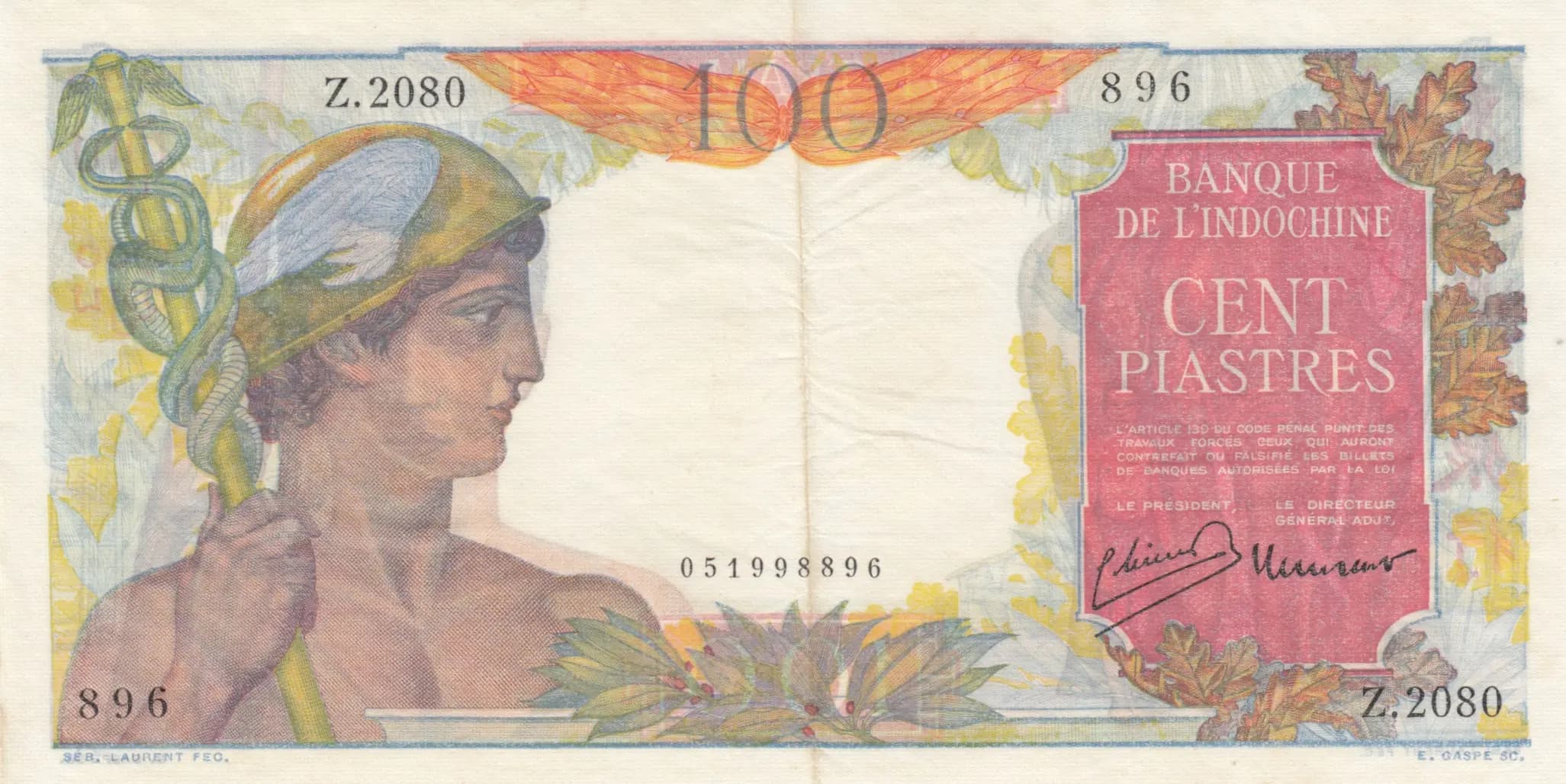
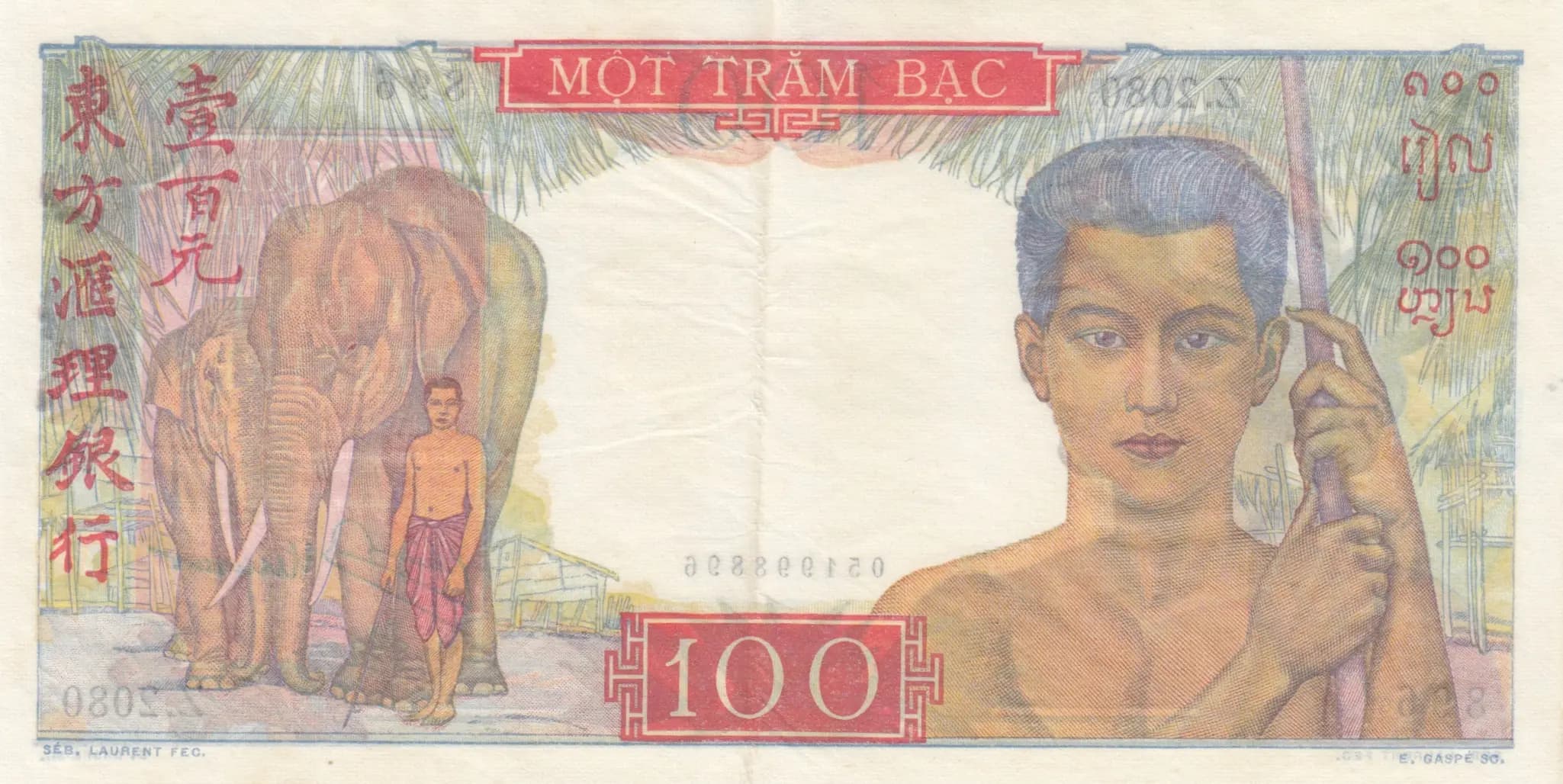
This is a VF-graded 100 Piastres note from the Banque de l'Indochine, featuring the iconic Mercury design (female classical bust) on the obverse and Southeast Asian cultural imagery on the reverse. The note displays a characteristic center vertical fold with age-appropriate foxing and yellowing consistent with mid-20th century circulation, yet retains excellent detail in the ornate engraving throughout. The specimen represents a widely-collected denomination from this prolific series with stable collector demand.
Common. The eBay transaction history provided shows consistent market activity across multiple condition grades spanning 2009-2023, with VF specimens regularly selling in the $12.50-$55.55 range and even lower prices common ($5.79-$14.02). The 2016 catalog value for VF is only $7.50. The extensive circulation evidence (center fold, foxing, yellowing) and stable pricing at modest levels indicate this is a mass-produced, widely-collected denomination with substantial surviving quantities. This is not a rare or scarce issue.
Issued during the twilight of French colonial rule in Indochina (the 1949 date reflects actual circulation despite the 1947 catalog designation), this note exemplifies the bicultural aesthetic of Banque de l'Indochine's currency. The obverse features Mercury—the classical Roman god of commerce—symbolizing European financial authority, while the reverse depicts an Asian elephant with two figures in traditional Southeast Asian dress, representing the colonial territory itself and its economic resources. The parallel French and Vietnamese inscriptions reflect the transitional period as French Indochina moved toward independence.
The obverse presents a classical allegorical female portrait—Mercury (Hermes)—in left profile, identifiable by the caduceus (intertwined serpents staff) positioned to the left of her head and the ornate winged headdress. A large winged numeral '100' dominates the top center. The design employs classical French bank note aesthetics with extensive ornamental scrollwork, laurel garlands, and oak leaf motifs framing the composition in green, gold, and red-brown hues. The reverse depicts an elephant in profile, possibly a working animal given its decorative blanket/covering, attended by two Asian figures—one standing and one shirtless—suggesting labor or commerce in the colonial territory. A geometric border pattern with repeating rectangular designs frames both sides, integrating classical Western motifs with Asian design sensibilities. The red cartouche on the obverse and red banner on the reverse containing denomination text emphasize the dual cultural presentation.
OBVERSE: 'BANQUE DE L'INDOCHINE' (Bank of Indochina); 'CENT PIASTRES' (One Hundred Piastres); 'L'ARTICLE 150 DU CODE PÉNAL PUNIT DES TRAVAUX FORCÉS CEUX QUI AURAIENT CONTREFAIT OU FALSIFIÉ LES BILLETS DE BANQUES AUTORISÉES PAR LA LOI' (Article 150 of the Penal Code punishes with hard labor those who would have counterfeited or falsified banknotes authorized by law); 'LE PRÉSIDENT' (The President); 'LE DIRECTEUR GÉNÉRAL ADJ.' (The Deputy General Director); 'SEB. LAURENT FEC.' (Engraver Sebastian Laurent, fecit/made it); 'E. GASPE SC.' (Sculptor E. Gaspe); Serial numbers: Z.2080, 896, 05199896. REVERSE: 'MỌT TRĂM BẠC' (Vietnamese: One Hundred Piastres); '100' (One Hundred); Serial numbers: 080, 082880120; Engraver and sculptor signatures repeated. Chinese/Japanese characters visible on left margin require specialist translation.
Intaglio (engraved) printing, characteristic of high-security banknotes of the period. The fine line work, precise portraiture detail, and ornamental complexity visible throughout both sides are hallmarks of steel plate engraving. The note was produced by Banque de l'Indochine's authorized security printer; French banknotes of this era typically employed the expertise of institutions like De La Rue or Banque de France's printing facilities, though specific printer attribution for this series would require archival verification.
This specimen represents Pick 82b (Type II with Lao text on reverse), as indicated in the catalog data. The visual analysis confirms Vietnamese text ('MỌT TRĂM BẠC') and Asian script elements, consistent with later printings of this type. The serial number prefix 'Z.2080' and matching reverse serial components may help identify the specific printing batch. The presence of both 'SEB. LAURENT FEC.' and 'E. GASPE SC.' signatures indicates the standard engraving team for this issue. No overprints or unusual varieties are apparent in the visual documentation.