10 cents 1942
Market Prices
40 salesAbout This Note
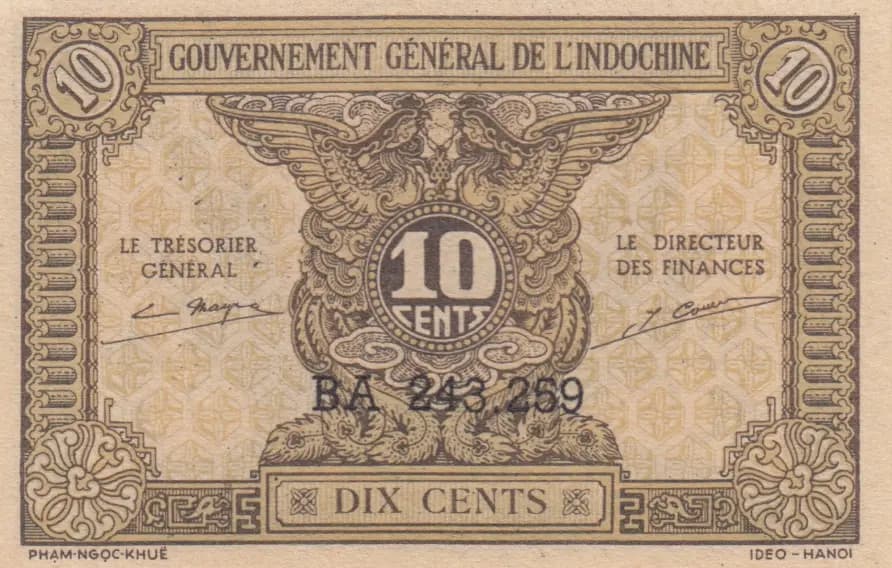
This is a French Indochina 10 cents banknote from 1942 (Pick P-89a) in Uncirculated condition, featuring an elegant classical design with a prominent winged eagle emblem centered at the top and ornate scrollwork borders in brown on tan underprint. The note exhibits the characteristic even coloration and light age patina consistent with authentic UNC examples from this era, with crisp paper quality and sharp detail work intact. This denomination and issuer represent a fascinating transitional period in Indochina's monetary history, with the bilingual French-Vietnamese text reflecting the colonial administration's governance structure.
Common. The eBay sales data provided shows consistent trading activity with examples regularly selling between $2-$20, with UNC examples recorded at $2.50 (2020), $3.25 (2009), and $4.25 (2014). Even graded examples (PMG 63-66) average $20-$60, indicating robust market availability. The 1942 10-cent denomination was issued as a standard regular-issue note during active colonial administration, suggesting substantial print runs. No historical evidence of recall, destruction, or short-run status exists for this Pick number.
The Gouvernement Général de l'Indochine issued this note during 1942, a critical year in World War II when French colonial authority in Indochina was under Japanese military occupation and nominal Vichy French administration. The iconography—particularly the classical French eagle emblem and ornate European design elements—reflects the French colonial aesthetic, while the Vietnamese text ('Một Hào') and Vietnamese credit line ('Pham-Ngoc-Khue') acknowledge the indigenous population and emerging Vietnamese administrative participation. The anti-counterfeiting legal text invoking Article 139 of the French Penal Code underscores the formal legal framework the colonial administration maintained even as geopolitical control shifted.
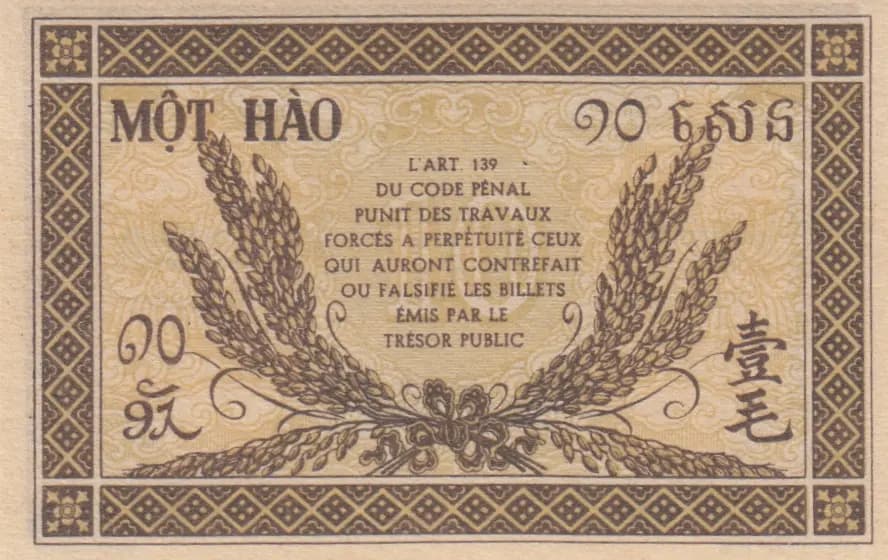
The obverse features a symmetrical neoclassical layout centered on a double-headed winged eagle emblem—a symbol of French imperial authority and governance—positioned prominently at the top center. This eagle is rendered in fine linework with classical ornamentation. The denomination '10' appears in a circular cartouche directly beneath the eagle. The note is bordered by ornate scrollwork patterns with floral and geometric flourishes, including decorative corner elements with sun-like radiant designs characteristic of Belle Époque-influenced colonial banknote aesthetics. The reverse displays a central wheat or grain wreath arrangement rendered symmetrically, symbolizing prosperity and agricultural wealth—economically significant for Indochina. The back incorporates geometric diamond and floral patterns within the border framework. The entire design employs fine engraved line work throughout, with no photographic elements. The color scheme of brown on tan creates a warm, harmonious appearance typical of 1942-era colonial currency design.
FRONT SIDE: 'Gouvernement Général de l'Indochine' (General Government of Indochina) | '10' (denomination) | 'Le Trésorier Général' (The General Treasurer) | 'Le Directeur des Finances' (The Director of Finance) | 'Dix Cents' (Ten Cents) | Serial number: 'BA 243 289' | 'Pham-Ngoc-Khue' (Vietnamese official's name) | 'Ideo - Hanoi' (Printing location). BACK SIDE: 'Một Hào' (Vietnamese: One Hao/monetary unit) | '壹毫' (Chinese characters: One Hao) | 'L'Art. 139 du Code Pénal punit des travaux forcés à perpétuité ceux qui auront contrefait ou falsifié les billets émis par le Trésor Public' (French legal warning: Article 139 of the Penal Code punishes with forced labor in perpetuity those who counterfeit or falsify banknotes issued by the Public Treasury) | '90' (Pick catalog reference).
Intaglio/engraving printing method, evidenced by the fine detailed line work, sharp portrait rendering, intricate border ornaments, and the precisely executed scrollwork visible throughout both sides. The printing location 'Ideo - Hanoi' indicates production by Imprimerie de l'Indochine or a related government printing facility in Hanoi. The two-color process (brown and tan) was applied through sequential intaglio passes, a standard security technique for mid-20th-century colonial currency to prevent counterfeiting through reproduction complexity.
The observed serial number 'BA 243 289' follows the standard LL123.456 format documented for this issue. Pick P-89a represents the primary cataloged variety for the 1942 10-cent denomination. Varieties for this issue may exist based on signature combinations (Treasurer General and Finance Director signatures appear on front), printing location variations, or date variations, but without comparison examples in the visual analysis, the specific variety designation remains P-89a as confirmed by catalog data. The Vietnamese name credit 'Pham-Ngoc-Khue' on this example may represent a known signature variety if this official held office during 1942.