10 cents 1939
Market Prices
23 salesAbout This Note
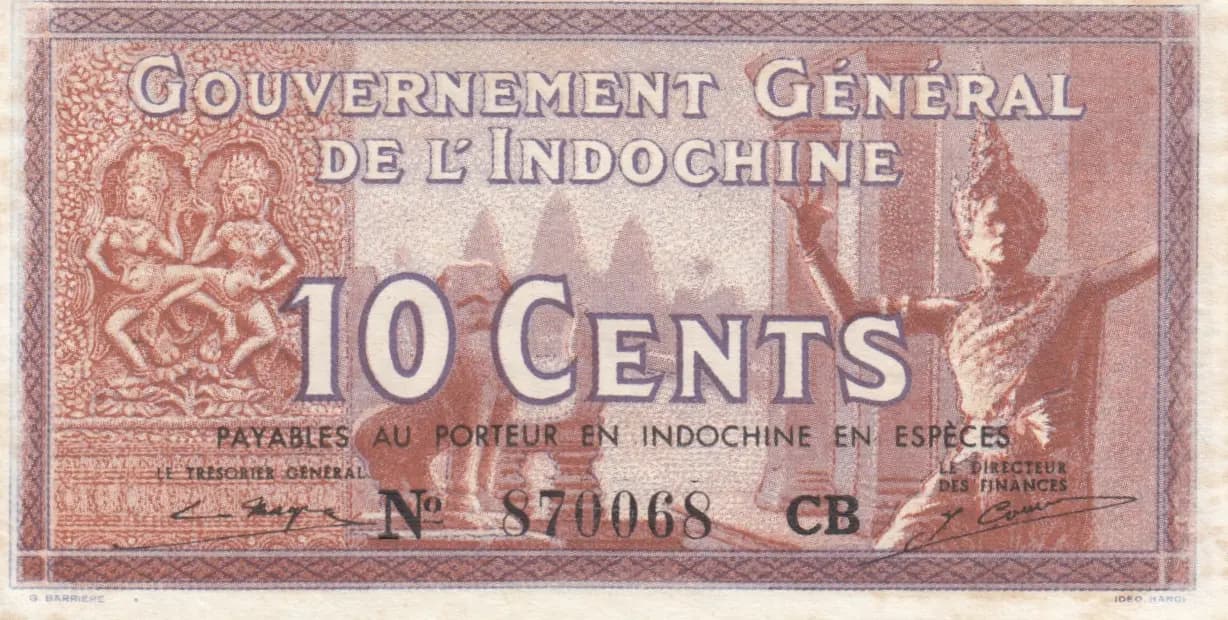
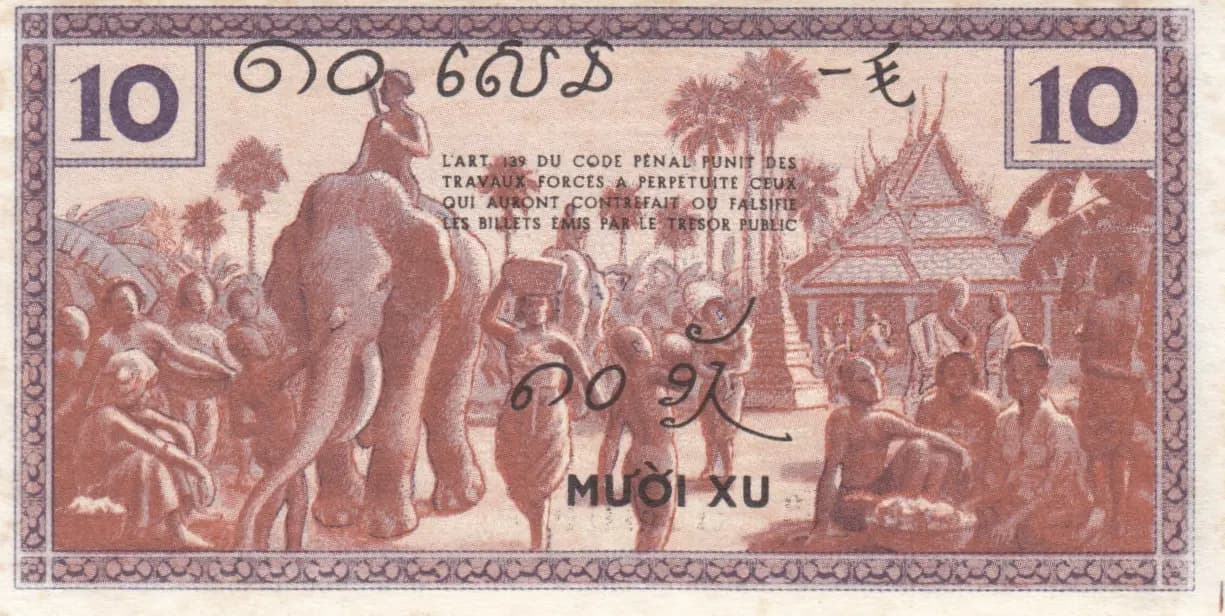
This is a French Indochina 10 cents banknote from 1939 (Pick P-85d) in Uncirculated condition, featuring distinctive reddish-brown tones and ornate Art Deco-influenced border design. The note displays exceptional craftsmanship with detailed engraved scenes on both sides: a carved relief with multiple figures in traditional dress on the front, and an elaborate colonial-era marketplace scene featuring an elephant and Southeast Asian temple architecture on the reverse. The presence of archival annotations and the well-preserved state of the paper and printing make this an interesting example of French Indochinese monetary design during the late colonial period.
Common. eBay market data shows consistent sales activity across multiple condition grades (VG through PMG 66) spanning from 2009 to 2024, with most sales falling in the $5-$30 range. The current asking price of $7.50 UNC in 2016 catalog values, combined with regular auction activity and the note's 1939 vintage from an actively circulated colonial currency system, indicates robust supply in the collector market. The 1939 10 cents denomination was a standard, widely-issued denomination throughout the French Indochina system; no evidence suggests an unusually limited print run or recall that would elevate this specific Pick number to scarce status.
Issued during 1939 by the Gouvernement Général de l'Indochine, this note represents French colonial monetary authority in Southeast Asia at a critical historical moment—just as World War II was beginning in Europe. The reverse depicts a romanticized vision of colonial Indochina with an elephant, traditional marketplace activity, and Southeast Asian temple architecture, reflecting how the French administration sought to present the territory through its currency. The bilingual inscriptions in French and Vietnamese, combined with the imagery of cultural synthesis, illustrate the colonial government's attempt to balance European administrative authority with acknowledgment of local traditions during the final years before Japanese occupation.
This banknote exemplifies French colonial monetary design with careful attention to security and cultural presentation. The front features an ornamental geometric and floral border pattern in reddish-brown, framing two distinct artistic elements: on the left, an intricate carved relief depicting multiple figures dressed in traditional Vietnamese and Southeast Asian attire, and on the right, a formal portrait in profile of an authority figure wearing traditional headwear, likely representing a colonial administrator or dignitary. The reverse presents an elaborate engraved scene depicting colonial Indochina's imagined prosperity, with a prominent elephant as the central figure surrounded by multiple individuals in varied dress (mixing traditional Vietnamese clothing with Western colonial attire) in what appears to be a marketplace or public gathering. In the background, characteristic Southeast Asian temple or pagoda architecture with pointed roofs and palm trees establishes the tropical colonial setting. The color scheme throughout—reddish-brown, tan, and cream with mauve tones in border areas—creates a unified, warm aesthetic appropriate to the region's climate and aesthetic traditions. The ornate borders and detailed engraving served both decorative and security purposes.
FRONT SIDE: 'GOUVERNEMENT GÉNÉRAL DE L'INDOCHINE' (General Government of Indochina) — official issuing authority; '10 CENTS' — denomination in English; 'PAYABLES AU PORTEUR EN INDOCHINE EN ESPÈCES' (Payable to bearer in Indochina in cash) — payment guarantee; 'LE TRÉSORIER GÉNÉRAL' (The General Treasurer) and 'LE DIRECTEUR DES FINANCES' (The Director of Finances) — signature lines of authorized officials; Serial number '870068' with letter suffix 'CB'. BACK SIDE: '10' — denomination markers in corner boxes; 'L'ART. 139 DU CODE PÉNAL PUNIT DES TRAVAUX-FORCÉS A PERPÉTUITÉ CEUX QUI AURONT CONTREFAIT OU FALSIFIÉ LES BILLETS ÉMIS PAR LE TRÉSOR PUBLIC' (Article 139 of the Penal Code punishes with perpetual hard labor those who have counterfeited or falsified notes issued by the Public Treasury) — counterfeiting warning; 'MUOI XU' — Vietnamese translation of the denomination (Ten cents).
Intaglio engraving (photogravure and steel engraving), the standard security printing method for banknotes of this era. The fine details visible in the relief carving, portrait, landscape scene, and ornamental borders are characteristic of high-quality intaglio work. This note was produced by the Banque de l'Indochine's printing facilities or associated security printers authorized by the French colonial administration. The multi-plate engraving process allowed for the combination of different design elements (borders, portraits, scenes, text) with varying depths of cut to create the dimensional quality and security features evident in the visual analysis.
This example is identified as Pick P-85d, indicating it is part of the 'd' variety group within the 1939 10 cents issue. Variations within the 1939 10 cents series typically relate to signature combinations (Le Trésorier Général and Le Directeur des Finances positions changed hands), letter designations on the serial number (this example shows 'CB'), and potentially subtle design modifications across the printing run. The serial number 870068 with 'CB' suffix may indicate a specific printing batch; collectors of French Indochina note varieties typically track these designations to catalog distinct printings within the nominal 1939 issue date.