1 piastre 1953
Market Prices
52 salesAbout This Note
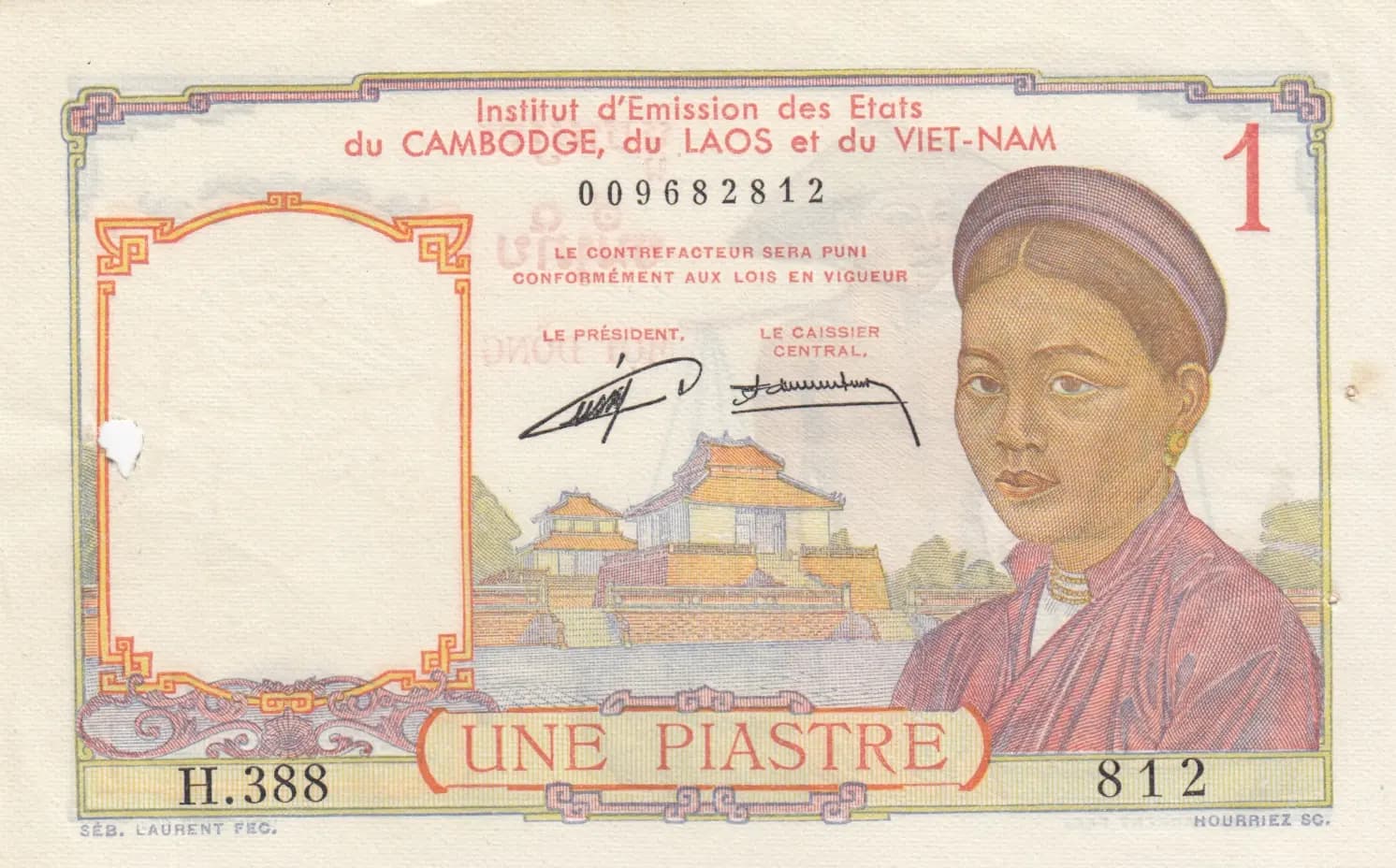
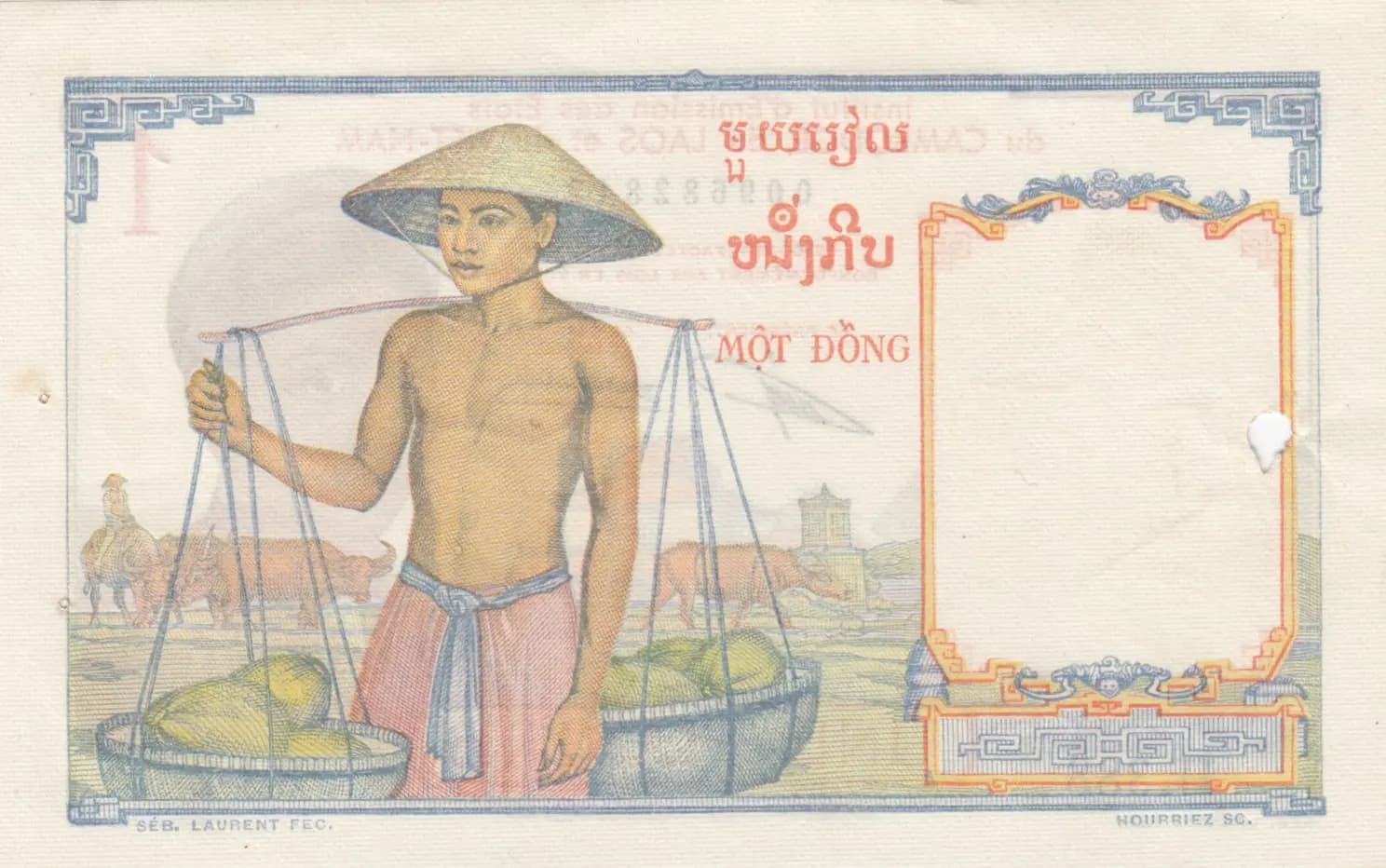
This 1953 French Indochina 1 piastre note (Pick P-92) presents an exceptional example of mid-20th century colonial currency design, featuring ornate Asian-inspired geometric borders and culturally significant imagery. The note displays visible foxing and age-related patina consistent with AU condition, with a woman in traditional dress and purple garments prominently featured on the obverse, while the reverse depicts a bare-chested laborer in a conical hat carrying baskets—imagery reflecting the working populations of colonial Indochina. The fine line engraving is crisp and well-preserved, with the blank cartouches suggesting this is a regular circulation issue rather than a specimen note.
Common. eBay market data shows numerous sales ranging from $0.99 to $192.49, with most regular circulation examples (VF-UNC) selling in the $4-$25 range. Even high-grade PMG-certified examples (65-67) typically sell for $38-$81. The note appears frequently in auctions with consistent bidding activity, indicating ready availability in the collector market. This regular issue from a 1-year denomination during the final year of the issuing authority's existence was produced in substantial quantities for circulation, making it a common date and type for the series.
Issued by the Institut d'Emission des Etats du Cambodge, du Laos et du Viet-Nam during the final years of French Indochina's existence (note issued 1953, just before French withdrawal in 1954), this note represents the monetary authority of the three associated states under French colonial administration. The reverse imagery of a rural laborer with baskets and agricultural landscape reflects the region's economy centered on peasant agriculture and colonial resource extraction, while the architectural imagery of pagodas and fortifications on the obverse represents the region's cultural and political structures under French oversight.
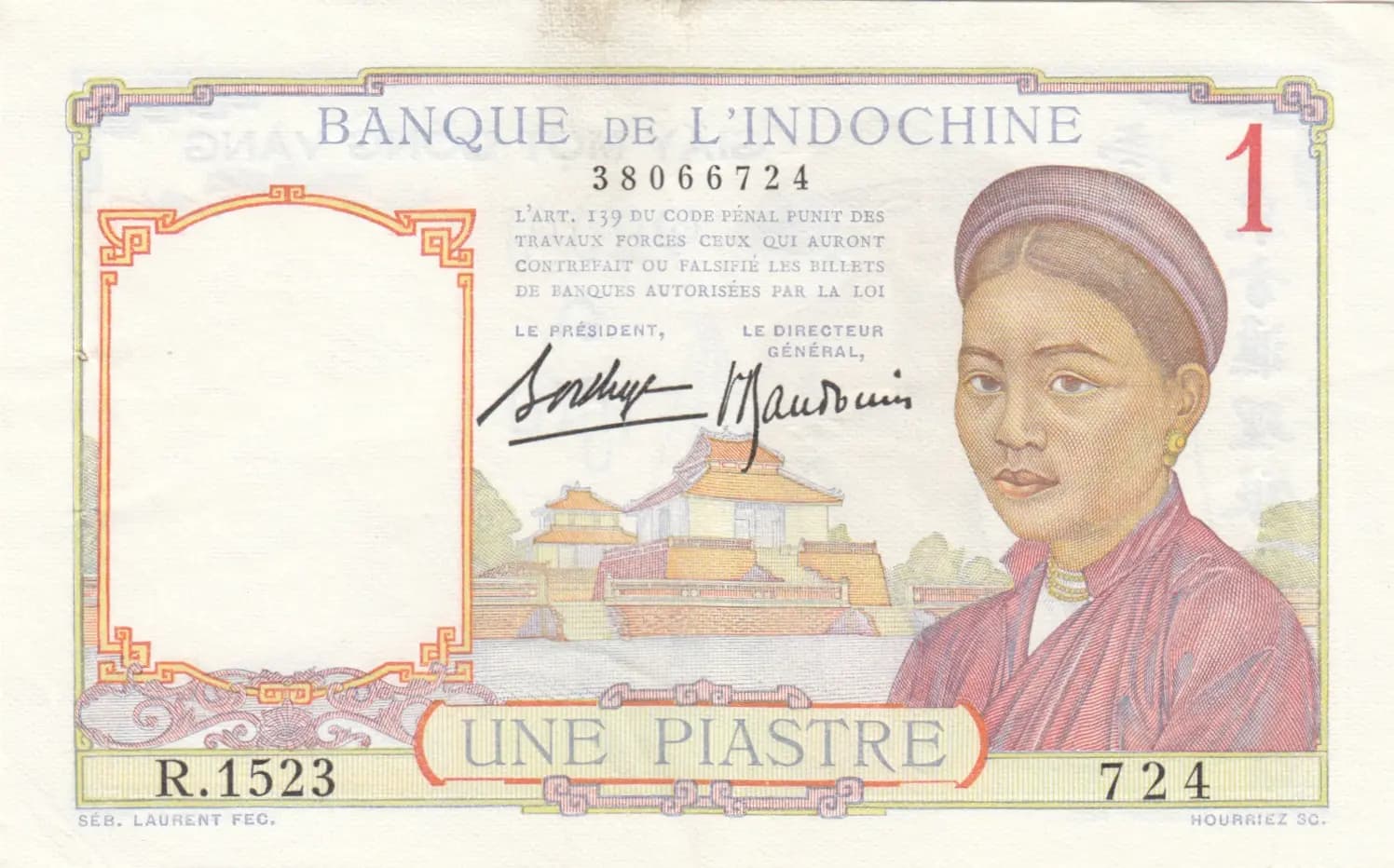
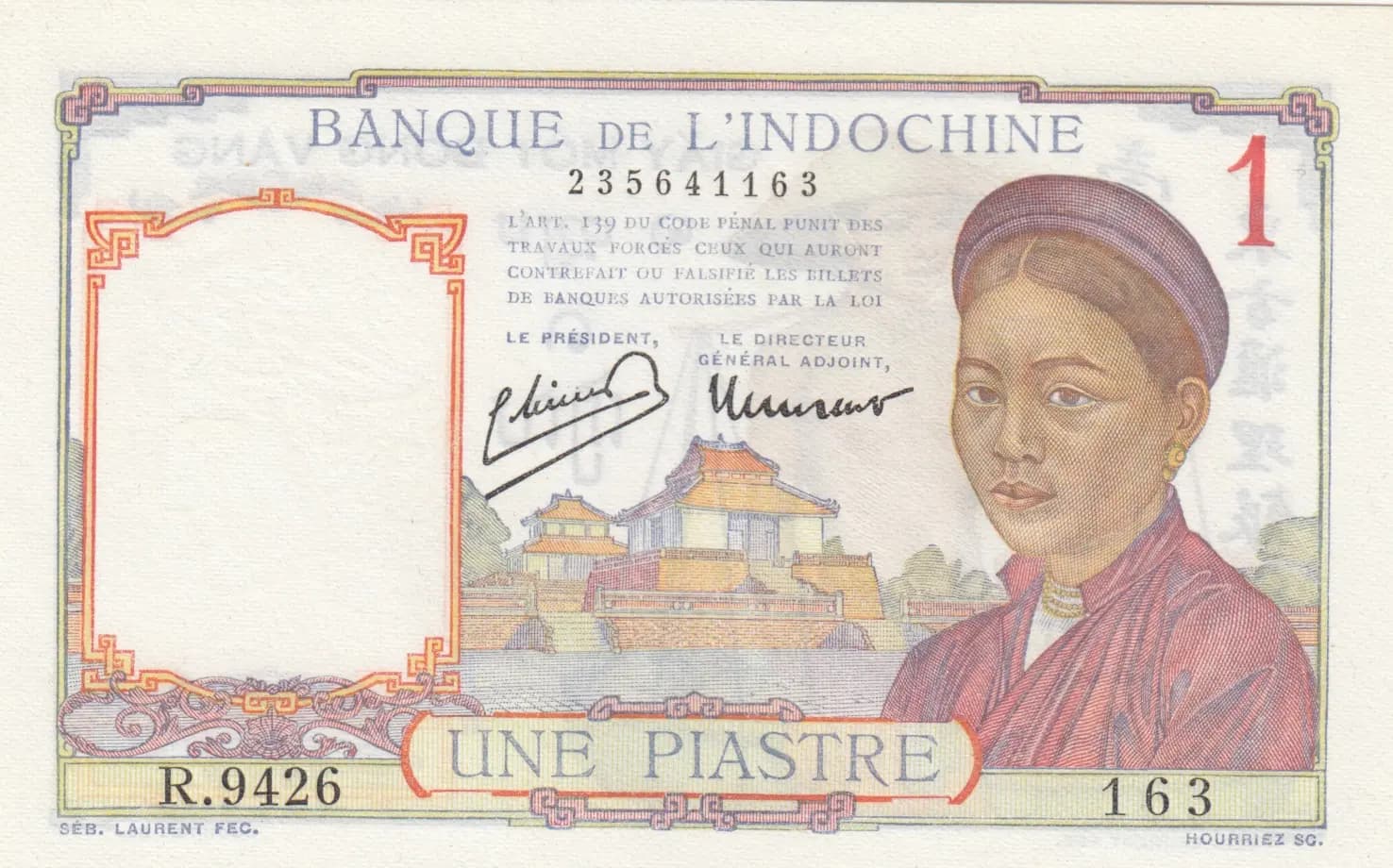
The obverse features an ornate cartouche frame (blank, likely for signature or denomination) surrounded by intricate geometric border patterns in orange, cream, and multi-color. A portrait of a woman in profile facing right occupies the right side, dressed in purple/mauve garments with a purple-grey head covering—likely representing a woman from the Indochinese region in traditional costume. Behind her is an illustration of an Asian pagoda or Buddhist temple with multiple tiered yellow/gold roofs and fortress-like walls, representing the region's religious and architectural heritage. The reverse depicts a full-length figure of a bare-chested male laborer wearing a traditional wide-brimmed conical hat (typical of Vietnamese and Cambodian peasantry) and a pink/coral loincloth, shown carrying two large baskets suspended from a wooden yoke across his shoulders. The background landscape includes a tower or fortified structure and agricultural fields with other working figures, emphasizing the agrarian economy and manual labor that sustained colonial Indochina.
OBVERSE: Institut d'Emission des Etats du CAMBODGE, du LAOS et du VIET-NAM (Institute of Issuance of the States of Cambodia, Laos and Vietnam); UNE PIASTRE (One Piastre); LE CONTREFACTEUR SERA PUNI CONFORMÉMENT AUX LOIS EN VIGUEUR (Counterfeiters will be punished in accordance with laws in force); LE PRÉSIDENT (The President); LE CAISSIER CENTRAL (The Central Cashier); Serial designation H.388; Serial number 00968281; Engraver credits: SÉB. LAURENT FEC. (Seb. Laurent engraved this) and HOURIEZ SC. (Houriez sculpted). REVERSE: MỘT ĐỒNG (One Dong/One Piastre in Vietnamese); Khmer script equivalent; Engraver credits: SÉB. LAURENT FEC. and HOURIEZ SC.
Intaglio engraving (line engraving), executed by the engravers Sébastien Laurent (design and engraving) and Houriez (sculpture/preparation). The fine line work throughout the borders, the detailed portrait rendering, and the crisp geometric patterns are characteristic of high-quality intaglio security printing standard for French colonial currency. The complexity of the border designs and the sharp detail preservation visible in the specimen suggest printing by a major European security printer, likely the French state printer or an affiliate security printing house.
The observed specimen carries serial designation H.388 with serial number 00968281. The 1953 date is the sole year of issue for this design under the Institut d'Emission des Etats du Cambodge, du Laos et du Viet-Nam. Varieties for Pick P-92 primarily relate to serial number prefixes and blocks. The blank cartouche frames (obverse and reverse) are standard for regular circulation issues of this type, distinguishing them from specimen or presentation notes which might have imprinted signatures or additional markings. No major overprints or color varieties are noted for this denomination in standard catalogs.