1 piastre 1944
Market Prices
22 salesAbout This Note
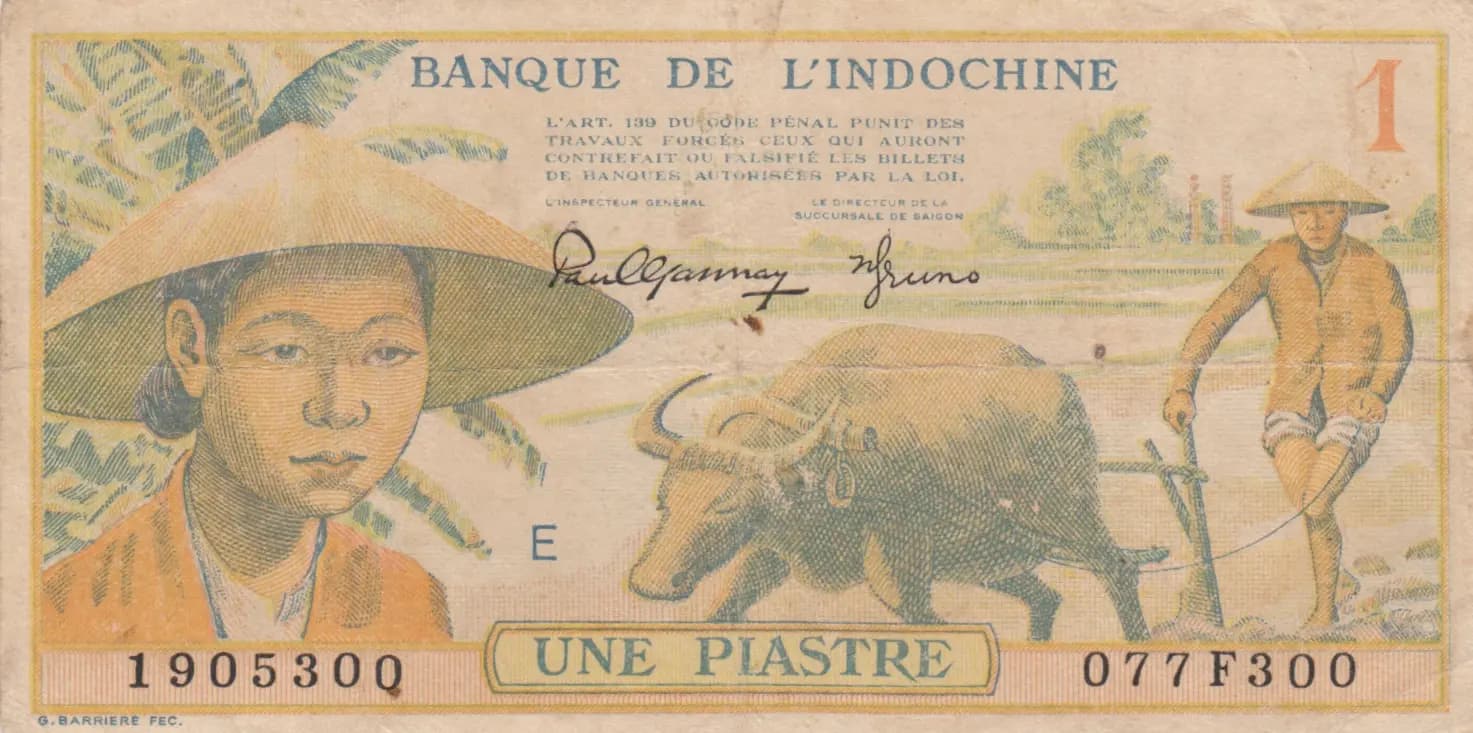
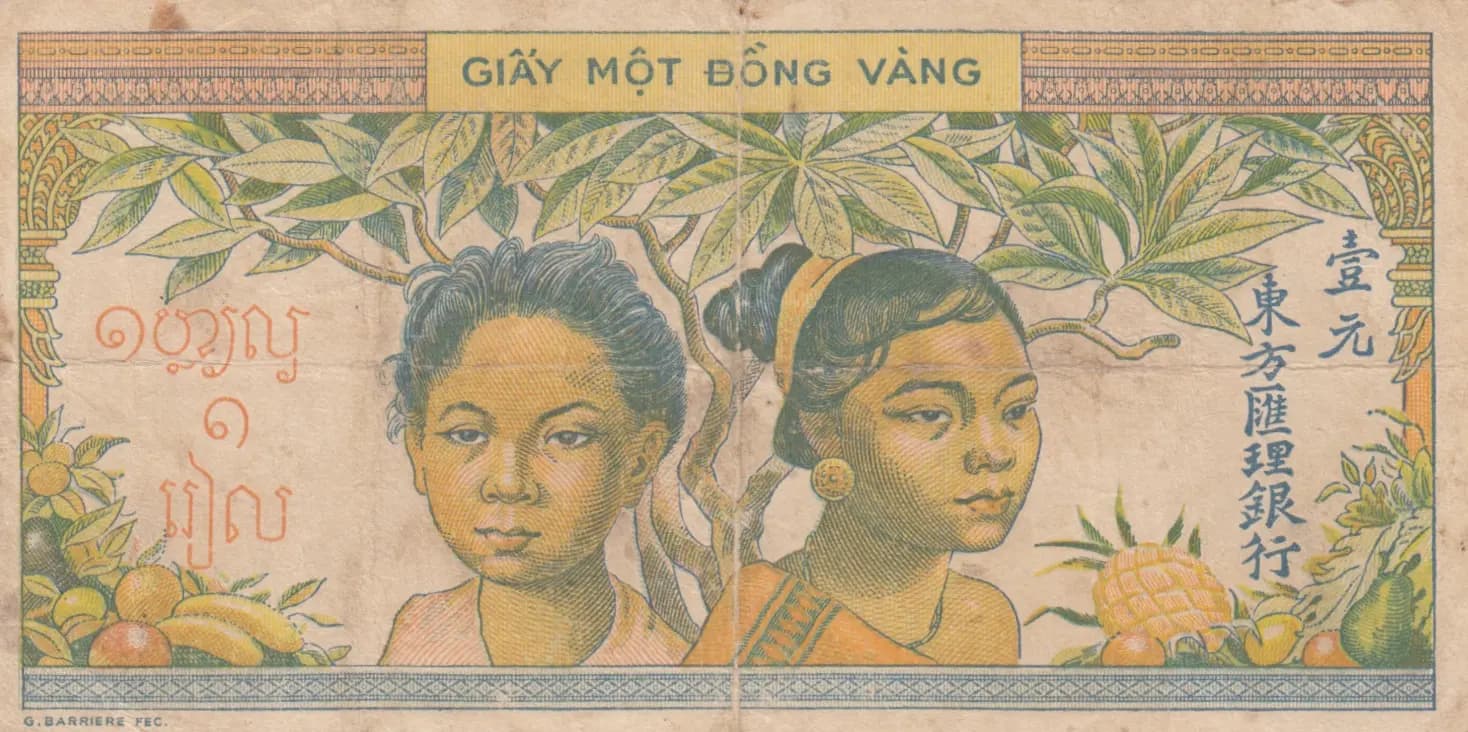
This 1944 French Indochina 1 Piastre (Pick P-74) displays the classic colonial imagery characteristic of Banque de l'Indochine issues, featuring a water buffalo and farmer on the obverse and two Vietnamese women amid flowering botanical elements on the reverse. The note exhibits significant age-related discoloration and foxing consistent with F (Fine) condition, with visible yellowing, creasing, and edge wear typical of a circulated historical specimen from the mid-20th century. The fine engraving work by G. Barriere and multi-language inscriptions reflect the cosmopolitan nature of French Indochina's monetary system.
Common. The eBay price history provided demonstrates consistent market activity at modest price levels, with notes in F condition selling for $12.50-$31 across multiple transactions from 2014-2022. Current market prices for F-grade specimens hover around $20-31 based on recent sales (2020-2025), and the 2016 catalog values F at only $2.50 with UNC at $30, indicating this is a standard-issue note without significant scarcity. The volume of transactions and relatively stable pricing over more than a decade confirms this Pick number was produced in substantial quantities and remains readily available to collectors.
This note was issued during 1944, a transitional period in French Indochina's monetary history as World War II drew to a close and colonial authority began to weaken in the region. The imagery—depicting water buffalo, farmers in traditional conical hats, and Vietnamese women—romanticizes the agricultural foundation of Indochinese economy while asserting French colonial cultural dominance through the Banque de l'Indochine's authority. The multilingual inscriptions in French, Vietnamese, Chinese characters, and Khmer script underscore the diverse population and economic reach of French Indochina before its dissolution in 1954.
The obverse features a romanticized colonial agricultural scene with a young Vietnamese man wearing a traditional nón lá (conical hat) on the left, a farmer in traditional dress guiding a water buffalo in the center, and another laborer in traditional clothing on the right. The composition emphasizes the water buffalo as a symbol of Indochinese agricultural wealth and ox-powered cultivation. Tropical foliage and palm fronds frame the scene in muted greens and browns. The reverse depicts two young Vietnamese women with traditional hairstyles and jewelry positioned within an ornate botanical garden setting, surrounded by flowering branches and fruit trees rendered in delicate engraving. This allegorical female representation traditionally symbolizes the land's fertility and natural resources under French stewardship. The decorative border patterns on both sides employ fine line work characteristic of high-security banknote engraving of the period.
FRONT: 'BANQUE DE L'INDOCHINE' (Bank of Indochina); 'UNE PIASTRE' (One Piastre); 'L'ART. 139 DU CODE PENAL PUNIT DES TRAVAUX FORCES CEUX QUI AURAIENT CONTREFAIT OU FALSIFIE LES BILLETS DE BANQUES, AUTORISEES PAR LA LOI' (Article 139 of the Penal Code punishes with hard labor those who have counterfeited or falsified banknotes authorized by law); 'L'INSPECTEUR GENERAL' (The Inspector General); 'LE DIRECTEUR DE LA SUCCURSALE DE SAIGON' (The Director of the Saigon Branch); 'Pellgamy Bruno' (signature); 'G.BARRIERE FEC.' (G. Barriere made it - engraver's mark); Serial numbers: '1905300' and '077F300'. BACK: 'GIÂY MỘT BÔNG VÀNG' (Vietnamese: One Gold Note/Certificate); '宣元庫理銀行' and '東元庫理銀行' (Chinese: Bank/Treasury - variant readings); 'ទឹក' (Khmer: Water); 'G.BARRIERE FEC.' (engraver's mark).
This note was produced using traditional intaglio (engraved line) printing, evidenced by the fine cross-hatching, detailed portrait work, intricate border patterns, and sharp line definition visible throughout both sides. The engraver G. Barriere's signature and the notation 'FEC.' (fecit/made) indicate hand-engraved original plates. The Banque de l'Indochine commissioned security printing from established French printers during this period; the technical quality and multi-color capability suggest production by a major security printer such as Banque de France or a contractor to the colonial administration. The fine detail work and security features including dual serial numbers are consistent with intaglio printing standards of 1940s French currency production.
The observed serial numbers are '1905300' and '077F300', with the latter format suggesting a branch or series indicator ('F' potentially indicating Saigon). The signature of Pellgamy Bruno as Director of the Saigon Branch appears on this specimen. Varieties of P-74 may exist based on different signature combinations (various directors and inspector generals), serial number prefixes, and printing dates within the 1944 issue, though the standard catalog treats these as a single pick number. No major overprints, date variations, or color varieties are noted on this example, suggesting it represents the standard 1944 issue.