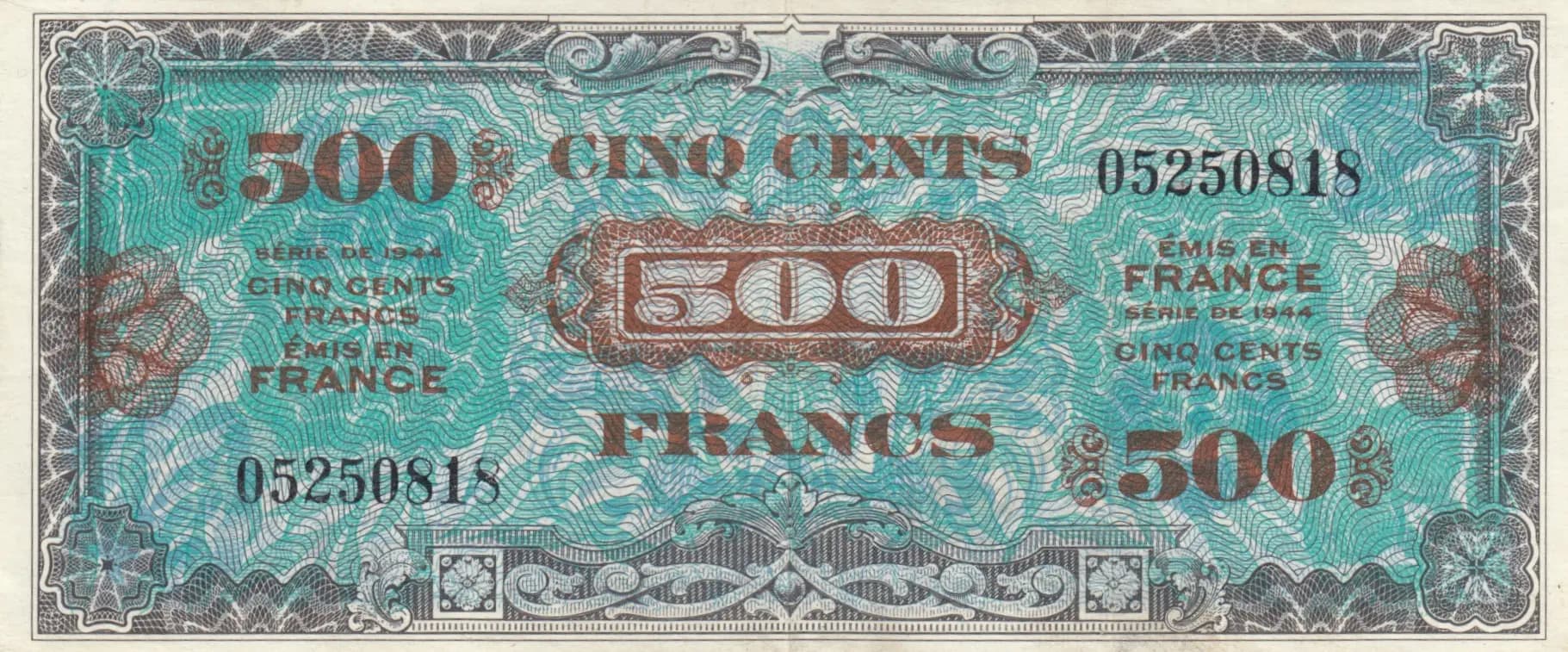
500 francs 1944
Market Prices
17 salesAbout This Note
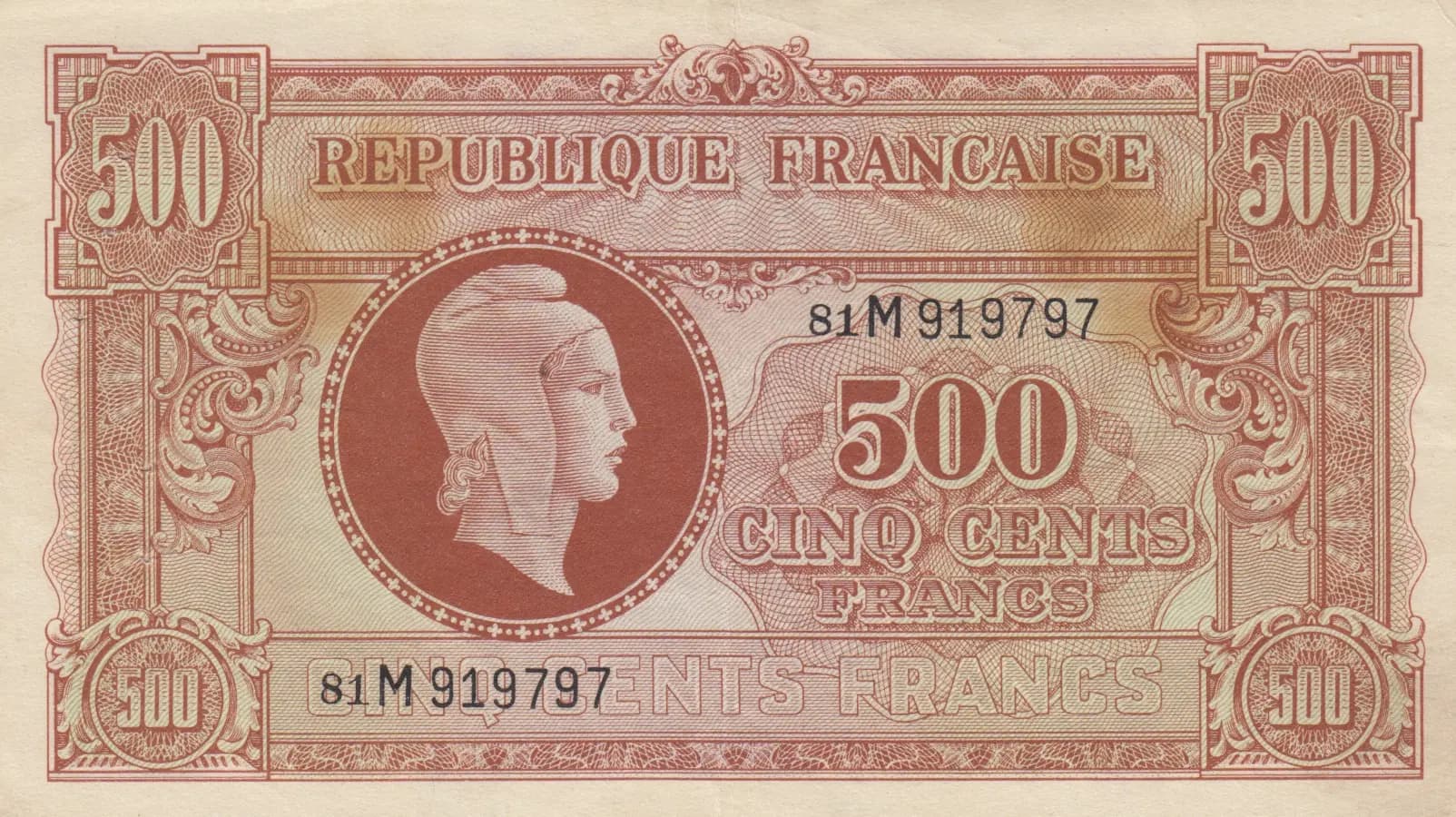
This 500 Francs note from 1944 is a classically engraved French banknote featuring a striking portrait of Marianne in a central circular medallion, rendered in the refined style typical of wartime French currency. The note exhibits an excellent condition grade (VF) with sharp printing, clean margins, and no visible wear, creases, or foxing—characteristics that make it desirable to collectors. The reddish-brown and tan color scheme and intricate geometric ornamentation are hallmarks of the TDLR printer's work, and the note's historical significance as a 1944 issue during the Liberation period adds numismatic interest.
Common. This is a regular-issue banknote with no indication of limited print run or early recall. The eBay market data shows consistent sales of VF examples ranging from $20–$39 over the past decade, with most sales clustering in the $20–$35 range. The 2016 catalog value of $50 for VF is in line with observed market prices. The note's age (1944) and historical context give it collector appeal, but it was produced in substantial quantities and remains readily available in the secondary market.
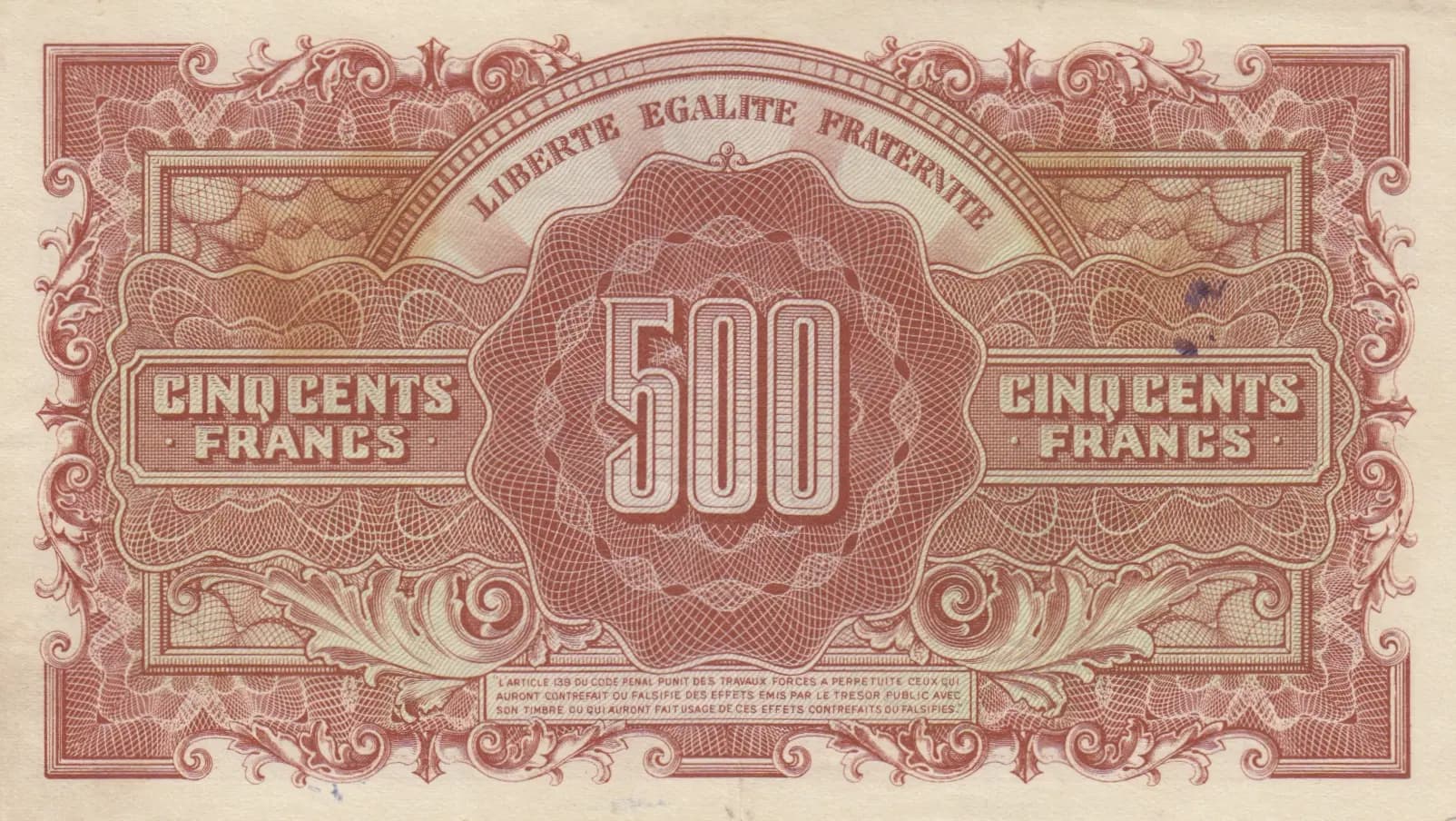
Issued by the Trésor Central (Central Treasury) of the French Republic in 1944, this banknote was produced during a pivotal moment in French history—the year of the Liberation from Nazi occupation. The prominent display of 'Liberté, Égalité, Fraternité' on the reverse reflects the renewed emphasis on Republican values following the German occupation, while the classical engraving style and patriotic imagery served to reassert French monetary sovereignty and national identity in the immediate post-liberation period.
The obverse features a classical engraved portrait of Marianne—the personification of the French Republic—in profile facing right, centered within a beaded circular medallion. The denomination '500' appears in ornate corner cartouches in the upper left and right. The reverse displays a large decorative shield-shaped cartouche as the central focal point, containing the denomination, surrounded by elaborate scrollwork, leaf motifs, and symmetrical corner flourishes. Both sides employ fine parallel line engraving as background pattern and incorporate classical architectural and botanical ornaments throughout. The overall aesthetic is deliberately formal and authoritative, befitting a high-denomination note issued during a period of national reconstruction.
Front: 'République Française' (French Republic), '500' and 'Cinq Cents Francs' (500 / Five Hundred Francs) displayed in corners and text; serial number '81M919797'. Back: 'Liberté Égalité Fraternité' (Liberty, Equality, Fraternity), '500' and 'Cinq Cents Francs' (Five Hundred Francs); legal warning: 'L'Article 139 du Code Pénal punit des travaux forcés à perpétuité ceux qui auraient contrefait ou falsifié des effets ayant cours par le Trésor Public avec son timbre ou auraient fait usage de ces effets contrefaits ou falsifiés' (Article 139 of the Penal Code punishes with perpetual forced labor those who would have counterfeited or falsified negotiable instruments having legal tender through the Public Treasury with its stamp or would have made use of these counterfeit or falsified instruments).
Intaglio engraving (line engraving) on both sides, executed by TDLR (Télégramme, Dessin, Lithographie, Rotogravure) without visible printer's imprint on the note itself. The fine parallel lines forming complex background patterns, the intricate geometric and floral borders, and the sharp definition of the portrait medallion are characteristic of high-quality intaglio work. The two-color printing (reddish-brown and tan/beige) was achieved through sequential plate impressions.
Two serial number varieties are documented for this issue. The observed serial number '81M919797' represents one documented variety. Pick catalog P-106 shows one registered variant in PMG's population reports. No overprints, signature varieties, or printing variants have been identified on this specific example.