100 francs 1941
Market Prices
151 salesAbout This Note
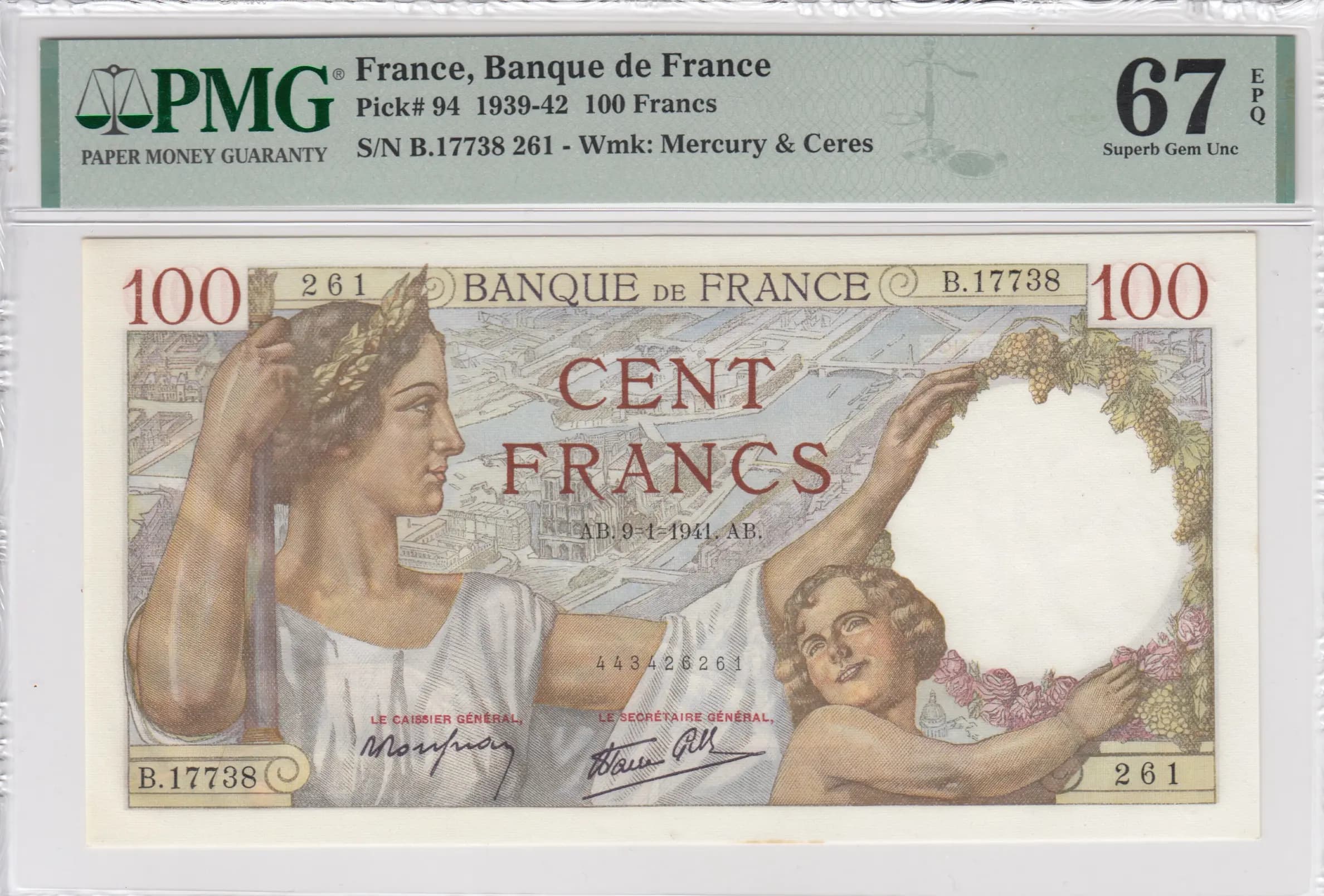
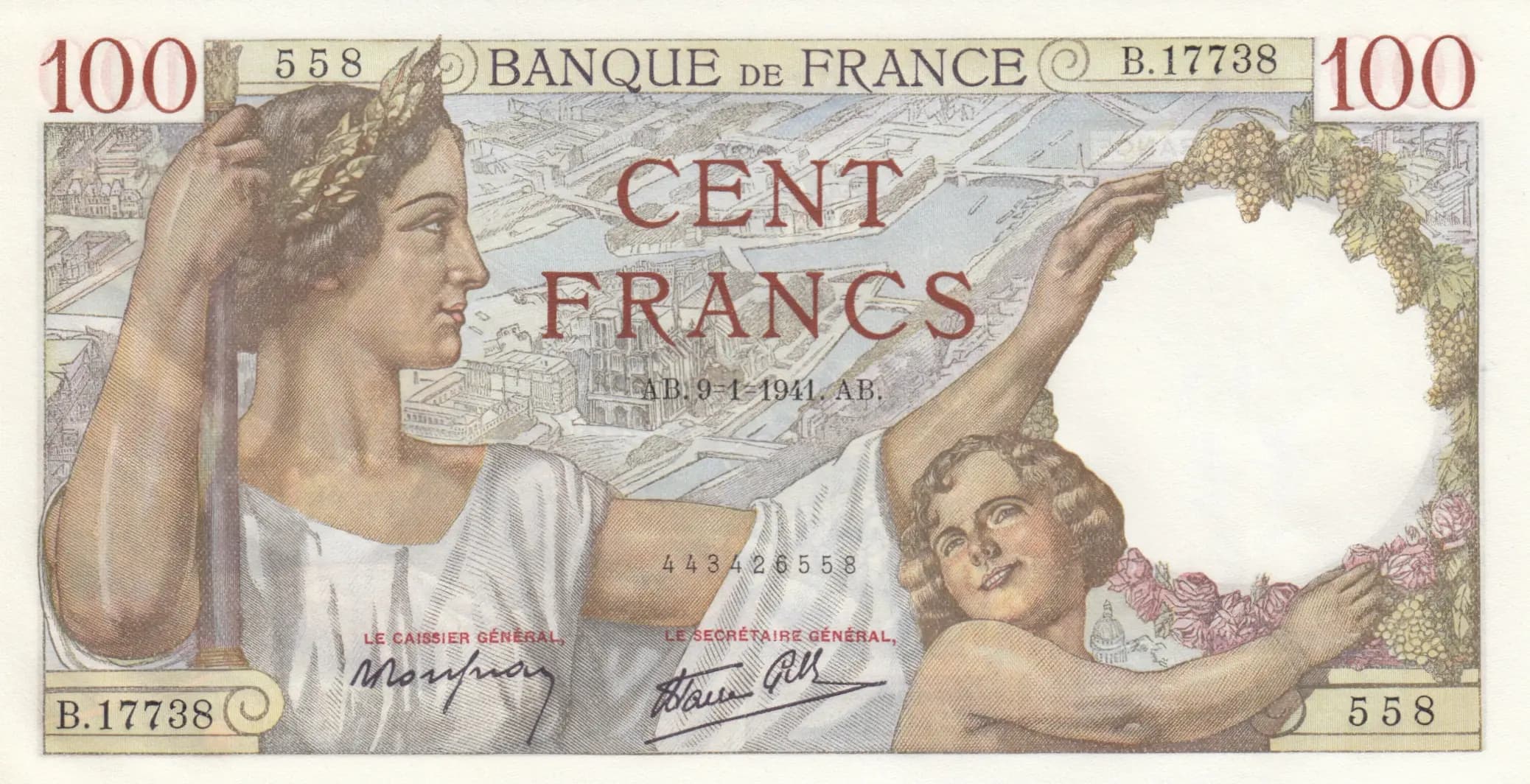
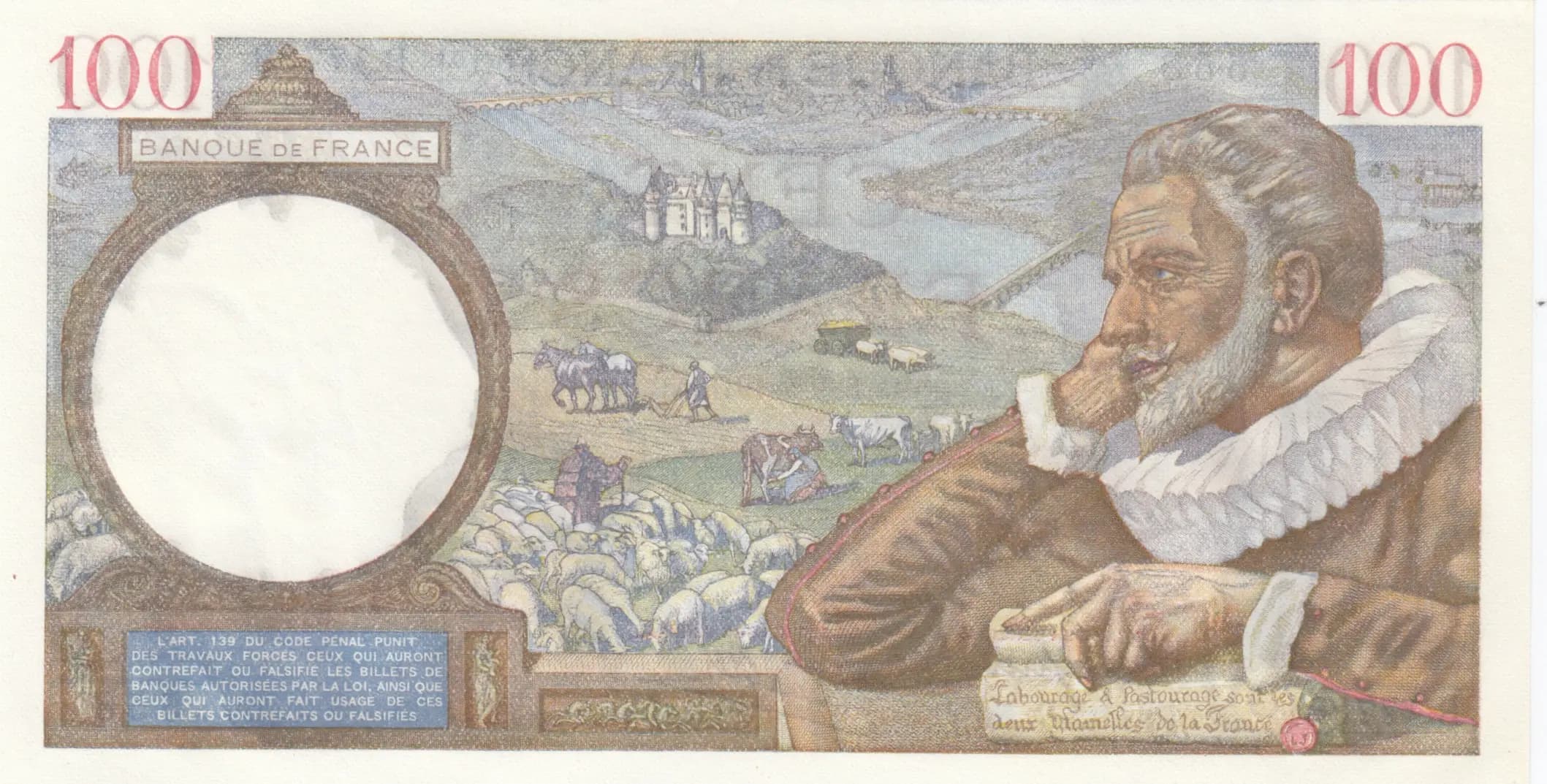
This is a 1941 French 100 Francs banknote (Pick P-94) in uncirculated condition, commonly known as the 'Sully' note among collectors. The obverse features a classical allegorical female figure in profile wearing a laurel wreath alongside a cherub holding grape vines, set against an architectural cityscape backdrop. The reverse depicts Maximilien de Béthune, Duc de Sully, in period dress with an elaborate landscape scene of the Loire Valley and Sully-sur-Loire Castle, representing France's pastoral wealth and feudal heritage.
Common. This note appears frequently in the secondary market with consistent, modest pricing across multiple condition grades spanning nearly two decades of eBay sales data. Regular UNC examples consistently sell between $13.80–$63.88, while PMG 65-66 examples range from $40–$117.50. The high frequency of sales, the broad price variation reflecting condition sensitivity rather than rarity, and the prevalence of this denomination from the 1939-1942 issue window all indicate substantial original production. No evidence of scarcity or recall status exists.
Issued during the Nazi occupation and Vichy regime period (1941), this banknote reflects the Banque de France's continued operation under extraordinary circumstances. The classical allegorical imagery—featuring idealized representations of France's cultural and agricultural heritage—served as nationalist iconography during a period of cultural reassertion. The choice to honor Sully, a 16th-17th century statesman and administrator, invoked historical continuity and administrative competence during a time of political upheaval.
The obverse presents a refined allegorical composition with a female figure representing France or Liberty, identifiable by her classical drapery and laurel wreath crown—symbols of victory and enlightenment. The accompanying putto (cherub) holding grape vines symbolizes abundance and France's agricultural prosperity. The background cityscape with detailed map elements references Paris and French urban sophistication. The reverse showcases Maximilien de Béthune, Duc de Sully (1559-1641), a distinguished statesman and minister under Henry IV, rendered in precise profile with period-appropriate clothing. Behind him unfolds an elaborate pastoral landscape encompassing the Loire Valley, with Sully-sur-Loire Castle prominently featured on a hilltop, surrounded by agricultural workers, livestock, and peasants engaged in traditional labor—evoking feudal prosperity and rural French identity. A large circular medallion on the left of the reverse remains blank, a design feature typical of this series.
FRONT: 'Banque de France' (Bank of France), 'Cent Francs' (One Hundred Francs), '9-1-1941. A.B.' (date and authorization mark), 'Le Caissier Général' (The General Cashier), 'Le Secrétaire Général' (The General Secretary), with signatures 'Marfinay' and 'Blan Allo'. Serial number: B.17738 / 4434265558. BACK: 'Banque de France' (Bank of France), 'L'Art. 139 du Code Pénal punit des travaux forcés ceux qui auraient contrefait ou falsifié les billets de banques autorisées par la loi, ainsi que ceux qui auraient fait usage de ces billets contrefaits ou falsifiés' (Article 139 of the Penal Code punishes with forced labor those who would counterfeit or falsify banknotes authorized by law, as well as those who make use of such counterfeit or falsified notes), signature 'Laboureur', and reference to 'Deux Vignettes de la Gloire' (Two Vignettes of Glory).
Intaglio (copperplate) engraving, the standard banknote security printing technique of the era. The fine line patterns, detailed background work, multiple color layering, and precise figural rendering are characteristic of high-security intaglio production. The Banque de France employed its own engraving and printing facilities for this series, known for meticulous craftsmanship. The complexity of the landscape background and portrait detail indicates work by skilled master engravers.
This specific example is dated 9-1-1941 (January 9, 1941) with serial number prefix B.17738 and full serial 4434265558. Signatures are 'Marfinay' (General Cashier) and 'Blan Allo' (General Secretary). The 'A.B.' authorization mark appears on the obverse. Signature combinations and date ranges are known varieties within the P-94 series; later dates (1942) and variant signature pairs exist. No exceptional overprints or error features are apparent on this example.