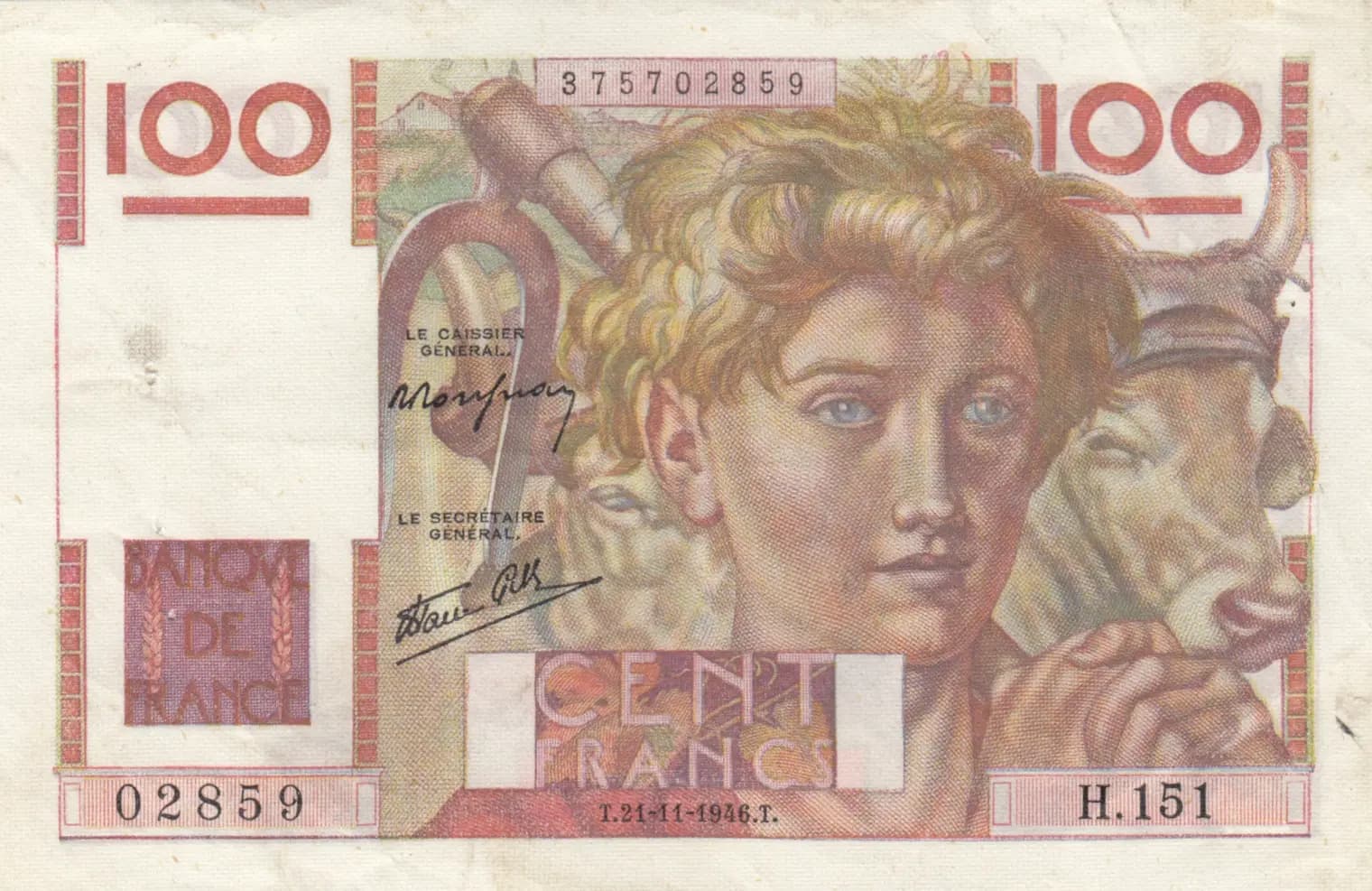
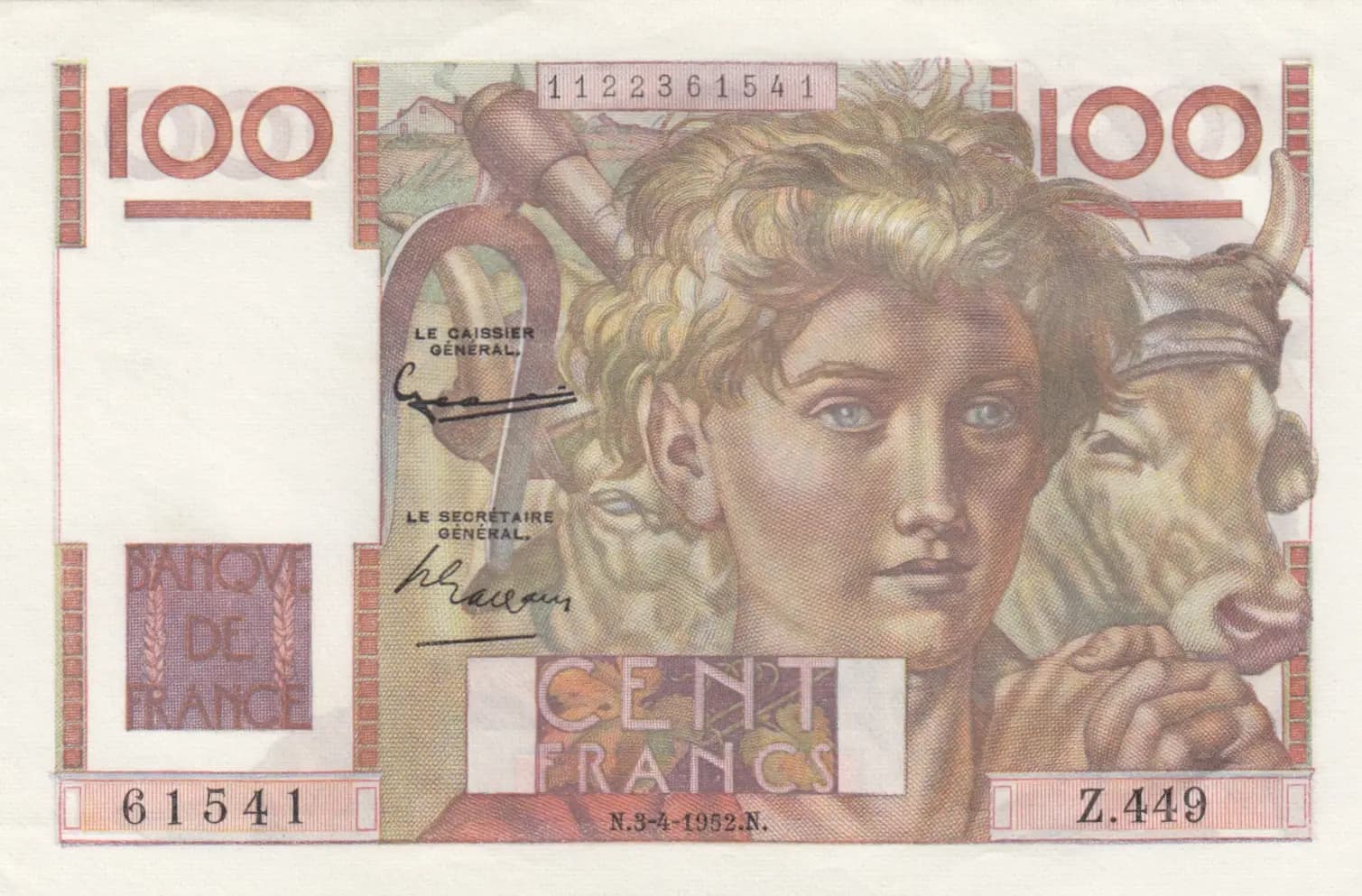
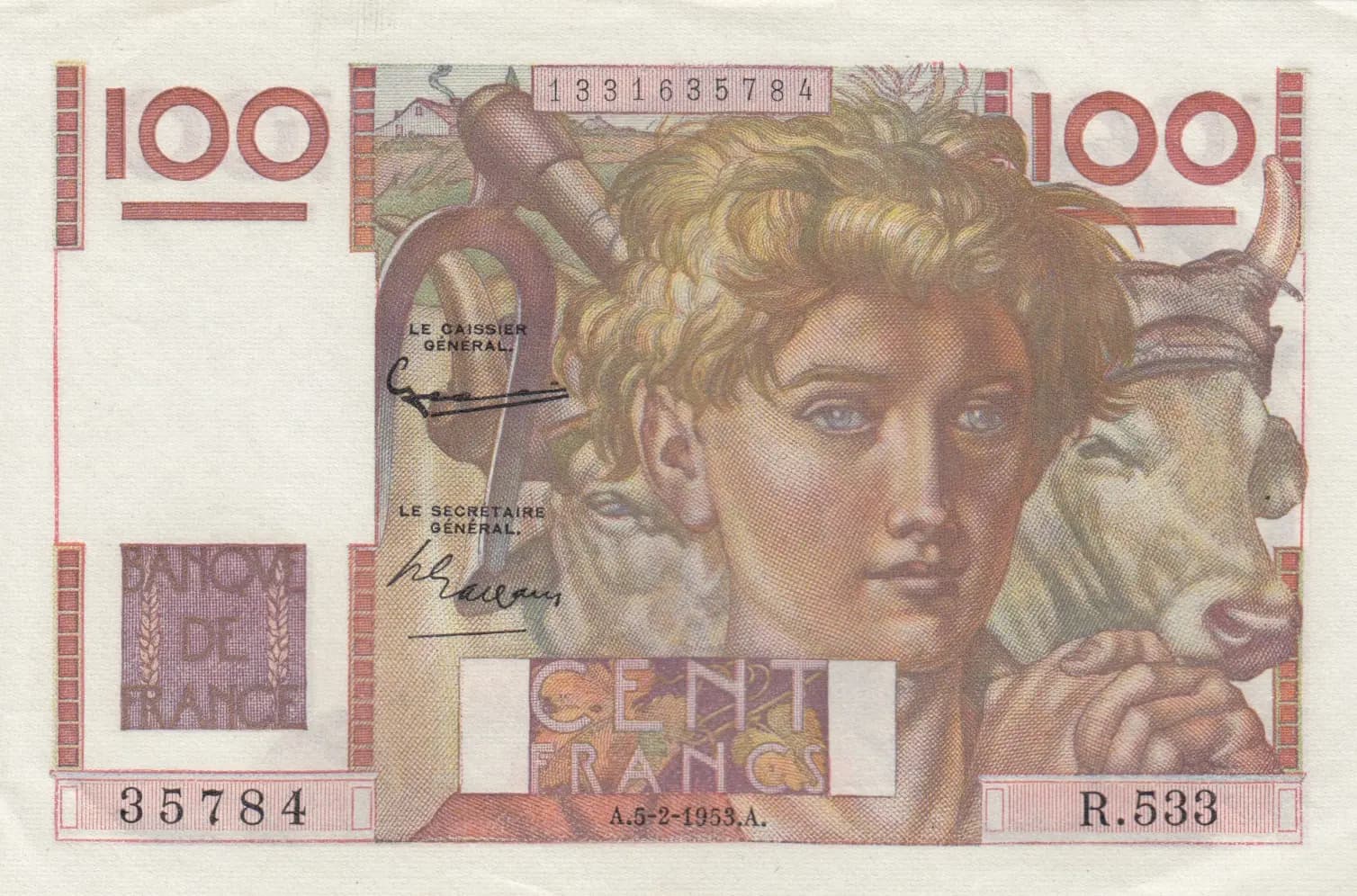
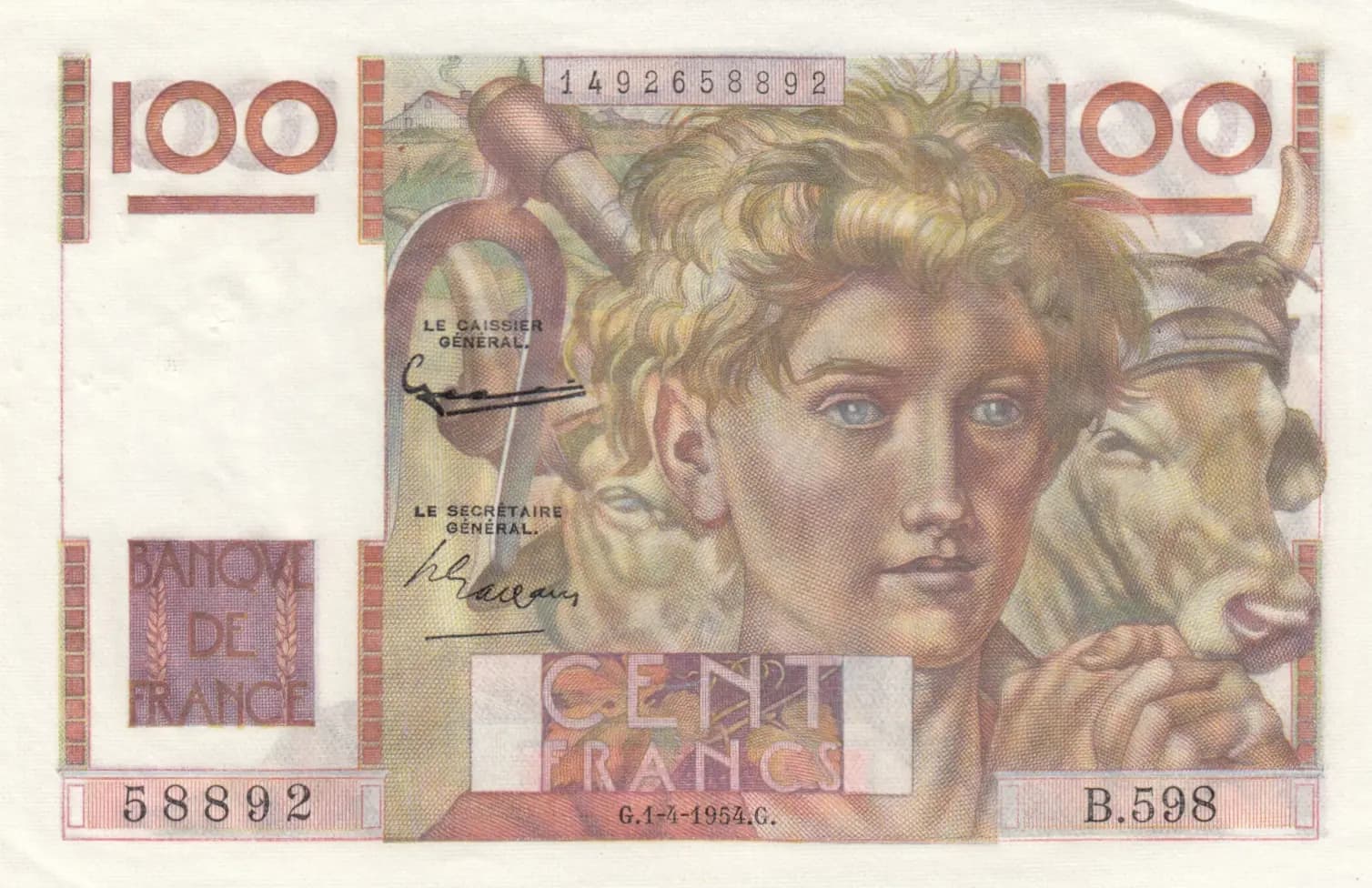
100 francs 1949
Market Prices
26 salesAbout This Note
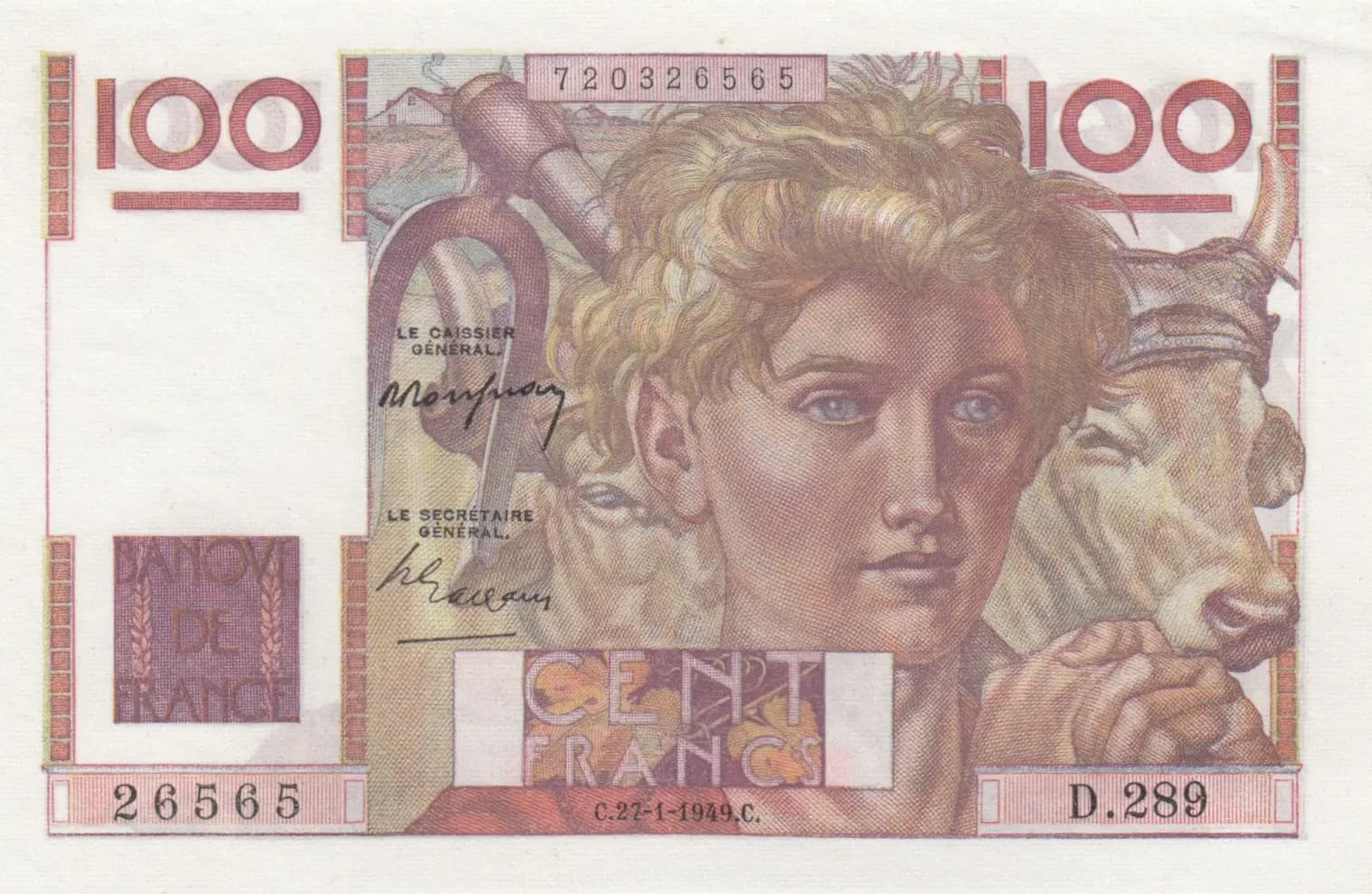
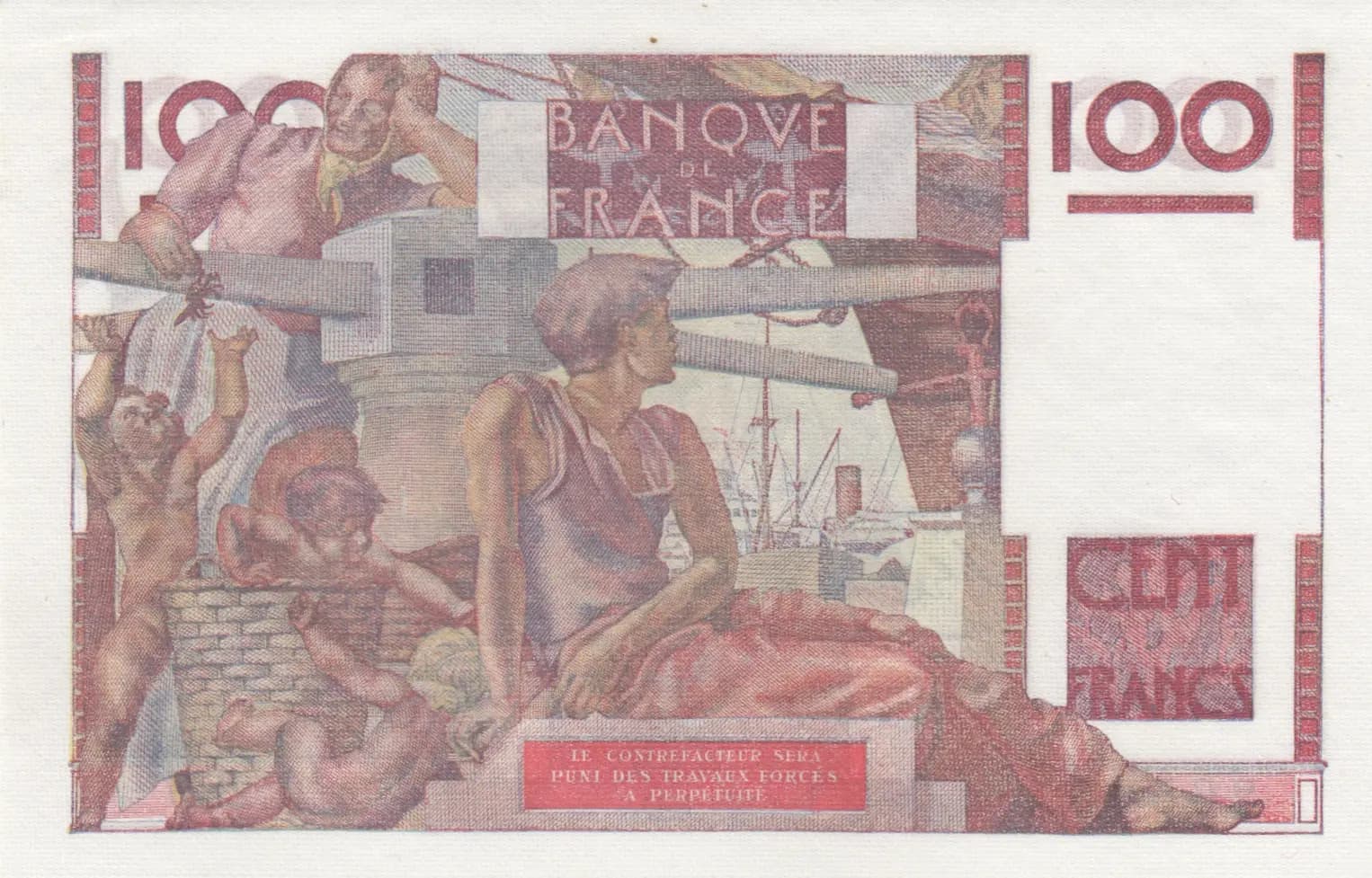
This is a spectacular example of the 1949 French 100 francs (Pick-128b) in AU condition, featuring the iconic allegorical design that represents post-war French recovery and commerce. The obverse displays three classical male figures rendered in elegant purple, pink, and beige tones with sharp engraving, while the reverse depicts a dynamic maritime and labor scene complete with a multi-masted sailing ship, symbolizing France's economic revival. The note shows virtually no circulation wear, with crisp details and excellent color preservation, making it an attractive specimen for collectors of French currency or post-war European issues.
Common. While this note is aesthetically significant and historically important, it was issued in substantial quantities during 1947-1949 and remains readily available in the numismatic market. eBay transaction data shows consistent sales activity across all condition grades from F (Fine) to UNC, with 2024 prices for PMG-graded examples ranging from $31-$130 depending on grade. The 2016 catalog value of $85 for UNC specimens and the robust trading history indicate strong collector demand but abundant supply. No evidence of scarcity exists—this is a standard circulation issue from a major central bank during the post-war period when large quantities were produced to support France's economic activities.
Issued by the Banque de France in 1947 but dated through May 1949, this note represents the immediate post-World War II period when France was rebuilding its economy and national identity. The allegorical imagery—classical male figures on the obverse and the labor/maritime scene on the reverse featuring industrial workers and a sailing vessel—deliberately celebrate French commerce, industry, and maritime trade as symbols of national recovery and modernization during the Fourth Republic. The design's emphasis on productive labor and seafaring reflects the government's focus on reconstruction and France's role in international commerce during the early Cold War era.
The obverse features three allegorical male figures in classical style, representing virtues or abstract concepts central to French identity—likely depicting Commerce, Industry, and Agriculture or similar concepts. The central figure with curled blonde hair dominates the composition, flanked by two additional male figures with darker and lighter features respectively. The reverse depicts an elaborate allegorical scene of Labor and Maritime Commerce, showing multiple figures engaged in work activities with a prominent multi-masted sailing ship in the background, symbolizing international trade. Additional industrial or maritime structures appear throughout the composition. Both sides are framed by ornate rectangular borders with decorative geometric patterns, particularly notable on the left margins. The color palette of muted purples, pinks, and beige tones gives the note a sophisticated, post-war modernist aesthetic. Fine line engraving throughout creates intricate detail and serves as a security feature.
OBVERSE: '100' and 'CENT FRANCS' (One Hundred Francs) appear as primary denomination markers. 'LE CASSIER GENERAL' (The General Cashier) and 'LE SECRETAIRE GENERAL' (The General Secretary) are signature authority lines. 'C.27-1-1949.C.' indicates the production date (January 27, 1949). Serial numbers '72032656' and related sequences identify the individual note. 'D.289' indicates the printer/plate mark. REVERSE: 'BANQUE DE FRANCE' (Bank of France) identifies the issuing authority. 'LE CONTREFACTEUR SERA PUNI DES TRAVAUX FORCES A PERPETUITE' (The counterfeiter will be punished with forced labor in perpetuity) is the standard anti-counterfeiting warning. The denomination '100' appears in large numerals on both left and right margins of both sides.
This note was produced using intaglio engraving (steel plate engraving), the standard security printing method for high-value banknotes of the era. The fine line work visible throughout the design, the sharp portrait details, and the complex allegorical compositions are characteristic of intaglio production. The Banque de France employed state-of-the-art security printers for this series; the 'D.289' marking indicates the specific printer plate used. The precision of the serial numbers, signatures, and security elements—including the watermark (woman with hair parted on her left, visible in the watermark area)—reflects the advanced engraving and security printing standards of the Banque de France during the late 1940s.
The specific variety can be identified by the date code 'C.27-1-1949.C.' (January 27, 1949) and serial number prefix patterns. Pick-128b denotes this as a known variety within the 100 francs 1947-1949 series; the 'b' designation typically indicates a specific signature, date range, or printing variation compared to the 'a' variety. The serial number '72032656' with the secondary portion '26565' and the D.289 printer mark help establish the specific printing run. Collectors should note variations in signature combinations for 'LE CASSIER GENERAL' and 'LE SECRETAIRE GENERAL' positions, which changed periodically during this issue's production run. The watermark featuring a woman with hair parted on her left is consistent across all 128-series varieties.