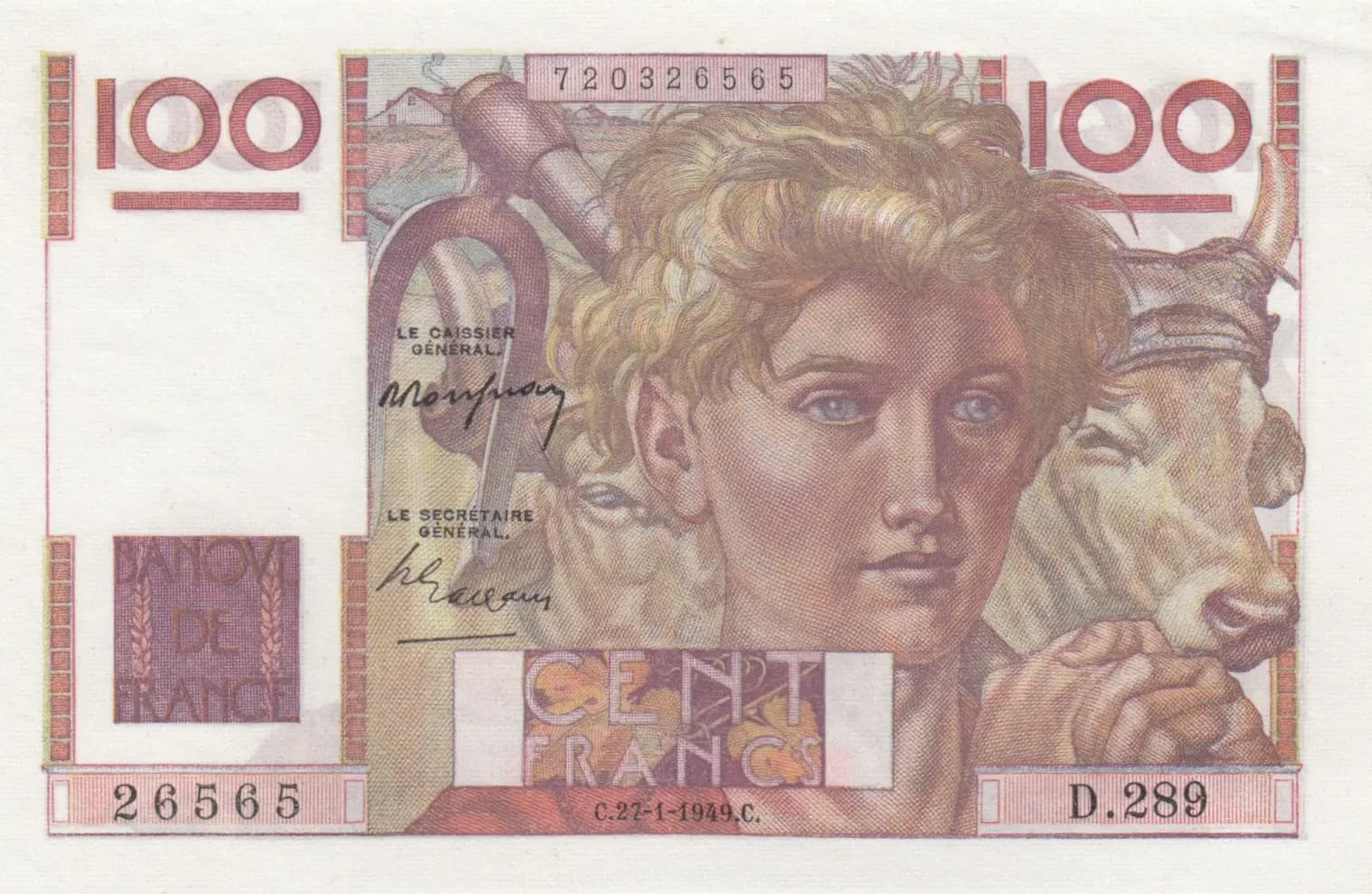
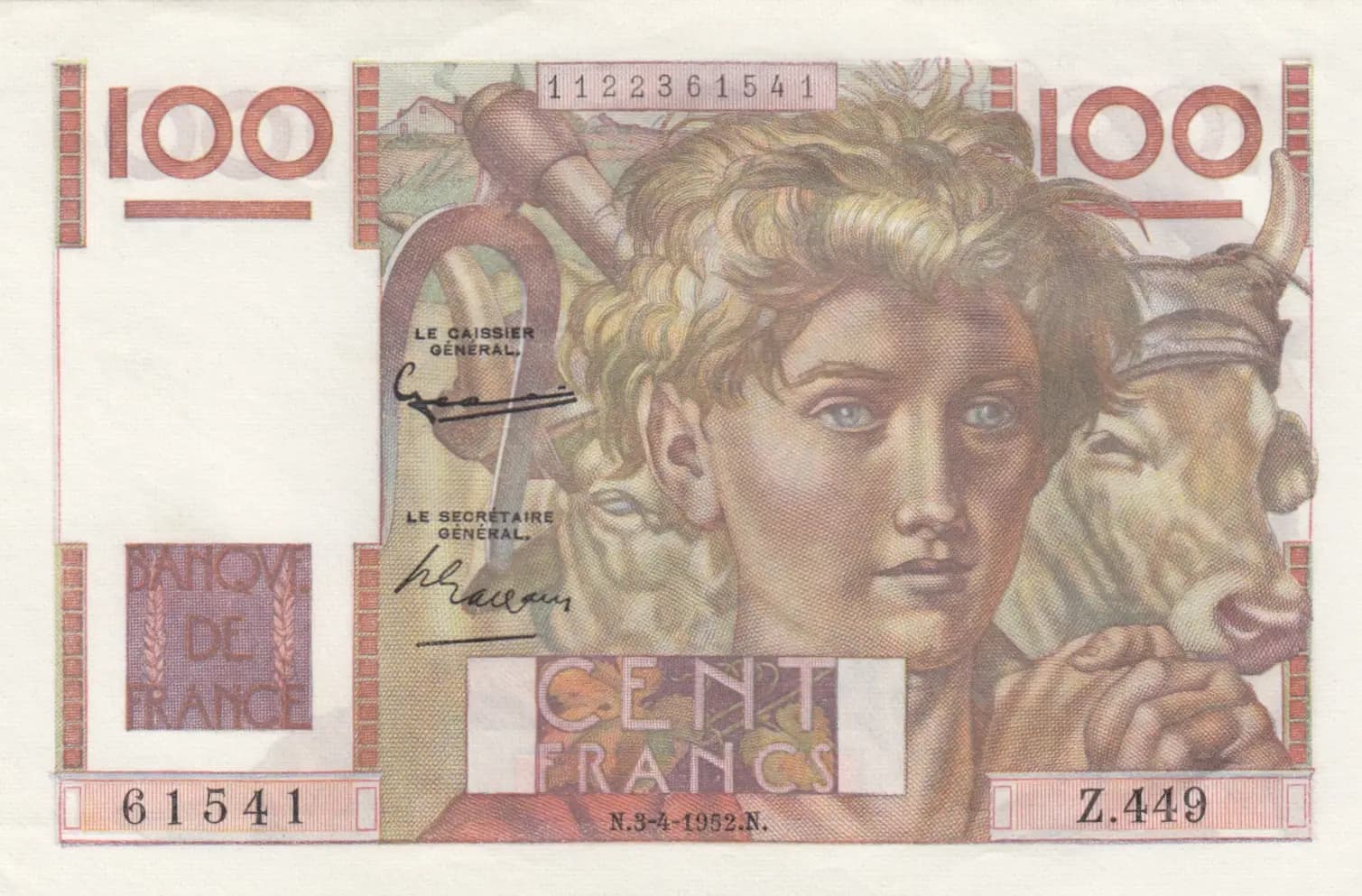
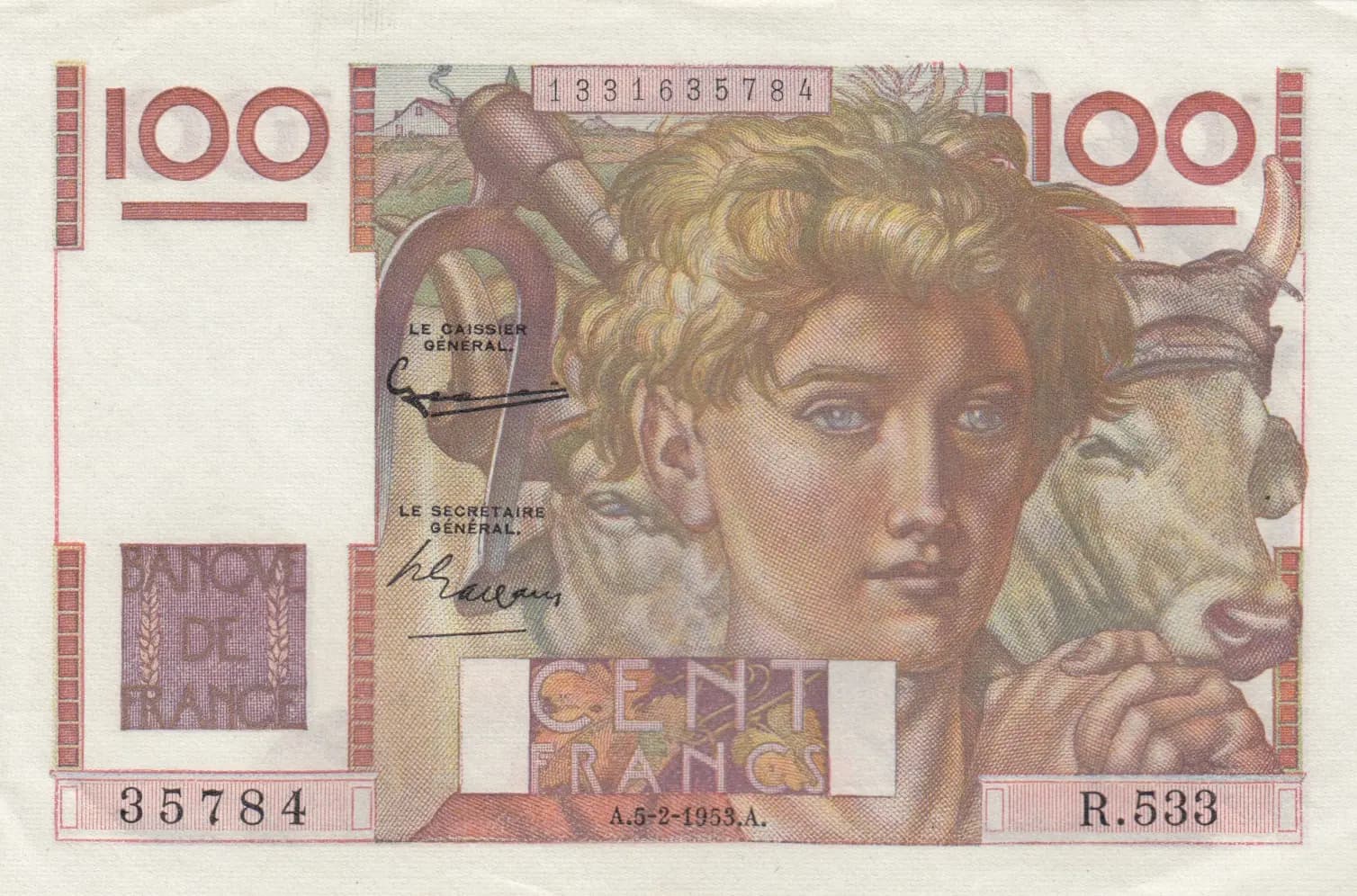
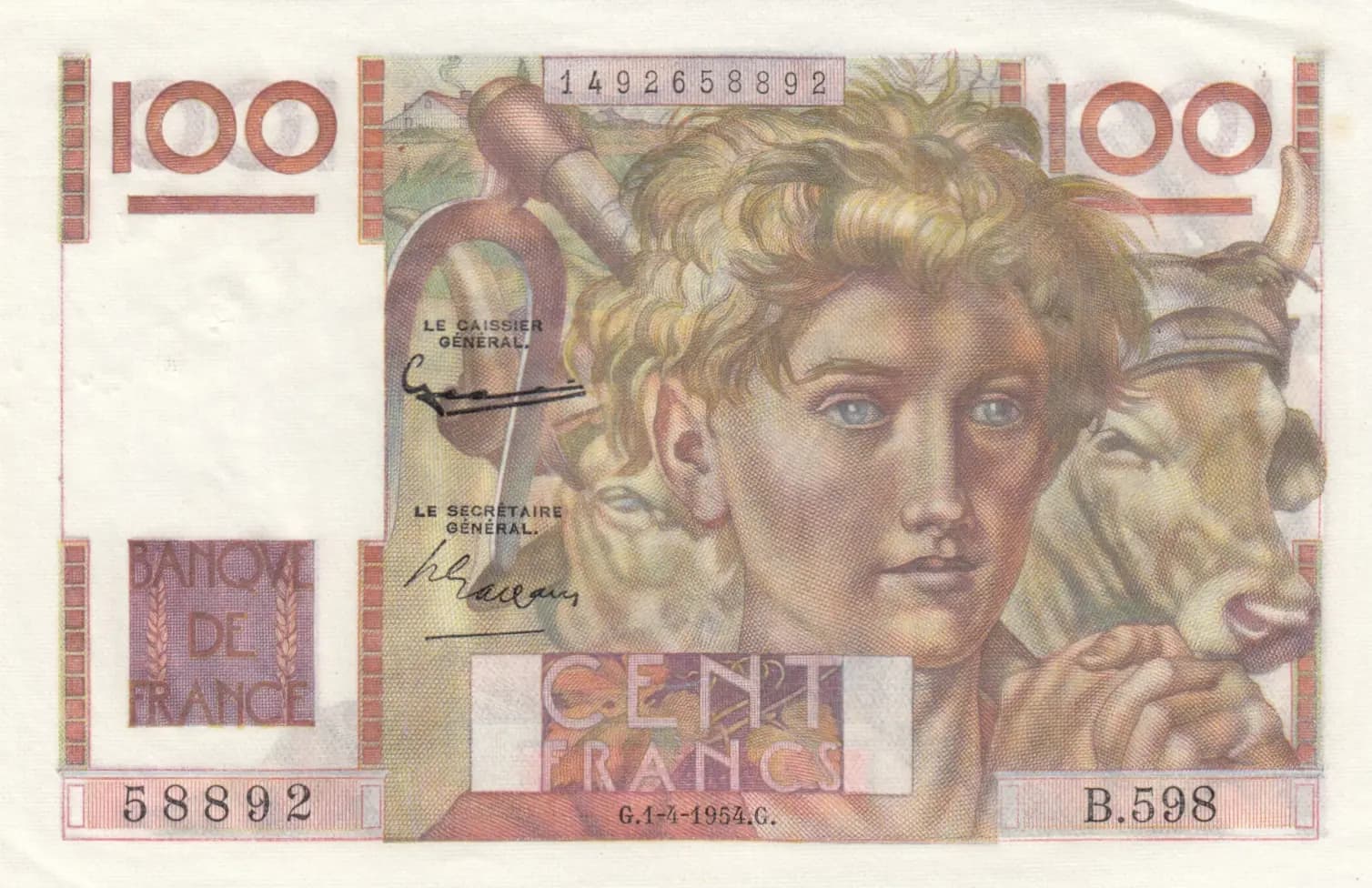
100 francs 1946
Market Prices
23 salesAbout This Note
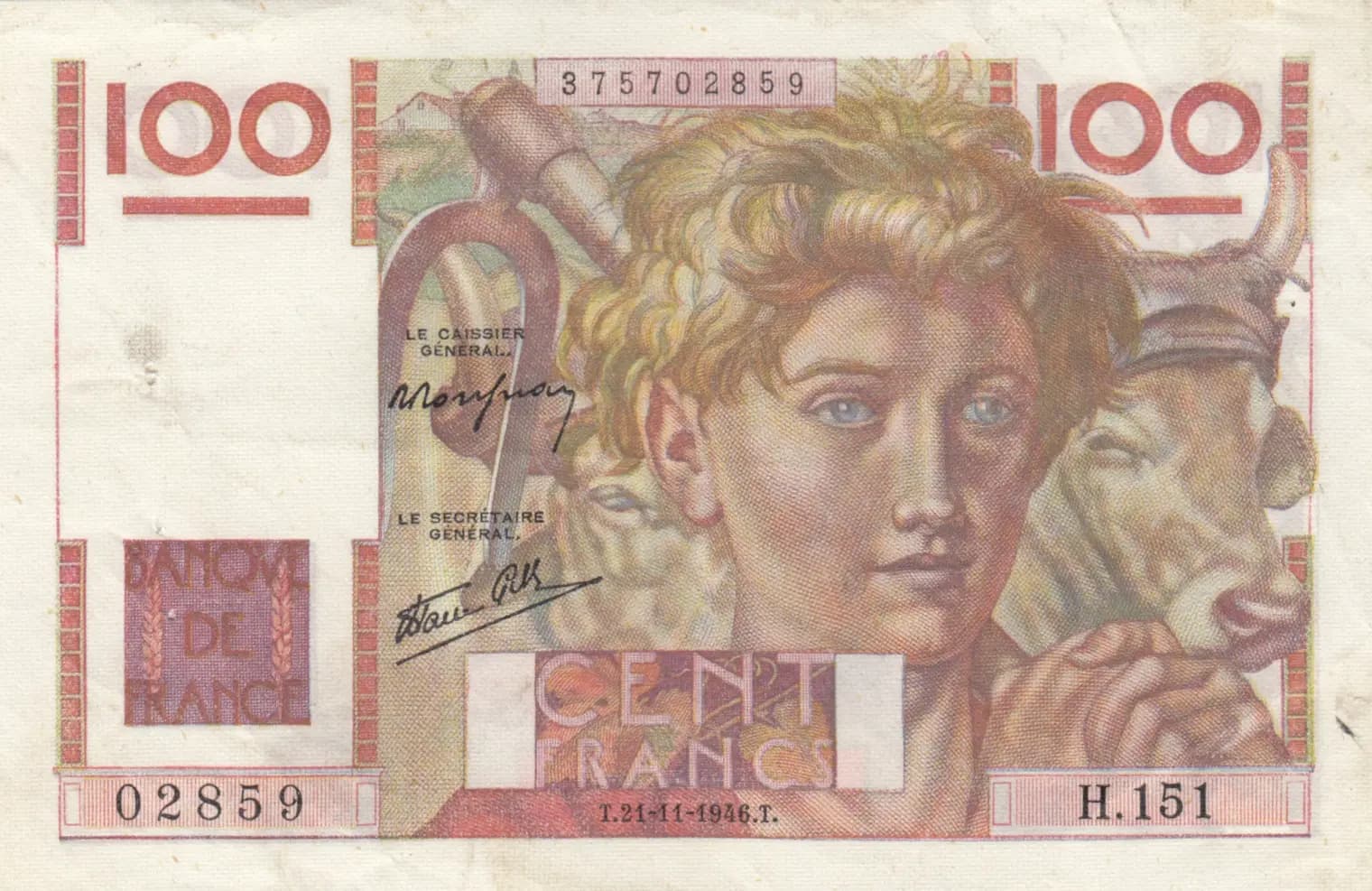
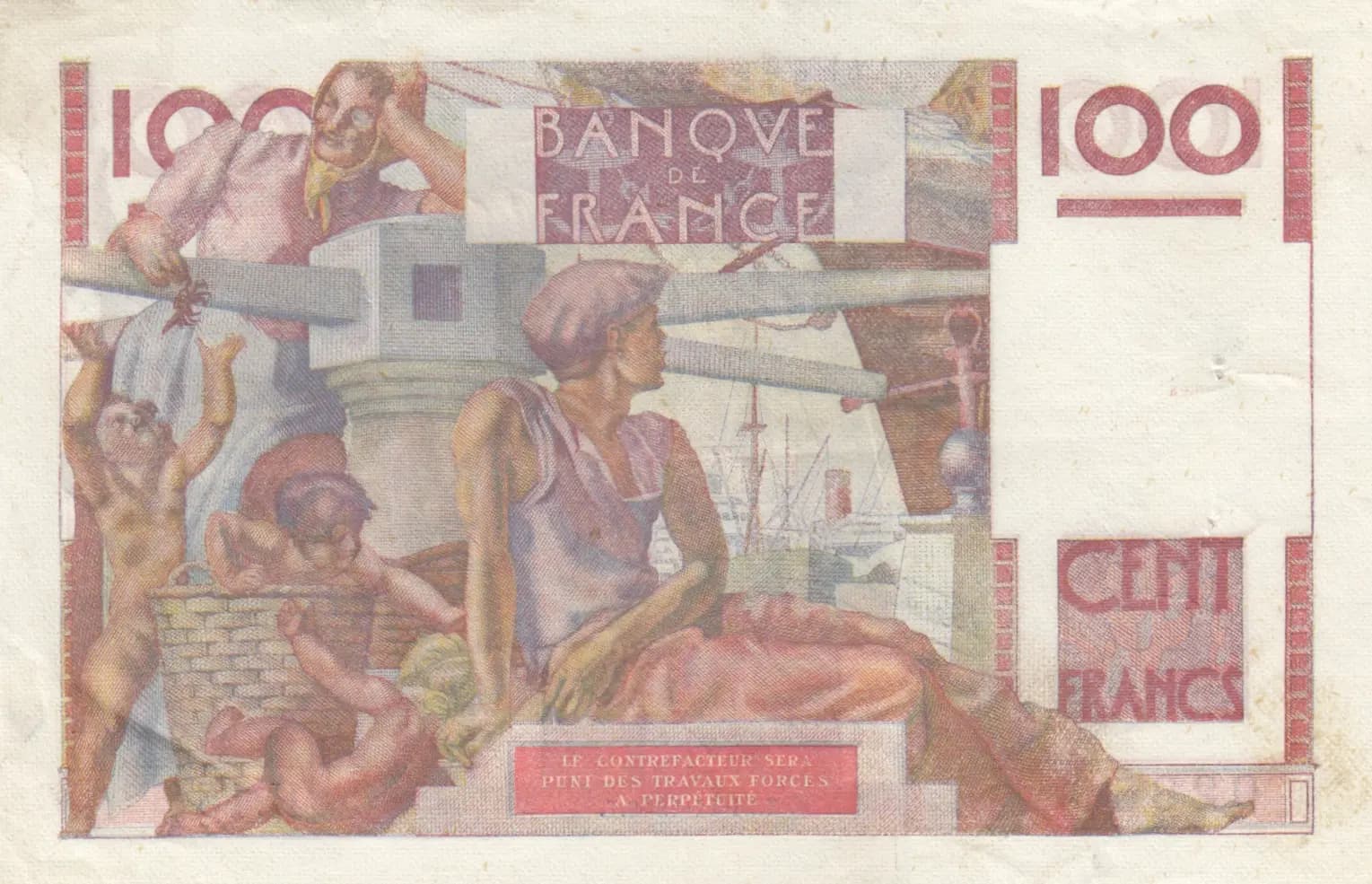
This 100 francs banknote from 1946 presents a fine example of post-World War II French currency featuring classical allegorical imagery characteristic of Banque de France designs from this period. The VF-graded specimen displays the aging patina typical of nearly 80-year-old paper currency, with visible foxing and creasing, yet maintains good clarity of the intricate engraved details on both obverse and reverse sides. The multicolor composition and detailed security printing reflect France's effort to establish monetary stability following the liberation and occupation period.
Common. This is a regular issue banknote with substantial print runs from 1945-1947. The eBay price history provided confirms common circulation status: VF specimens consistently sell in the $5-8 range (with outliers reaching higher prices for graded/exceptional examples), and the 2016 catalog value for VF grade is $10.50. Over 25 documented sales at various grades spanning 2010-2025 demonstrate regular market availability. There are no documented print run restrictions, special commemorative status, or early withdrawal that would classify this as scarce or rare.
Issued in late 1946 (specifically dated 21 November 1946 per visible inscription), this note represents the immediate post-WWII reconstruction period when France was reasserting its economic and political sovereignty. The classical allegorical imagery on the reverse—depicting commerce, maritime trade, and prosperity with cherubs and classical figures—reflects the optimistic iconography the Banque de France employed to project confidence and stability during post-war currency reform. The prominent warning against counterfeiting inscribed on the reverse underscores the security concerns of a nation rebuilding its monetary infrastructure.
The obverse features three classical male portrait heads in allegorical style, arranged on the right portion of the note, rendered in the neoclassical engraving tradition characteristic of 19th-century currency design. These heads, with their curled hair and period features, represent abstract concepts of authority and civilization. The reverse presents a complex allegorical scene of maritime commerce and prosperity, with a central classical female figure (representing France or Commerce) surrounded by male figures and multiple cherubim (putti), with sailing ships visible in the background suggesting international trade and economic recovery. The color palette of red, blue, green, and sepia tones demonstrates sophisticated multicolor intaglio printing. The decorative borders in red and the rectangular frame elements provide additional security through their fine detail and complexity. The watermark features a woman's profile with hair parted on her left, a common security feature of Banque de France notes from this era.
FRONT SIDE: '100' (denomination in numerals); 'BANQUE DE FRANCE' (Bank of France); 'LE CAISSIER GENERAL' (Chief Cashier General); 'LE SECRETAIRE GENERAL' (General Secretary); 'CENT FRANCS' (One Hundred Francs in text); 'H.151' (series/signature identifier); 'T.21-11-1946.T.' (issue date, 21 November 1946); signatures of 'Morflou' and 'Boisel' (authorized officials); serial number '375702859'. REVERSE SIDE: '100' (denomination); 'BANQUE DE FRANCE' (Bank of France); 'CENT FRANCS' (One Hundred Francs); 'LE CONTREFACTEUR SERA D'UNI DES TRAVAUX FORCES A PERPETUITE' (The counterfeiter shall be subject to forced labor in perpetuity—legal warning).
Intaglio engraving (taille-douce) with multicolor printing. The fine detail visible in both the classical portrait heads and the elaborate allegorical reverse scene indicates professional security printing typical of Banque de France production. The complexity of the border patterns, the precision of the allegorical composition, and the successful overprinting of multiple colors demonstrate advanced printing capability. This note was produced by Banque de France's authorized security printers during the immediate post-war period.
This specimen is identified as Pick 128a, the standard 1946 issue. The visible signatures of Morflou and Boisel, the date notation of 21-11-1946, and the series identifier 'H.151' represent standard production variants from this printing period. The serial number prefix and signature combinations indicate this is from the regular production run rather than any special issue or replacement note variety. No replacement notes, experimental variants, or color varieties are documented for this Pick number.