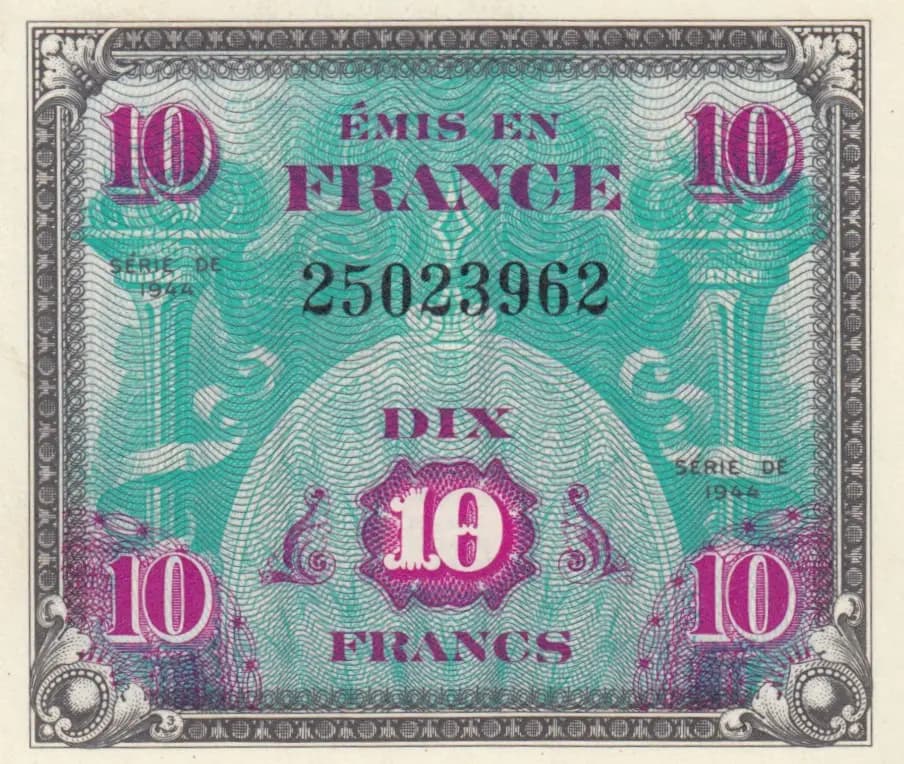
10 francs 1944
Market Prices
76 salesAbout This Note
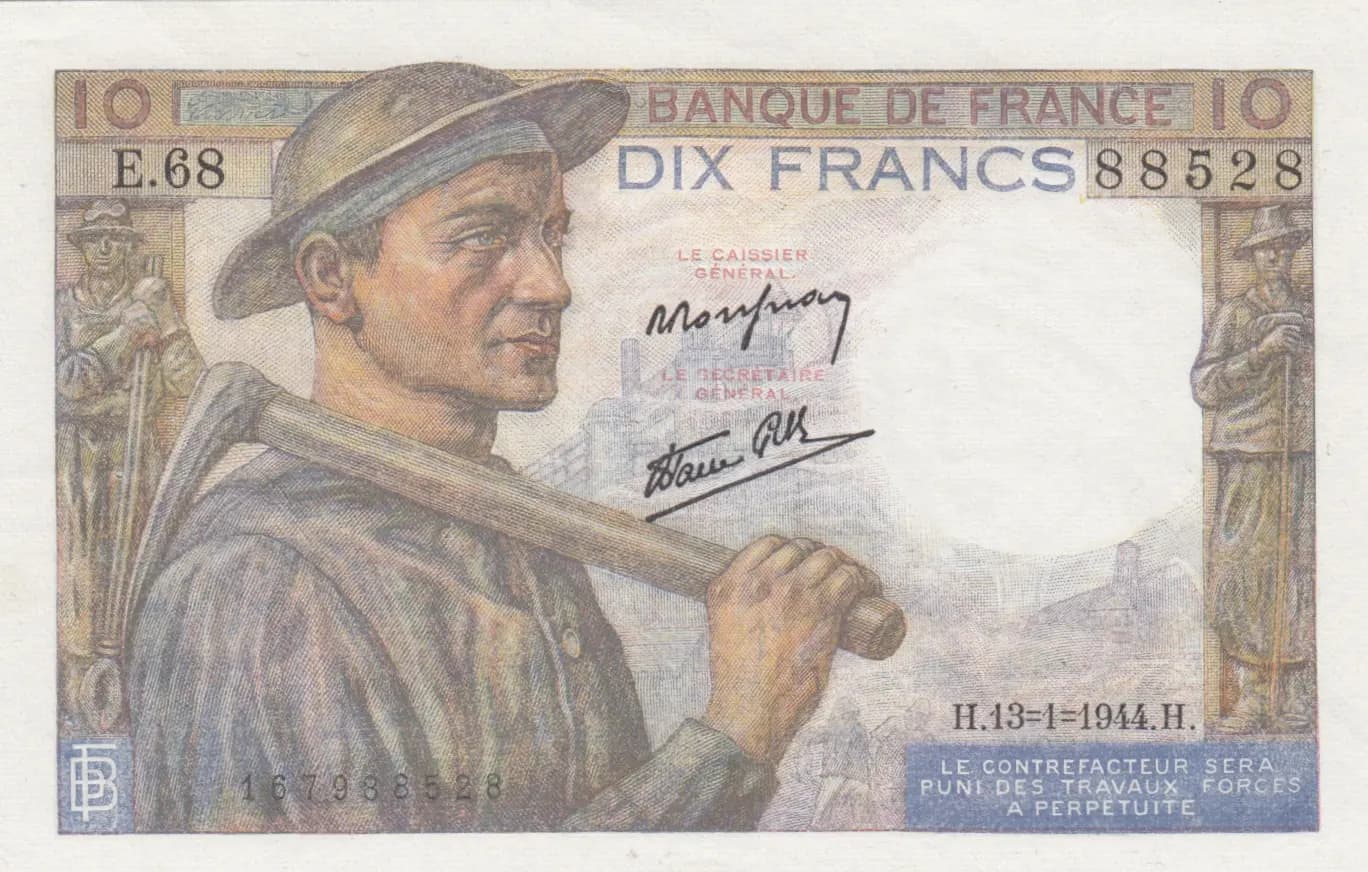
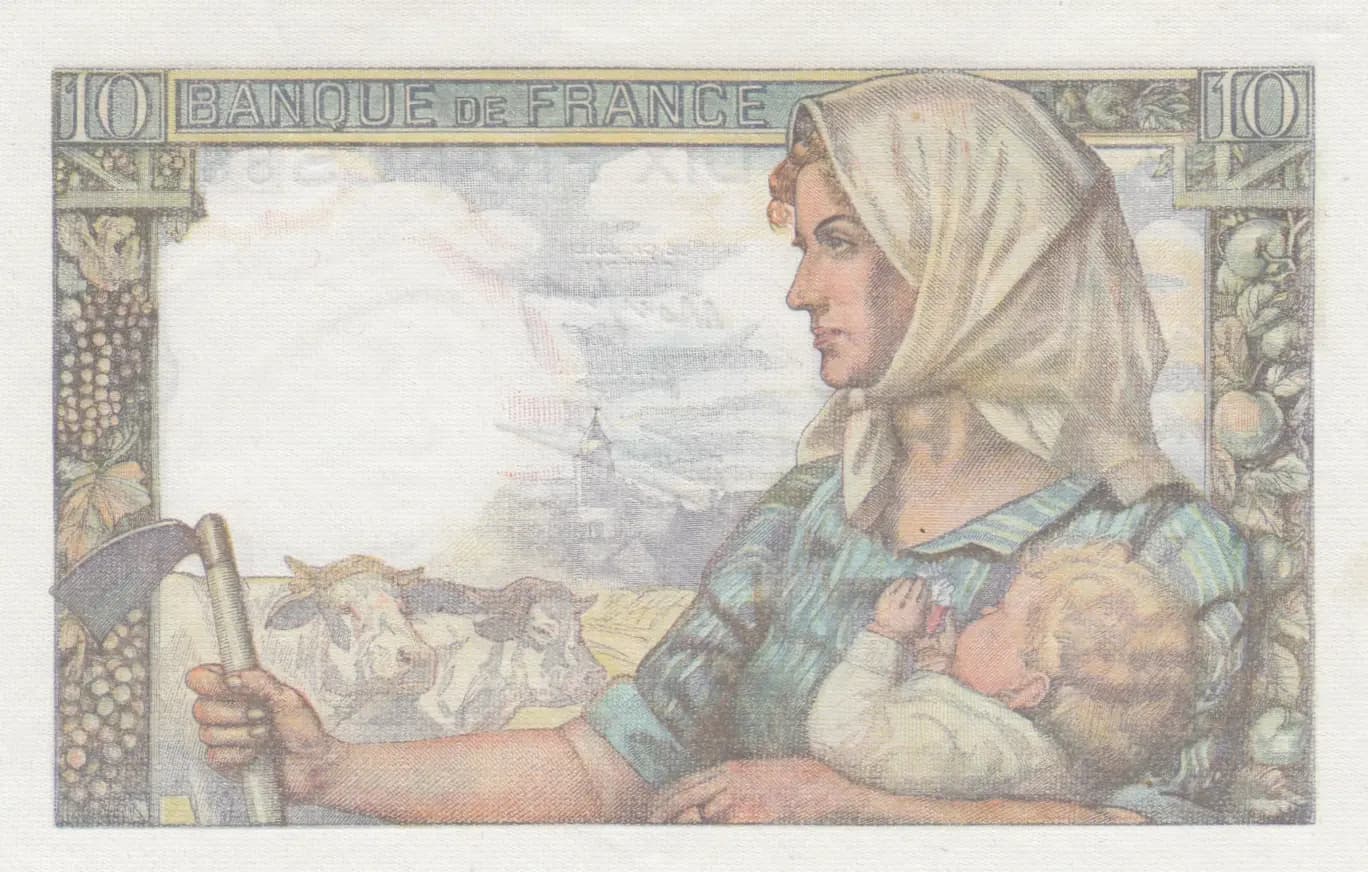
This is a 1944 French 10 Francs banknote (Pick P-99e) featuring the iconic 'Mineur' (Miner) design, presented in Uncirculated condition. The obverse displays a portrait of a male laborer in profile wearing a cap and work clothes, holding a tool across his shoulder, while the reverse depicts a peasant woman in a bonnet nursing a child with rural pastoral landscape elements. Despite showing some age-related creasing and subtle discoloration consistent with 80-year storage, the note retains excellent visual clarity with sharp engraving details throughout, making it an attractive example of Vichy-era French currency.
Common. The eBay sales data provided shows this note selling consistently in the $30–90 range depending on grade, with hundreds of documented transactions spanning over a decade. UNC examples have sold as recently as 2023 for ~$50, and 2016 for $89.77, indicating steady but not strong demand. Print runs for the 1944 issue were substantial, and examples remain readily available in the market. The P-99e variant is one of four documented varieties for this base Pick number, and none are indicated as scarce in professional grading population reports.
This note was issued during the German occupation of France and represents the Vichy regime's banking continuity under the Banque de France. The imagery deliberately emphasizes French rural and industrial labor—the miner and peasant woman—reflecting the Vichy government's ideological focus on 'Travail, Famille, Patrie' (Work, Family, Fatherland) and the glorification of manual labor and agrarian values. The 1944 date marking confirms this note's circulation during the final year of occupation before Liberation, making it a significant artifact of this complex period in French monetary history.
The obverse features a three-quarter profile portrait of a male miner or industrial laborer facing right, distinguished by his work cap and sturdy clothing, holding a tool (likely a pickaxe or similar implement) diagonally across his shoulder. A distant landscape provides subtle background depth. Classical allegorical figures adorn the left and right borders, providing ornamental framing typical of Belle Époque banknote design. The reverse depicts a peasant woman (representing France's agrarian heritage) in profile facing right, wearing a traditional white bonnet and holding agricultural implements while nursing or cradling an infant—symbolizing fertility, family, and continuity. A rural pastoral landscape with fields and a distant church structure anchors the composition. Decorative borders feature grapevine motifs on the left and classical ornamental elements on the right, reinforcing the agricultural theme. The color palette—browns, tans, greens, and creams—evokes earth and harvest imagery throughout.
FRONT: 'BANQUE DE FRANCE' (Bank of France) / 'DIX FRANCS' (Ten Francs) / 'E.68' (Series designation) / '88528' (Serial number) / 'LE CAISSIER GÉNÉRAL' (The General Cashier) / 'LE SECRÉTAIRE GÉNÉRAL' (The General Secretary) / 'H.13=1=1944.H.' (Date designation: 1944) / 'LE CONTREFACTEUR SERA PUNI DES TRAVAUX FORCÉS À PERPÉTUITÉ' (Counterfeiting will be punished by forced labor for life) / '4698852' (Serial number) / Signatures of 'Morgang' (General Cashier) and 'Jdan ou' (General Secretary). BACK: 'BANQUE DE FRANCE' (Bank of France) / '10' (Ten).
This note was produced using traditional steel-engraved intaglio printing, the standard security-printing method for French banknotes of this era. The Banque de France contracted with the Imprimerie Nationale for most issues of this period. The intricate engraved designs, fine-line work in borders and backgrounds, subtle tonal gradations, and sharp portrait definition are characteristic of high-quality intaglio production. Security features include multiple serial numbers in different locations, elaborate ornamental borders with fine detail work, and multiple signature lines for authentication purposes.
This note is cataloged as Pick P-99e, one of four variants (P-99b, P-99c, P-99e, P-99f) issued between 1941–1949, all featuring the Joan of Arc watermark. The visual analysis confirms the date marking as 'H.13=1=1944.H.' (1944 issue), with series designation 'E.68' and serial number '88528' on the obverse. The signatures visible are 'Morgang' (Le Caissier Général) and 'Jdan ou' (Le Secrétaire Général). The 'B' circlet symbol observed on the lower left of the obverse is consistent with Banque de France currency of this period. Without access to comprehensive variety catalogs distinguishing the P-99 sub-variants by signature or printer mark, the specific diagnostic features that differentiate P-99e from P-99b, P-99c, and P-99f cannot be definitively confirmed from the images alone; however, the catalog assignment is accepted as provided.