25 penniä 1918
Market Prices
21 salesAbout This Note
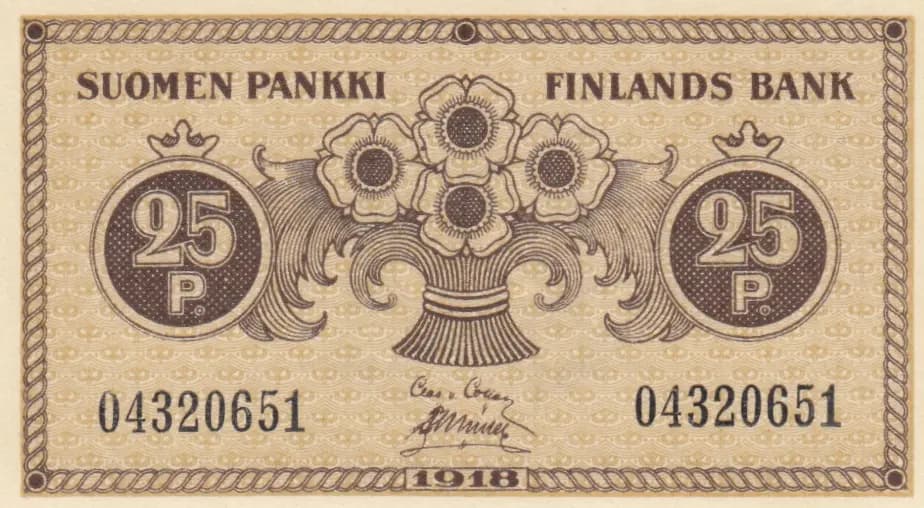
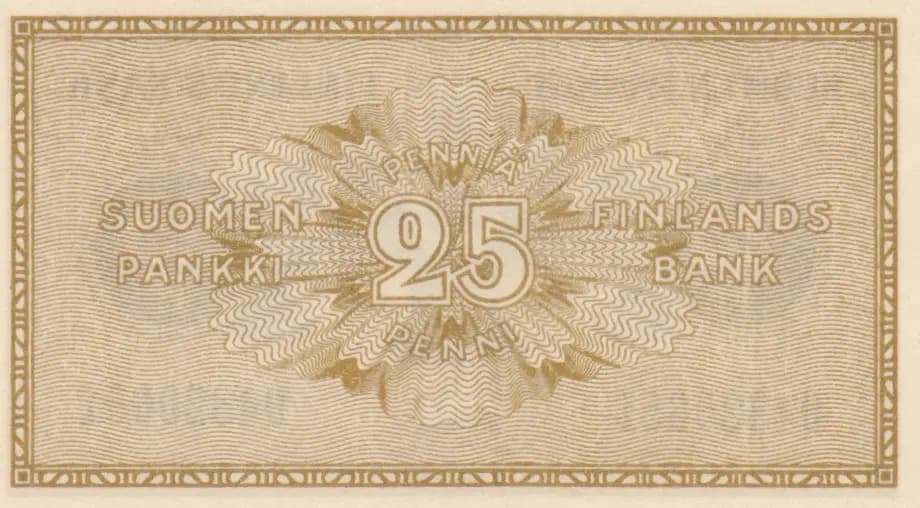
This 1918 Finnish 25 Penniä note from Suomen Pankki is presented in uncirculated condition with pristine paper quality and no visible wear, creasing, or foxing. The note features an elegant Art Nouveau-influenced design with a distinctive floral basket on the obverse and an intricate rosette pattern on the reverse, both rendered in fine intaglio printing with warm brown and purple tones on a cream background. As an early independence-era Finnish banknote issued shortly after independence from Russia, this denomination represents an important chapter in Finnish monetary history, and its exceptional preservation enhances its appeal to collectors of early Nordic currency.
Common. The eBay sales data provided shows consistent pricing well under $20 for uncirculated examples ($11.50 and $10.50 in 2019-2020), with even certified PMG specimens at PMG 64-66 levels averaging $21-29. This indicates healthy supply and regular dealer availability. The 1918 25 Penniä was part of Finland's standard early circulation series with presumably significant print runs to support commercial transactions. While early, it is not scarce in numismatic market terms.
The 25 Penniä note of 1918 was issued by Suomen Pankki (Bank of Finland) during Finland's first year of independence following the Russian Revolution and the Finnish Declaration of Independence in December 1917. The deliberately civilian ornamental design—featuring flora and geometric patterns rather than imperial imagery—reflects Finland's rejection of Czarist symbolism, notably the absence of any eagle or imperial insignia that would have appeared on earlier Russian-controlled currency. The dual-language inscriptions in Finnish and Swedish reflect the nation's bilingual heritage and the central role of both languages in the new Finnish state's identity.
The obverse features a centralized floral basket arrangement containing four stylized flowers rendered in fine detail, symbolizing Finnish nature and national identity rather than historical figures or landmarks. This design is framed by two circular denomination medallions bearing '25 P' on the left and right sides, with ornamental scrollwork and flourishes throughout. A decorative rope border frames the entire composition. The reverse presents a large central rosette or sunburst design—a classical ornamental motif—surrounded by an elaborate field of parallel wavy lines serving as both decorative and anti-counterfeiting elements. The denomination '25 PENNIÄ' is prominently displayed in an ornamental cartouche at the center. The color scheme of warm browns and purples on a cream background creates a sophisticated aesthetic typical of early 20th-century Nordic banknote design.
Front side: 'SUOMEN PANKKI' (Bank of Finland in Finnish) and 'FINLANDS BANK' (Bank of Finland in Swedish) appear in the upper portion; '25 P' or '25 Penniä' (25 Penniä) appears in two circular medallions on the left and right sides; '1918' indicates the issue year; serial number '04320651' appears twice at the bottom along with signature marks. Back side: 'SUOMEN PANKKI' (Bank of Finland in Finnish) and 'FINLANDS BANK' (Bank of Finland in Swedish) frame the design symmetrically; '25' and 'PENNIÄ' (25 Penniä) appear within the central ornamental frame.
The note was produced using intaglio (copperplate) printing, evidenced by the fine line work, precise details in the floral and rosette designs, and the security pattern of parallel wavy lines covering the reverse. The layered color printing (brown/dark purple on light brown/cream underprint) indicates multiple printing passes. For this Pick number from the 1918 Finnish series, the Bank of Finland likely commissioned this work from a specialized banknote printer, though specific printer attribution for this denomination requires archival research.
The visual analysis identifies serial number 04320651 on this specimen. Early Finnish banknotes exhibit variation in signature marks and initials representing different Bank of Finland officials. Notable for this Pick number is the confirmed absence of Czarist eagle imagery, distinguishing it clearly from any preceding Russian currency. Collectors should note potential varieties in signature combinations, though without comprehensive attribution records, specific signature varieties cannot be definitively cataloged. The standard version described here—without imperial eagle, dual-language text, and the floral basket motif—represents the standard variety for P-33.