1000 markkaa 1922
About This Note
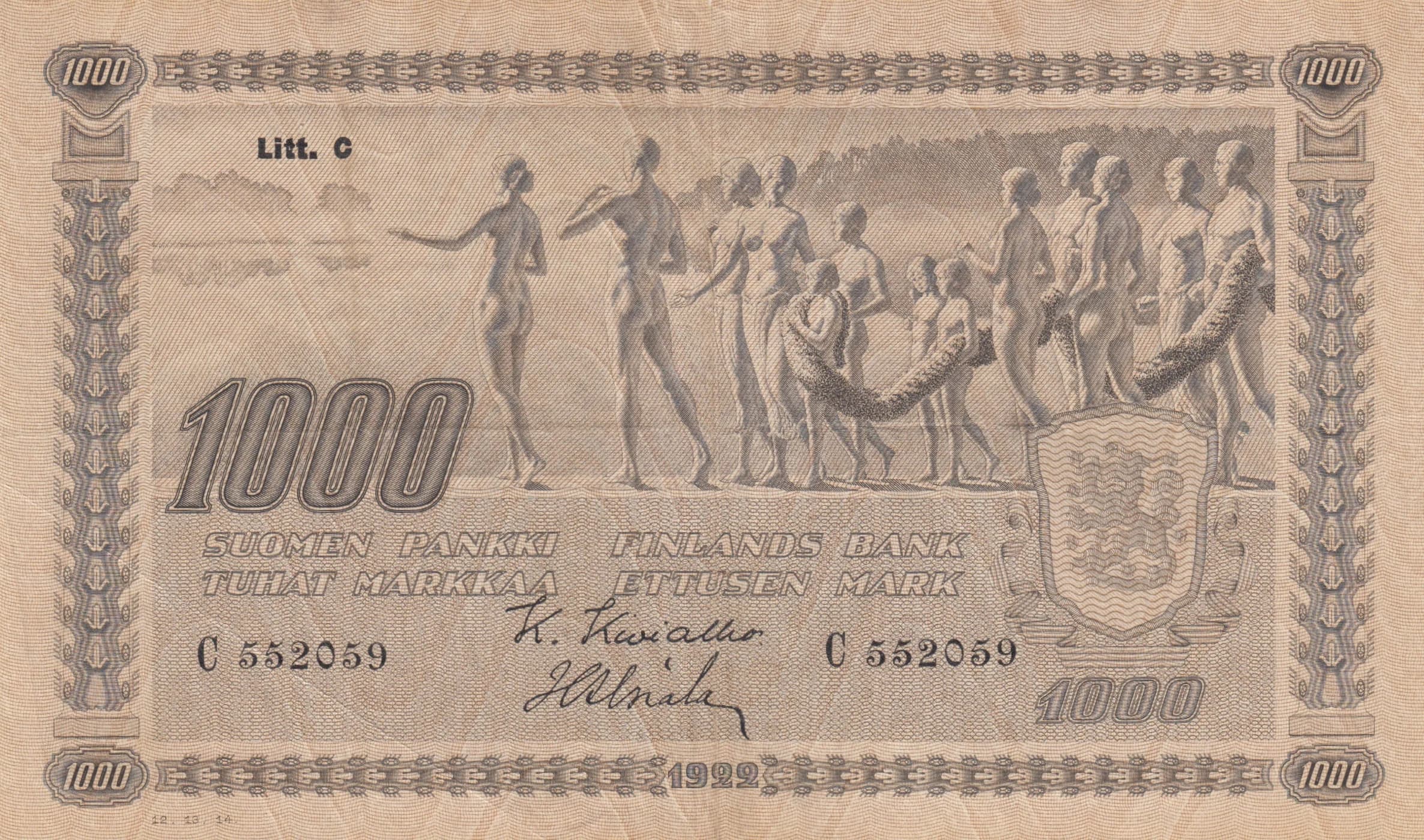
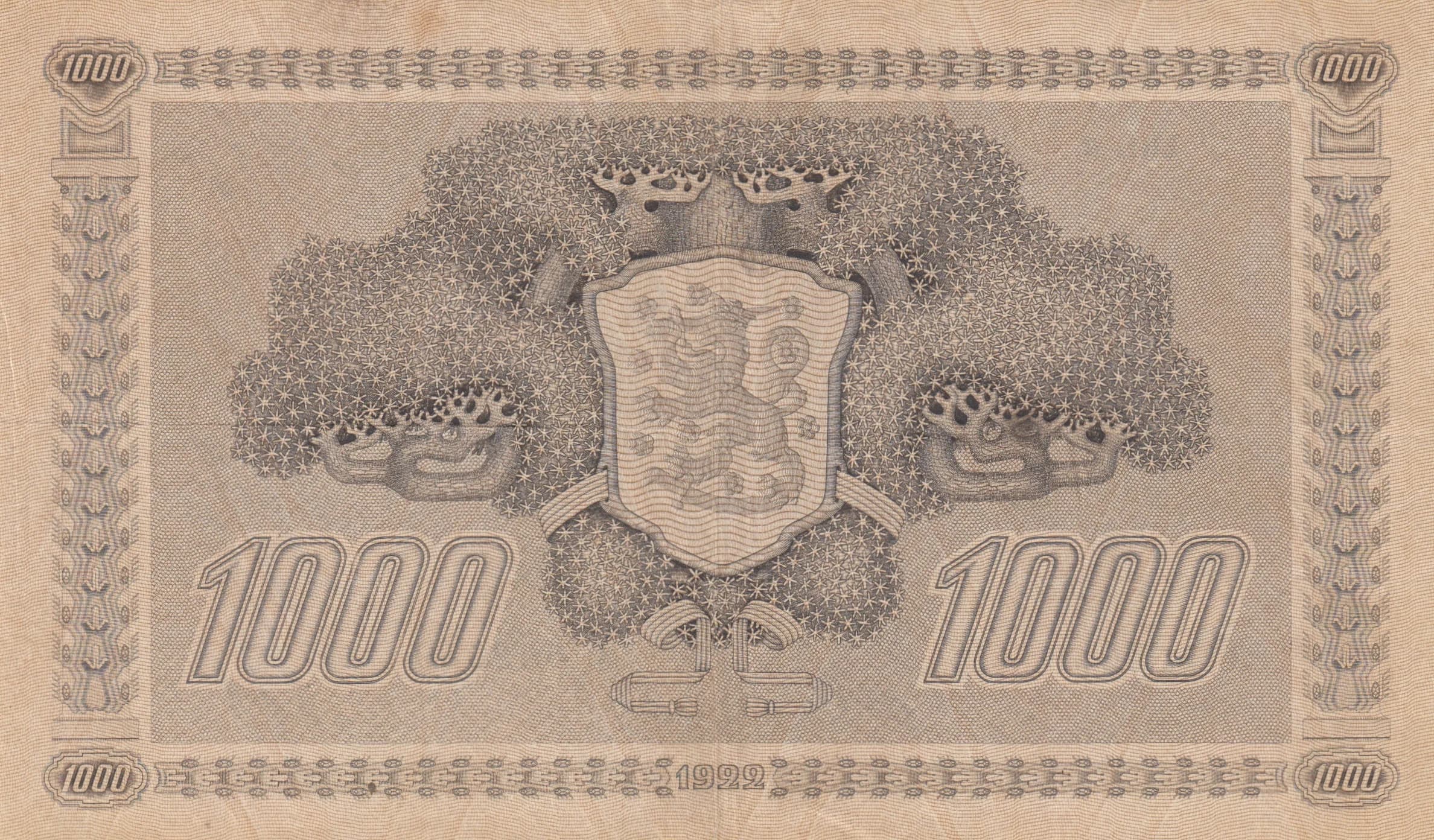
This 1000 markkaa banknote from 1922 exemplifies early Finnish currency design with classical allegorical imagery on the obverse and heraldic symbolism on the reverse. The note displays excellent preservation with uniform sepia patina and sharp engraved details throughout, showing minimal circulation wear despite its century-old age. The VF grade reflects well-maintained paper quality and legible inscriptions in both Finnish and Swedish, making this a notable example of interwar Finnish banking design.
Common. The 1000 markkaa 1922 (Pick 67) from this series is a frequently encountered denomination in the Finnish markkaa series. No evidence of limited print run or recall exists for this note type. VF condition examples are readily available in the numismatic market, and the serial number C 552059 shows no characteristics of a particularly scarce printing. This note represents standard circulation currency from Finland's early independence period.
Issued during Finland's early independence period (1922), this banknote reflects the newly sovereign nation's desire to establish national identity through classical and heraldic imagery. The allegorical procession scene on the front evokes Greco-Roman civilization, while the reverse's Finnish coat of arms with flanking heraldic lions asserts national sovereignty and continuity with historical symbols. The bilingual inscriptions (Finnish and Swedish) reflect Finland's linguistic and cultural duality during this formative period of statehood.
The obverse features a classical allegorical scene depicting multiple robed figures in procession or gathering, rendered in detailed line engraving style reminiscent of historical European banknote design. The composition conveys themes of civilization, commerce, or national prosperity through Greco-Roman iconography. The reverse displays Finland's national coat of arms as a large central heraldic shield, crowned and flanked symmetrically by two heraldic lions wearing crowns, emphasizing royal authority and national prestige. The background employs an intricate repeating geometric pattern serving both aesthetic and security functions. Decorative borders with geometric patterns frame all sides, and denomination numerals (1000) appear prominently in the corners.
Front: 'SUOMEN PANKKI' / 'FINLANDS BANK' (Bank of Finland, bilingual); 'TUHAT MARKKAA' / 'ETTUSIEN MARK' (One Thousand Marks, bilingual); '1922' (year of issue); 'C 552059' (serial number, printed twice); 'Litt. C' (letter classification); signatures of 'K. Revallis' and second official. Back: '1000' (denomination, printed twice); '1922' (year of issue).
Intaglio engraving (line engraving), characteristic of high-security banknote production in the 1920s. The fine line work throughout, detailed background pattern texturing, and sharp definition of heraldic elements are consistent with traditional copper plate engraving. The security printing was executed to standards typical of major European central banks of this period, with the dense background pattern serving as an anti-counterfeiting measure.
The note is identified as 'Litt. C' (Letter C), indicating this is from the C-series printing of this design. Serial number C 552059 with signatures of K. Revallis and a second official represents standard production from this series. No overprints or unusual printing variations are apparent. The letter designation system was used to distinguish between different printing runs of this design.