10 markkaa 1922
Market Prices
2 salesAbout This Note
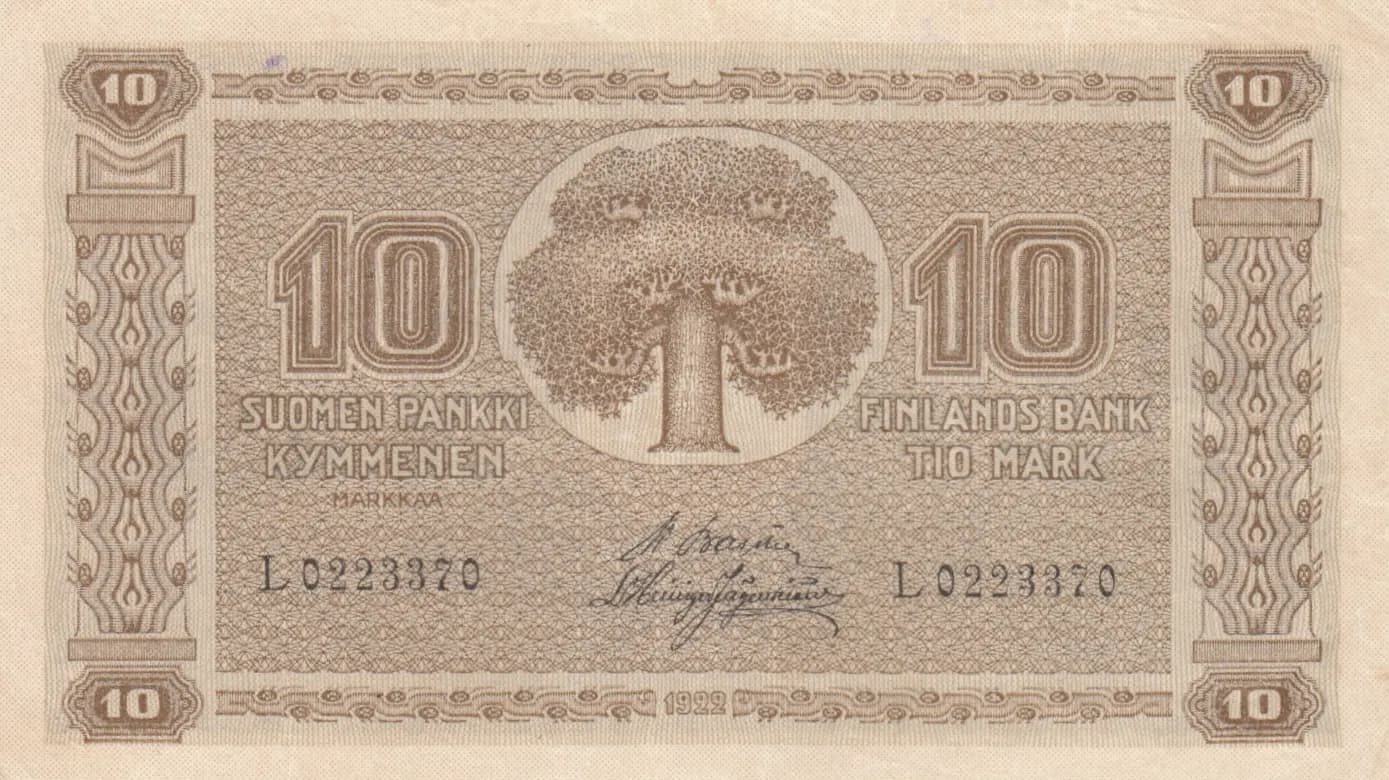
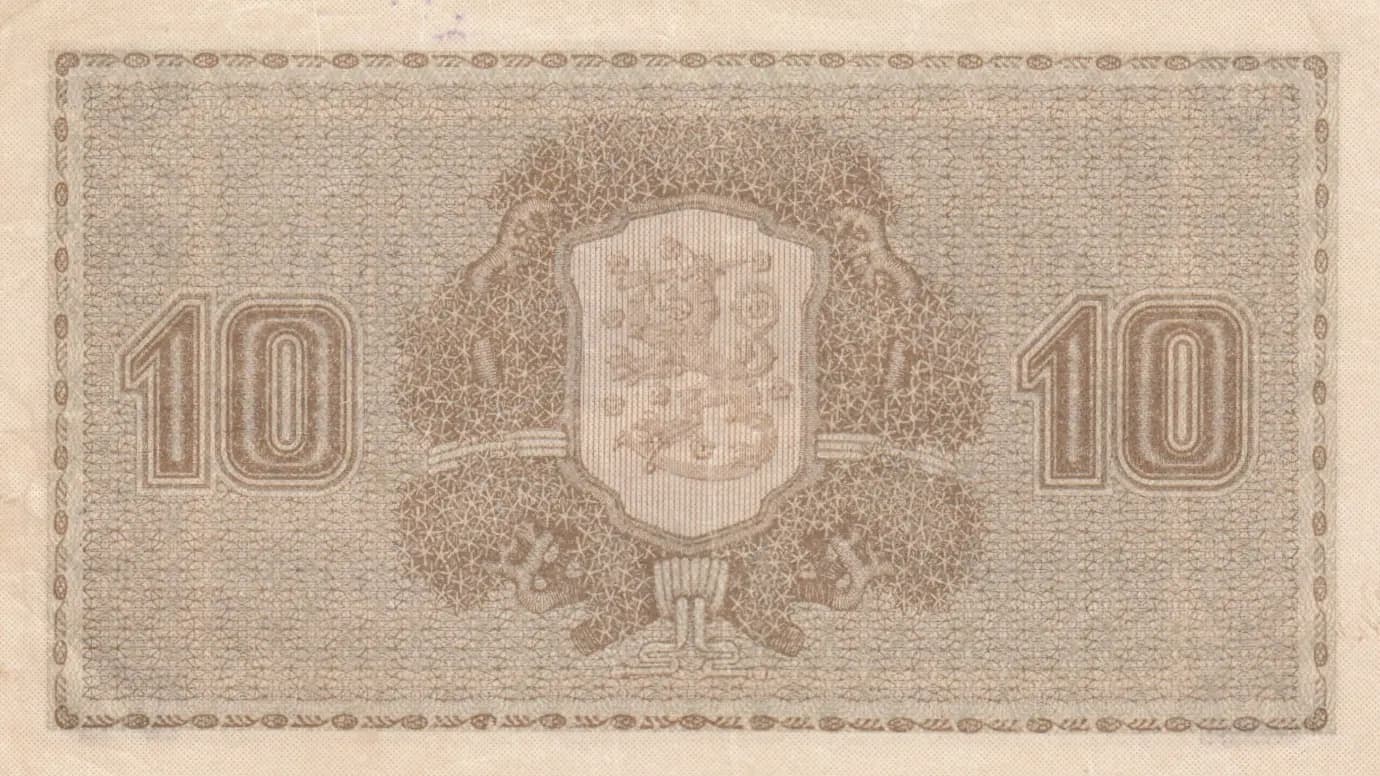
This is a Finnish 10 Markkaa note from 1922, issued by Suomen Pankki (Bank of Finland), graded in Very Fine condition. The note displays the characteristic early Finnish design featuring a prominent pine tree in a circular frame on the obverse and the Finnish coat of arms on the reverse, both rendered in fine engraved detail with warm brown and tan tones. While showing minor aging and foxing consistent with its century-old age, the note exhibits no significant damage, tears, or creasing, making it an attractive example of early Finnish currency.
Common. This is a regular issue 10 Markkaa note from the early post-independence period with no evidence of a limited print run or recall. eBay market data shows examples selling for $12-$52 depending on condition, with catalog valuations placing VF examples at approximately $15 (2016 data). These price points indicate a readily available note in the collector market. While early Finnish notes have collector interest, this particular denomination and issue does not demonstrate the scarcity characteristics that would warrant a higher rarity classification.
This banknote was issued during Finland's early period of independence and monetary sovereignty following the 1917 declaration of independence from Russia. The prominent pine tree depicted on the obverse symbolizes Finland's natural heritage and forests, which were central to the nation's economy, while the heraldic coat of arms on the reverse represents the newly established Finnish state and its institutional authority through the Bank of Finland. The bilingual inscriptions in Finnish and Swedish reflect Finland's dual linguistic heritage from its period as part of the Swedish realm.
The obverse features a majestic pine tree (Pinus sylvestris, the Scots pine) depicted in full foliage within a prominent circular frame, centered on the note and flanked by ornate geometric and floral border patterns on both sides. The denomination '10' appears in large outlined numerals within shield-shaped emblems positioned in all four corners. The reverse displays the Finnish state coat of arms—a heraldic shield design featuring characteristic vertical line pattern work—positioned centrally within an ornate rectangular frame with decorative wreaths above and below. Large outlined '10' numerals frame this central heraldic emblem on the left and right sides. Both sides feature intricate fine-line engraved background work with detailed ornamental borders incorporating repeating circular motifs, typical of security banknote design of the early 20th century.
Front side: '10' (denomination), 'SUOMEN PANKKI' (Bank of Finland in Finnish), 'KYMMENEN MARKKAA' (Ten Marks in Finnish), 'FINLANDS BANK' (Bank of Finland in Swedish), 'TIO MARK' (Ten Marks in Swedish), '1922' (year of issue), 'L 0223370' (serial number, printed twice). Back side: '10' (denomination, printed twice on left and right sides). The bilingual presentation reflects Finland's official languages of the period.
This note was produced using intaglio engraving, the dominant security printing method for banknotes of this era. The fine-line detailed engraving work visible throughout both sides, the intricate crosshatching and texture patterns in the background, the precise rendering of the pine tree and heraldic emblem, and the deeply impressed appearance of all design elements are characteristic of intaglio printing. The dual printing of the serial number and the fine ornamental borders demonstrate the multi-stage printing typical of high-security banknote production. This note was likely printed by a specialized security printer, though specific printer attribution for this Pick number would require archival research.
Serial number observed: L 0223370. The 'L' prefix on this note's serial number is a standard identifier for this series. Minor varieties in this issue may exist related to signature variants or slight differences in the ornamental border engraving between printings, but without direct comparison to known reference examples, specific variety designation cannot be confirmed from the visual analysis alone. The bilingual (Finnish/Swedish) text presentation is standard for this issue and not a variety marker.