1 pound 1965
Market Prices
5 salesAbout This Note
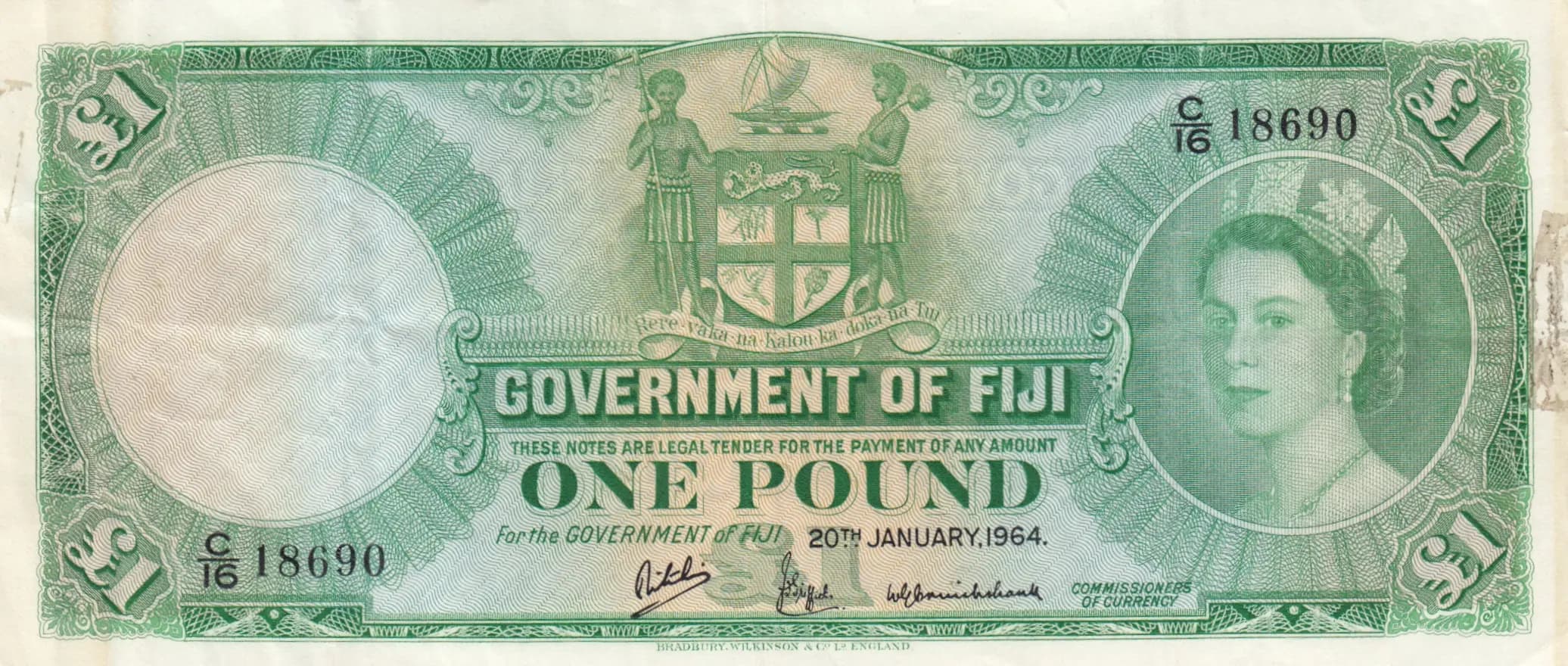
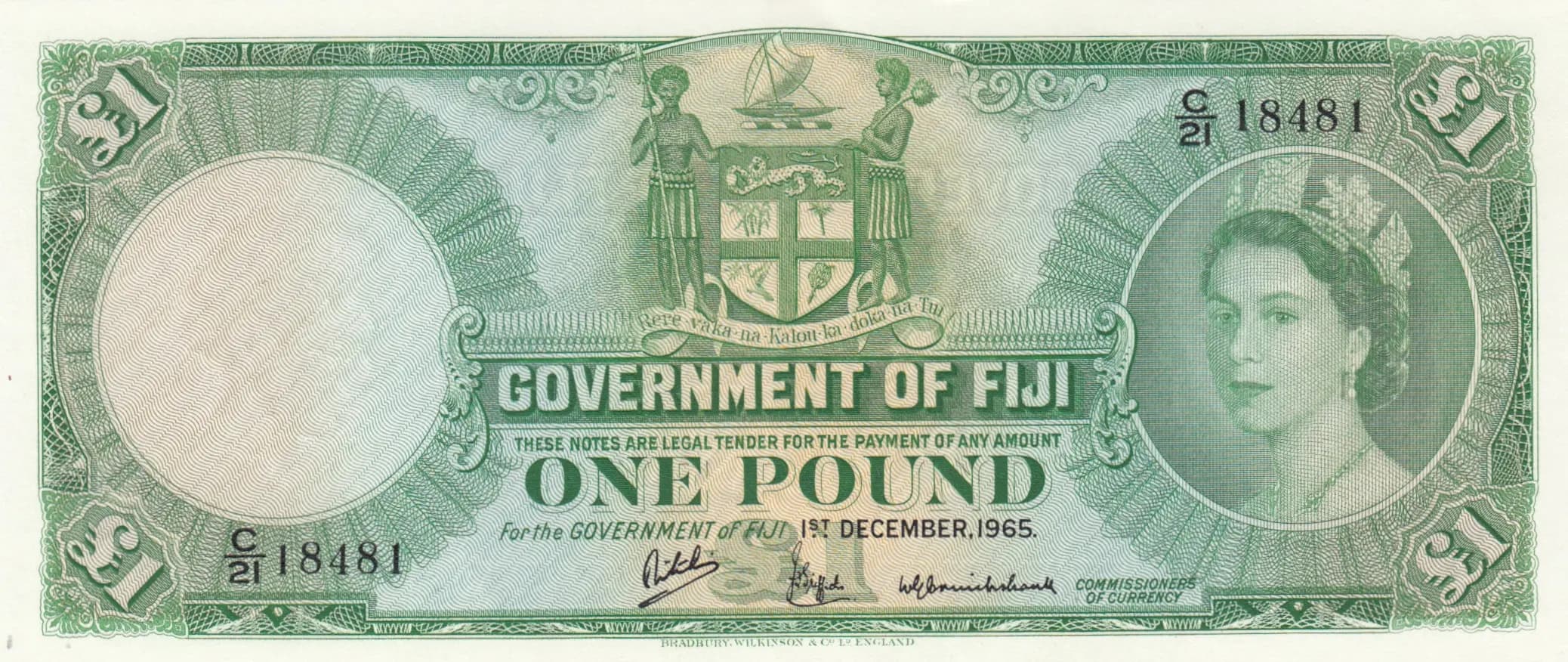
This is an uncirculated 1965 Government of Fiji one pound note (Pick P-53h), featuring a striking green and cream design with the coat of arms at center and a profile portrait of Queen Elizabeth II on the right. The note exhibits pristine condition with sharp, crisp printing throughout and no signs of wear, creases, or damage, making it an excellent example of this Commonwealth-era currency. According to 2019 catalog values, uncirculated examples of this denomination command $700, reflecting its desirability among collectors of Commonwealth and Pacific island currency.
Common. Despite the relatively high 2019 UNC catalog value of $700, market data from eBay sales shows most examples selling in the $17.50-$155 range, with most transactions under $75 for F-AUNC grades. The broad price range reflects condition-dependent valuation rather than absolute scarcity. This is a regular issue from a major Commonwealth printer with presumably substantial print runs during 1954-1967. The denomination and period are popular with collectors, supporting catalog valuations, but the note is readily available in the market.
Issued on 1 December 1965, this note commemorates Fiji's transition during a pivotal period in Pacific decolonization, with the Government of Fiji and Commissioners of Currency authority displayed prominently. The inclusion of Queen Elizabeth II's portrait reflects Fiji's status as a British Commonwealth territory at the time of issue, while the Fijian coat of arms with its dual heraldic supporters emphasizes local sovereignty within the Commonwealth framework. The incorporation of Fijian language text alongside English underscores the bicultural nature of Fiji's post-independence governance structure.
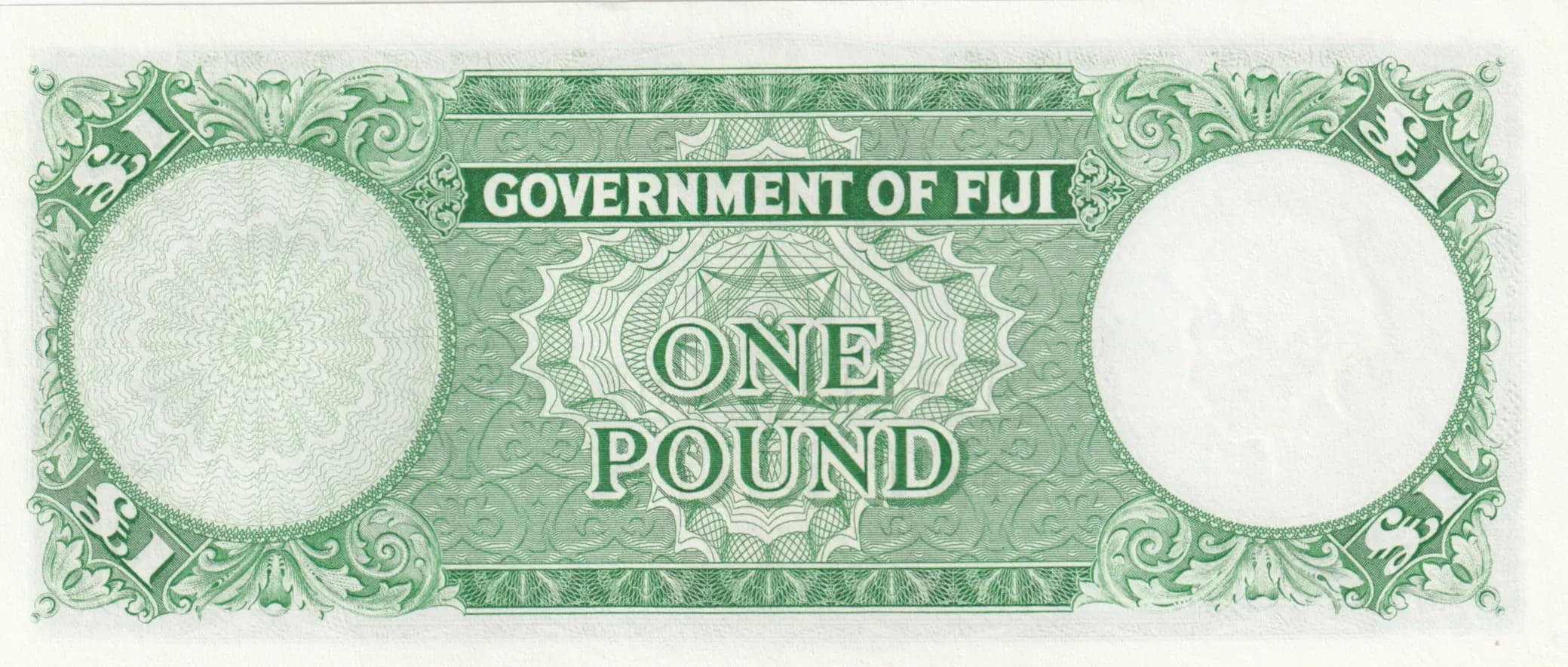
The obverse features the coat of arms of the Government of Fiji positioned at upper center, consisting of a quartered heraldic shield supported by two standing figures in traditional dress, crowned with decorative scrollwork. To the right is a profile portrait of Queen Elizabeth II facing right, rendered in fine line engraving. Both upper corners display lion emblems, with ornate scrolling corner ornaments throughout. The reverse presents a more minimalist design with two large circular watermark windows and decorative border work featuring scrolling patterns and floral elements, with the denomination prominently displayed. The overall design employs sophisticated guilloche patterns and fine line work characteristic of high-security banknote production.
FRONT: 'GOVERNMENT OF FIJI' / 'ONE POUND' / 'THESE NOTES ARE LEGAL TENDER FOR THE PAYMENT OF ANY AMOUNT' / '1ST DECEMBER, 1965' / 'For the GOVERNMENT OF FIJI' / 'COMMISSIONERS OF CURRENCY' / Serial number: C 18481 (appears twice) / 'Rete-vu-ni-Ra-tou-ka-doka-tici-tini' (Fijian language text) / 'BRADBURY, WILKINSON & CO. LTD. ENGLAND' (printer attribution). BACK: 'GOVERNMENT OF FIJI' / 'ONE' / 'POUND'. All text is in English except for the single line of Fijian on the front, reflecting the dual-language policy of the Government of Fiji.
Intaglio engraving (line engraving) executed by Bradbury, Wilkinson & Co. Ltd., the renowned London-based security printer. The visual analysis confirms the hallmarks of intaglio production: fine detailed line work, sharp edges on all design elements, intricate guilloche background patterns, and the characteristic raised ink impression visible in well-preserved examples. The printer's name appears on the front of the note, and BWC (Bradbury Wilkinson & Co.) is confirmed as the production source across all P-53 variants.
This note is cataloged as Pick P-53h, one of at least five documented variants (P-53a, P-53d, P-53h, P-53i, P-53s) all bearing the Fijian Head watermark and produced by Bradbury Wilkinson & Co. The varieties are primarily distinguished by subtle differences in design elements or serial number characteristics rather than major design changes. The observed specimen shows serial number C 18481, which may be relevant for distinguishing between varieties, though comprehensive variety documentation would require comparison with other graded examples. The 1 December 1965 date confirms this as part of the initial issue from the 1954-1967 series.