1 pound 1964
Market Prices
2 salesAbout This Note
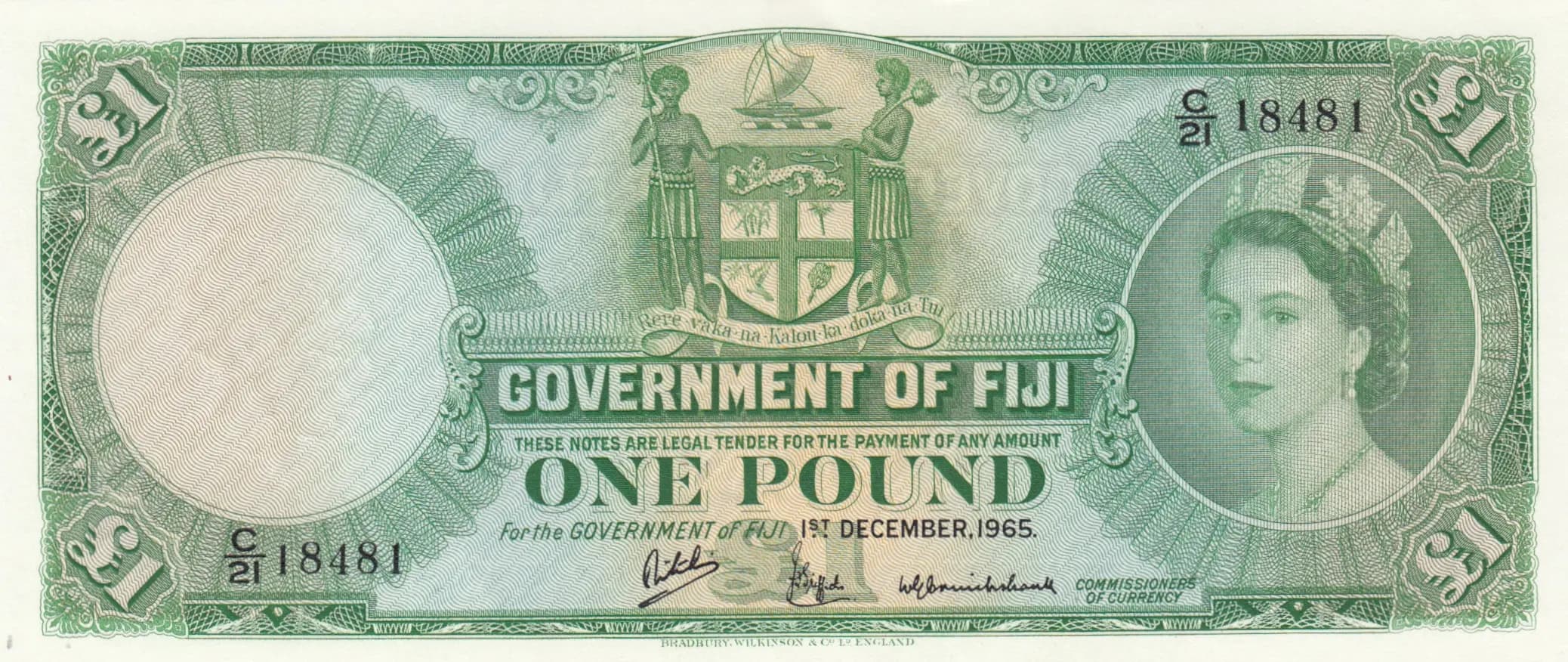
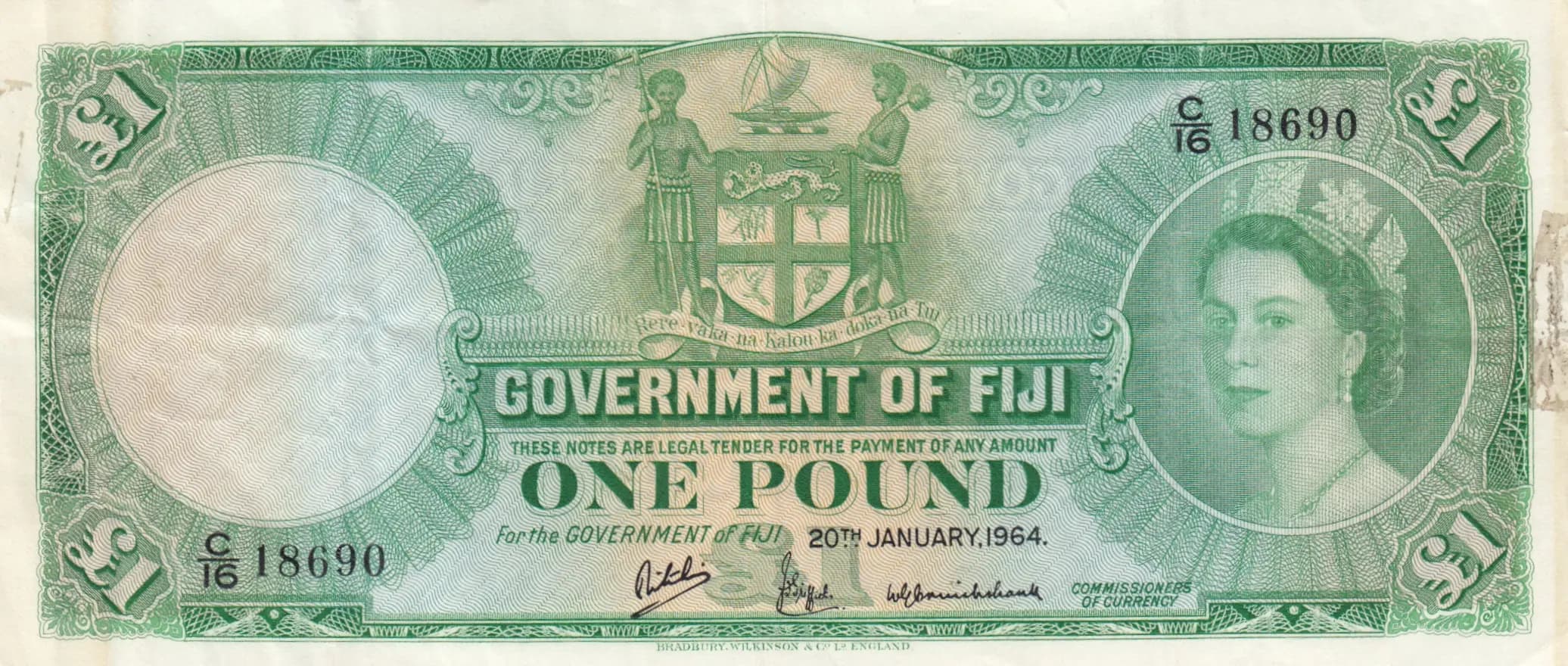
This is a VF-graded 1 Pound note from the Government of Fiji dated 20th January 1964, featuring an elegant green on yellow and blue underprint design by Bradbury Wilkinson. The note displays Queen Elizabeth II in profile on the right side within a circular medallion, flanked by the Fijian coat of arms at center, with characteristic period ornamental borders and guilloché security patterns. Despite visible creasing and circulation wear consistent with its age, the design remains clear and the note represents an attractive mid-grade example of this classic Commonwealth colonial currency.
Common. eBay price tracking data shows comparable grades selling for $18.99–$21.50 in the early 2010s, well below the $70 catalog value for VF grade listed for 2019, indicating steady but unexceptional collector demand. This note was issued as a regular circulation note during the final years of the pound sterling system in Fiji (1954–1967) with substantial print runs, and surviving examples in mid-grades like VF are readily available on the secondary market. There is no evidence of limited mintage, recall, or scarcity that would elevate this Pick number above common status.
This note was issued during Fiji's final period under the British pound sterling system, just three years before the country gained independence in 1967. The prominence of Queen Elizabeth II's portrait and the elaborate Fijian coat of arms reflect Fiji's status as a British Crown colony, while the denomination in pounds sterling connects the island nation to the broader sterling currency bloc that dominated Commonwealth territories during the early 1960s. The 20th January 1964 date marks a significant moment in Fiji's monetary history, as these pound notes would soon be replaced by decimal currency.
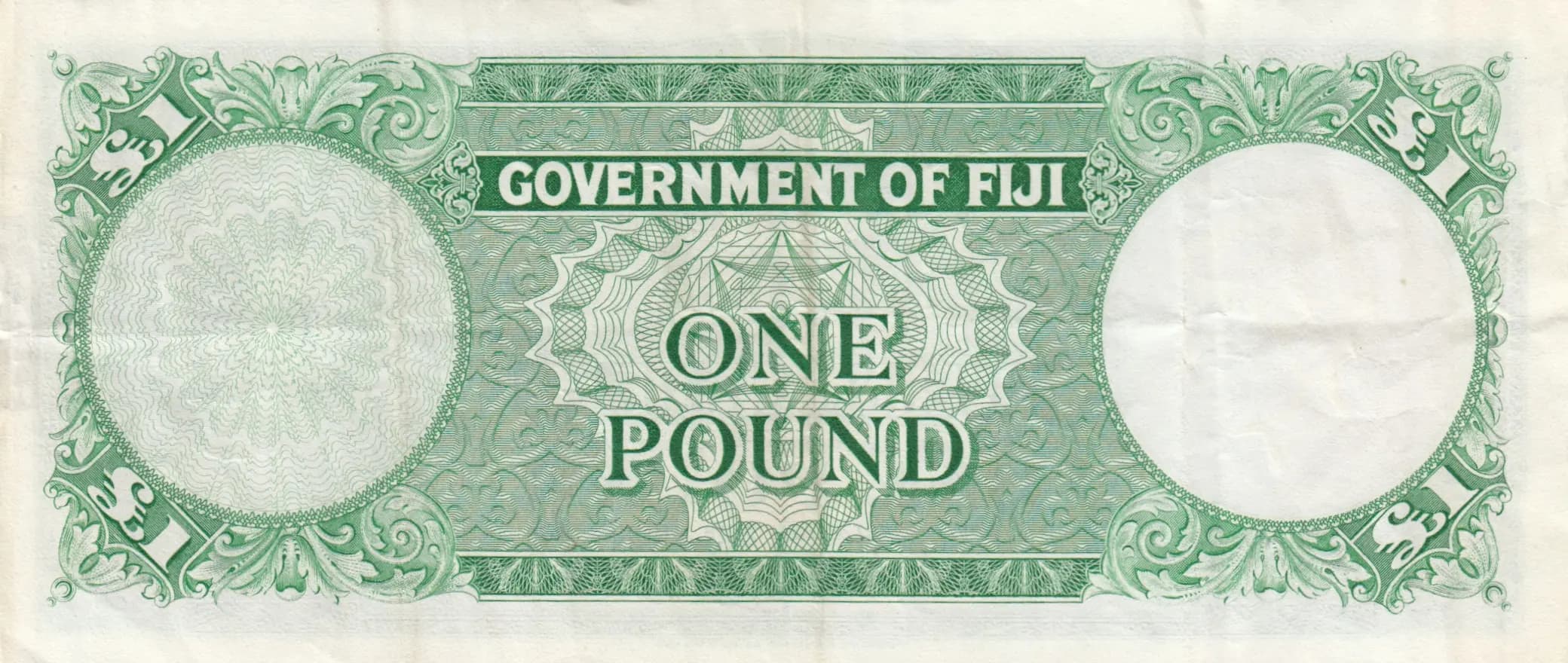
The obverse features Queen Elizabeth II rendered in profile facing left within a circular medallion on the right side of the note, a standard portraiture convention for Commonwealth currency of this era. The center is dominated by the Fijian coat of arms, displaying a shield with four quarters supported by male and female figures representing the island nation's cultural identity. The reverse presents a more symmetrical design with the ONE POUND denomination prominently centered within an ornate rectangular frame, flanked by large circular ornamental medallion areas on both sides that serve as security features and watermark locations. The overall design employs elaborate scrollwork, fine-line engraving patterns, and guilloché work typical of high-security banknote production from this period.
Front Side: 'GOVERNMENT OF FIJI' (top); 'ONE POUND' (denomination); 'THESE NOTES ARE LEGAL TENDER FOR THE PAYMENT OF ANY AMOUNT' (legal tender clause); 'for the GOVERNMENT of FIJI' (issuing authority); '20TH JANUARY, 1964' (issue date); 'COMMISSIONER OF CURRENCY' (authorizing official title); 'BRADBURY, WILKINSON & CO LTD, ENGLAND' (printer attribution); Serial number 'C/16 18690' (appears top right and bottom left). Back Side: 'GOVERNMENT OF FIJI' (top); 'ONE POUND' (denomination in ornate frame). All inscriptions are in English, reflecting the colonial administration's official language.
This note was produced using traditional intaglio engraving and steel plate printing by Bradbury, Wilkinson & Co Ltd of New Malden, England, one of the world's premier security printers. The visual analysis reveals characteristic fine-line engraving patterns, complex guilloché geometric designs, and multiple color printing (green on yellow and blue underprint) that are hallmarks of this technique. The watermark featuring a Fijian youth's bust was incorporated during paper manufacture, and the ornamental borders and security patterns demonstrate the high-quality craftsmanship standard for Commonwealth banknotes of this era.
This note is cataloged as Pick-53f. The PMG population report documents at least five variants of the base P-53 pick number (P-53a, P-53d, P-53h, P-53i, and P-53s), differentiated by watermark and printer variations. The 'f' designation in P-53f suggests this is one of multiple sub-varieties within this pick number, likely reflecting different printing runs or minor design modifications. The observed serial number prefix 'C/16' and the 20th January 1964 date are consistent with the assigned Pick number, though without access to detailed variety catalogs, the precise distinguishing characteristics of the P-53f variant cannot be definitively determined from the images alone.