1 pound 1951
Market Prices
3 salesAbout This Note
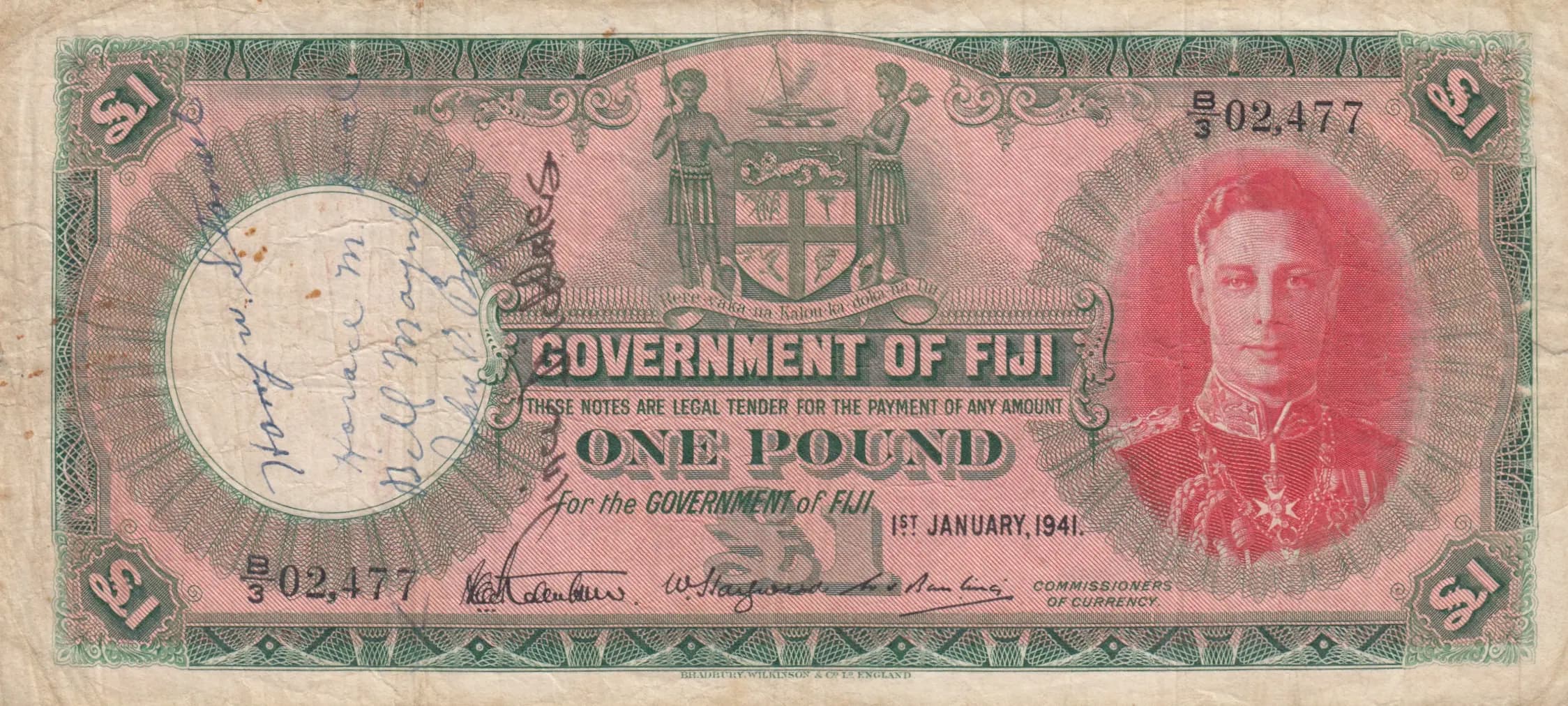
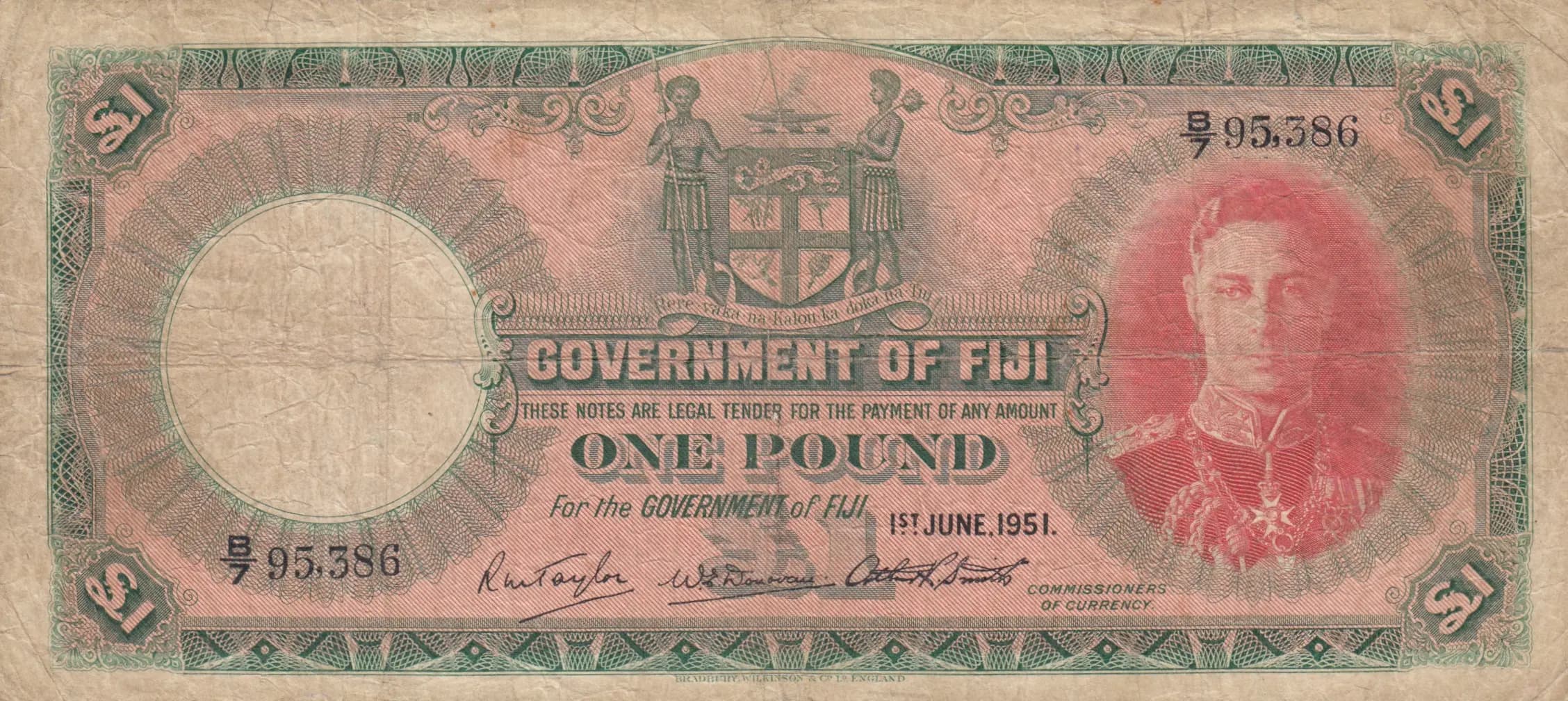
This is a Government of Fiji 1 Pound note dated 1st June 1951, representing the post-WWII British colonial currency system in the Pacific. The note displays King George VI in military dress uniform with medals on the obverse in red/pink tones against green borders, with characteristic ornamental designs. In VG condition, the note shows expected wear from circulation including creases, foxing, and discoloration consistent with a 70+ year old banknote, yet retains legible inscriptions and visible security features.
Common. The eBay market data provided shows multiple sales ranging from $42-$183, with the VG-grade example catalogued at $25 (2016 values). The note was part of a regular issue with a production span of 1941-1951 and represents standard circulation coinage of a major British colony. The existence of at least 3 catalogued varieties (P-40a, P-40c, P-40f) suggests reasonable print quantities. Notes regularly appearing at modest auction prices ($25-$350 across grades) and documented in community catalogs are definitionally common rather than scarce.
This 1951 note was issued during the reign of King George VI (1936-1952) and represents Fiji's currency system under British colonial administration. The portrait of the King in military uniform and the formal 'Government of Fiji' inscriptions reflect the Commonwealth monetary structure of the post-WWII era, when Fiji remained under British sovereignty. The note's classical architectural ornaments and formal design aesthetic were typical of British colonial currency printing standards maintained by the security printer Bradbury Wilkinson.
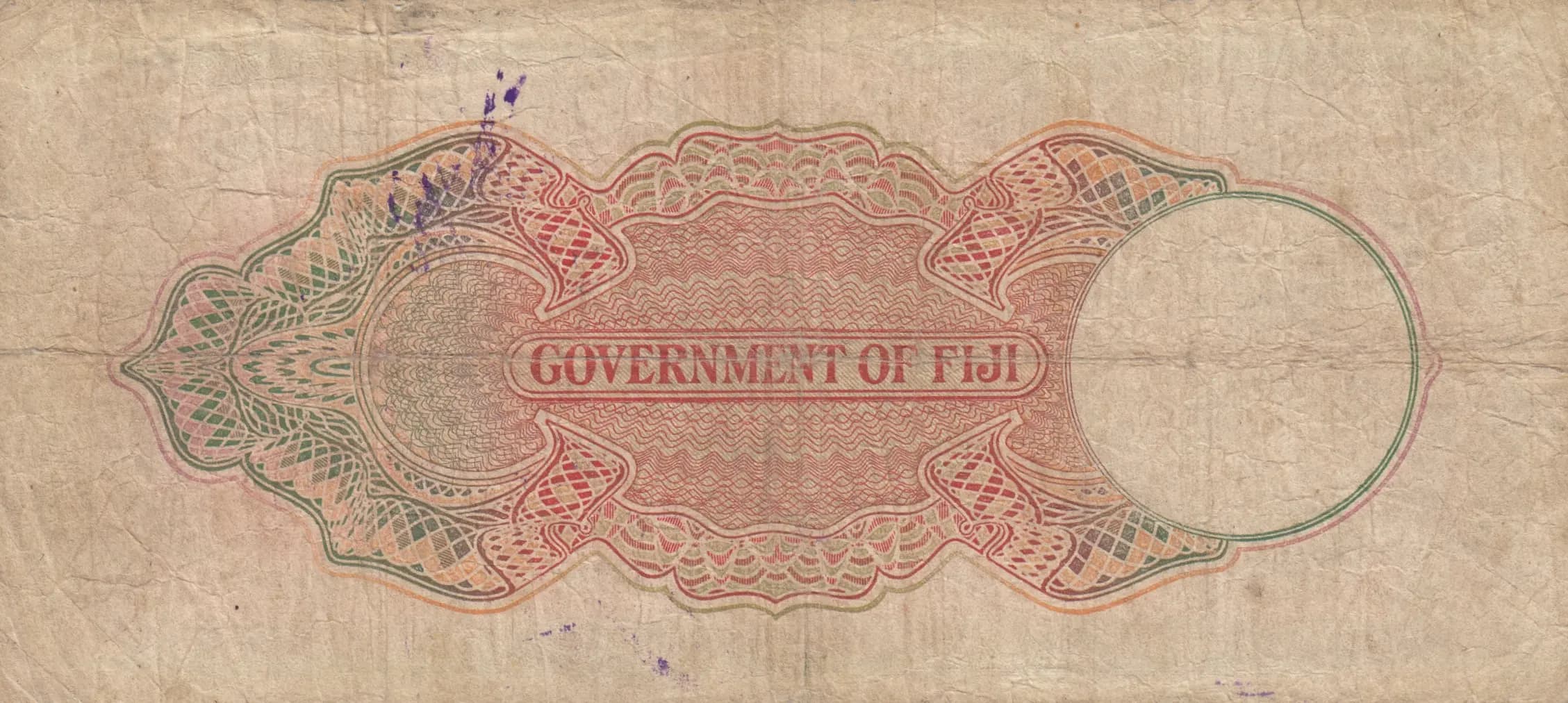
The obverse features a formal portrait of King George VI positioned at right center, rendered in military dress uniform with visible medals and insignia, printed in red/pink tones. The left side contains a large circular watermark area (Fijian Head watermark per PMG designation). The reverse displays elaborate ornamental design work featuring classical architectural motifs with columns and figural elements at top center, floral and scrollwork patterns, and geometric designs without a portrait. Both sides incorporate decorative borders with corner ornaments, pound symbols, and fine engraved line work throughout in green, red/pink, and beige/tan colors. The overall design follows formal British colonial banknote conventions of the period.
Front: 'GOVERNMENT OF FIJI' (issuing authority), 'THESE NOTES ARE LEGAL TENDER FOR THE PAYMENT OF ANY AMOUNT' (legal tender declaration), 'ONE POUND' (denomination), 'for the GOVERNMENT of FIJI' (issuer attribution), '1ST.JUNE.1951.' (issue date), 'COMMISSIONERS OF CURRENCY' (authorizing body), 'B 95,386' (serial number, repeated). Back: 'GOVERNMENT OF FIJI' (issuer identification). The pound symbol (£) appears as ornamental elements on both sides.
Intaglio engraving, characteristic of high-security banknote production. Printed by Bradbury Wilkinson, New Malden (noted as 'BWC' in catalog references), the premier British security printer of this era. The fine line work, intricate ornamental patterns, and detailed scrollwork visible throughout the note are hallmarks of intaglio engraving. The watermark security feature (Fijian Head) was integral to the paper stock and represents the security printing standards of 1950s British colonial currency.
This note is specifically identified as Pick P-40f, one of three catalogued varieties for the 1 Pound 1951 Government of Fiji issue. All variants feature Bradbury Wilkinson as printer and Fijian Head watermark. The variety distinction (P-40a, P-40c, P-40f) likely relates to subtle design differences, signature variants, or sequential printing runs. The serial number prefix 'B' and number '95,386' are visible on this specimen. Without detailed comparative analysis of all varieties, the specific distinguishing features of P-40f versus P-40a and P-40c cannot be definitively stated from the visual analysis alone, though variants are confirmed to exist within this Pick number.