1 pound 1941
Market Prices
4 salesAbout This Note
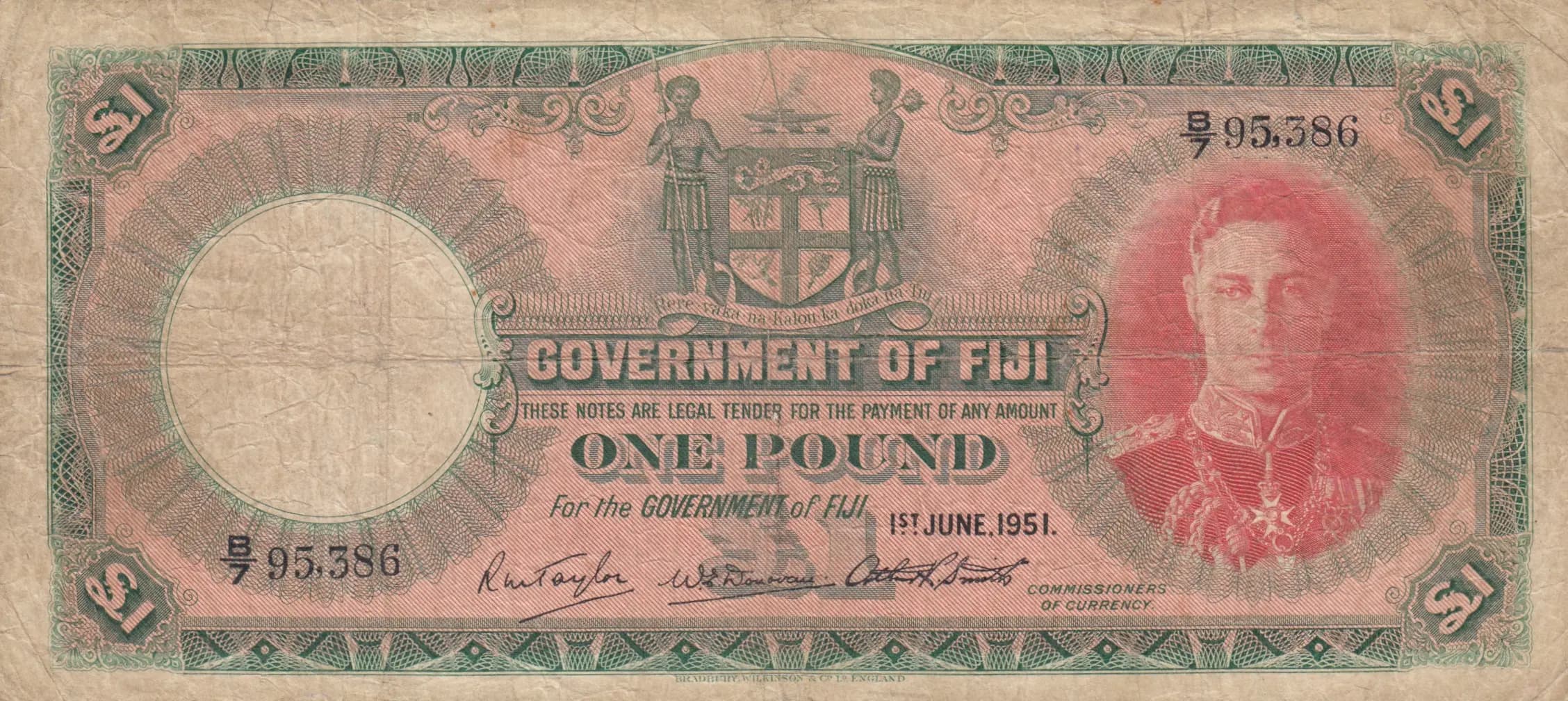
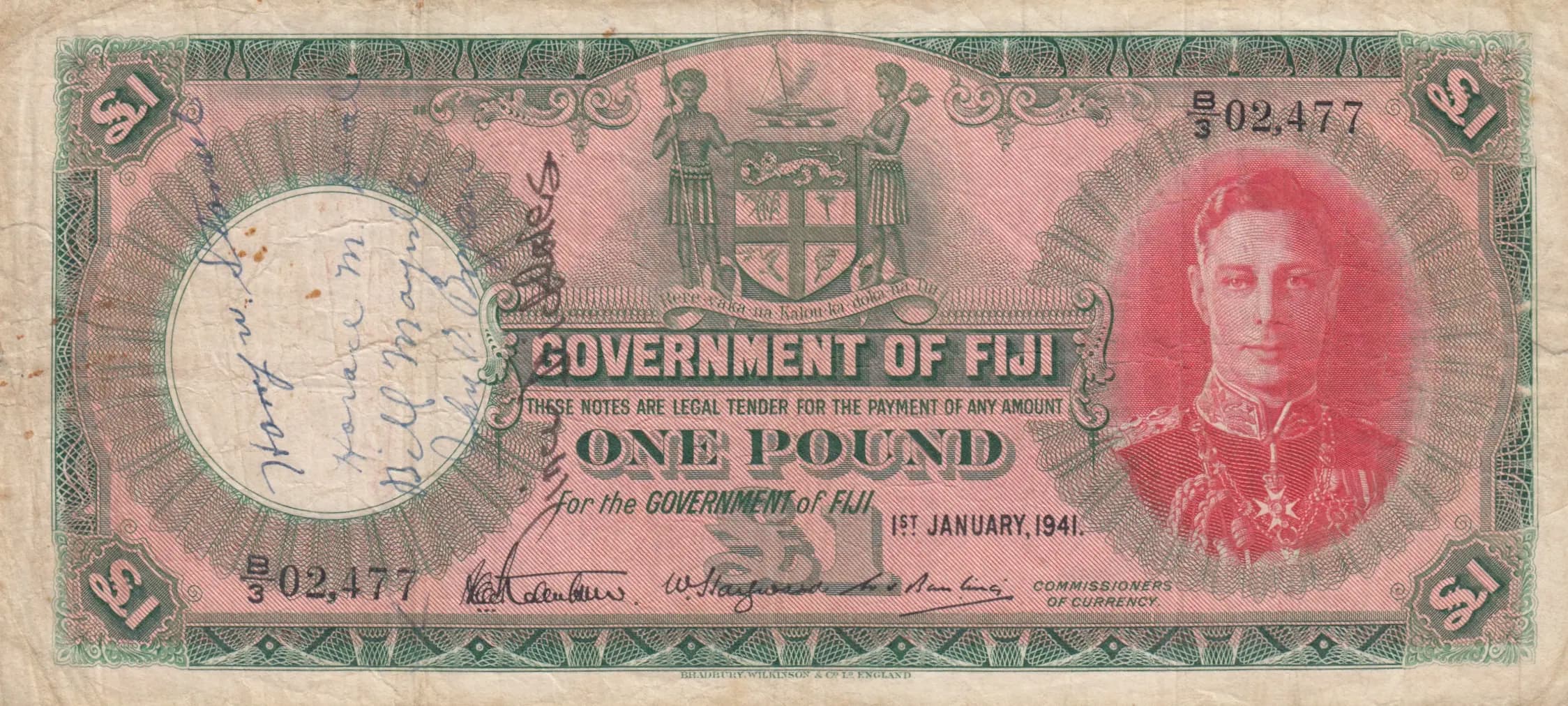
A 1941 Fiji 1 Pound note in Fair condition, issued by the Government of Fiji on 1st January 1941 and printed by Bradbury Wilkinson. The note features a striking portrait of King George VI in military dress uniform with medals, rendered in red/pink tones on the obverse, set against a pink/mauve background with green decorative borders. Significant age-related wear is evident throughout, including foxing, staining, creasing, and discoloration consistent with over 80 years of circulation and storage, with handwritten annotations visible on the watermark area.
Common. eBay sales data shows notes in Fair condition selling for approximately $46 (2023), with graded PMG 30 examples commanding $205-213. These prices and active market transactions indicate steady supply and demand rather than scarcity. While 1941 is the first year of issue for this series, the sustained circulation life of Fiji pound notes through 1951 and the relatively accessible pricing in lower grades suggest this is a commonly encountered note in the collector market.
This note was issued at the height of World War II, during which Fiji remained under British colonial administration and George VI served as reigning monarch. The military dress uniform and medals depicted on the obverse reflect the wartime context and emphasized imperial authority during a period of global conflict. The legal tender inscription and Government of Fiji designation underscore the colonial administrative structure under which Fiji operated in 1941, prior to independence in 1970.
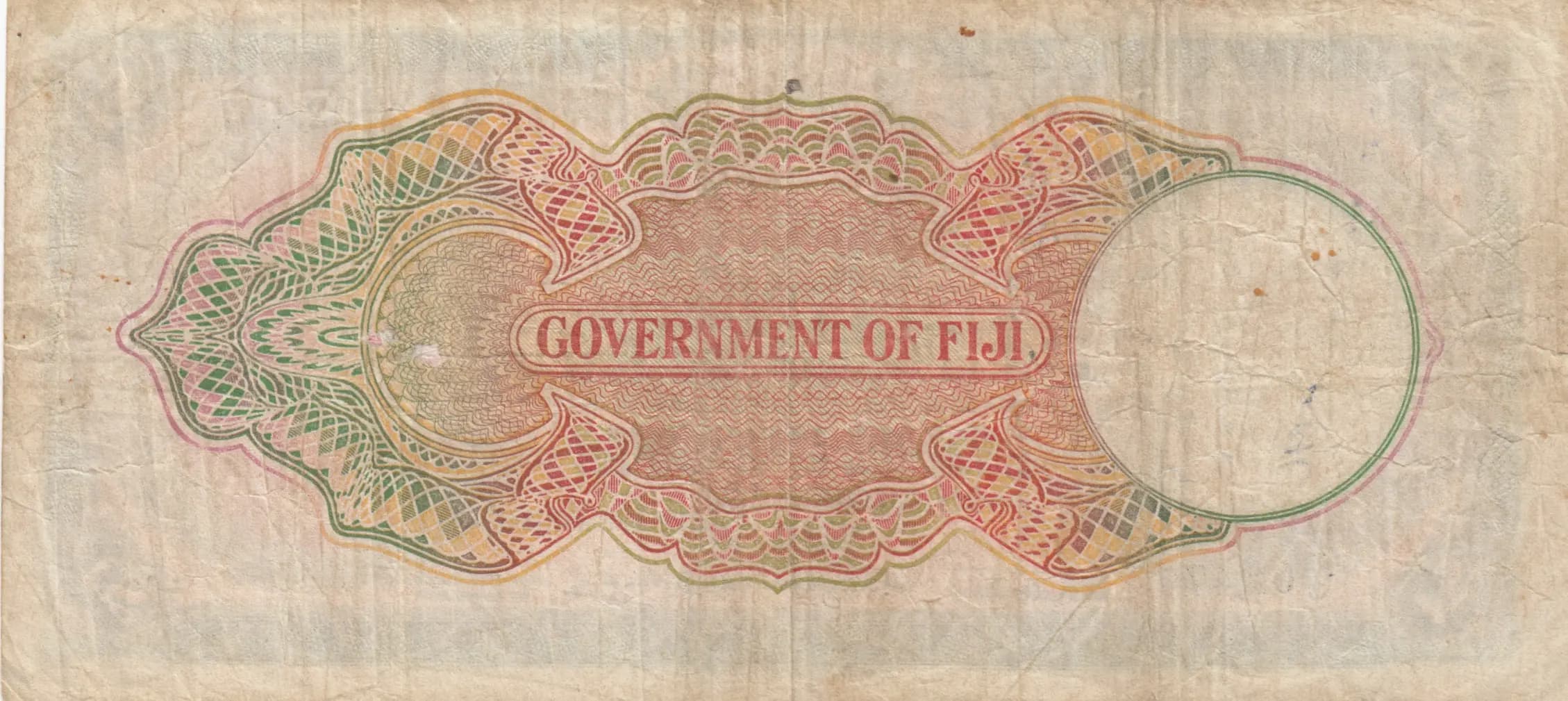
The obverse features a three-quarter profile portrait of King George VI positioned at the right side of the note, depicted in full military dress uniform with visible medal ribbons, rendered in red and pink tones. A coat of arms or heraldic shield is positioned in the center-upper portion, featuring architectural and figural elements characteristic of Commonwealth heraldry. The design incorporates elaborate ornamental borders with geometric and floral patterns, corner ornaments displaying the numeral '1' in circular designs at top-left and top-right, and a circular watermark area on the left side. The reverse presents a more restrained design centered on an ornamental cartouche with elaborate scrollwork in pink, green, and gold tones, with circular watermark placeholders positioned left and right of center. The color scheme throughout employs pink/mauve as the primary underprint with green decorative elements and tan/beige accents.
FRONT: 'GOVERNMENT OF FIJI' (issuing authority), 'THESE NOTES ARE LEGAL TENDER FOR THE PAYMENT OF ANY AMOUNT' (legal tender declaration), 'ONE POUND' (denomination), 'for the GOVERNMENT of FIJI' (attribution), '1ST JANUARY, 1941' (issue date), serial number '02,477', 'COMMISSIONER OF CURRENCY' (authorized signatory title), 'PRINTED BY WILKINSON & CO., ENGLAND' (printer identification). BACK: 'GOVERNMENT OF FIJI' (issuing authority). All inscriptions are in English.
The note was produced using traditional intaglio printing methods by Bradbury Wilkinson & Co., a prominent British security printer known for high-quality banknote production. The detailed portraiture, fine line work in the ornamental borders, and color layering visible in the design are characteristic of intaglio printing. The multi-color appearance (green on red/pink underprint as documented in reference sources) indicates the use of multiple printing passes, a standard technique for banknotes of this era.
This note is cataloged as Pick P-40a, one of three known variants (P-40a, P-40c, P-40f) for the 1941-1951 £1 denomination. All variants share Bradbury Wilkinson as printer and feature a Fijian Head watermark. The specific variety (P-40a) can be confirmed through detailed examination of the watermark design and any subtle printing differences, though these distinctions are not always apparent without direct comparison or expert authentication. The serial number visible on this example is 02,477.