500 pesetas 1969
Market Prices
15 salesAbout This Note
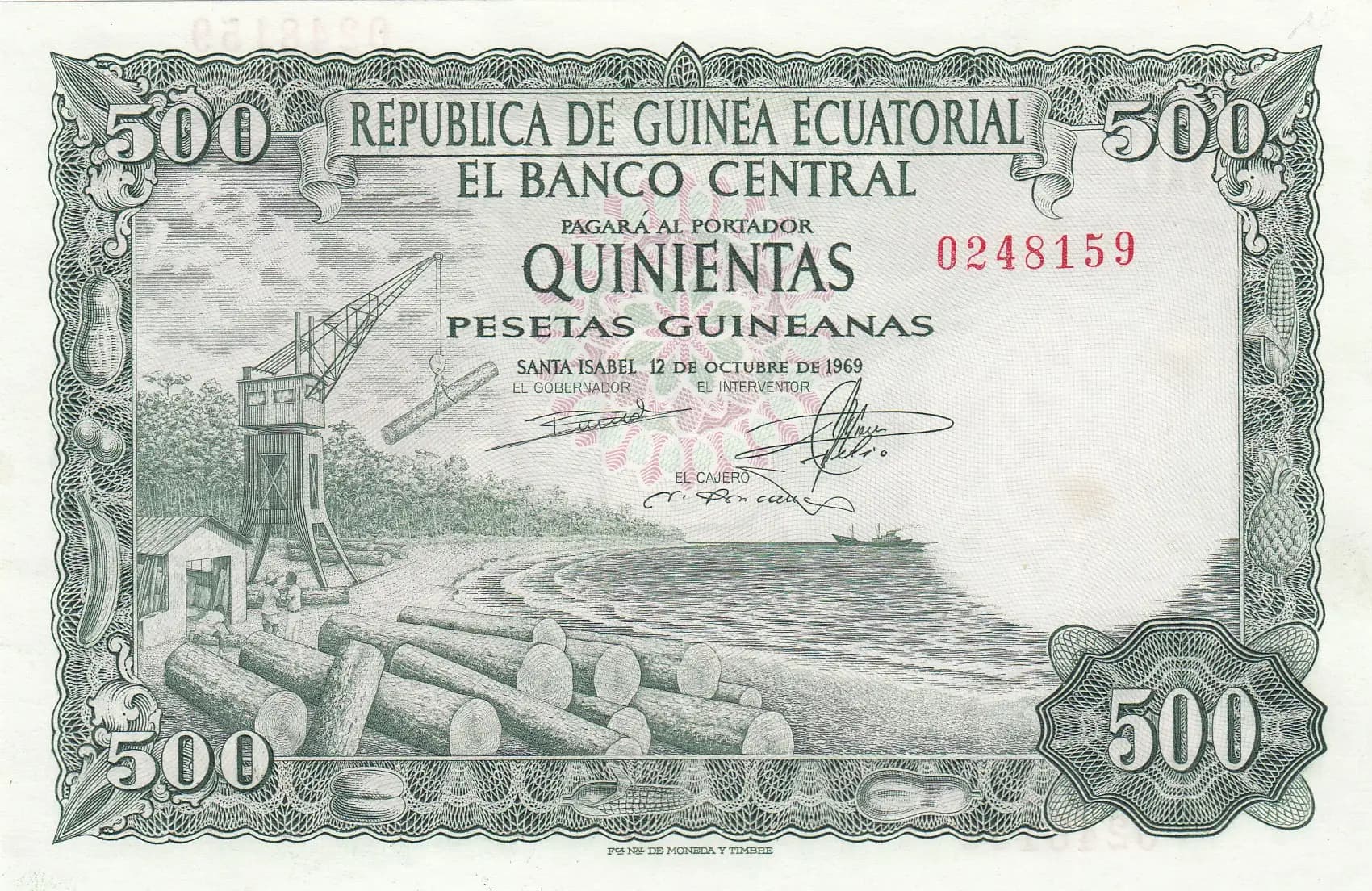
This is an uncirculated 500 Pesetas Guineanas note from Equatorial Guinea's inaugural currency issue, dated October 12, 1969, and printed by Spain's Fábrica Nacional de Moneda y Timbre. The note features vibrant green and multicolored intaglio printing depicting the nation's economic foundation—a dramatic port scene with industrial cargo crane and timber loading on the obverse, and an allegorical female figure with palm fronds representing the nation's agricultural wealth on the reverse. The specimen shows excellent preservation with minimal wear, consistent with UNC-grade material, and represents an early example from the newly independent nation's first banknote series.
Common. The eBay market data shows consistent sales in the $45–$75 range for UNC examples over the past decade, with multiple transactions at modest prices indicating steady collector interest but no scarcity premium. The 2019 catalogue value of $60 UNC aligns with observed transaction prices. No evidence of restricted print runs or early recall exists for this Pick number. As a foundational issue from a recognized nation-state with ongoing collector demand, this note remains readily available in the secondary market.
Issued exactly one year after Equatorial Guinea achieved independence on October 12, 1968, this inaugural peseta note symbolizes the nation's economic transition. The obverse's emphasis on timber exports and port infrastructure reflects the country's primary economic activities during this period, while the reverse's coat of arms bearing the national motto 'Unidad, Paz, Justicia' (Unity, Peace, Justice) and the allegorical woman with palm fronds underscore the nation's hopes for prosperity built on agricultural and forestry resources. The Santa Isabel (Malabo) date location and the choice of Spanish currency reflected the currency union with Spain that Equatorial Guinea initially maintained after independence.
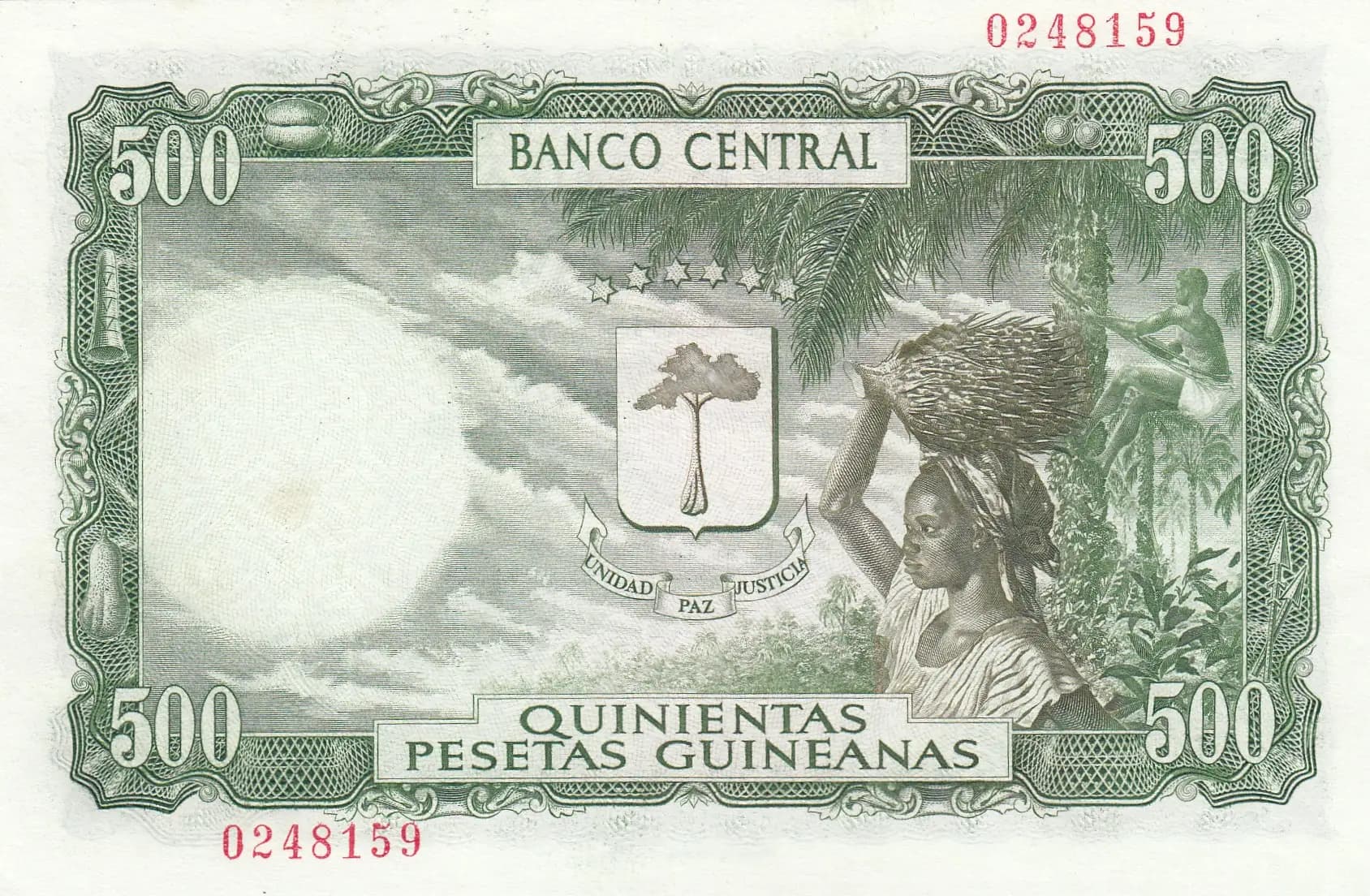
The obverse displays an industrial port scene symbolizing Equatorial Guinea's timber export economy, with a prominent cargo derrick or loading crane positioned at the left, large logs in the foreground, a water body and merchant ship at center-right, and forested landscape completing the composition. All elements are rendered in fine intaglio line work with dominant greens and blacks on a cream underprint. The reverse features the national coat of arms—a stylized tree within a heraldic shield flanked by five-pointed stars and the national virtues 'Unidad, Paz, Justicia.' To the right stands an allegorical female figure in classical pose holding palm fronds, representing agricultural prosperity, with date palms and tropical vegetation in the background and a lighthouse tower visible in the upper right corner. Both sides feature ornate decorative borders with fine scrollwork and floral motifs characteristic of Spanish intaglio banknote design. The overall composition reflects the modernist aspirations of the newly independent nation while celebrating its natural resources.
FRONT SIDE: 'República de Guinea Ecuatorial' (Republic of Equatorial Guinea); 'El Banco Central' (The Central Bank); 'Pagará al Portador' (Will Pay to Bearer); 'Quinientas' (Five Hundred); 'Pesetas Guineanas' (Guinean Pesetas); 'Santa Isabel 12 de Octubre de 1969' (Santa Isabel, October 12, 1969); 'El Gobernador' (The Governor); 'El Interventor' (The Comptroller); 'El Cajero' (The Cashier); Serial number: 0248159; Denomination: 500. BACK SIDE: 'Banco Central' (Central Bank); 'Unidad' (Unity); 'Paz' (Peace); 'Justicia' (Justice); 'Quinientas Pesetas Guineanas' (Five Hundred Guinean Pesetas); Serial number: 0248159; Denomination: 500.
Intaglio (line engraving) process, as confirmed by the fine linear details, precise line work in borders and portraits, and the characteristic sharp impression visible in the images. Printed by the Fábrica Nacional de Moneda y Timbre (National Mint and Stamp Factory) of Madrid, Spain—the official Spanish currency printer. The multicolored effect was achieved through multi-plate intaglio printing with careful registration, typical of Spanish banknote production standards of the period.
Pick catalog P-2 is the standard variety for the 500 Pesetas Guineanas 1969 issue. The observed specimen with serial number 0248159 represents a typical example from this regular-issue series. No known overprint varieties, signature variants, or limited-run sub-types are documented for this denomination. The note is signed by three officials (Governor, Comptroller, Cashier) in the standard format for this series, consistent with all known examples of P-2.