1000 pesetas 1969
Market Prices
23 salesAbout This Note
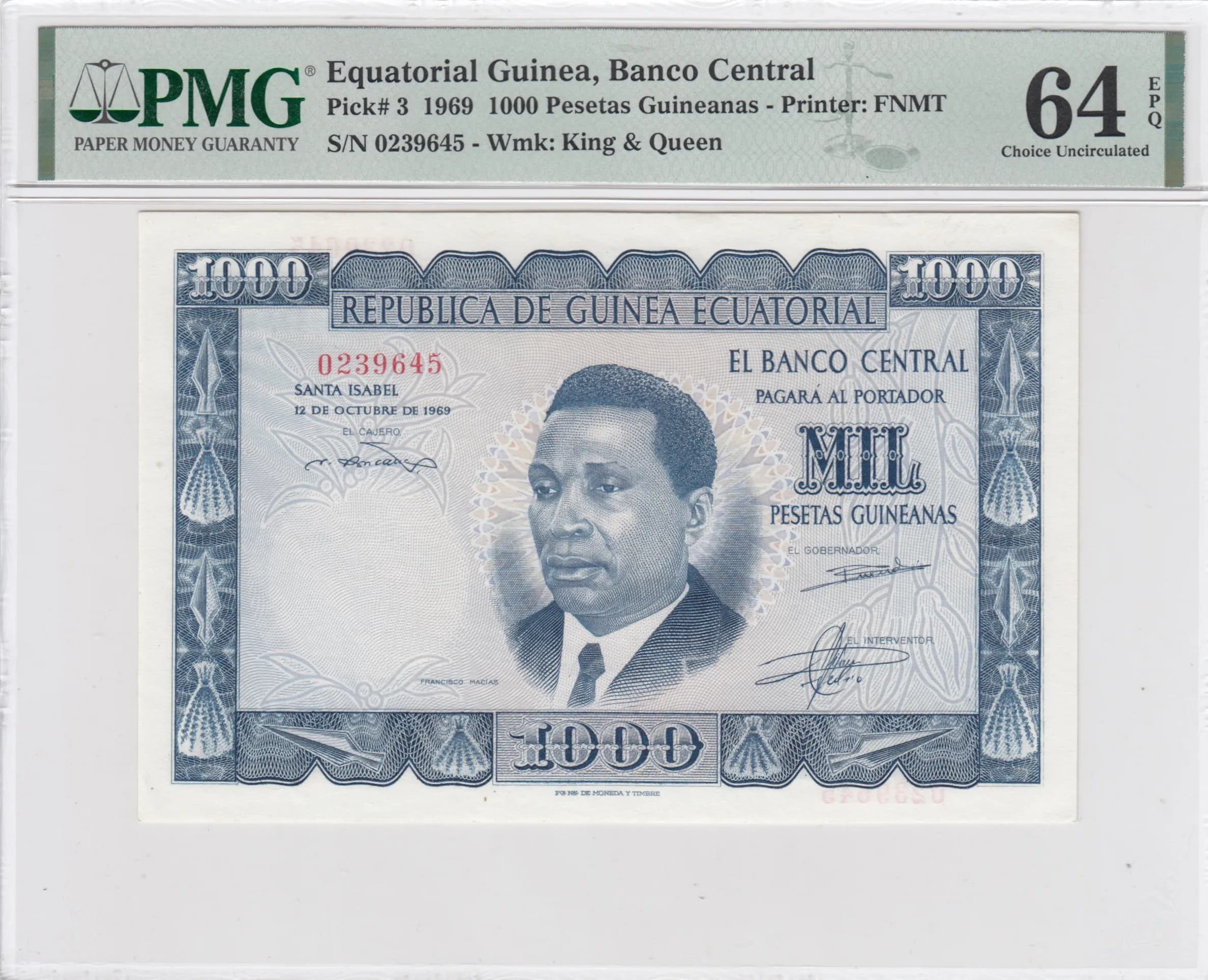
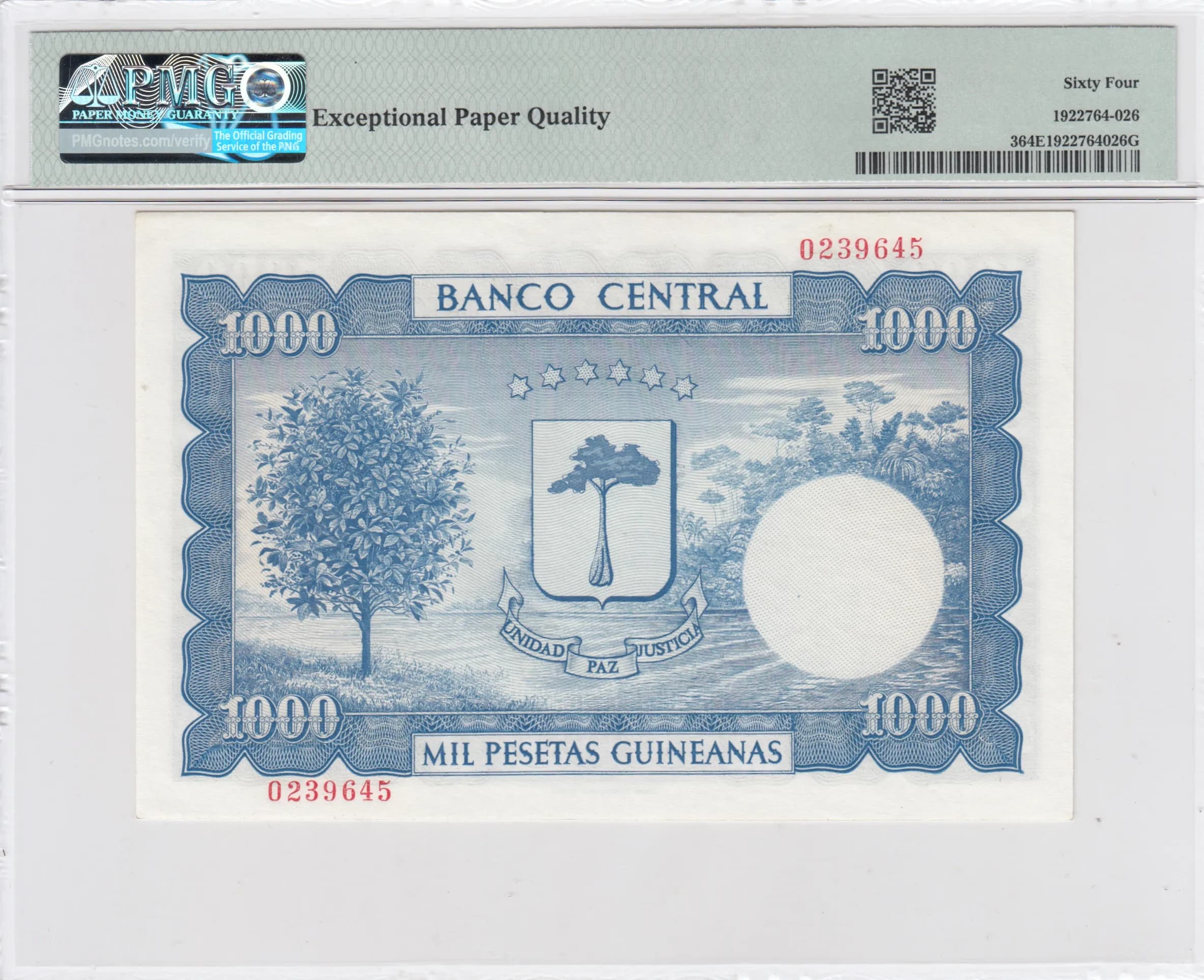
This 1000 Pesetas Guineanas note from 1969 is a beautiful example of Equatorial Guinea's early currency issued by Banco Central. The note features a formal portrait of a man in business attire on the obverse and a distinctive heraldic landscape design on the reverse, with both sides rendered in elegant blue and white with ornate shell-motif borders. Graded PMG 64 Choice Uncirculated EPQ, this note exhibits pristine condition with exceptional paper quality and sharp, clean printing throughout, representing an important piece of Equatorial Guinea's early independence-era numismatic heritage.
Common. The 1000 Pesetas Guineanas from 1969 (Pick P-3) is a standard-issue banknote from the early circulation period of Equatorial Guinea's currency. With a PMG grade of 64 (Choice Uncirculated), this note is in above-average condition but not exceptionally rare. The note was part of the regular currency issue from Banco Central and would have been produced in quantities sufficient for normal monetary circulation. Unless specific information about extremely limited print runs or early recall exists, this denomination from this period should be considered common in the overall context of world banknotes, though examples in PMG 64 EPQ condition command a modest premium over lower grades.
Issued on October 12, 1969, just one year after Equatorial Guinea's independence from Spain (October 12, 1968), this note represents the fledgling nation's establishment of its own monetary system under the Banco Central. The heraldic shield on the reverse, featuring a distinctive tall tree and the national motto 'UNIDAD PAZ JUSTICIA' (Unity Peace Justice), symbolizes the new republic's aspirations during its early post-colonial period under President Francisco Macías Nguema, whose name appears on the obverse. The bearer-to-order design and Spanish-language inscriptions reflect the nation's colonial heritage while asserting its new independence.
The obverse presents a formal frontal portrait of an unidentified dignitary in Western business attire (suit and tie), centered within an ornate rectangular frame. The design employs decorative shell or fan-shaped motifs along the left and right borders, with geometric patterns creating an elegant frame. The issuing information and denomination are distributed around the portrait, with the place of issue (Santa Isabel) and date (12 DE OCTUBRE DE 1969) prominently featured. The reverse displays the national heraldic design at center: a tall tree within a shield, surrounded by a curved arrangement of stars above, with the national motto 'UNIDAD PAZ JUSTICIA' inscribed in a banner beneath. The landscape composition suggests the natural environment of Equatorial Guinea, with trees and vegetation depicted in the background. Denomination indicators appear in all four corners, with institutional information at top and bottom. Both sides maintain the blue and white color scheme with fine line engraving throughout.
FRONT SIDE: '1000' (denomination), 'REPÚBLICA DE GUINEA ECUATORIAL' (Republic of Equatorial Guinea), 'EL BANCO CENTRAL' (The Central Bank), 'PAGARÁ AL PORTADOR' (Will Pay to Bearer), 'MIL' (Thousand), 'PESETAS GUINEANAS' (Guinean Pesetas), '0239645' (serial number), 'SANTA ISABEL' (Santa Isabel - the capital), '12 DE OCTUBRE DE 1969' (October 12, 1969), 'EL CAJERO' (The Cashier), 'EL GOBERNADOR' (The Governor), 'EL INTERVENTOR' (The Inspector), 'FRANCISCO MACIAS' (Francisco Macías). BACK SIDE: '1000' (denomination repeated in corners), 'BANCO CENTRAL' (Central Bank), 'MIL PESETAS GUINEANAS' (Thousand Guinean Pesetas), 'UNIDAD' (Unity), 'PAZ' (Peace), 'JUSTICIA' (Justice), '0239645' (serial number).
The note exhibits characteristics of intaglio engraving, the standard security printing method for currency of this era. The fine line patterns, ornate border work, and sharp detail visible in both the portrait and landscape elements indicate traditional engraved plates used in offset printing. The precise registration of colors and the crisp reproduction of geometric and natural design elements are consistent with high-security currency production techniques employed by established security printers of the late 1960s. The watermark area (King & Queen watermark as noted in PMG assessment) and the overall print quality suggest production by a professional international security printer, likely a European firm with experience in Spanish-language colonial currency.
Serial number observed: 0239645. This appears to be a standard first-issue note from the 1969 series. Specific varieties for P-3 may exist based on signature variations (El Gobernador, El Interventor, El Cajero positions), different serial number prefixes, or printing runs from different security printers, but without comprehensive variety catalogs specific to Equatorial Guinea's early currency, individual varieties cannot be definitively identified from this single example. Collectors should note signature types and serial number patterns when building collections of this issue.