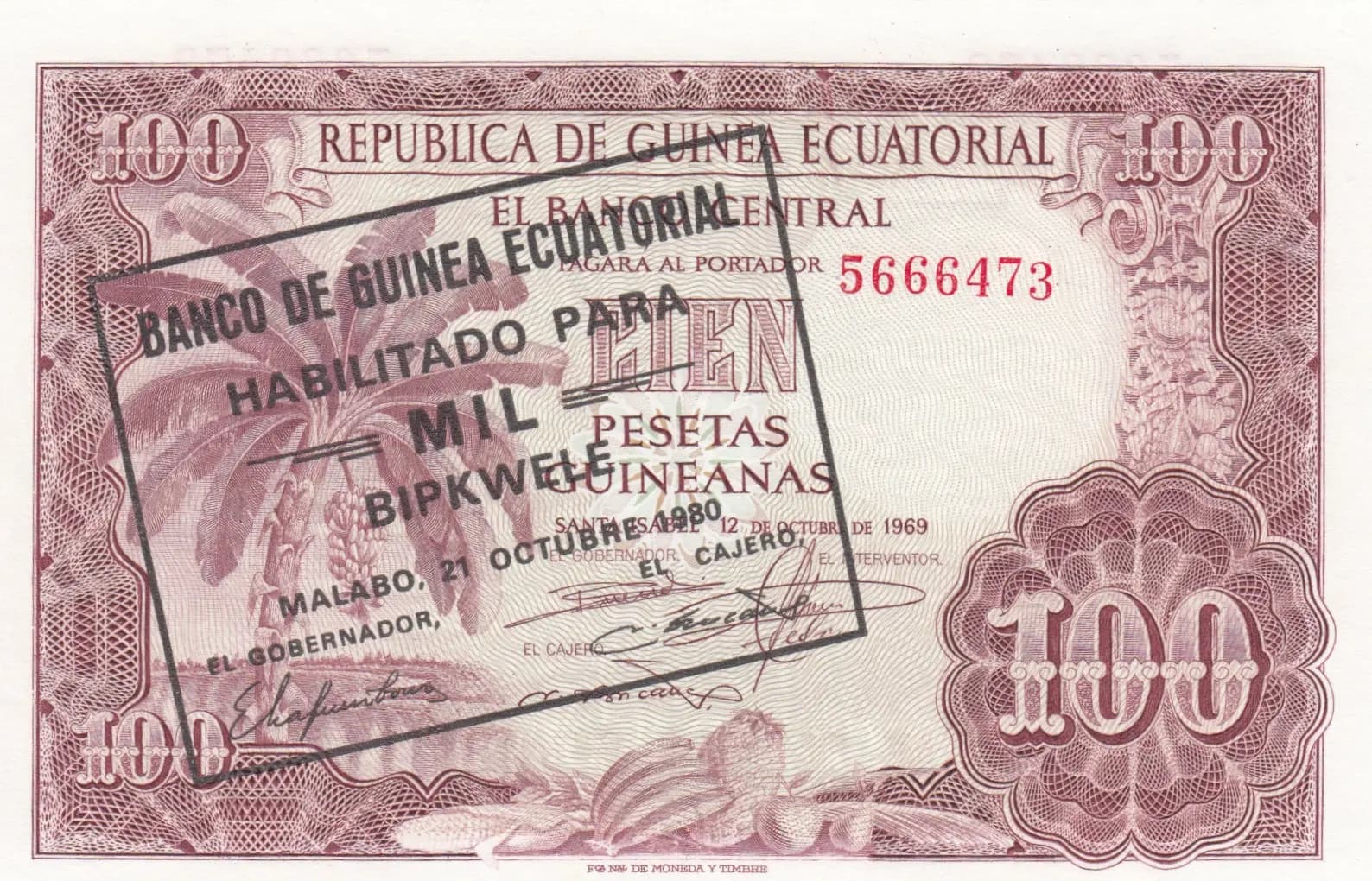
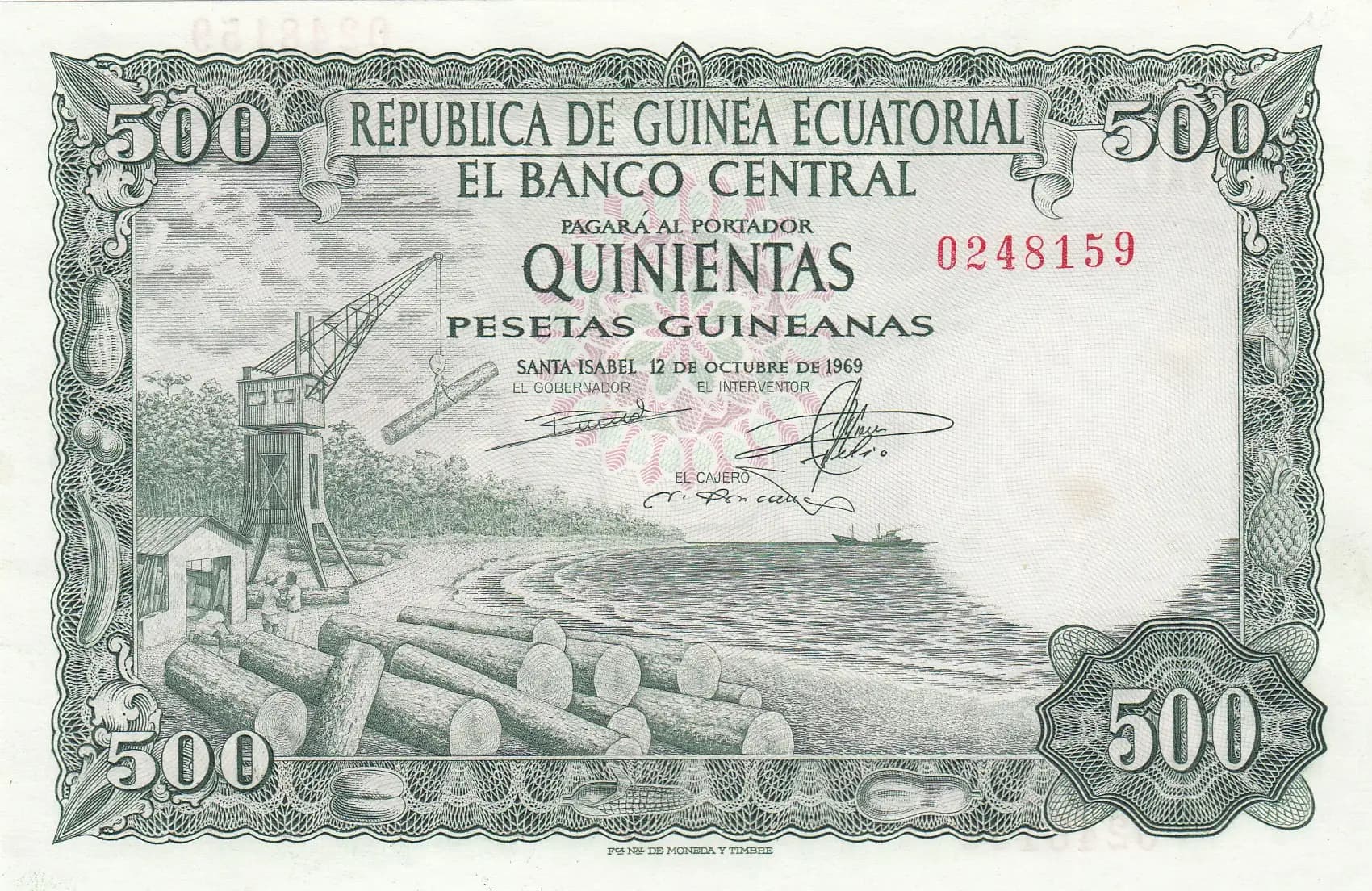
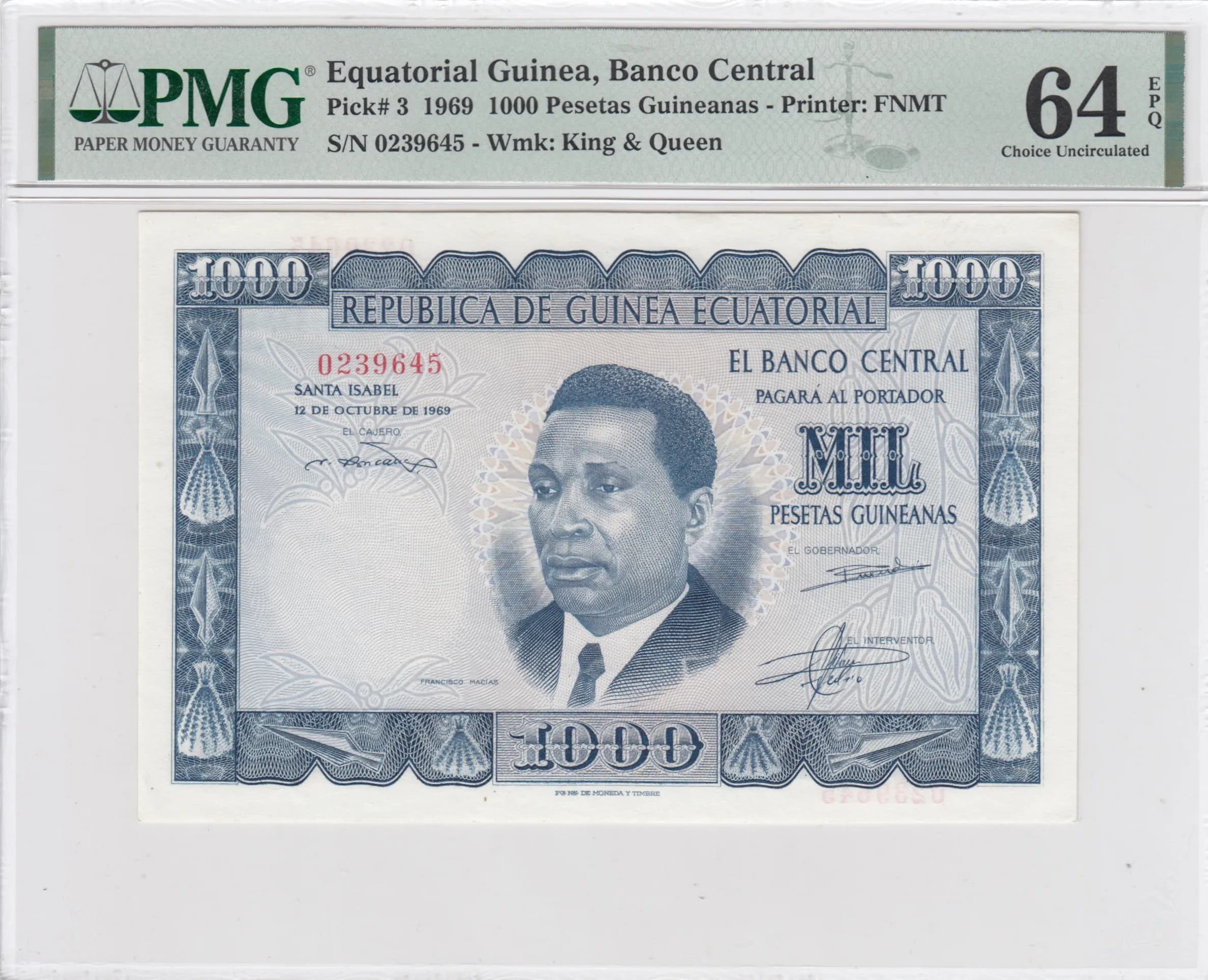
100 pesetas 1969
Market Prices
21 salesAbout This Note
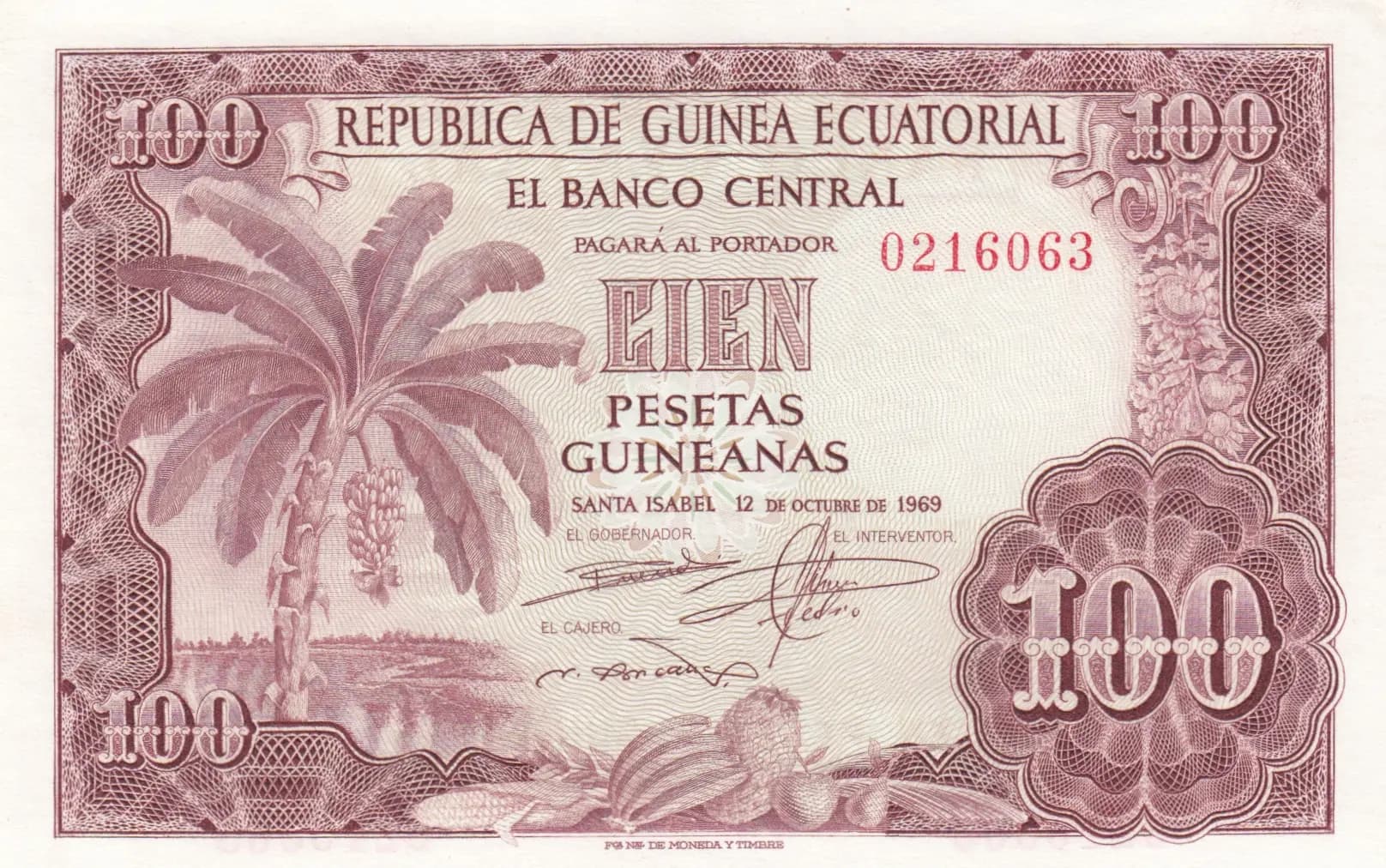
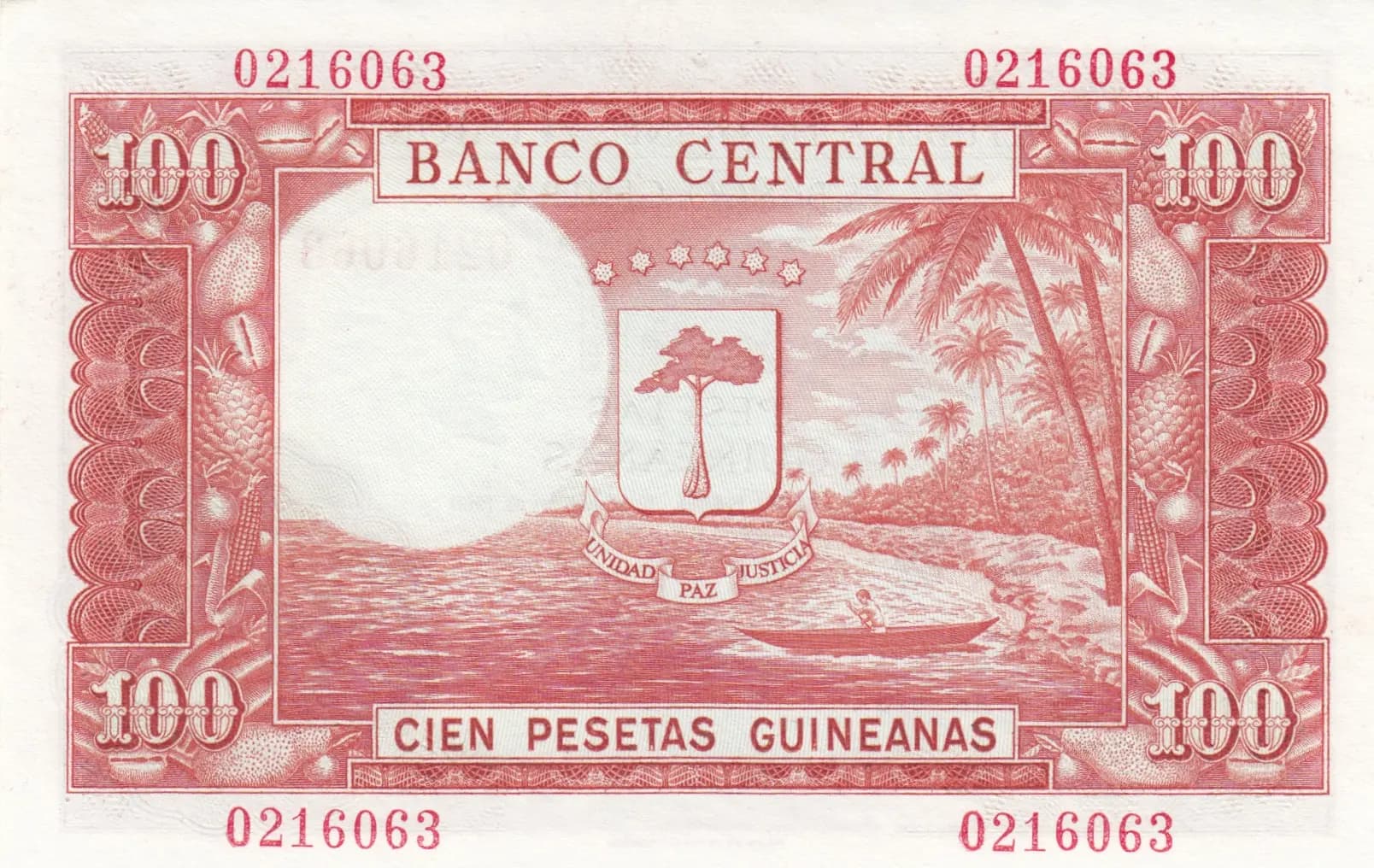
This is a striking first-issue 100 Pesetas Guineanas banknote from Equatorial Guinea's Banco Central, dated October 12, 1969, in uncirculated condition. The obverse features a beautifully engraved banana plant with prominent fruit bunches set against a cream and burgundy color scheme with ornate decorative borders, while the reverse showcases a tropical landscape with palm trees, a central ceremonial tree, coastal scenery, and the national coat of arms. The sharp engraving, pristine condition, and historical significance as the earliest pesetas issue make this an important piece of Equatorial Guinea's monetary heritage.
Common. Market data from realbanknotes.com shows regular sales activity with UNC examples consistently selling in the $27–$34 range across multiple transactions from 2013 to 2025, indicating steady collector demand but not scarcity. The 2019 catalogue value of $40 for UNC examples is modest for a first-year independence issue, and the frequency of eBay sales (over 20 recorded transactions across all grades) demonstrates adequate supply in the collector market. While this is the first and only Pesetas Guineanas issue before the currency was replaced by the Ekuele in 1975, the print run was sufficient to maintain common status.
Issued just as Equatorial Guinea achieved independence from Spain on October 12, 1969, this banknote represents the country's first currency under the newly-formed República de Guinea Ecuatorial. The imagery reflects the nation's tropical agricultural economy and natural resources—the banana plant symbolizing the country's primary export crop, while the coastal landscape and vegetation emphasize the nation's equatorial geography and biological wealth. The national motto 'Unidad Justicia Paz' (Unity Justice Peace) displayed on the reverse underscores the ideals of the newly independent nation.
The obverse depicts an agricultural motif centered on a mature banana plant with multiple fruit bunches in the left portion, symbolizing Equatorial Guinea's primary export commodity. The design is framed by ornate burgundy and mauve decorative borders featuring detailed corner cartouches with floral patterns and fine guilloche work typical of currency design of the era. The reverse presents a panoramic tropical landscape featuring a prominent ceremonial or baobab tree in the center, flanked by palm trees, with a setting sun or moon on the horizon and coastal water elements visible in the composition. The national coat of arms shield is centrally positioned on the reverse, incorporating a tree emblem and banner with the national motto. Decorative pineapple motifs appear in the border designs, reinforcing the equatorial agricultural theme. Both sides employ the light cream and beige underprint with burgundy, mauve, and coral overprinting.
FRONT: '100' and 'CIEN PESETAS GUINEANAS' (One Hundred Guinean Pesetas); 'REPÚBLICA DE GUINEA ECUATORIAL' (Republic of Equatorial Guinea); 'EL BANCO CENTRAL' (The Central Bank); 'PAGARÁ AL PORTADOR' (Will Pay to Bearer); 'SANTA ISABEL 12 DE OCTUBRE DE 1969' (Santa Isabel October 12, 1969); signature lines for 'EL GOBERNADOR' (The Governor), 'EL INTERVENTOR' (The Controller), and 'EL CAJERO' (The Cashier); 'POR JOSÉ DE MONEDA Y TIMBRES' (By José of Currency and Stamps—printer attribution); Serial number '0216063'. BACK: '100' and 'CIEN PESETAS GUINEANAS' (One Hundred Guinean Pesetas); 'BANCO CENTRAL' (Central Bank); Serial number '0216063' (repeated in four corners); 'UNIDAD JUSTICIA PAZ' (Unity Justice Peace).
Steel engraving and intaglio printing, executed by the Fábrica Nacional de Moneda y Timbre (FNMT) in Madrid. The fine line work visible in the decorative borders, particularly the ornate guilloche patterns and detailed landscape engraving on the reverse, demonstrates the high-quality security printing standards characteristic of FNMT production. The sharp clarity of all impressions, fine detail in the botanical engravings, and precise color registration indicate professional-grade currency production techniques.
This is Pick-1, the base variety for the first 100 Pesetas Guineanas issue. The PMG population report indicates a variant P-1s exists (likely a specimen note). The serial number observed on this example is 0216063. No evidence of overprints, emergency issues, or replacement notes is visible. This represents the standard regular issue from the October 12, 1969 inaugural release by the Banco Central of the newly independent Republic of Equatorial Guinea.