2 colones 1976
Market Prices
21 salesAbout This Note
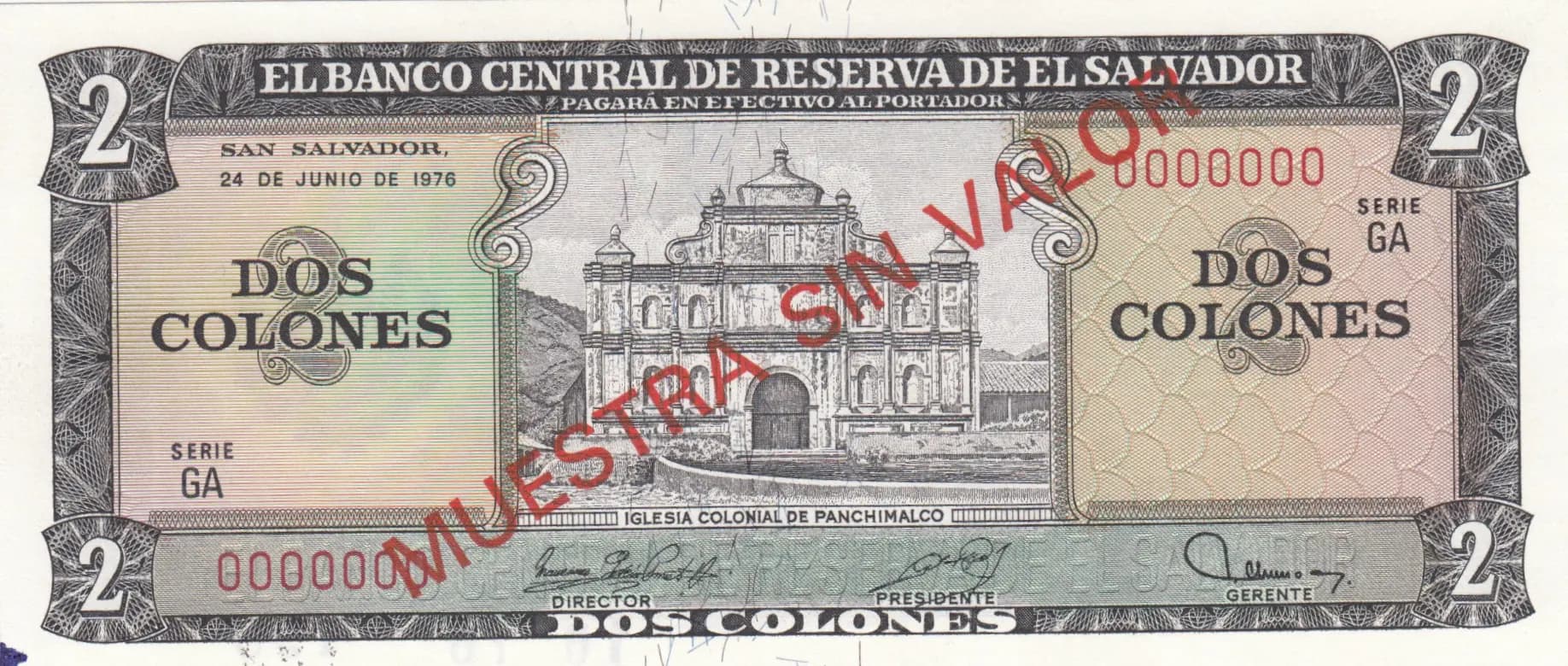
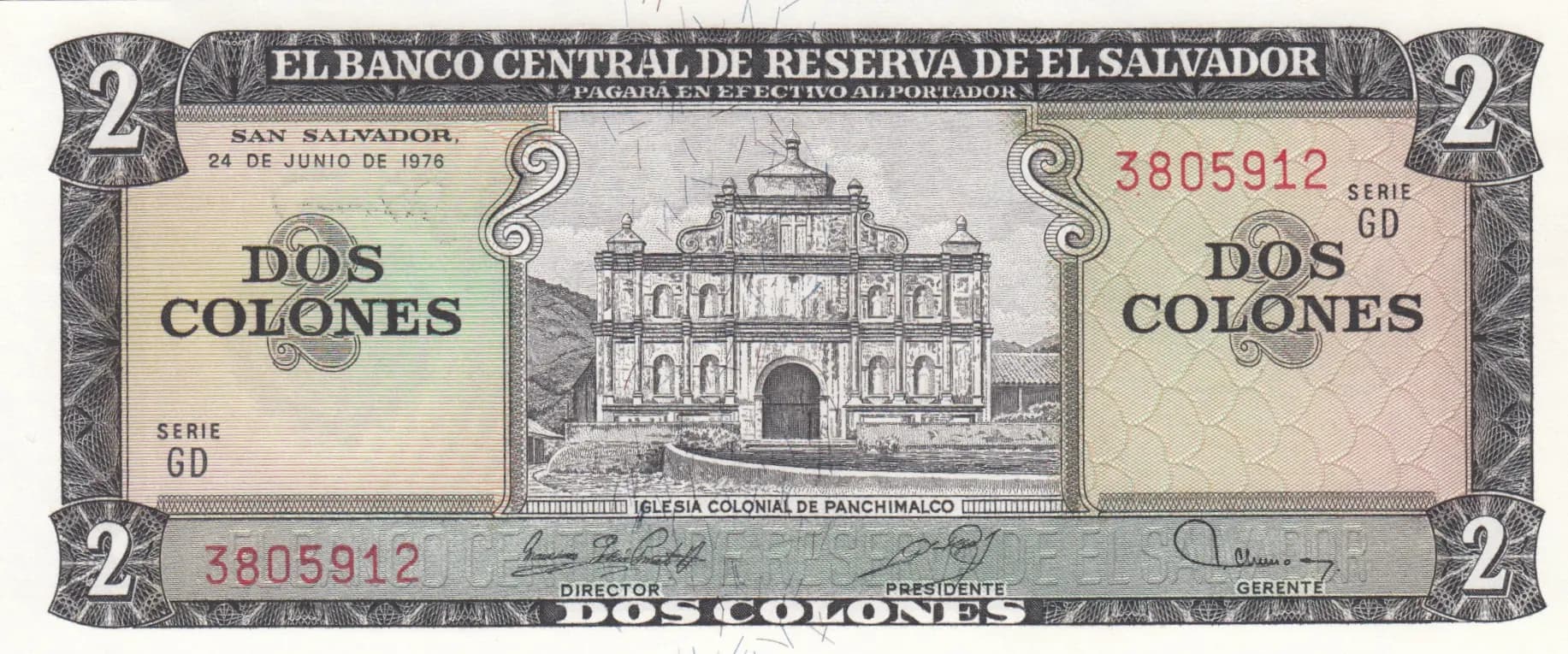
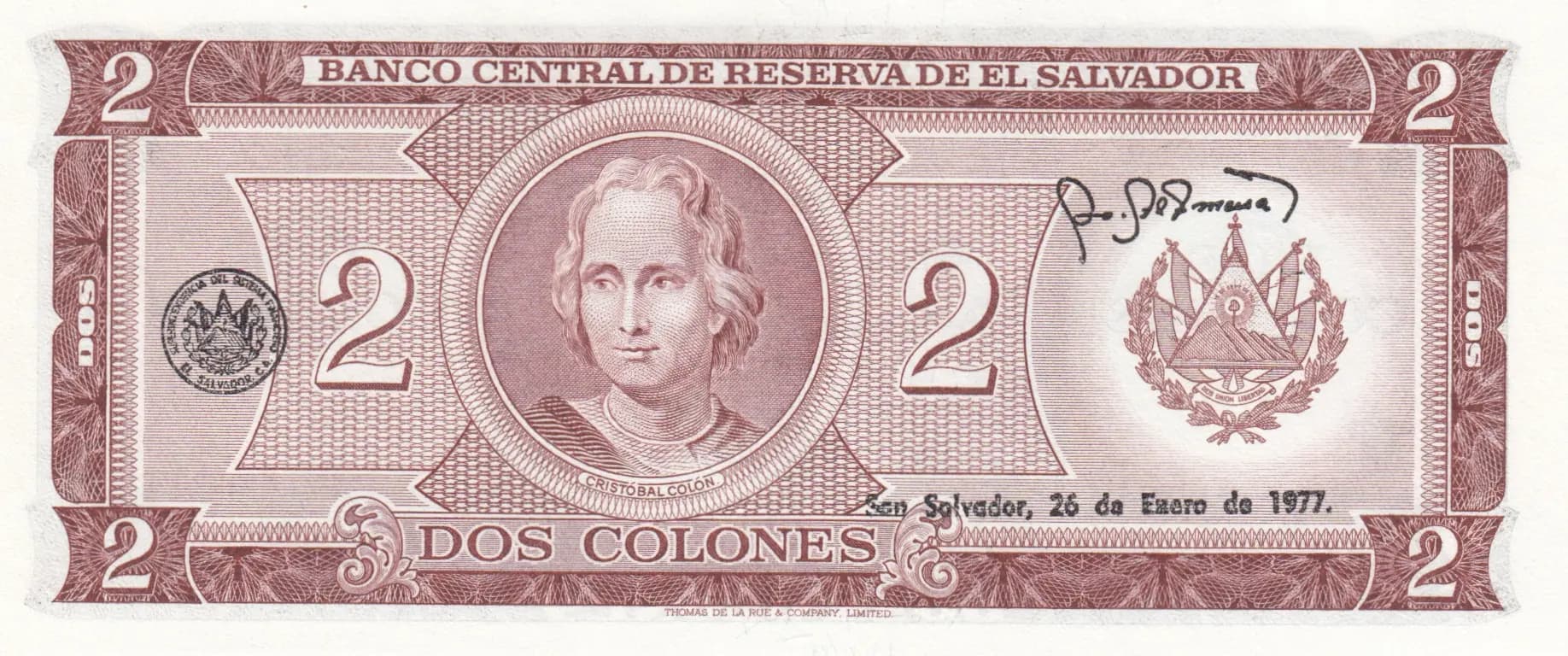
This is a well-preserved uncirculated example of El Salvador's 2 colones banknote from 1976, featuring the iconic Colonial Church of Panchimalco on the obverse and a portrait of Christopher Columbus on the reverse. The note displays crisp, clear printing with no visible creases, tears, or wear, exemplifying the high-quality intaglio work characteristic of Thomas de la Rue production. With consistent eBay market pricing around $15-25 for UNC examples in recent years, this note represents an accessible entry point into Central American currency collecting.
Common. This is a regular-issue banknote with substantial circulation and multiple printings. The eBay market data demonstrates consistent availability, with UNC examples regularly selling in the $15-25 range and lower-grade examples available for under $15. The note has been readily available in the collector market for decades, and no specific scarcity indicators are evident from print run data or catalog information. The catalog value of $22 for UNC (2019) further confirms common status.
Issued in 1976 by the Banco Central de Reserva de El Salvador, this banknote commemorates two key elements of Salvadoran identity: the Colonial Church of Panchimalco, representing the nation's Spanish colonial heritage and architectural legacy, and Christopher Columbus, whose voyages initiated the European contact that shaped Central American history. The dual imagery reflects El Salvador's positioning between its indigenous past and European colonial legacy during a period of relative economic stability before the nation's internal conflicts of the 1980s.
The obverse features a detailed engraved representation of the Iglesia Colonial de Panchimalco, a multi-story colonial church structure with ornate architectural detailing, centered on the note with decorative spiral and scrollwork ornaments flanking both sides. The denomination '2' appears in all four corners with 'DOS COLONES' text positioned at left and right. The reverse showcases a classical portrait of Christopher Columbus (Cristobal Colón) depicted in left-facing profile within an ornate circular frame, with his characteristic curled hair rendered through fine line engraving. The Salvadoran national coat of arms appears on the right side of the reverse, featuring national symbols including architectural elements and heraldic wreath. Both sides employ extensive guilloche patterning as background security elements, and signature lines for Director, President, and Manager appear on the obverse.
Front side: 'EL BANCO CENTRAL DE RESERVA DE EL SALVADOR' (The Central Reserve Bank of El Salvador), 'PAGARA EN EFECTIVO AL PORTADOR' (Will pay in cash to the bearer), '24 DE JUNIO DE 1976' (June 24, 1976), 'DOS COLONES' (Two Colones), 'SERIE GD' (Series GD), Serial number 3805912, 'IGLESIA COLONIAL DE PANCHIMALCO' (Colonial Church of Panchimalco), 'DIRECTOR' (Director), 'PRESIDENTE' (President), 'GERENTE' (Manager). Back side: 'BANCO CENTRAL DE RESERVA DE EL SALVADOR' (Central Reserve Bank of El Salvador), 'CRISTOBAL COLON' (Christopher Columbus), 'DOS COLONES' (Two Colones), 'San Salvador, 26 de Enero de 1977' (San Salvador, January 26, 1977), 'TOLLES DE LA RUE & COMPANY, LIMITED' (printer attribution).
Intaglio (engraved) printing executed by Thomas de la Rue, London, one of the world's premier security printers. The visual analysis reveals characteristic features of high-quality intaglio production including fine line engraving throughout the design, detailed portrait work with precise cross-hatching, intricate guilloche patterns, and crisp impression quality. The note was printed without a watermark, relying instead on the artistic complexity and multi-color intaglio work for security.
The examined note is Series GD with serial number 3805912, printed in red. The back inscription shows a date of January 26, 1977 (San Salvador, 26 de Enero de 1977), which differs from the front issuance date of June 24, 1976, a common characteristic of banknote production where obverse and reverse plates may be printed separately. PMG has catalogued P-124a as a variant of this Pick number; without additional identifying information on the specimen examined, it cannot be definitively assigned to a specific sub-variety, though the standard characteristics match the base P-124 designation.