5 pesos 1909
Market Prices
About This Note
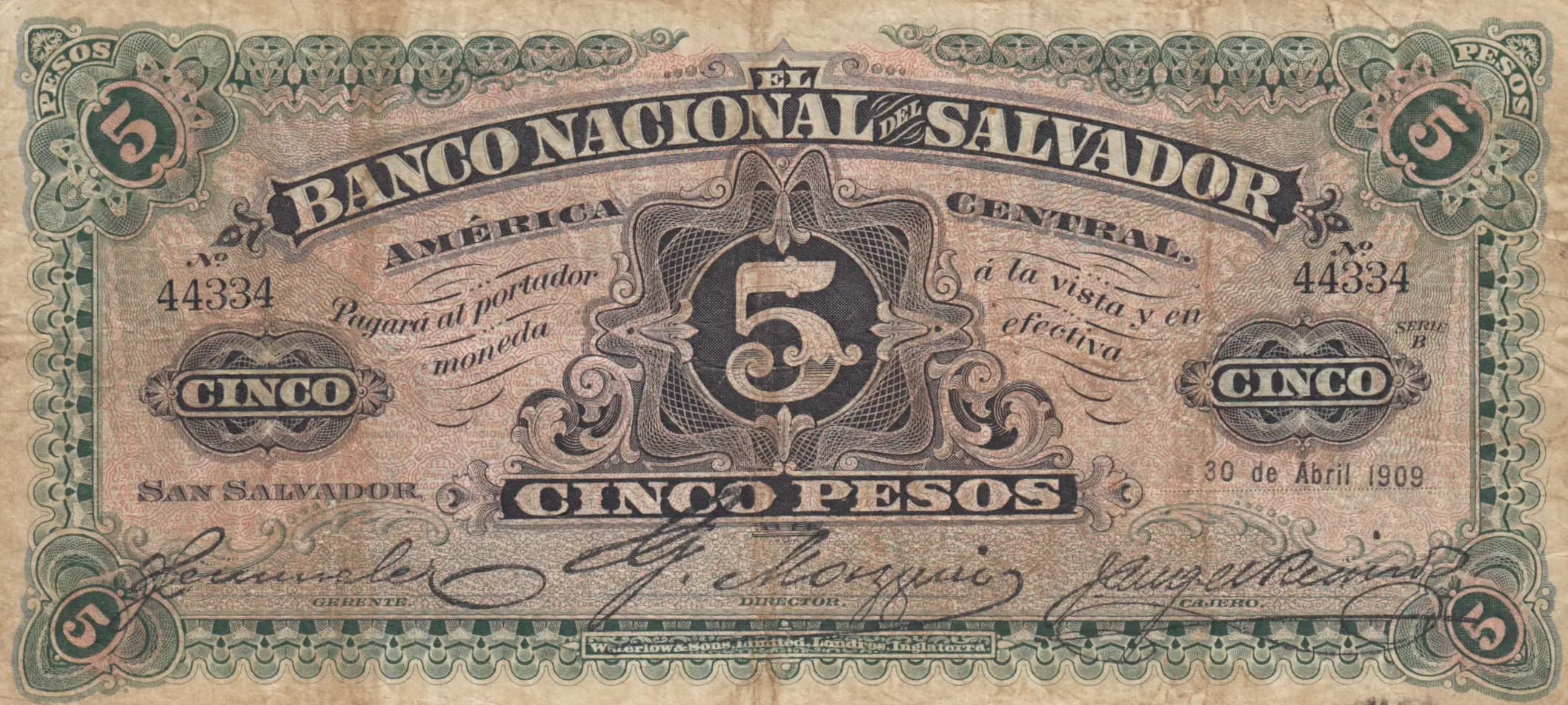
This is a 5 Pesos note from the Banco Nacional del Salvador dated April 30, 1909, representing an early example of El Salvador's national currency during the pre-revolutionary period. The note displays the characteristic ornate design of early 20th-century Central American banking with elaborate guilloche work and decorative border elements in black, green, and tan tones. In Fair condition, the note shows significant age-related wear including creasing, folds, and foxing, yet retains legible inscriptions and the intricate engraved details that define this classic issue.
Common. The eBay price tracking data shows a wide range of sales from $99.99 to $5,999.95, with most standard condition examples (VF grade) trading at $280.00 and unknown conditions between $100-$400. The presence of multiple eBay listings and the broad price range typical of regular-issue banknotes indicates this is not a scarce variety. Fair condition examples would typically fall in the lower to mid-range of recorded sales ($100-$300), confirming this is a commonly available issue from a regular production run by the Banco Nacional del Salvador.
Issued during the presidency of Fernando Figueroa, this 1909 note represents El Salvador's monetary system in the early 20th century before the country's significant political upheavals. The Banco Nacional del Salvador, established as the country's primary financial institution, issued this currency under the promise 'Pagará al portador moneda a la vista y en efectiva' (Will pay to bearer currency on sight and in cash), reflecting the gold standard monetary principles of the era. The ornamental design featuring the numeral 5 within elaborate scrollwork and botanical motifs exemplifies the security printing standards and aesthetic conventions of international banknote production during this period.
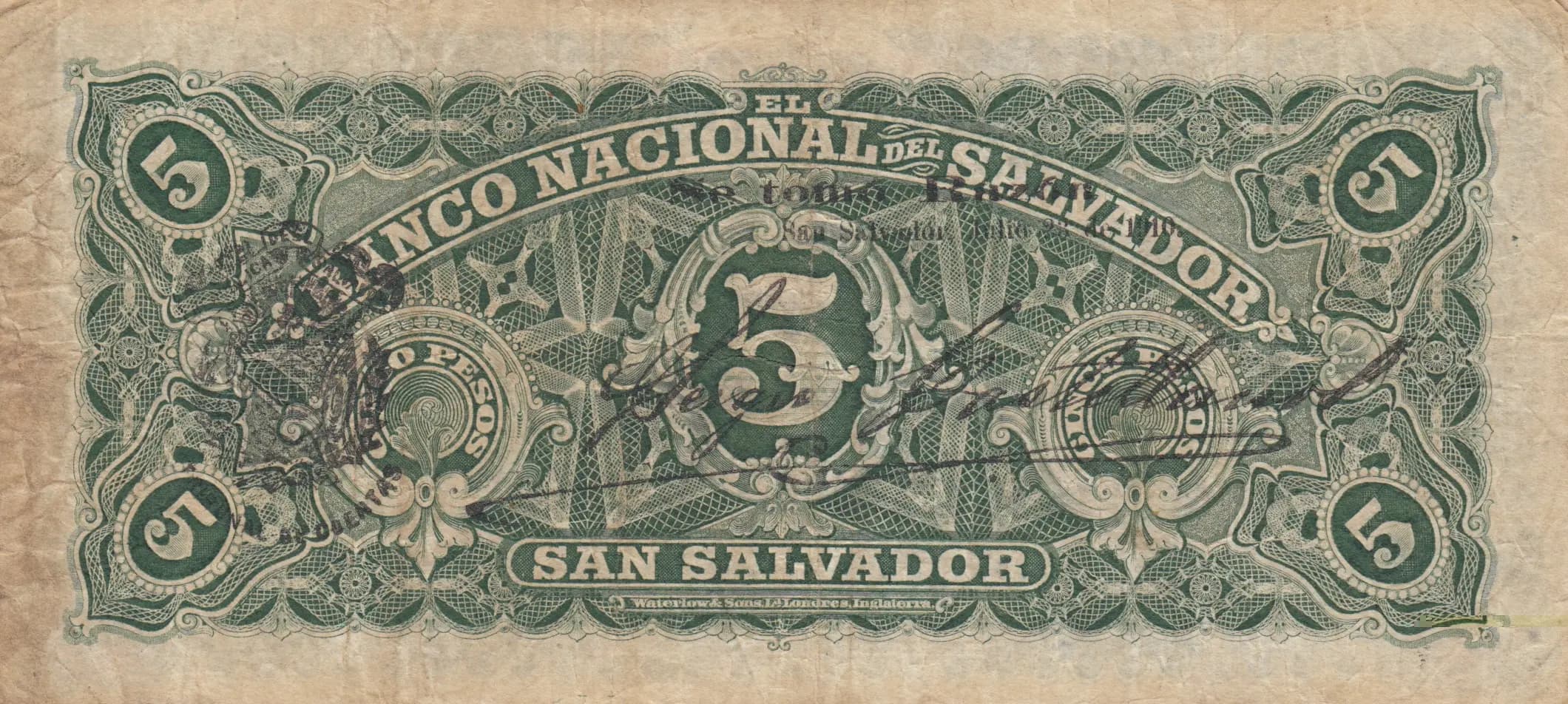
This banknote features a symmetrical design centered on a large ornamental cartouche displaying the numeral 5, which serves as the primary focal point on both front and back. The design employs extensive guilloche work with elaborate corner medallions containing decorative botanical and scrollwork motifs typical of Waterman & Sons security printing. The border consists of repeated ornamental patterns with fine line engraving throughout. The front includes three signature lines at the bottom for bank officials (Manager, Director, and Cashier), with the issue date prominently displayed. The back mirror the front's ornamental approach with similar corner seals and scrollwork arrangements. No portrait elements are present; instead, the security relies entirely on intricate decorative engraving and the complexity of the guilloche patterns.
FRONT: 'BANCO NACIONAL DEL SALVADOR' (National Bank of El Salvador), 'AMERICA CENTRAL' (Central America), 'CINCO PESOS' (Five Pesos), 'Pagará al portador moneda a la vista y en efectiva' (Will pay to bearer currency on sight and in cash), 'SAN SALVADOR', '30 de Abril 1909' (April 30, 1909), Serial number '44334', signature titles 'GERENTE' (Manager), 'DIRECTOR' (Director), 'CAJERO' (Cashier). BACK: 'EL BANCO NACIONAL DEL SALVADOR' (The National Bank of El Salvador), 'SAN SALVADOR', denomination numeral '5'.
Intaglio engraving (also known as steel engraving) on banknote stock, typical of security printing from this era. The note was produced by W&S (Waterman & Sons), a renowned international security printer. The detailed guilloche patterns, fine line work, and elaborate decorative elements visible throughout confirm the use of steel plate engraving with multiple color application (black, green, and tan/red underprint). The precision of the border designs and the depth of the engraved lines are characteristic of high-quality intaglio production from the early 20th century.
This note is identified as Series B with printed signatures, per the catalog reference (Pick P-S162c). The observed serial number '44334' falls within the range expected for this series. The specific date of 'Abril 30, 1909' (April 30, 1909) matches the catalog designation for the 1909-1913 issue period. The note exhibits characteristics consistent with the standard Series B variety; no significant overprints or unusual variants are evident from the visual analysis. Multiple signature combinations exist within the Series B designation, but this particular example represents the standard printed signature variety without additional overprints or modifications.