10 colones 1978 specimen
Market Prices
3 salesAbout This Note
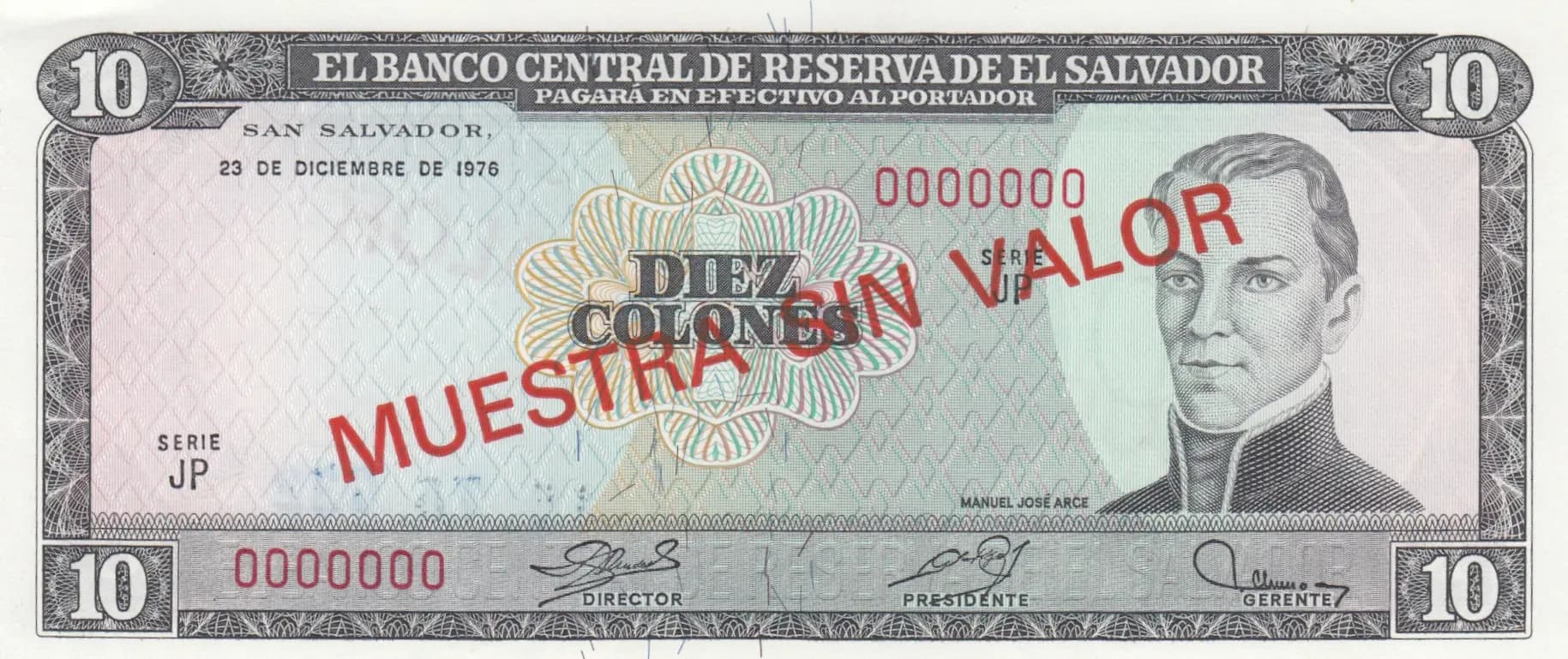
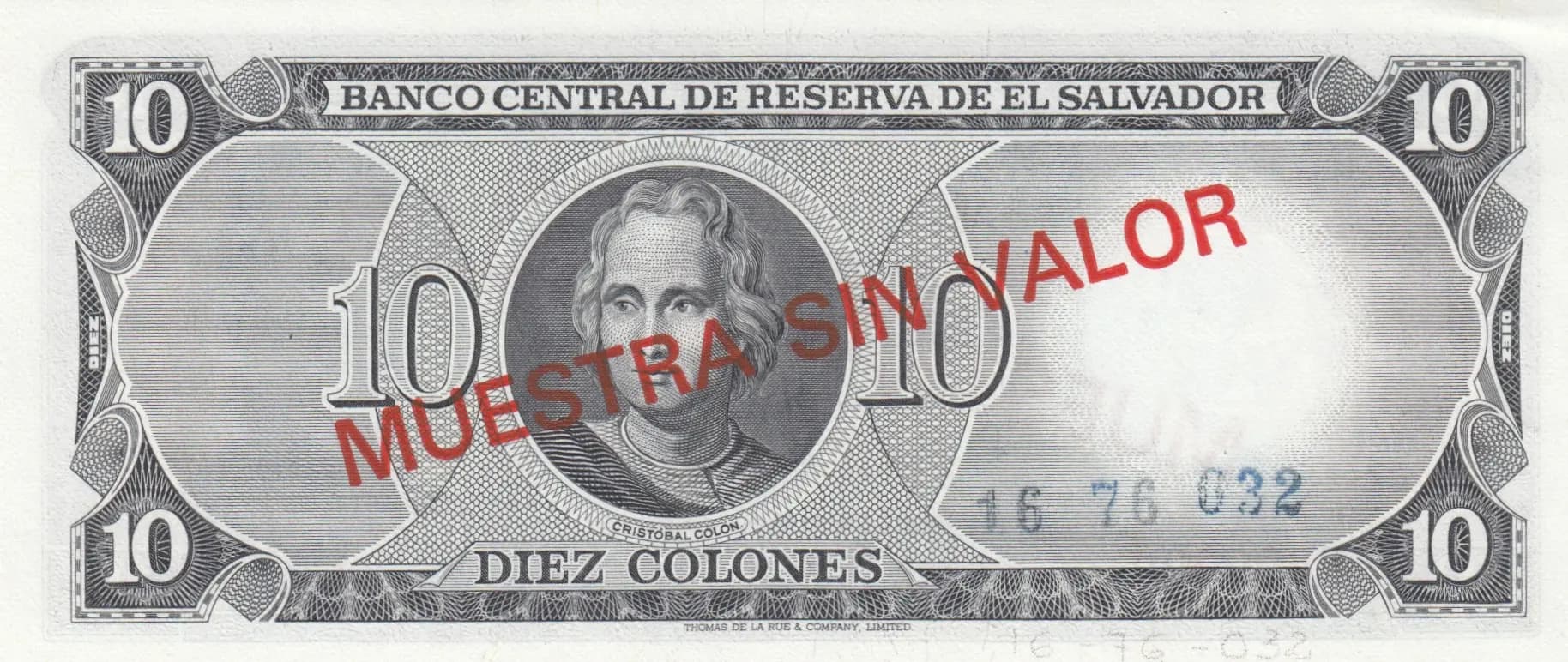
This is an uncirculated 1978 specimen note of the 10 Colones from El Salvador's Central Reserve Bank, printed by Thomas De La Rue. The note features Manuel José Arce on the front and Christopher Columbus on the back, both rendered in fine line engraving with exceptional clarity. As a specimen issue marked with prominent red "MUESTRA" and "SIN VALOR" overprints, this note represents an exceptional example of 1970s Central American currency design and remains in pristine condition with no visible wear.
Common. While this is a specimen note, which typically has a smaller print run than circulation issues, the eBay sales data shows these notes trading in the $35-$86 range in recent years (2018-2021), with UNC examples at approximately $80. This price point, combined with the availability of documented sales and PMG grading records, indicates the note is readily available in the collector market. Specimen overprints, while less common than circulation versions, were produced in sufficient quantity to supply banks and official institutions, resulting in a common designation for this issue.
This note was issued during a significant period in El Salvador's monetary history, reflecting the country's mid-to-late 20th century economic development. The choice of Manuel José Arce—El Salvador's first president—on the obverse honors the nation's founding leadership, while Christopher Columbus on the reverse connects El Salvador to the broader narrative of Central American colonial heritage. As a specimen note issued by the Banco Central de Reserva de El Salvador, it documents the institution's official currency designs during the late 1970s.
The obverse features a portrait of Manuel José Arce positioned on the right side in formal dress, shown in profile facing rightward. The center of the note contains an ornamental circular rosette pattern with intricate concentric geometric line work, serving as both a design element and security feature. The note employs a delicate pink/lavender background with detailed security patterns and radiating border designs in gray and black. Large "10" denominational numerals appear in all four corners within ornamental frames. The reverse presents a monochromatic design dominated by a central oval-framed portrait of Christopher Columbus with his characteristic long curly hair and formal period dress, surrounded by fine line engraved decorative elements and geometric patterns. Both sides feature complex security underprints and precision engraving throughout.
FRONT SIDE: "EL BANCO CENTRAL DE RESERVA DE EL SALVADOR" (The Central Reserve Bank of El Salvador); "PAGARÁ EN EFECTIVO AL PORTADOR" (Will pay in cash to bearer); "SAN SALVADOR, 23 DE DICIEMBRE DE 1976" (San Salvador, December 23, 1976); "DIEZ COLONES" (Ten Colones); "SERIE JP" (Series JP); "MUESTRA" (Specimen); "SIN VALOR" (Without value); "MANUEL JOSÉ ARCE" (portrait identification); signature lines labeled "DIRECTOR" (Director), "PRESIDENTE" (President), and "GERENTE" (Manager). BACK SIDE: "BANCO CENTRAL DE RESERVA DE EL SALVADOR" (Central Reserve Bank of El Salvador); "MUESTRA SIN VALOR" (Specimen without value); "10 / DIEZ COLONES" (10 / Ten Colones); "CRISTÓBAL COLÓN" (Christopher Columbus); "THOMAS DE LA RUE & COMPANY, LIMITED" (printer attribution).
Intaglio (engraved line printing), the standard method for high-security currency production. The visual characteristics—fine cross-hatching in portrait areas, intricate geometric line patterns, sharp definition of small details, and the precision of corner ornaments—are all hallmarks of intaglio printing. Thomas De La Rue & Company, Limited, one of the world's premier security printers, executed this design using traditional engraving techniques combined with multicolor offset printing for the background underprints, as evidenced by the layered color scheme on the obverse.
This is a specimen variety (Pick 129s) of the base 1978-1980 issue, as indicated by the prominent red diagonal "MUESTRA" and "SIN VALOR" overprints. The visual analysis indicates Series JP with specimen serial number 0000000. The front is dated December 23, 1976, though this note is cataloged as part of the 1978-1980 issuance period—a discrepancy potentially reflecting the design approval date versus circulation date. The PMG population report references P-129b as a variant, though the specimen version (P-129s, as presented here) represents the documented variety shown in the catalog data.