10 colones 1966
Market Prices
5 salesAbout This Note
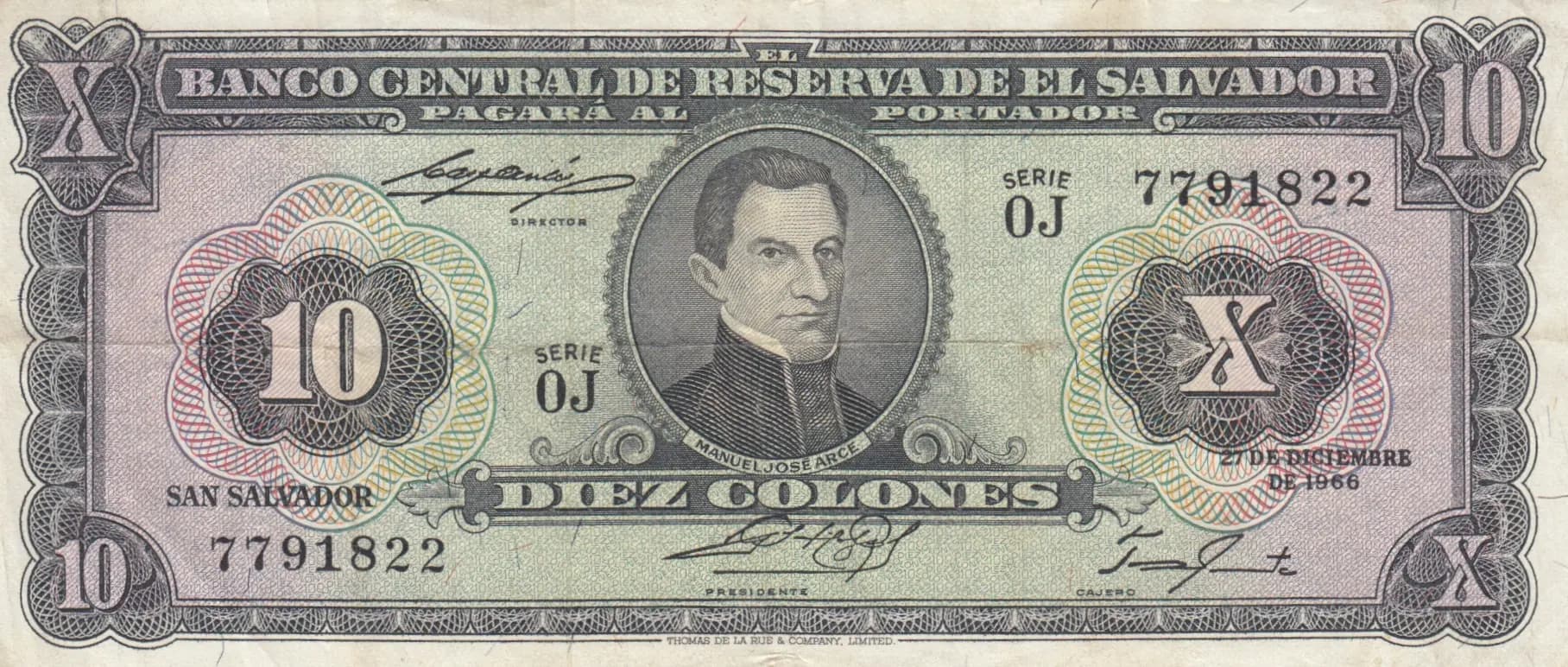
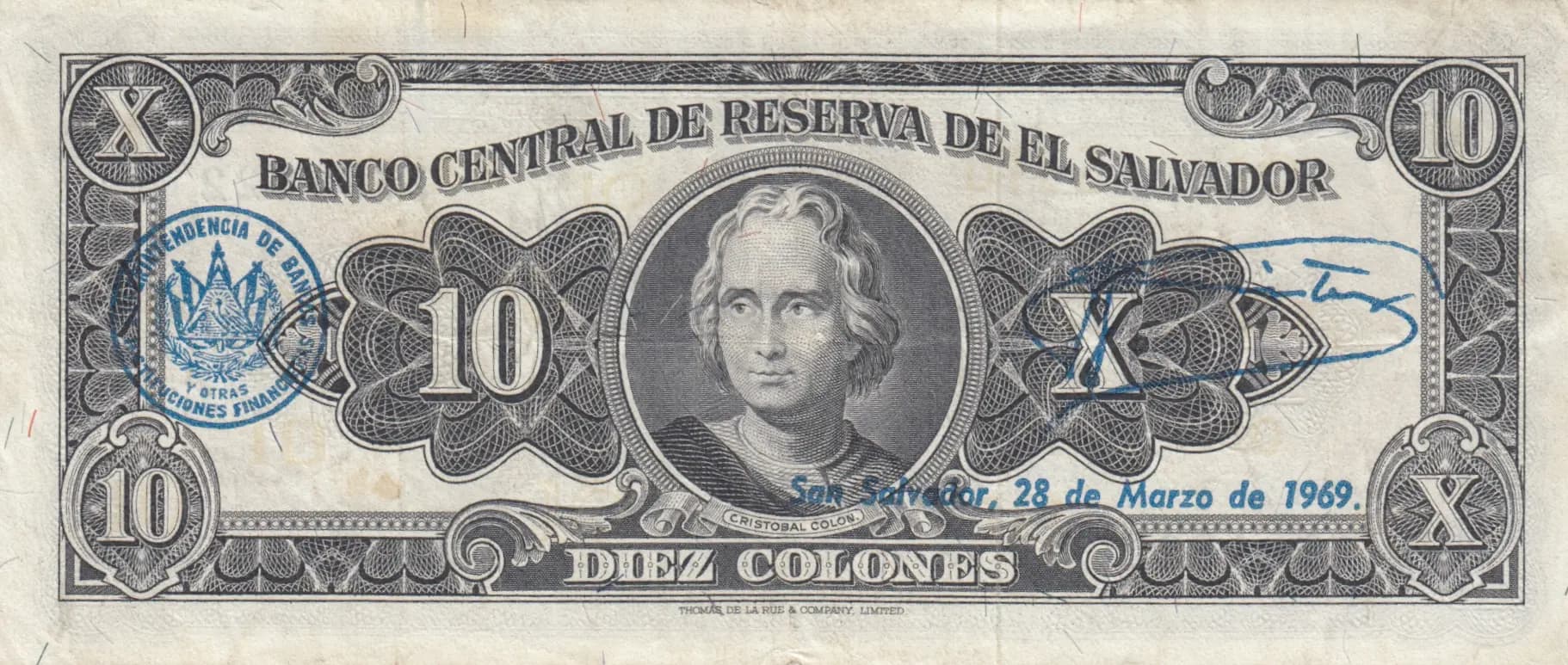
This is a VF-grade 10 colones note from El Salvador dated December 27, 1966, issued by the Banco Central de Reserva de El Salvador. The note features high-quality engraved portraits of Manuel José Arce on the obverse and Christopher Columbus on the reverse, with intricate ornamental borders and multicolored rosette patterns. Despite visible signs of circulation including creasing, discoloration, and foxing consistent with age, the note retains good clarity in its fine line work and design elements, making it a representative example of mid-1960s El Salvadoran currency.
Common. This note was part of a regular issue spanning 1962-1966 with significant circulation, as evidenced by recent eBay sales consistently below $50 (VF examples catalogued at $20 in 2019, with recent circulation-grade sales at $15-40). The series prefix 'OJ' and visible wear patterns indicate substantial original mintage. No print run restrictions, recall events, or short-lived issuing circumstances are documented for this Pick-103 variety.
This 1966 issue reflects El Salvador's monetary evolution during a period of Central American modernization under the Banco Central de Reserva's stewardship. The dual portraiture honors both Manuel José Arce, El Salvador's first president and founding figure, and Christopher Columbus, representing the colonial historical narrative common in Latin American numismatics of this era. The note's production by Thomas de la Rue, London's premier security printer, demonstrates the country's confidence in international-standard currency design during the mid-twentieth century.
The obverse features a classical left-facing profile portrait of Manuel José Arce, El Salvador's first constitutional president (1823-1828), rendered in fine engraving within a central oval frame. The design is anchored by symmetrical ornamental corner decorations containing the denomination '10,' with elaborate geometric rosette patterns in red, blue, yellow, and green flanking the portrait on both sides. The reverse displays a right-facing profile of Christopher Columbus (Cristóbal Colón) in a similar oval medallion format, with simplified corner ornaments and the denomination repeated. Both sides employ classical numismatic composition with decorative borders and include official insignia — a blue circular seal appears on the reverse left side. The overall aesthetic reflects late-19th/early-20th century security printing standards emphasizing intricate engraved detail as anti-counterfeiting measures.
OBVERSE: 'BANCO CENTRAL DE RESERVA DE EL SALVADOR' (Central Reserve Bank of El Salvador); 'PAGARA AL PORTADOR' (Payable to Bearer); 'DIEZ COLONES' (Ten Colones); 'MANUEL JOSE ARCE' (Manuel José Arce); 'SERIE OJ' (Series OJ); Serial number '7791822'; 'DE DICIEMBRE DE 1966' (Of December 1966); 'DIRECTOR' (Director); 'PRESIDENTE' (President); 'CAJERO' (Cashier). REVERSE: 'BANCO CENTRAL DE RESERVA DE EL SALVADOR' (Central Reserve Bank of El Salvador); 'DIEZ COLONES' (Ten Colones); 'CRISTOBAL COLON' (Christopher Columbus); '28 de Marzo de 1969' (March 28, 1969); 'PRESIDENCIA DE EL SALVADOR' (Presidency of El Salvador).
Intaglio/engraved process by Thomas de la Rue, London. The fine line work visible in the ornamental borders, rosette patterns, and portrait details, combined with the crisp denominational numerals and inscriptions, are characteristic of high-quality steel-plate engraving. The multicolor elements (red, blue, yellow, green) on the obverse suggest multiple passes or color separation plates typical of mid-20th century security printing, with colors applied to underprint before final overprinting of black design elements.
This specific example is from Series OJ with serial number 7791822, dated December 27, 1966. The reverse bears a later authentication date of March 28, 1969, which is typical for this issue series and represents official validation dating rather than original issuance. Multiple date varieties exist across the 1962-1966 issue period; this represents the final year variety. No overprints or significant varieties beyond serial number and series prefixes are observed.