5 piastres 1940
Market Prices
45 salesAbout This Note
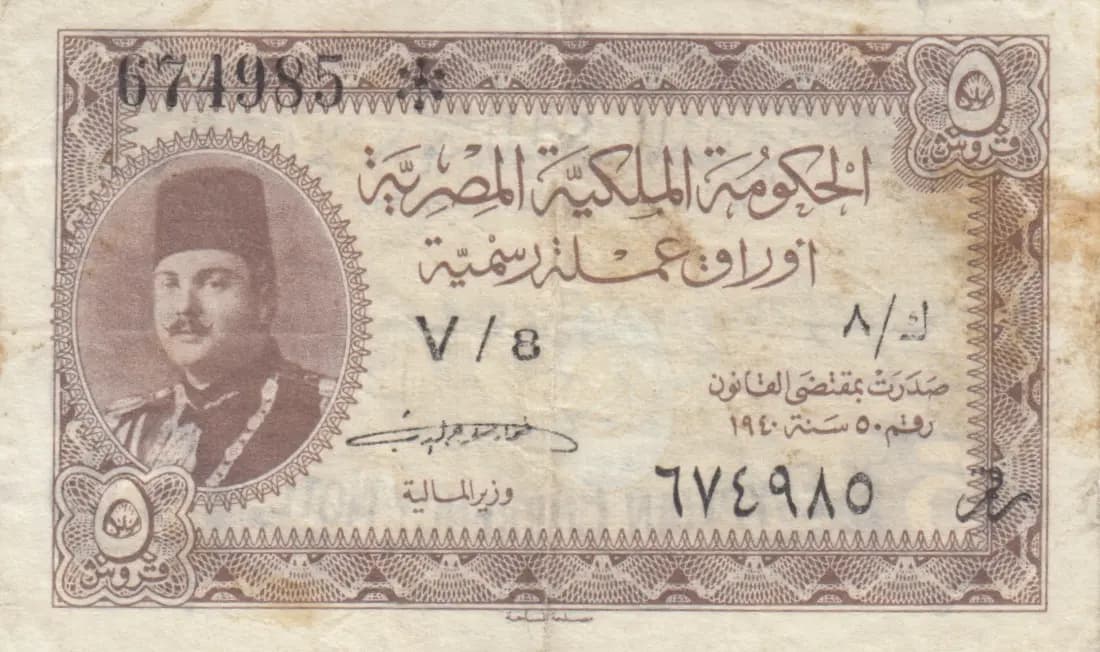
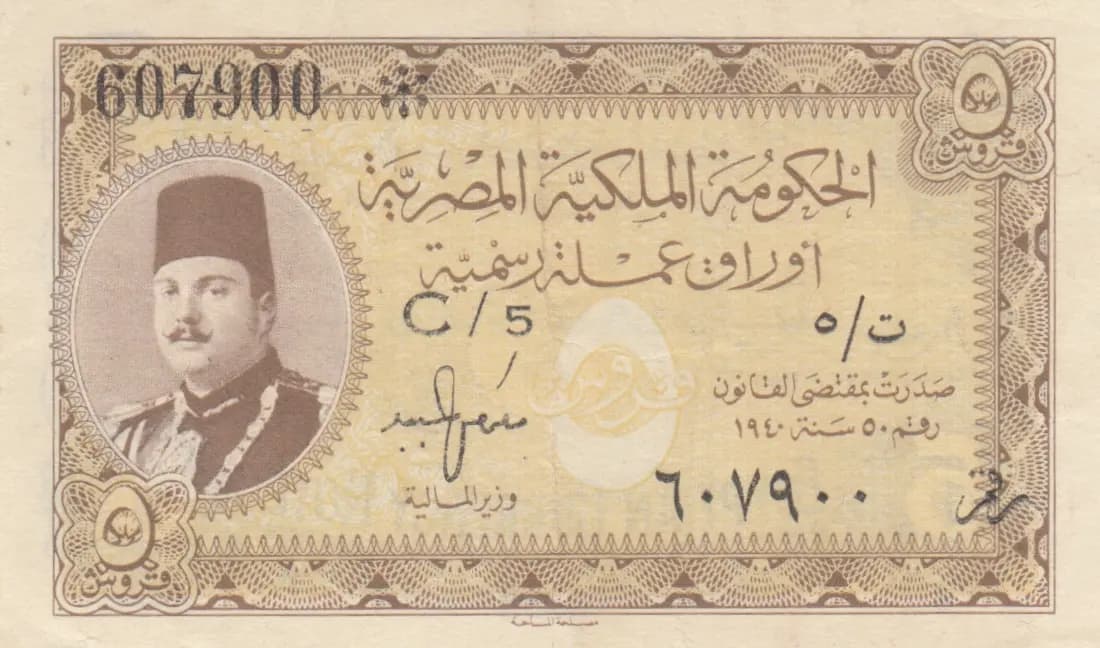
This Egyptian 5 Piastres note from 1940 presents a fine example of interwar Middle Eastern currency design, featuring an ornate portrait of King Farouk I in military dress within elaborate decorative borders. In VF condition, the note displays moderate aging with expected foxing and yellowing consistent with an 84-year-old banknote, while maintaining clear impressions and legible inscriptions across both sides. The intricate fine-line engraving and geometric patterns remain well-preserved, making this a representative specimen of Egypt's royal banking era.
Common. The eBay auction price data provided shows consistent sales in the VF grade ranging from approximately $20–$55 across multiple years (2009–2023), with the median transaction price for VF specimens around $23–$42. These moderate, steady prices indicate healthy supply and demand for this denomination and year. The note was produced under a standard government currency law (No. 50/1940) for regular circulation, and no evidence of small print runs, recalls, or rarity is present in the catalog data. This is a typical circulating banknote from Egypt's mid-20th century coinage era.
Issued under Law No. 50 of 1940 by the Royal Government of Egypt, this note reflects the period when King Farouk I (whose portrait dominates the obverse) reigned over Egypt during a pivotal moment in the nation's history—between the Anglo-Egyptian Treaty of 1936 and the tumultuous events leading to the 1952 revolution. The note's bilingual design (Arabic and English) and formal royal imagery underscore Egypt's status as a constitutional monarchy under British influence during this era. The attribution to the Survey of Egypt as printer indicates the note's official government production during the administration of Egypt's royal banking system.
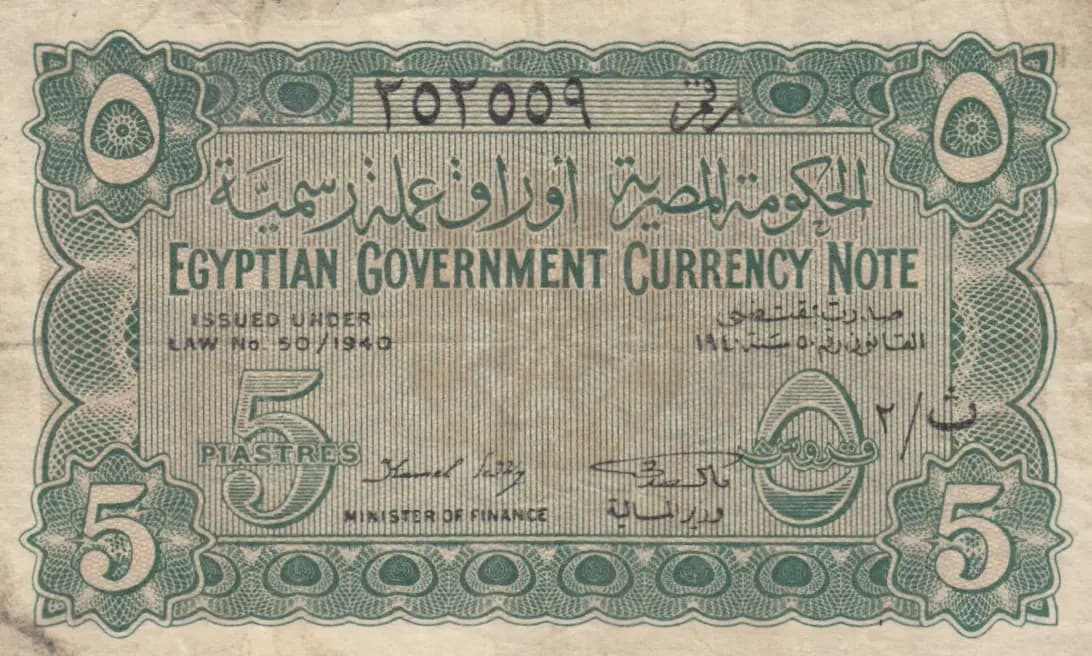
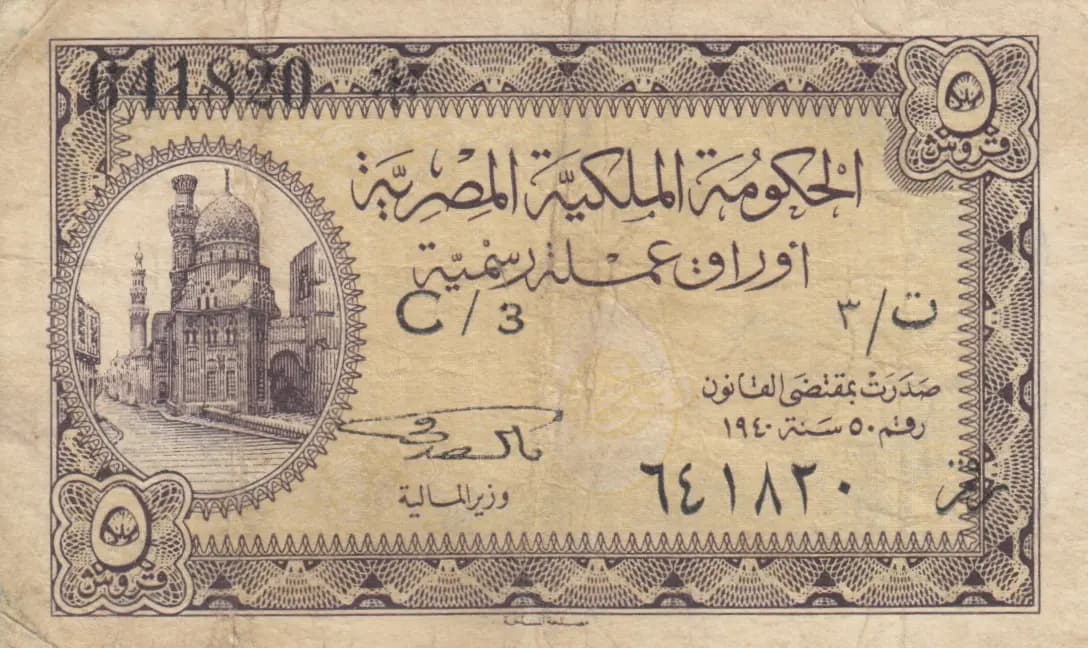
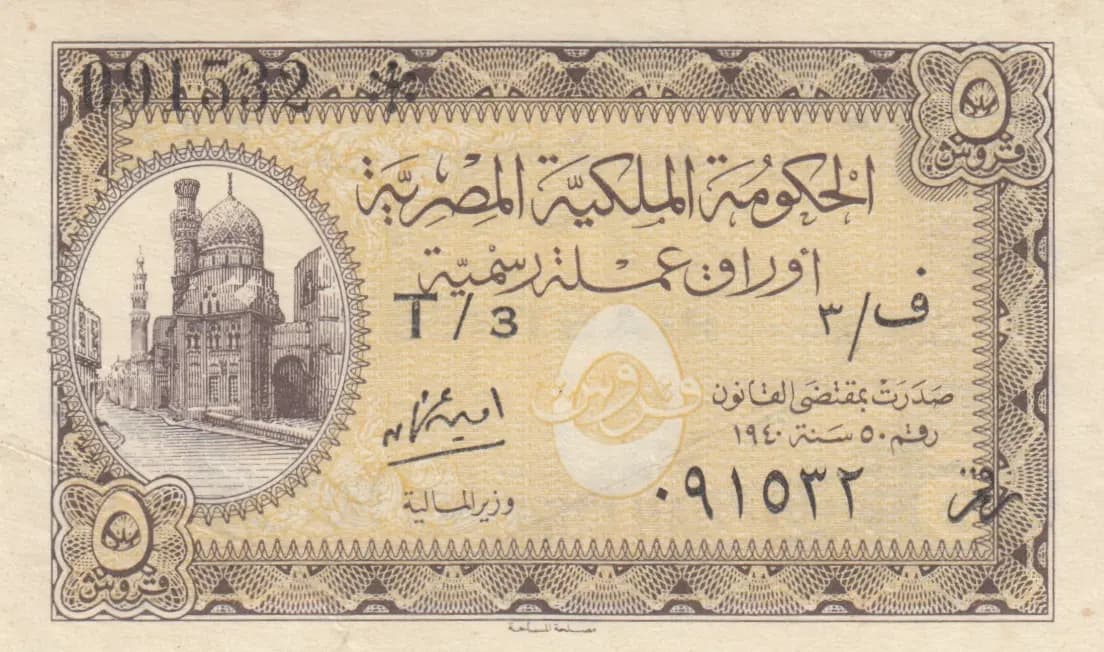
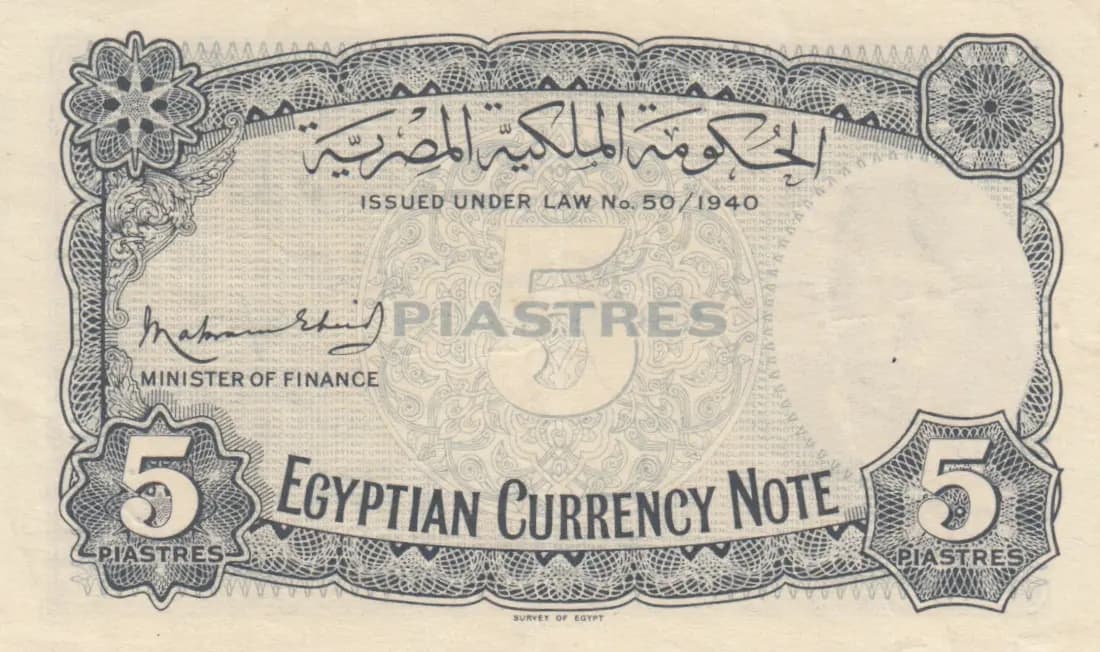
The obverse features a formal portrait of King Farouk I positioned left of center, depicted in three-quarter profile wearing a traditional fez and ornate military uniform with decorative insignia, enclosed within an ornamental circular frame. The entire note is surrounded by an elaborate geometric and floral decorative border with quatrefoil elements positioned in the corners, characteristic of early 20th-century Middle Eastern banknote design. The reverse maintains the same ornate border framework with a large central numeral '5' in ornamental style, accompanied by bilingual denominations and issuing authority information. The color scheme of brown and tan on the obverse transitions to light blue and gray tones on the reverse, a common design choice for multi-color banknotes of this period.
Front side: 'الحكومة الملكية المصرية' (The Egyptian Kingdom Government), 'اوراق عرضشفتي' (Currency notes), 'ت/5' (5 piastres), 'C/5' (5 piastres in English), 'صدرت مقررة القانون رقم 50 سنة 1940' (Issued under Law No. 50 of 1940), 'دراهم' (Dirhams). Back side: 'البنك الملكي المصرية' (The Egyptian Royal Bank), 'ISSUED UNDER LAW No. 50/1940' (English), 'EGYPTIAN CURRENCY NOTE' (English), 'MINISTER OF FINANCE' (English), 'SURVEY OF EGYPT' (printer attribution), 'PIASTRES' (denomination in English, appearing twice).
This note was produced using intaglio (engraved) printing, as evidenced by the fine-line detail, sharp portrait work, and intricate geometric patterns visible throughout both sides. The Survey of Egypt, listed as the printer on the reverse, employed traditional engraving techniques to create the plates. The consistent depth of impression and fine linear details in the decorative borders are hallmarks of intaglio production, supplemented by color lithography for the background tints (yellow underprint on obverse, gray-blue on reverse).
This specimen is cataloged as Pick P-165a, with a variant P-165b also recorded. Differences between varieties likely relate to signature combinations or minor design elements. The visual analysis does not provide sufficient detail to distinguish which specific signature variant this particular note represents, though the reference to 'signature varieties' in the secondary sources confirms that multiple signatory combinations exist for this issue. Further investigation of the signature blocks would be required to definitively establish whether this is an 'a' or 'b' variety.