5 piastres 1940
Market Prices
45 salesAbout This Note
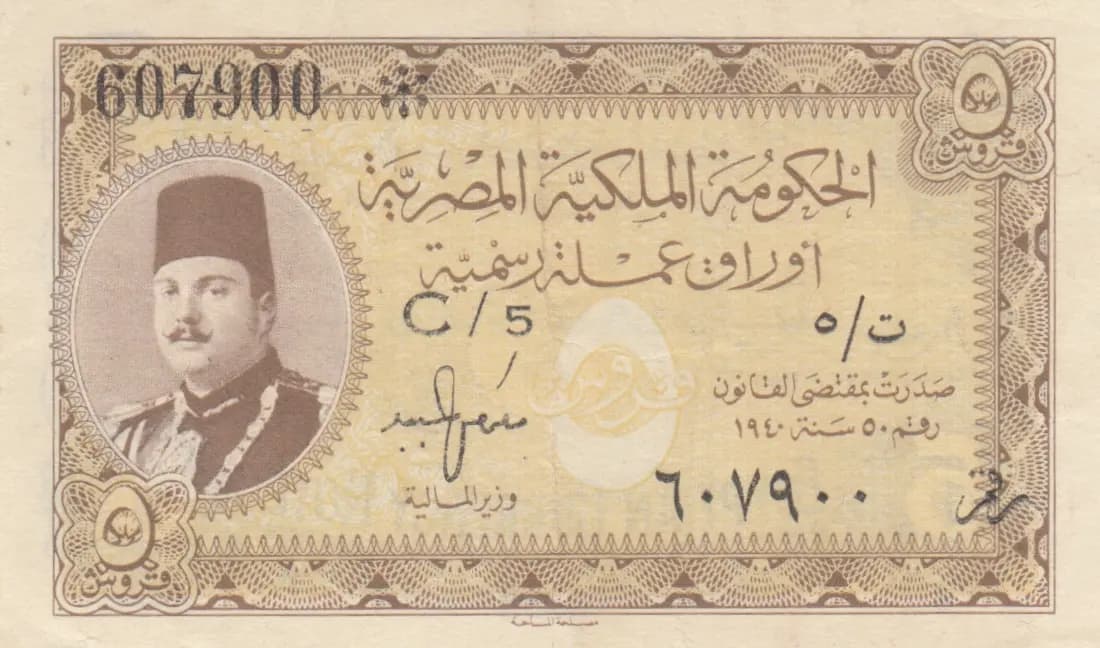
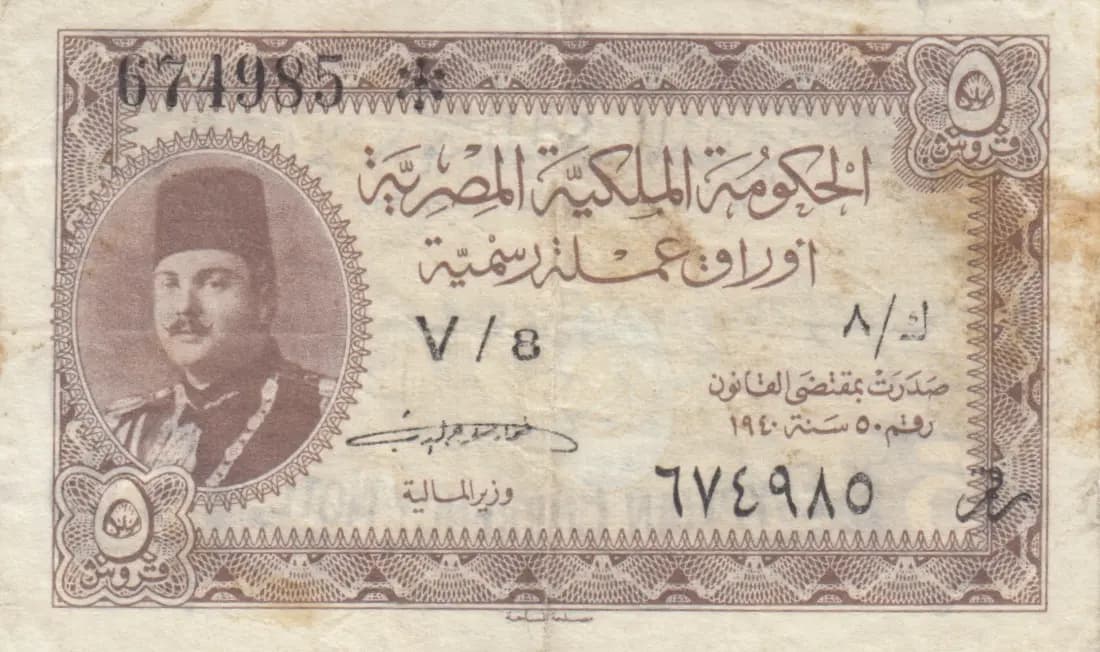
This is an Egyptian 5 Piastres note from 1940 (Pick P-165a), featuring a portrait of King Farouk I in traditional Egyptian military dress with a fez, rendered in brown and tan tones on the obverse. The note displays the characteristic ornate geometric and floral borders typical of mid-20th century Egyptian currency, with bilingual Arabic and English inscriptions. In Fair condition, this well-circulated example shows expected aging with foxing, creases, and fold marks consistent with decades of use, and remains a desirable piece of Egyptian monarchical currency.
Common. The eBay sales data shows consistent circulation of this note across multiple condition grades over more than a decade, with Fair condition examples regularly selling in the $5–$50 range. The 2016 catalog value of $50 for VG and $150 for VF, relative to the actual market prices observed, suggests good availability. The existence of two cataloged varieties (P-165a and P-165b) also points to a substantial print run. No evidence of scarcity, recall, or limited issue exists.
Issued under Law No. 50 of 1940 during the reign of King Farouk I, this note reflects Egypt's position as a British-influenced constitutional monarchy in the pre-revolutionary era. The Royal Bank of Egypt designation and prominence of the Ministry of Finance signature underscore the formal government structure of the period. This particular series, printed by the Survey of Egypt, represents the final years before Egypt's political transformation in the mid-20th century.
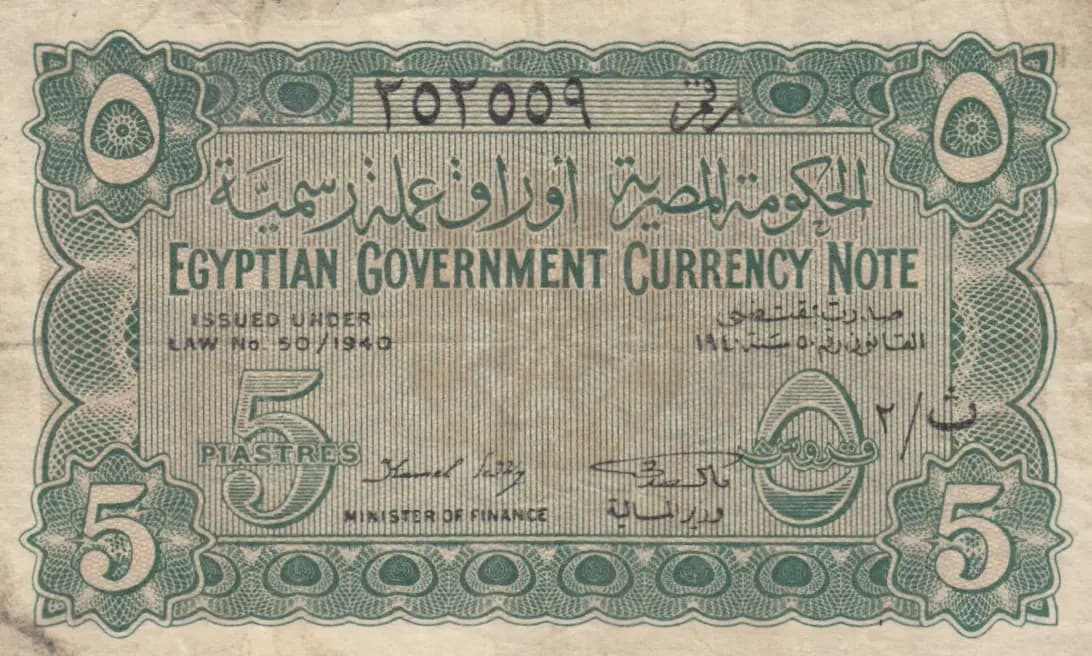
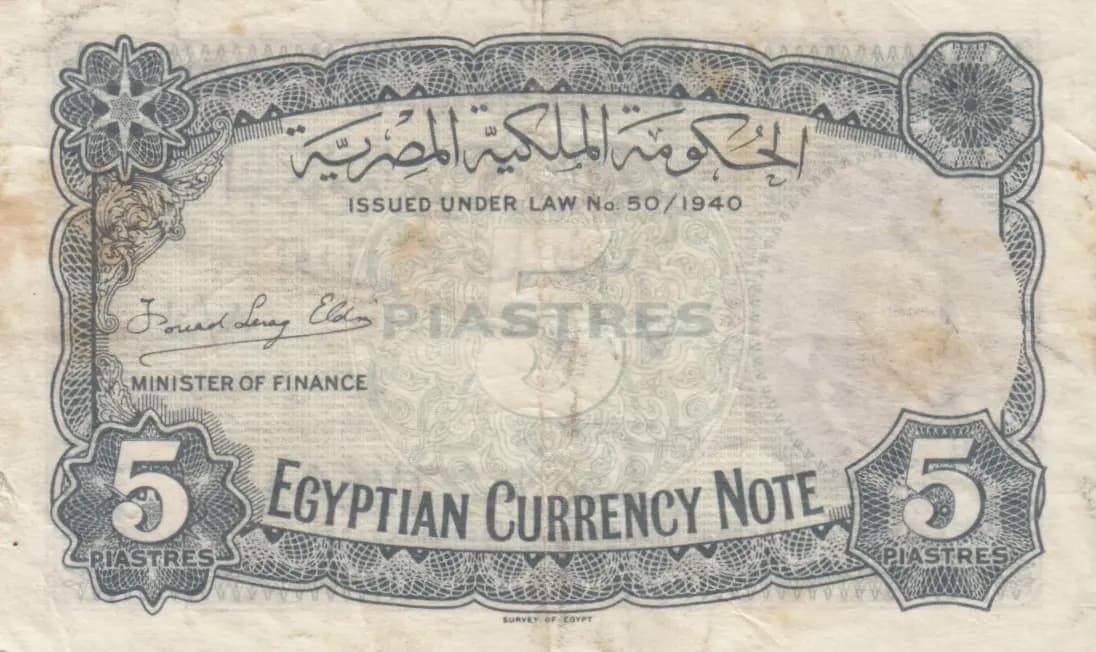
The obverse features a left-facing portrait of King Farouk I wearing a red-brown military fez and formal dress uniform with medals, rendered in fine engraving with detailed cross-hatching. The design is dominated by an intricate border of geometric and floral patterns, with four-lobed ornamental roundels in each corner containing botanical motifs. The reverse employs a blue-gray color scheme and maintains the same decorative corner elements and serrated borders, with central English and Arabic text identifying the note as an official Egyptian currency. The bilateral text arrangement reflects Egypt's post-colonial administrative structure, with bilingual presentation emphasizing both Arabic heritage and English-language governmental protocols. The overall composition exemplifies the formal, highly detailed engraved style typical of 1930s-1940s Middle Eastern currency design.
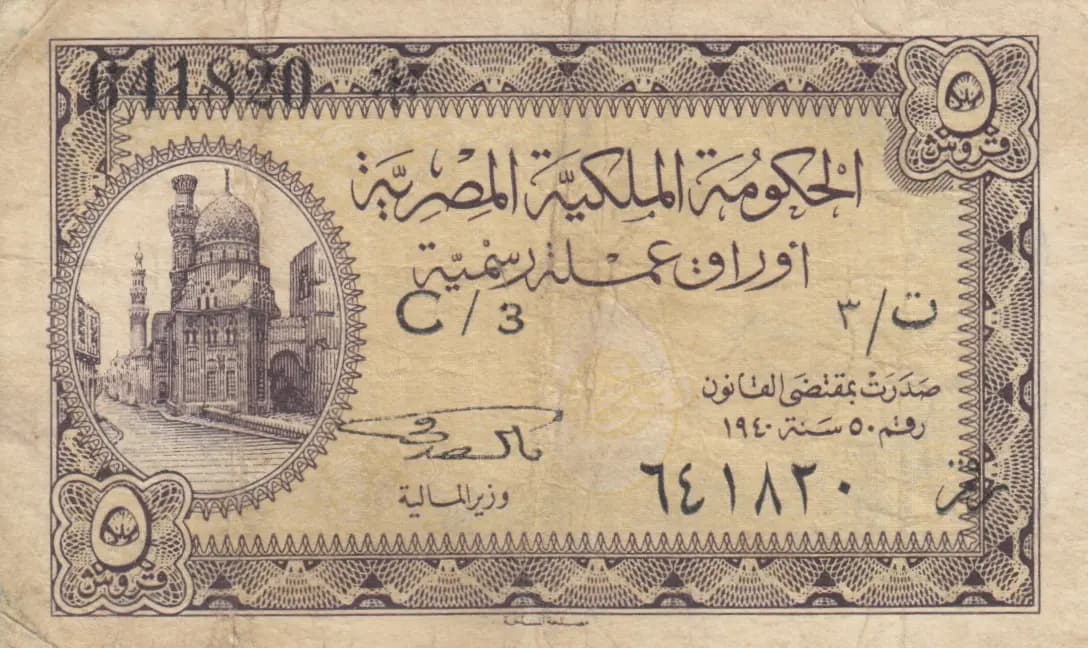
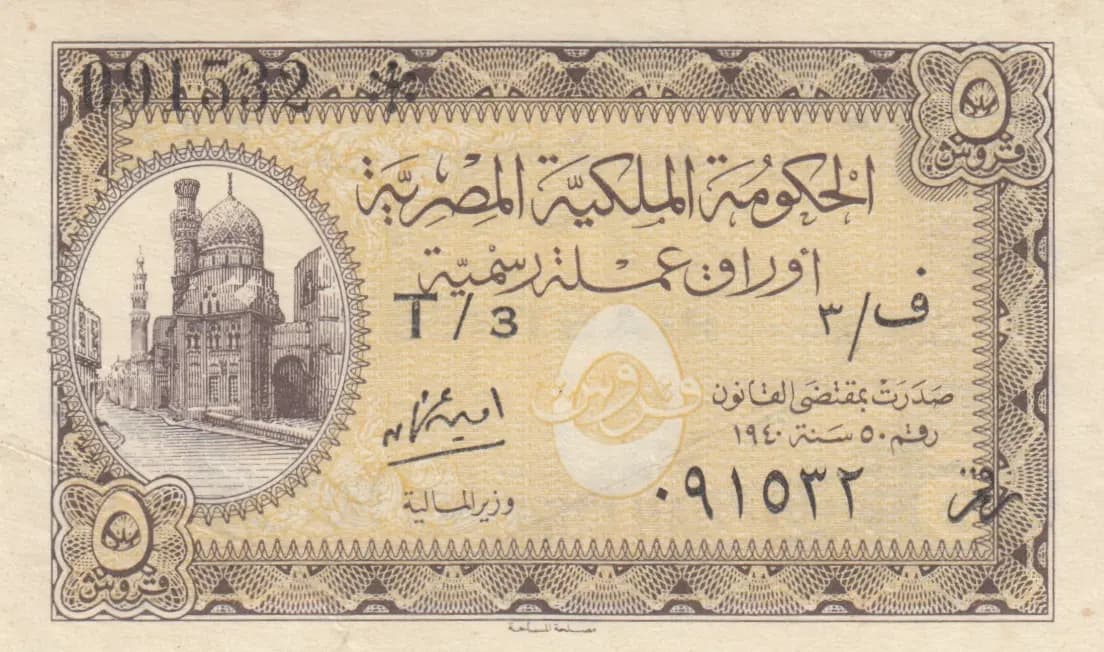
FRONT SIDE: 'البنك الملكية المصرية' (Royal Bank of Egypt) | 'اوراق لزرشفتي' (Bank notes) | '1/8' (denomination fraction) | 'صدرت بمقتضى المافون' (Issued by law) | 'رقم 50 سنة 1940' (Law Number 50, Year 1940) | 'وزارة المالية' (Ministry of Finance) | Serial numbers: 6729880 and 6749955 | Series: V/8. BACK SIDE: 'البنك الملكية المصرية' (Royal Bank of Egypt) | 'ISSUED UNDER LAW No. 50/1940' (English) | 'PIASTRES' (English denomination) | 'EGYPTIAN CURRENCY NOTE' (English) | 'MINISTER OF FINANCE' (English) | 'SURVEY OF EGYPT' (English printer attribution) | Signature of 'Fouad Sarag Eldin' (Minister of Finance) | '5' (denomination markers in ornamental boxes)
This note was produced using intaglio engraving (line engraving) by the Survey of Egypt, the official printer. The fine line work, detailed cross-hatching, ornamental border complexity, and portrait rendering all indicate traditional steel plate engraving with offset printing. No modern security features such as watermarks, security threads, or color-shifting inks are evident from the visual analysis, which is consistent with 1940 production standards.
This note is cataloged as Pick P-165a, with a known variant P-165b also in circulation. The visual analysis identifies the signature as 'Fouad Sarag Eldin' (Minister of Finance), series designation V/8, and serial numbers 6729880 / 6749955. Signature varieties are documented for this issue. The brown-on-yellow underprint with gray-blue reverse, as noted in the reference catalog, is consistent with standard P-165a specifications. The specific series and signature combination may indicate a particular printing batch within the 1940 issue.