5 piastres 1940
Market Prices
17 salesAbout This Note
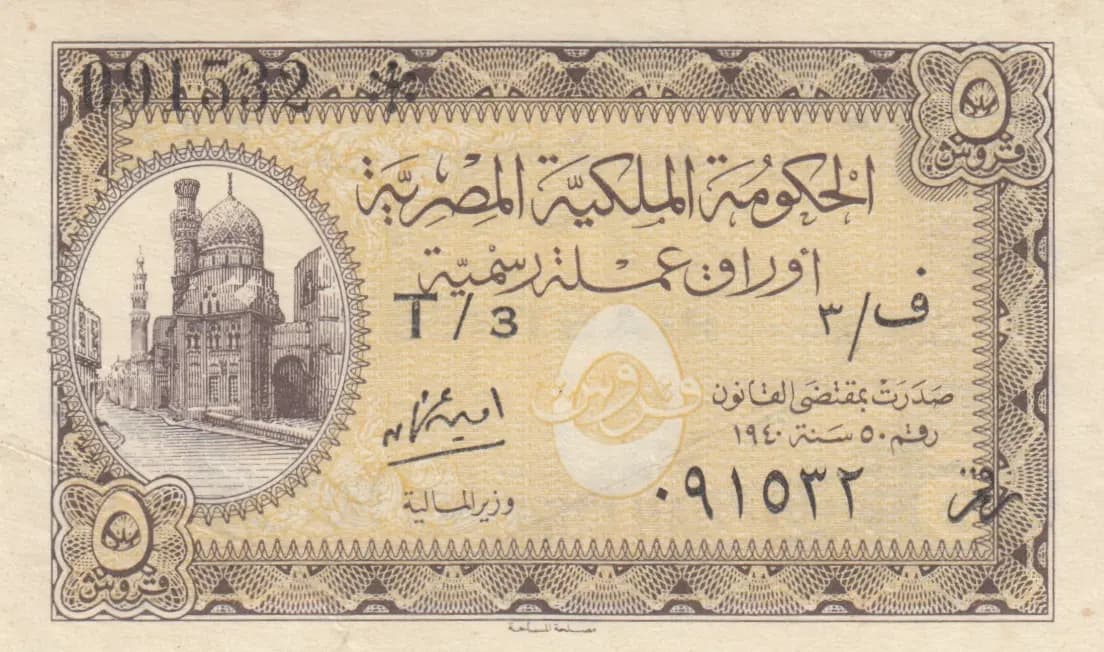
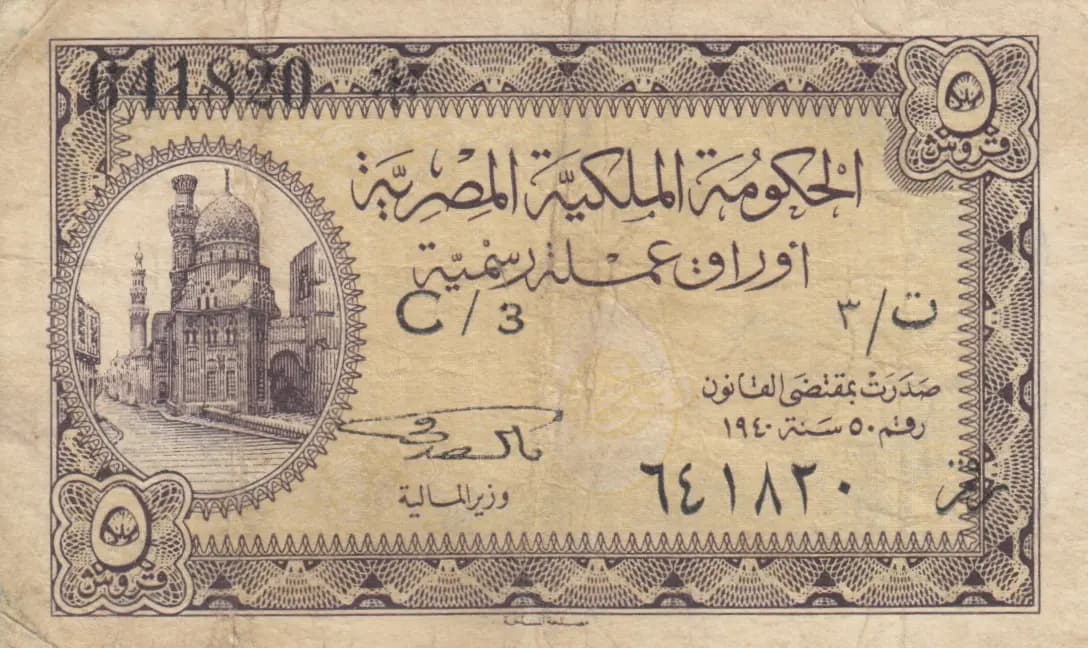
This Egyptian 5 Piastres note from 1940 presents a well-preserved example of Royal Government currency from the interwar period, featuring the iconic Mosque of Emir Khairbak in an ornate circular medallion on the obverse. The note displays the characteristic brown-on-yellow color scheme with cream aging patina consistent with an 80+ year old artifact, and the Fine condition grade reflects moderate handling wear while maintaining excellent legibility of both Arabic and English inscriptions. This denomination and issue represent an important transitional period in Egyptian monetary policy under the monarchy.
Common. This is a regular issue denomination from a substantial print run during 1940 by the Royal Government of Egypt. eBay market data shows consistent sales of this note in Fine condition ranging from $13.50 to $44.99 over the past decade, with multiple F-grade sales in the $16-$23 range (2012-2019), indicating steady collector demand but no scarcity premium. The catalog value for VG grade at $10 and VF at $40 reflects typical pricing for commonly available notes. The note has no known recall status, short supply issues, or exceptional rarity factors for this Pick number.
This note was issued under Law No. 50 of 1940 by the Royal Government of Egypt during the reign of King Farouk, representing the final years of the Egyptian monarchy before the 1952 revolution. The Mosque of Emir Khairbak, prominently featured in the circular frame on the obverse, is a significant Cairo Islamic landmark dating to the Mamluk period, symbolizing Egypt's cultural heritage and architectural legacy. The bilingual design (Arabic and English) reflects Egypt's position as a British-influenced monarchy and the cosmopolitan nature of Egyptian financial institutions during this era.
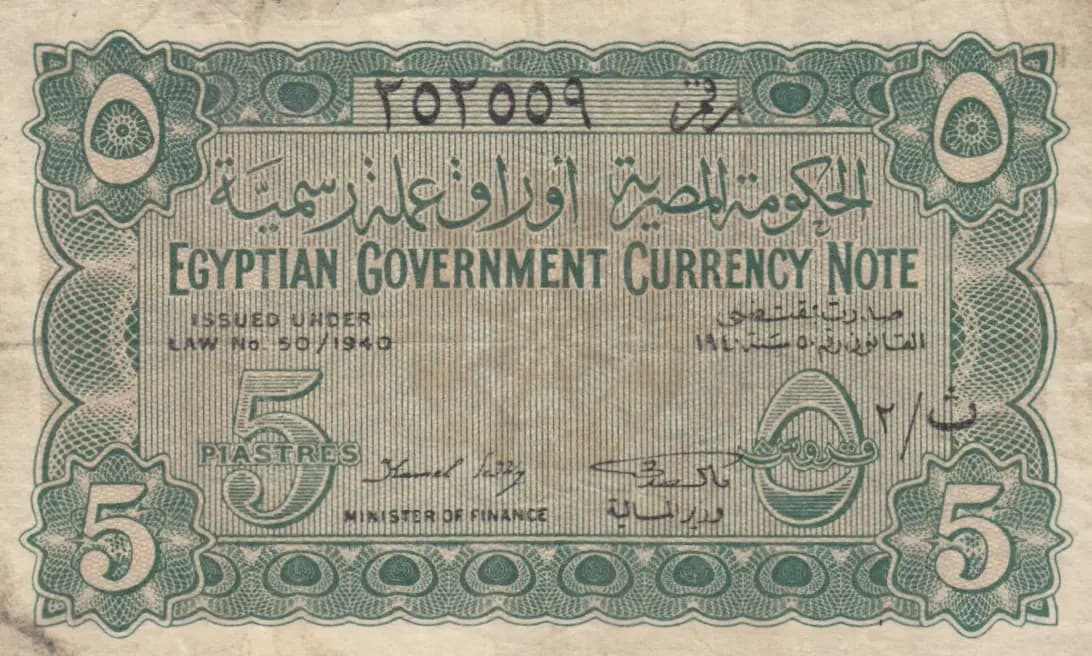
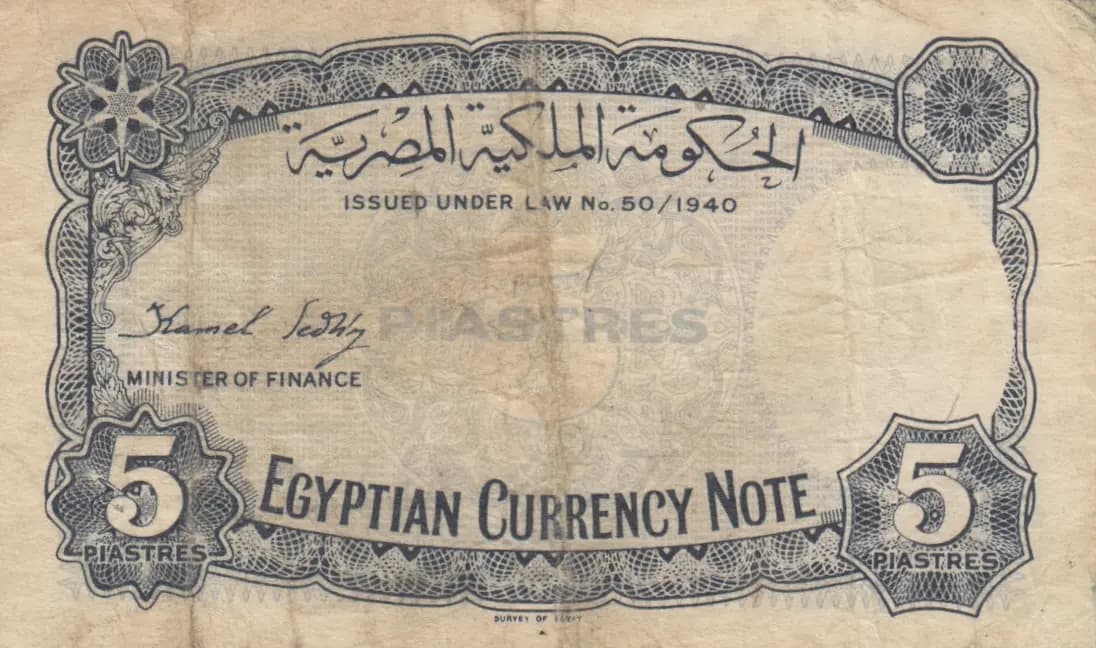
The obverse features a detailed engraving of the Mosque of Emir Khairbak (also known as Khayrbak Mosque), a 16th-century Mamluk structure located in Islamic Cairo, depicted within a circular frame with radiating line patterns suggesting architectural significance. The mosque illustration shows characteristic Islamic architectural elements including a domed structure and minarets rendered in fine line work. The reverse side presents the legal and financial authority information with the signature of Kamel Loufty as Minister of Finance. Both sides incorporate ornate decorative medallions with floral and geometric patterns in the corners and elaborate border frames typical of high-security currency printing. The color scheme employs brown tones on a yellow underprint with cream coloration from aging, creating subtle tonal variations throughout the note.
FRONT SIDE: 'الحكومة الملكية المصرية' (The Egyptian Royal Government) / 'اوراق عملشرعية' (Legal tender notes) / 'صدّرت بموجب قانون رقم 50 سنة 1940' (Issued under law No. 50 of 1940) / 'وزارة المالية' (Ministry of Finance) / Signature reference marks 'ت/3' and 'ث/3' (T/3 signature varieties) / Serial number reference '64.1820'. BACK SIDE: 'الحكومة الملكية المصرية' (The Egyptian Royal Government) / 'ISSUED UNDER LAW No. 50/1940' (English legal reference) / 'EGYPTIAN CURRENCY NOTE' (denomination descriptor) / '5 PIASTRES' (denomination in English, appears twice) / 'Kamel Loufty' (signature of Minister of Finance) / 'MINISTER OF FINANCE' (official title) / 'SURVEY OF EGYPT' (printer attribution).
Intaglio engraving (copperplate or steel plate gravure), as evidenced by the intricate fine line work, deeply detailed border patterns, and the characteristic security printing visible in both the decorative medallions and the architectural rendering of the mosque. The Survey of Egypt, credited as the printer on the reverse, employed this traditional security printing method which was standard for government currency production in 1940. The quality of line work, the precision of the geometric patterns, and the fine detail in the architectural rendering are hallmarks of intaglio printing technology used for high-security currency.
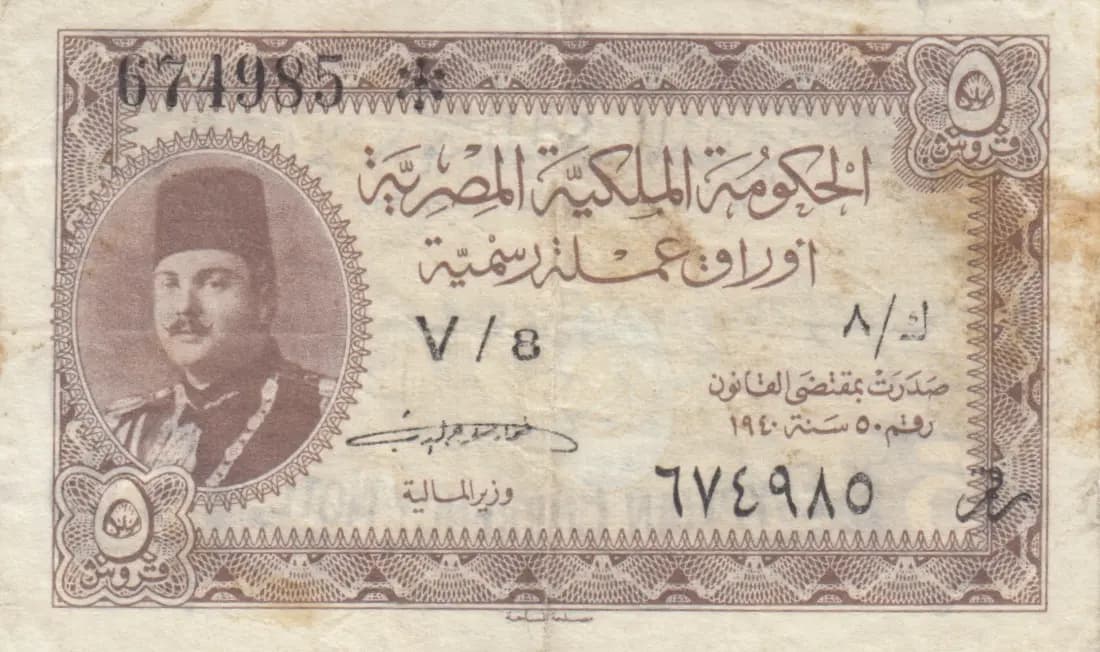
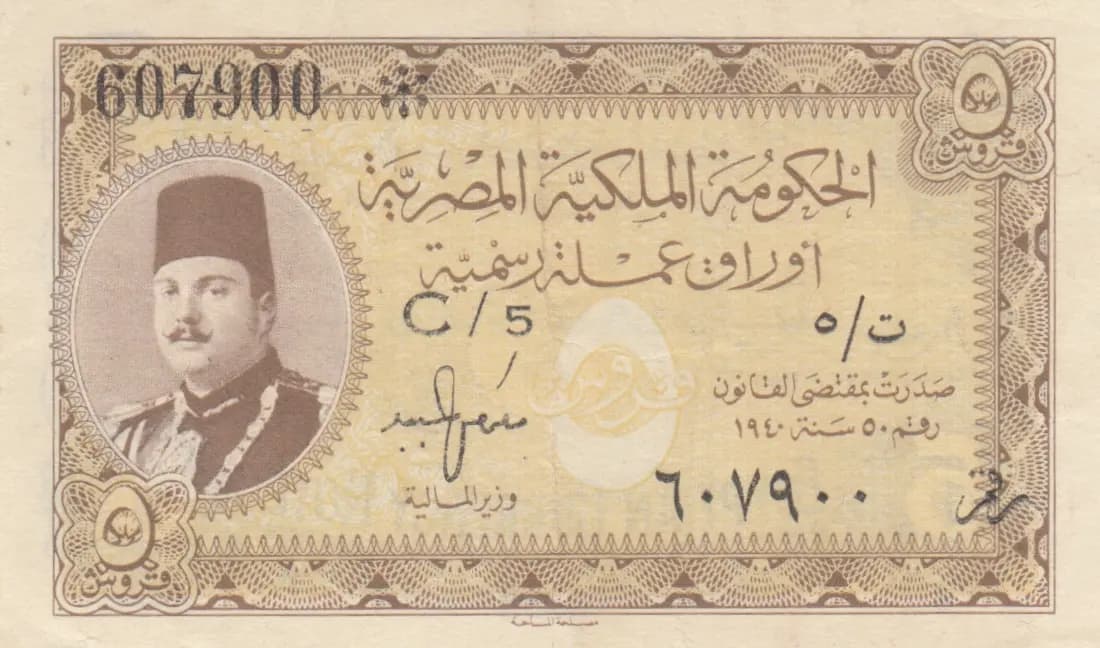
The visual analysis indicates signature varieties exist for this issue, with reference marks 'ت/3' and 'ث/3' visible on the front side, corresponding to different signature blocks. Kamel Loufty's signature is confirmed on this example as Minister of Finance. The Pick catalog designates this as P-164a, suggesting variant 'a' status; collectors should compare serial number prefixes and signature varieties with other examples to distinguish between P-164a and other varieties (such as P-164b if it exists). The consistent appearance across eBay sales suggests this particular variant is the standard circulation issue, though specific signature variety documentation would require comparison with other cataloged examples.