500 gulden 1924
Market Prices
About This Note
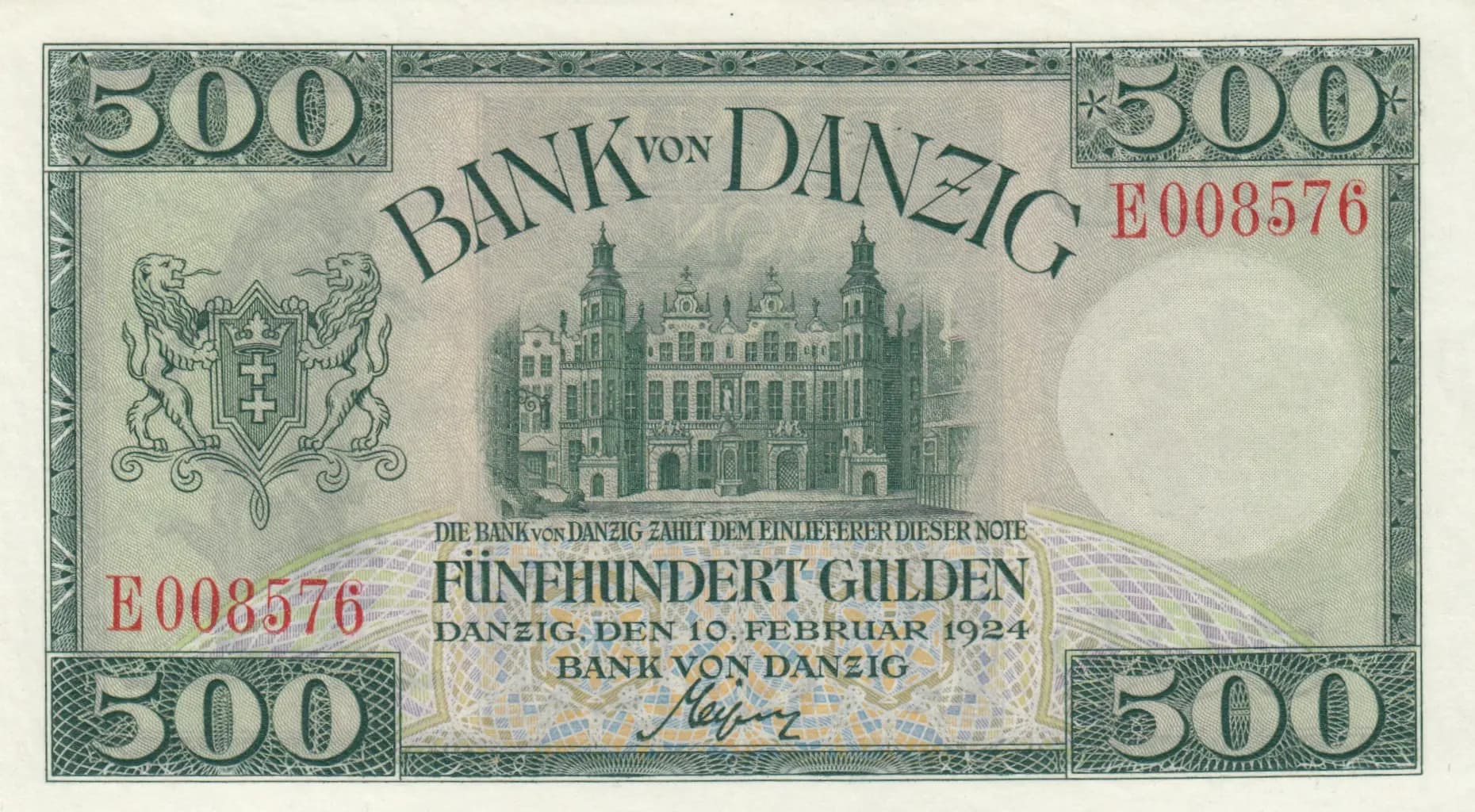
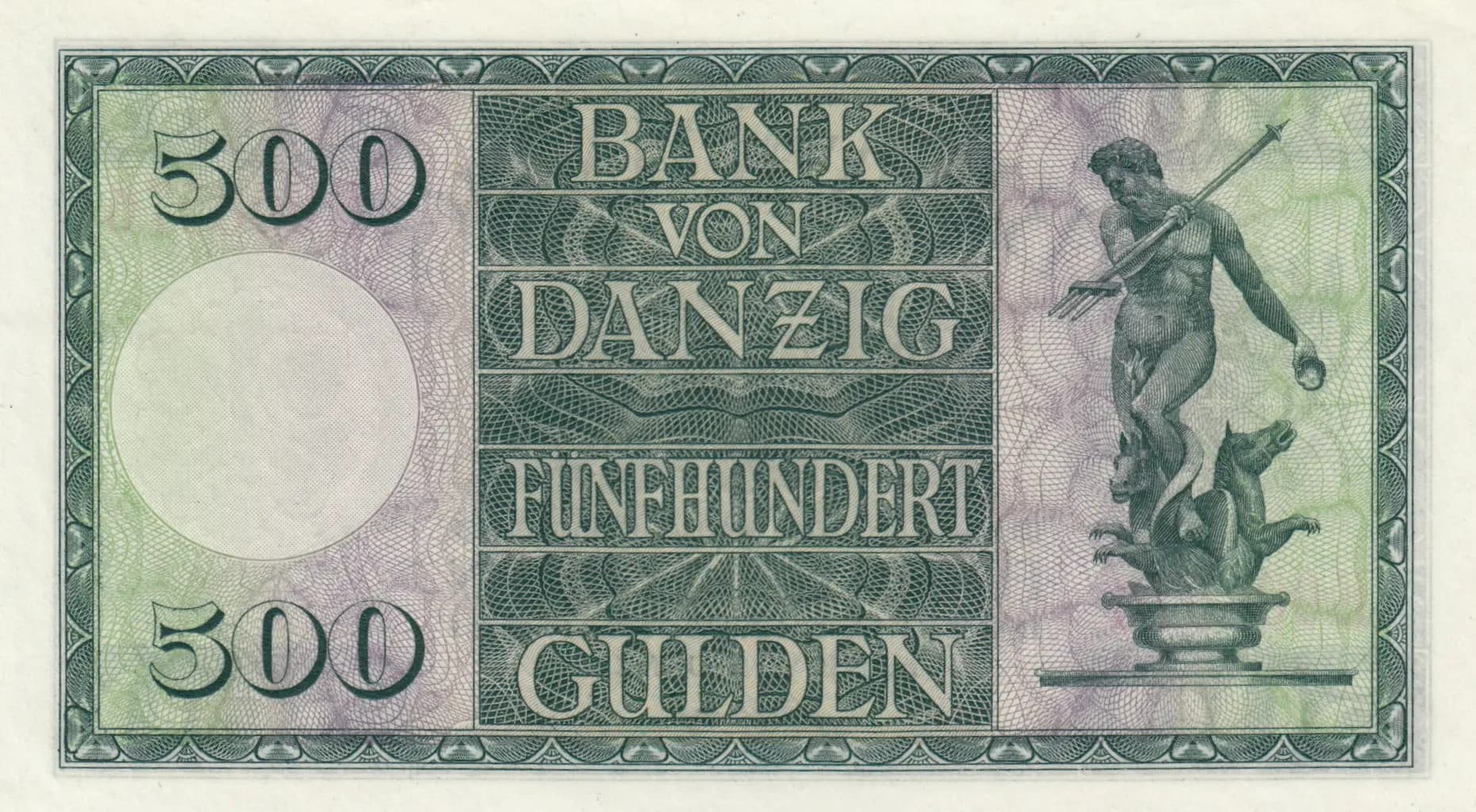
An exceptional example of the 500 Gulden issued by the Bank von Danzig on February 10, 1924, graded UNC. This note exemplifies the artistic sophistication of interwar Danzig currency, featuring an ornate heraldic coat of arms with rampant lions on the obverse and a classical allegorical figure (winged cherub) overcoming a serpent on the reverse. The specimen displays pristine paper quality with vibrant green and muted purple-grey tones, no visible wear, and represents a key issue from the Free City's brief period of monetary independence.
Uncommon. While the catalog value of $2500 for UNC specimens indicates this is not a common date-denomination combination in the market, the existence of multiple eBay listings ranging from $80–$2500 and the presence of three PMG-recognized variants (P-56, P-56cts, P-56s) suggest moderate scarcity rather than extreme rarity. The print run for the 1924 500 Gulden was finite, and survival rates in uncirculated condition are evidently low enough to command strong prices. However, the note was not recalled and is not from a prohibitively short-lived issuing period, placing it in the 'uncommon' rather than 'rare' category.
The Bank von Danzig issued this denomination during a critical period following World War I, when the Free City of Danzig (Gdańsk) operated as a semi-autonomous entity under League of Nations mandate (1920-1939). The heraldic imagery prominently displayed reflects Danzig's civic pride and medieval heritage as a major Baltic trading center, while the allegorical victory over the serpent symbolizes the city's aspirations for stability and prosperity during a turbulent economic period marked by post-war inflation and currency reform across Central Europe.
The obverse features the coat of arms of Danzig—two rampant lions as supporters flanking a shield containing the distinctive crossed symbols of the city's heraldry—positioned left of center. The dominant architectural element is an elaborate multi-spired civic building, likely the Danzig Town Hall (Rathaus) or another prominent municipal structure, rendered in detailed fine-line engraving with multiple towers and domed cupolas. Ornamental corner designs and a horizontal security band with geometric patterns enhance the composition. The reverse displays a classical allegorical figure in the style of Renaissance and Baroque engraving—a winged cherub or putto (symbolizing either Liberty, Commerce, or Victory) depicted with a spear or staff, triumphantly positioned above a dragon or serpent. A large reserved circular vignette area appears on the left side of the reverse, suggesting space for additional security elements or design balance. The color palette employs green as the primary hue on both sides, with purple-grey accents on the reverse and tan/beige undertones.
FRONT SIDE: '500' (corner denominations); 'BANK VON DANZIG' (top center); 'FÜNFHUNDERT GULDEN' (Five Hundred Gulden); 'DIE BANK VON DANZIG ZAHLT DEM EINLIEFERER DIESER NOTE' (The Bank of Danzig pays to the bearer of this note); 'DANZIG, DEN 10. FEBRUAR 1924' (Danzig, February 10, 1924); Serial number 'E 008576'; Bank signature. BACK SIDE: '500' (corner denominations, repeated); 'BANK VON DANZIG' (centered text block); 'FÜNFHUNDERT GULDEN' (Five Hundred Gulden).
Steel plate engraving (intaglio), the standard security printing method for banknotes of this era. The printer is identified as BWC (Banknote Printing Company) in the PMG population data. Fine-line cross-hatching, detailed architectural rendering, and intricate border designs are characteristic of high-security intaglio production. The multi-line geometric security band visible on the obverse represents advanced anti-counterfeiting engraving technique typical of 1920s European currency design.
This example is catalogued as P-56 (standard type, printer BWC). The PMG population report indicates three recognized varieties: P-56 (base type), P-56cts (likely a specimen or canceled type), and P-56s (likely a signature variant or special printing). Serial number E 008576 with red-printed denomination overprints visible in the images. The specific signature on this specimen is not clearly legible in the visual analysis, but signature varieties are known to exist for this issue. Further specialized research into Danzig Bank serial numbering and signature combinations would be required to pinpoint the precise variety within P-56.