50 pfennig 1919
Market Prices
9 salesAbout This Note
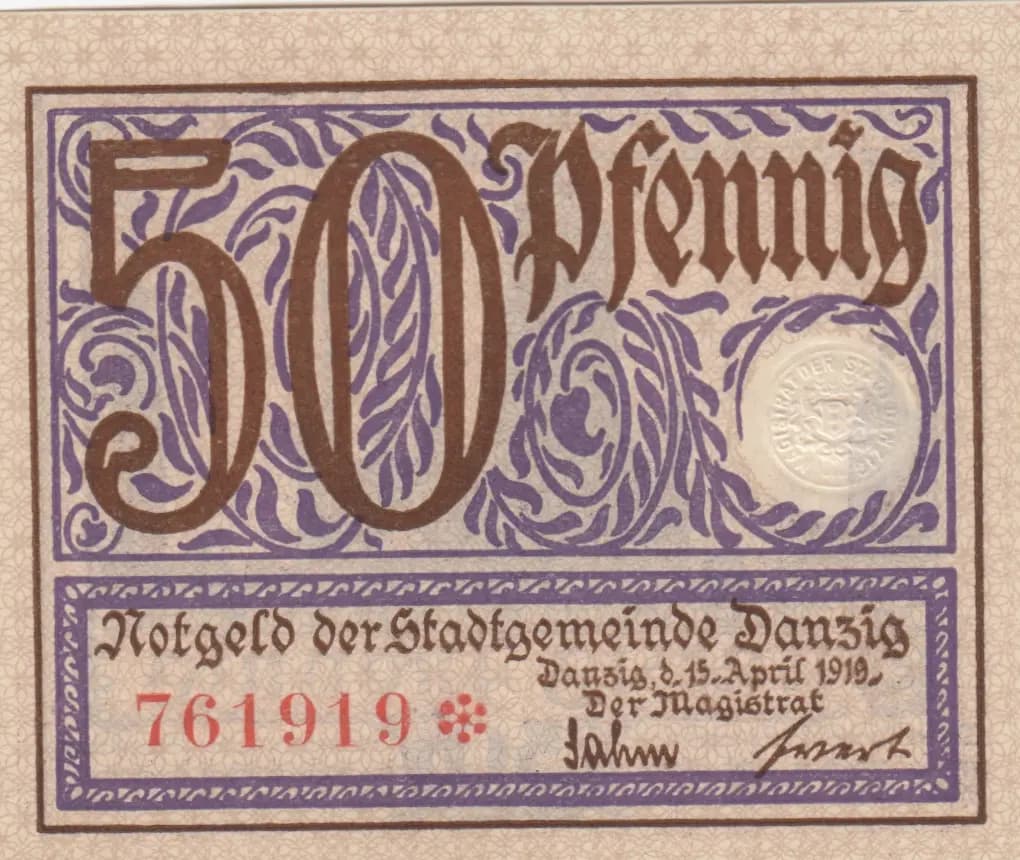
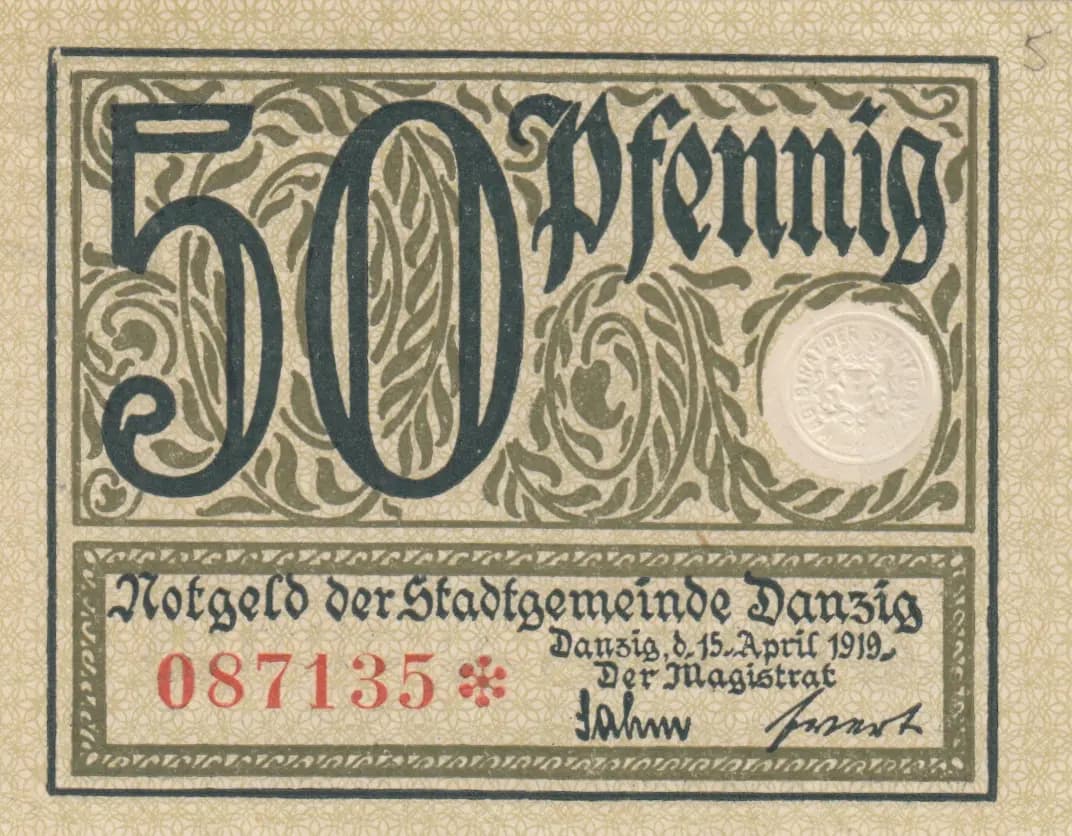
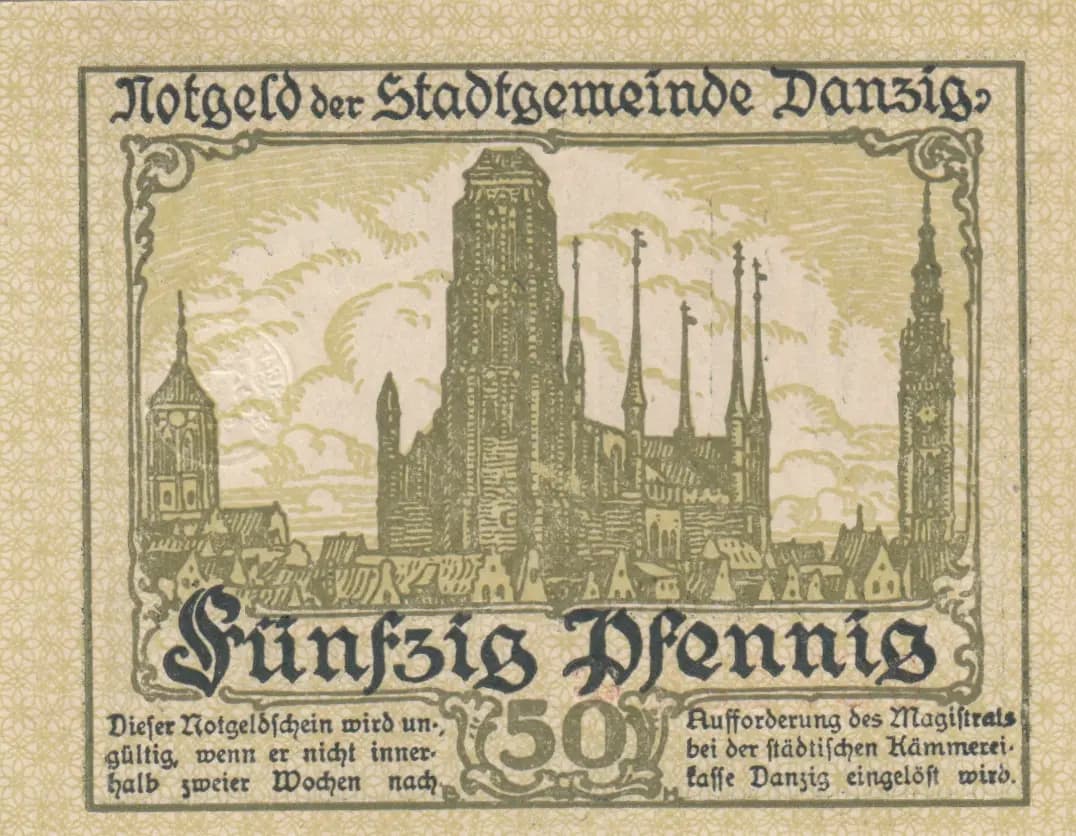
This 50 Pfennig notgeld from Danzig (Pick-12) dated April 15, 1919, presents a beautifully preserved example of emergency currency issued during the post-WWI period. The obverse features an ornate denomination numeral in dark green and olive tones with a heraldic seal, while the reverse displays a detailed engraving of Danzig's distinctive skyline with prominent church spires—characteristic imagery for civic pride during this tumultuous era. The note exhibits minimal wear consistent with UNC grades, with crisp engraving details and the characteristic aged patina expected of a 1919-era notgeld note.
Common. The eBay transaction data shows PMG-graded examples (primarily PMG 64-66) consistently selling between $16.50 and $44 in recent years, with UNC catalog values listed at $80 (2016). The existence of multiple professionally graded sales and the consistent market pricing indicate this is a widely held note with substantial supply in the collector market. Danzig notgeld issues, while historically significant, were produced in sufficient quantities that individual denominations remain readily available at modest prices. Serial number 087135 represents mid-range numbering without special premium characteristics.
Danzig, having just emerged as a semi-autonomous Free City under the Treaty of Versailles in 1919, issued this notgeld (emergency money) to address severe currency shortages following World War I and the German Empire's collapse. The reverse depicts Danzig's iconic skyline, particularly its impressive church architecture including what appears to be the Marienkirche and other prominent ecclesiastical structures that defined the medieval hanseatic city. The two-week redemption clause printed on the reverse reflects the temporary nature of emergency currency, meant to stabilize local commerce until regular currency supplies could be restored.
The obverse centers on a large, ornately framed denomination '50' in the left-center field, rendered in dark green with black detailing. A circular heraldic seal (likely the coat of arms of Danzig, featuring the crowned eagle or similar civic emblem) occupies the upper right quadrant. Elaborate scrollwork and floral decorative motifs frame the entire note in the tradition of quality notgeld production. The reverse presents an engraved cityscape featuring Danzig's medieval skyline with the prominent spires of major churches—most notably the Marienkirche (Church of St. Mary) with its distinctive tower, flanked by other ecclesiastical buildings characteristic of the Hanseatic architectural tradition. The cityscape is enclosed within an ornate decorative border with scrollwork, clouds, and botanical corner elements typical of fine security printing. The composition emphasizes civic identity and architectural heritage, serving both as beautiful imagery and implicit security against counterfeiting through detailed engraving.
FRONT: '50' (denomination numeral) | 'Pfennig' (currency unit) | 'Notgeld der Stadtgemeinde Danzig' (Emergency money of the city municipality of Danzig) | 'Danzig, d.15. April 1919' (Danzig, the 15th of April 1919) | 'Der Magistrat' (The Magistrate) | Serial number: '087135' (printed in red). BACK: 'Notgeld der Stadtgemeinde Danzig' (Emergency money of the city municipality of Danzig) | 'Fünfzig Pfennig' (Fifty Pfennig) | 'Dieser Notgeldschein wird ungültig, wenn er nicht innerhalb zweier Wochen nach Aufförderung des Magistrats bei der städtischen Kämmereikaße Danzig eingelöst wird.' (This emergency money note becomes invalid if it is not redeemed within two weeks after request of the Magistrate at the municipal treasury office Danzig.)
Intaglio (line engraving) combined with letterpress printing. The fine-line engraved cityscape on the reverse and the detailed decorative borders demonstrate hallmarks of professional security printing from this period. The note was likely produced by a specialized German security printer, with the combination of engraved architectural detail and typeset inscriptions characteristic of post-WWI German notgeld production. The crisp, well-preserved impression of fine lines indicates high-quality intaglio work, standard practice for civic emergency currency requiring security against counterfeiting.
Pick-12 base catalog number with no reported variants according to PMG population data. The note is dated April 15, 1919, with serial number 087135. No known printer's marks, signatures, or significant overprint variations have been identified on this example. The consistent design and printing across known examples suggests a single printing run without major varieties, typical of notgeld issues from single municipalities with limited circulation periods.