1000 mark 1922
Market Prices
4 salesAbout This Note
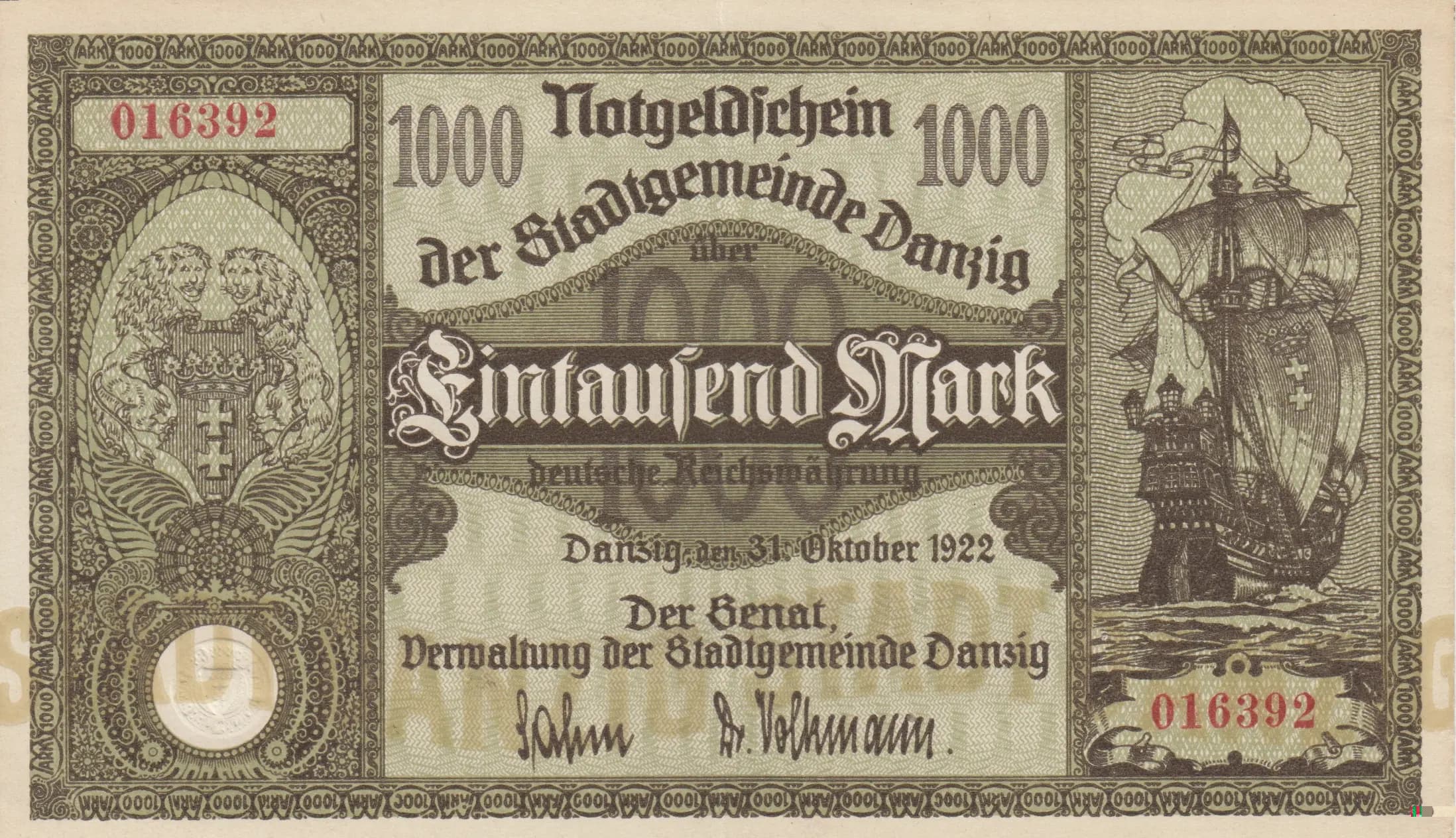
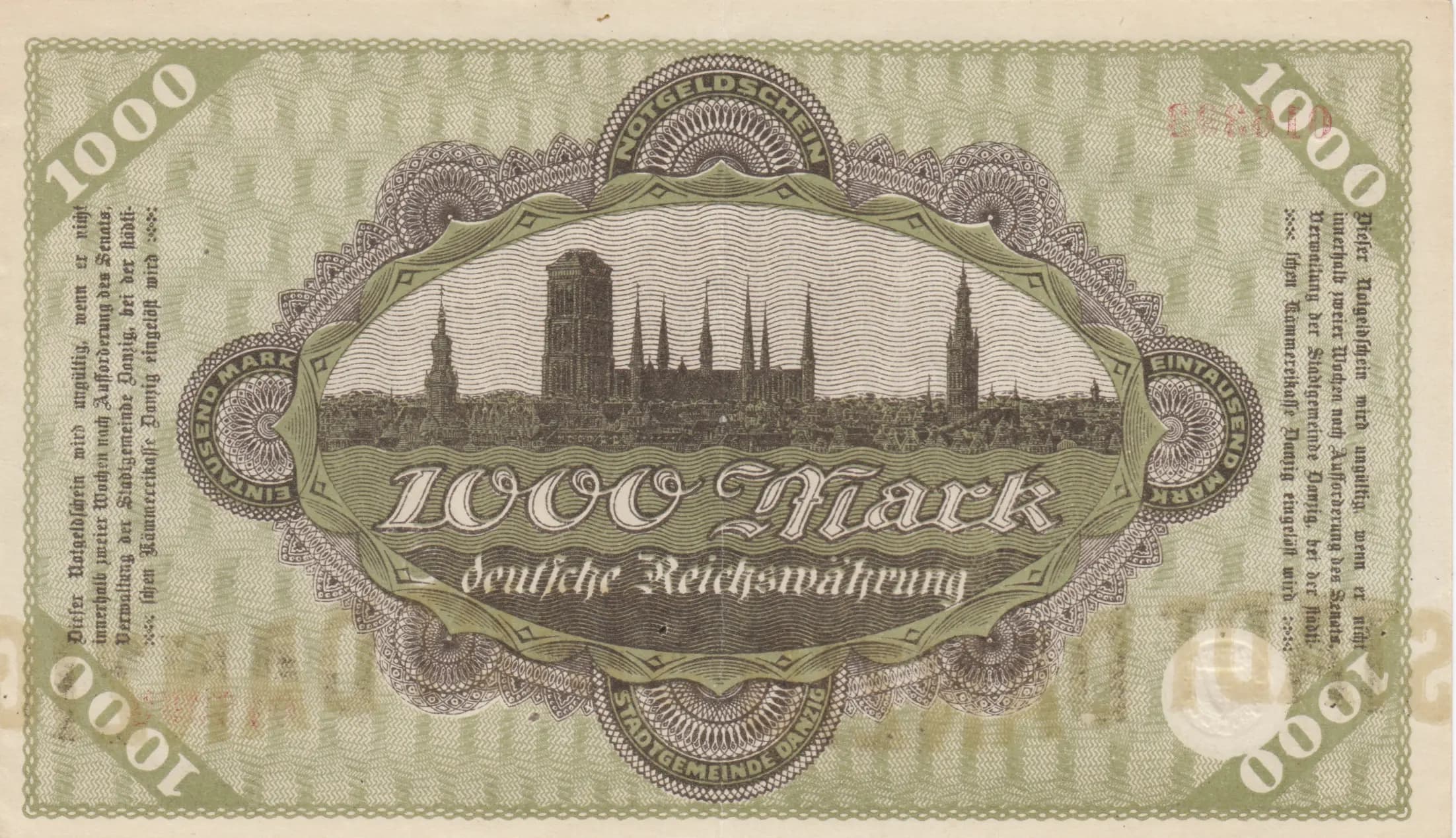
This 1000 Mark Danzig banknote from 31 October 1922 is a fine example of Notgeld (emergency currency) issued during the hyperinflation period of the Weimar Republic. The note displays exceptional preservation with minimal wear, crisp engraving details, and well-defined vignettes on both sides—the obverse featuring an Imperial eagle and historical sailing ship, and the reverse showcasing Danzig's distinctive cathedral skyline. The ornate Art Nouveau-style design, brown and olive-green color scheme, and fine line engraving work exemplify the high-quality production standards maintained even during economic crisis.
Common. The eBay market data shows regular sales activity with notes in VF condition selling for $157.50 to $186.50 (2011-2020) and lower grades (VG) selling for $30-40, indicating consistent but modest collector demand. The 2016 catalog values ($300 VF, $600 UNC) suggest this is a relatively accessible note for collectors of Weimar-era Notgeld. The Senat der Stadtgemeinde Danzig issued substantial quantities of these emergency notes during 1922, and surviving examples in various grades are regularly encountered in the market. The note's historical interest and attractive design maintain steady collector interest, but it is not a scarce or rare issue.
Issued by the Senate (Senat) of the Free City of Danzig on 31 October 1922, this note reflects the acute currency shortage and hyperinflation gripping Germany and its constituent territories during the final years of the Weimar Republic. The imagery—featuring Danzig's medieval skyline with prominent church spires and an Imperial eagle—emphasizes local civic pride and historical continuity during a period of profound economic and political instability. The reference to 'Deutsche Reichsbahn' (German State Railways) on the reverse indicates this emergency currency's acceptance within the transportation and commerce networks that held Danzig's economy together.
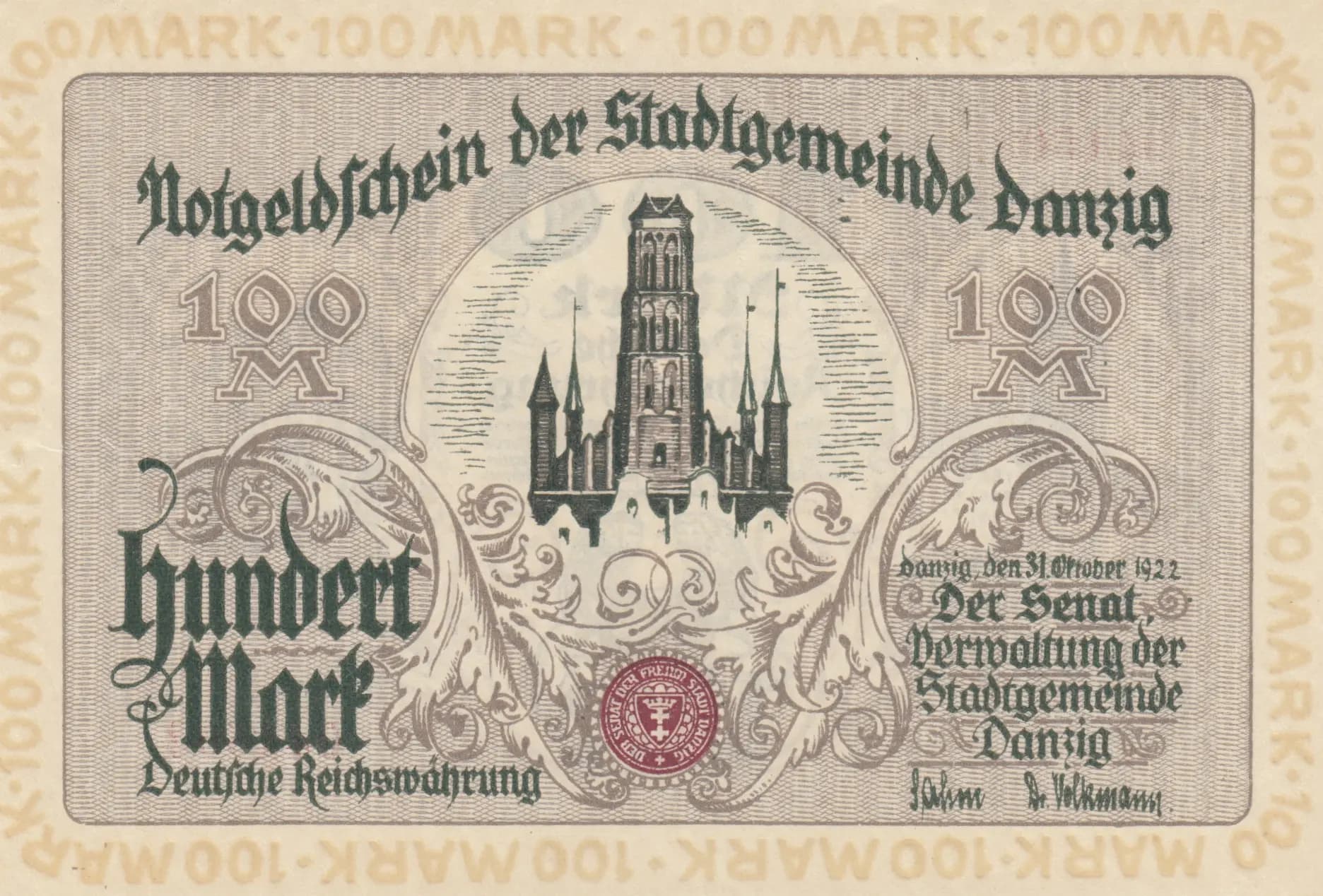
The obverse features a meticulously engraved German Imperial eagle with spread wings displayed within an ornate oval frame on the left, surmounted by a crown and shield—representing imperial authority. The right side depicts a historical sailing vessel, likely representative of Danzig's maritime heritage as a major Baltic port. The denomination '1000' appears prominently in both left and right margins within a repeating ornamental border pattern characteristic of Art Nouveau design. Two authorized signatures (Kohn and A. Volkmann) appear at the bottom, certifying the note's validity. The reverse displays a central oval vignette containing Danzig's recognizable cathedral skyline, with multiple prominent church spires (including what is likely the Church of Saint Mary and other civic structures) dominating the cityscape. This vignette is surrounded by elaborate decorative scrollwork with geometric and floral ornamental patterns. The denomination '1000' appears in large numerals in all four corners, with '1000 Mark' in decorative script in the center below the cityscape. A watermark is visible in the center of both sides, enhancing security. The overall color palette uses brown, tan, cream, and olive green inks.
FRONT SIDE: '1000' (denomination, repeated in margins); 'Notgeldschein' (Emergency currency note); 'der Stadtgemeinde Danzig' (of the city municipality of Danzig); 'Eintausend Mark' (One thousand Mark); 'Danziger' (of Danzig); 'Dantzig, 31 Oktober 1922' (Danzig, 31 October 1922); 'Der Senat Verwaltung der Stadtgemeinde Danzig' (The Senate Administration of the City Municipality of Danzig); Signatures: 'Kohn' and 'A. Volkmann'; Serial number: '016392'. BACK SIDE: '1000 Mark' (denomination in decorative script); '1000' (denomination in all four corners); 'Deutsche Reichsbahn' (German State Railways, vertical text on margins); 'Notgeldschein' (Emergency currency note); Additional legal/validity text in German appearing vertically in margins.
This note was produced using fine line engraving on steel plates, a traditional intaglio printing method that creates the deeply detailed and intricate patterns visible throughout the design. The precision of the ornamental borders, the delicate cityscape vignette, and the crisp definition of the eagle and sailing ship imagery all indicate high-quality engraving work typical of established currency printers of the period. The layered color work (brown on the obverse, olive-green on the reverse) suggests multicolor intaglio printing with separate plates for each color. While the specific printer is not definitively identified in available catalog data, the technical quality suggests production by a reputable German security printer capable of sophisticated currency production.
This specific note is identified as Pick P-15 with issue date 31 October 1922, bearing signatures of Kohn and A. Volkmann and serial number 016392. The PMG population report indicates one cataloged variant for this base Pick number. No overprints, color variations, or other distinguishing varieties are evident from the visual analysis. The consistent appearance and standard production characteristics suggest this represents the primary and likely only significant variety of the 1000 Mark denomination issued by Danzig in 1922.