50 gulden 1937
Market Prices
About This Note
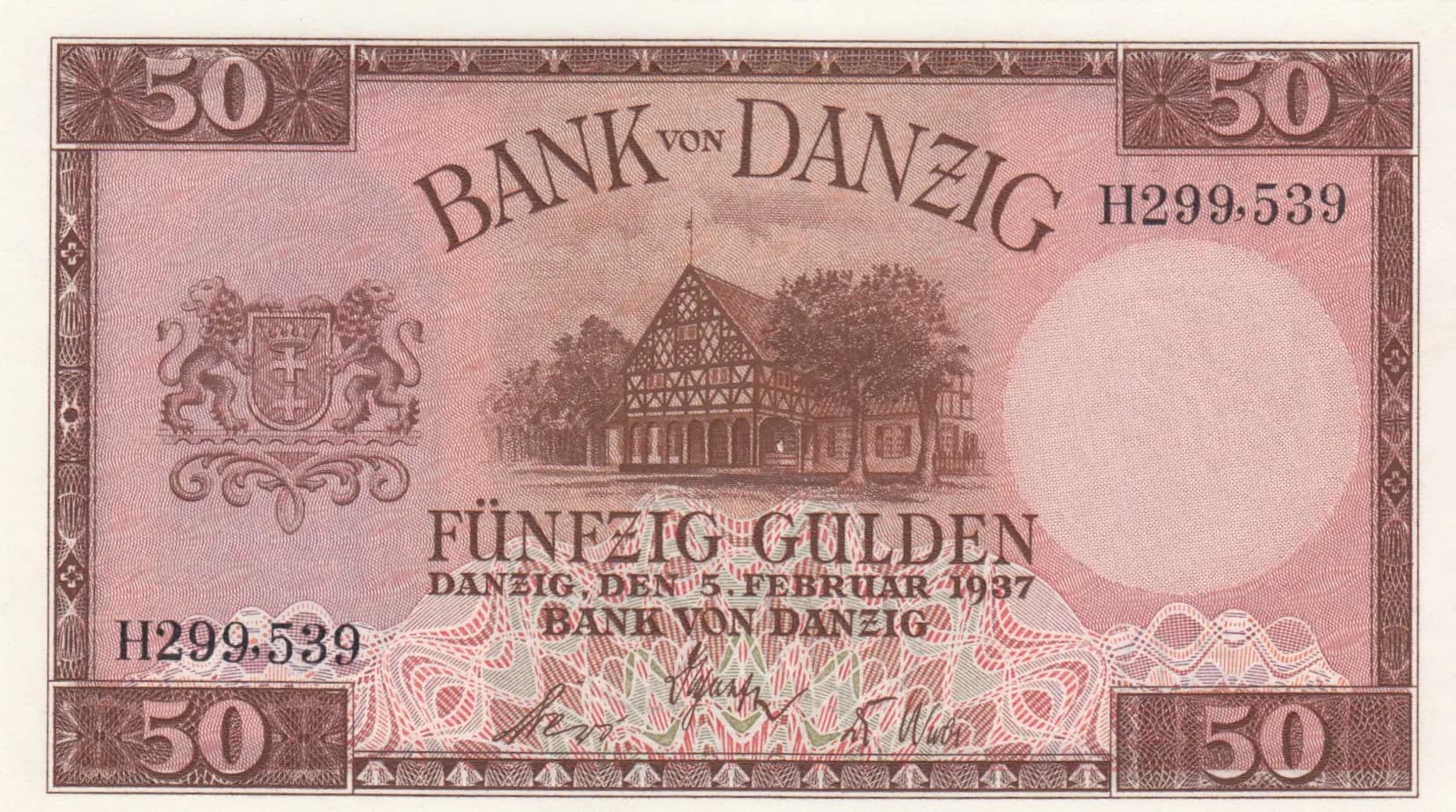
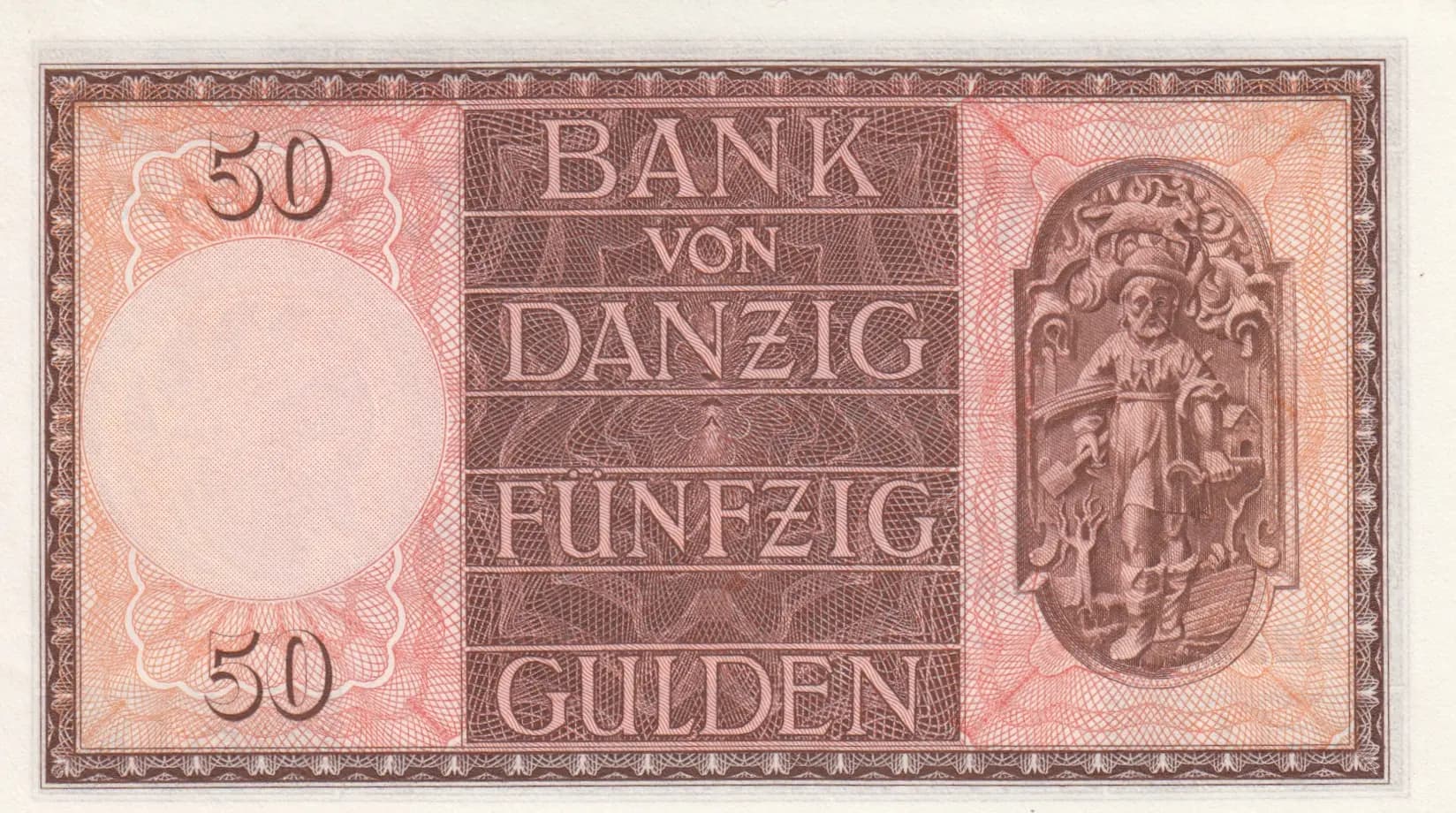
This is an exceptional example of the 1937 Bank von Danzig 50 Gulden note (Pick P-65) in uncirculated condition, showcasing the finest quality of interwar Danzig currency. The note features a beautifully engraved half-timbered civic building on the obverse and a classical portrait medallion on the reverse, both rendered in delicate mauve, brown, and pink tones with pristine preservation. As currency from the Free City of Danzig during the interwar period—just two years before WWII dramatically altered the region—this note represents an important historical artifact with strong collector appeal.
Uncommon to Scarce. While the 2016 catalogue value of $1,700 UNC indicates this is not a common note, the observed eBay market prices showing significant variation ($46.50 to $2,500 UNC) suggest variable demand and availability. The Free City of Danzig's short-lived political status (1920-1939) combined with wartime destruction and post-WWII currency exchanges resulted in limited survivor populations for high-denomination notes. UNC examples are considerably less frequently encountered than lower grades, justifying the uncommon classification.
This note was issued by the Bank von Danzig on February 5, 1937, during the final years of the Free City of Danzig's independence as a League of Nations mandate territory. The half-timbered building depicted on the obverse represents Danzig's rich medieval and early modern architectural heritage, reflecting the city's long history as a major Baltic trading center. The classical portrait on the reverse likely commemorates a historical figure significant to Danzig's civic identity, exemplifying the nationalistic symbolism common to European currencies of this period.
The obverse features a prominent coat of arms with two heraldic supporting figures positioned on the left, symbolizing Danzig's civic authority and sovereignty. The central vignette showcases a half-timbered building with characteristic Hanseatic architecture, likely representing Danzig's historic market hall (Artushof) or similar civic structure, framed within ornamental borders. The reverse displays large denomination numerals in ornate frames flanking a central cartouche containing the denomination text in German. A classical male portrait in profile, depicted within a decorative medallion on the right side, provides numismatic elegance typical of early 20th-century European design.
FRONT SIDE: 'Bank von Danzig' (Bank of Danzig), '50' and 'Fünfzig Gulden' (Fifty Gulden), 'Danzig, den 5. Februar 1937' (Danzig, the 5th of February 1937), Serial number: H299.539. BACK SIDE: '50' (denomination numeral), 'Bank von Danzig' (Bank of Danzig), 'Fünfzig Gulden' (Fifty Gulden).
Intaglio engraving (line engraving and steel plate printing) produced by BWC (Banknoten-Werke und Creditanstalt), as indicated in the PMG population data. The note demonstrates sophisticated security printing techniques including fine guilloché patterns, detailed cross-hatching, intricate line shading, and ornamental engraved patterns throughout both sides—characteristic of premium interwar European banknote production.
This note is identified as P-65 (standard variant), printed by BWC. The PMG population report indicates two catalogued variants exist for this Pick number: P-65 and P-65s (specimen). The serial number H299.539 with the standard H-prefix indicates this is a regular circulation issue rather than a specimen or special variety. No overprints or unusual characteristics are visible in the examined example.