20 gulden 1932
Market Prices
About This Note
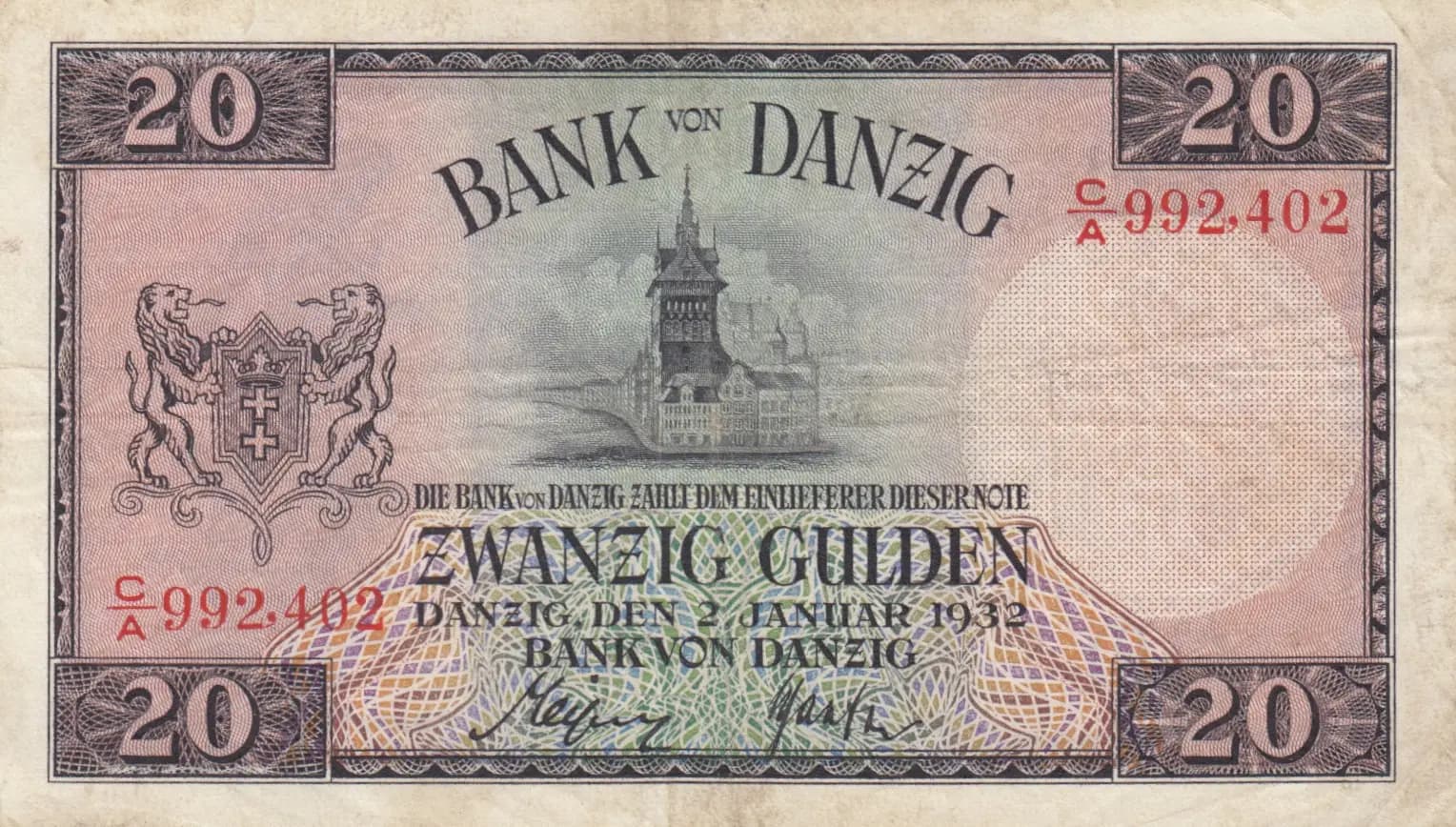
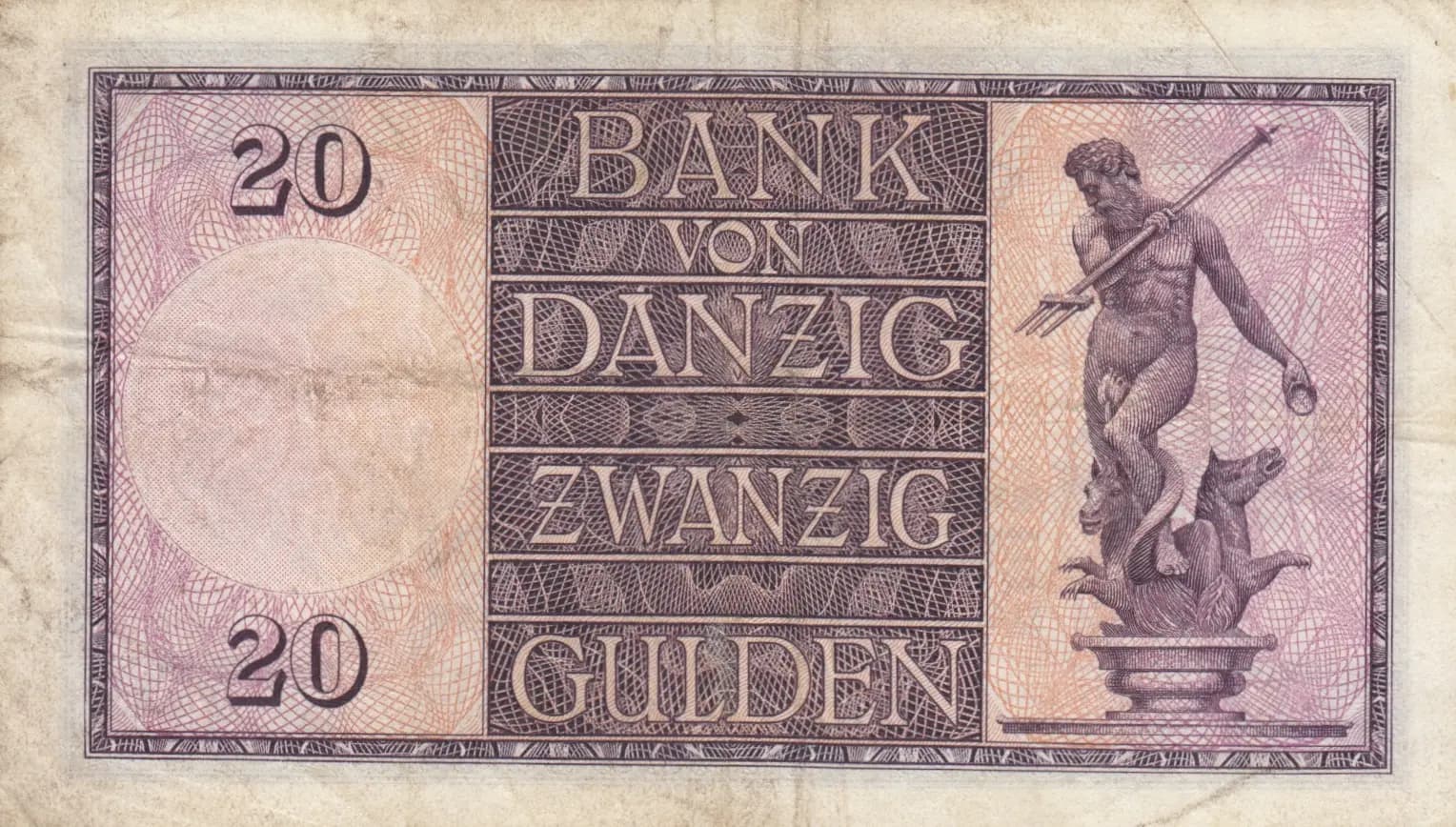
This 20 Gulden note from the Bank von Danzig, dated January 2, 1932, displays the characteristic pink-rose and purple color scheme typical of interwar Danzig currency. The note features prominent architectural imagery of the Stockturm (the local tower) on the obverse and an allegorical Neptune/cherub figure on the reverse, reflecting Danzig's maritime heritage. In Fine condition, this circulated example shows expected age-related foxing and creasing consistent with its near-century of existence, with well-preserved engraving details and legible inscriptions.
Common. The eBay price tracking data shows multiple listings with significant price variance ($46.50 to $2,500), but the median 'Unknown' condition price of $1,186.50 and the presence of multiple UNC examples at $46.50 and $63.17 indicates adequate market supply. The 2016 catalogue value for VF condition ($800) further suggests this is a widely available note. The Bank von Danzig operated for nearly two decades and produced several denominations in reasonable quantities; this 20 Gulden denomination shows no evidence of having been short-printed or recalled. Fine condition examples are standard circulated survivors of the period.
This note was issued during the Free City of Danzig period (1920-1939), a League of Nations-administered territory with its own banking authority and currency system. The imagery—the fortified Stockturm representing civic authority and the classical allegorical figure embodying commerce and maritime trade—reflects Danzig's historical importance as a Baltic trading port. Issued just three years before the city's reincorporation into Nazi Germany, this represents a significant piece of the city's brief independent monetary history.
The obverse features the Stockturm (tower of the city gate/fortification), a prominent landmark in historical Danzig's skyline, rendered in central position with fine engraving detail. The left side displays the Danzig coat of arms—two rampant lions supporting a shield bearing a cross design—symbolizing civic authority. The reverse depicts Neptune or a classicized allegorical putto (cherub figure) in flowing robes, holding a trident or staff, standing upon a decorative pedestal, embodying maritime power and commercial prosperity. Both sides employ intricate geometric cross-hatching and ornamental border patterns as security features. The color scheme of pink, rose, purple, and brown tones with yellow-gold accents is characteristic of Bank von Danzig's design aesthetic during this period.
OBVERSE: 'BANK VON DANZIG' (Bank of Danzig) — 'ZWANZIG GULDEN' (Twenty Gulden) — '20' (denomination, repeated in all four corners) — 'DIE BANK VON DANZIG ZAHLT DEM EINLIEFERER DIESER NOTE' (The Bank of Danzig pays the bearer of this note) — 'DANZIG, DEN 2. JANUAR 1932' (Danzig, January 2, 1932) — Serial Number: 'A 992.402'. REVERSE: 'BANK VON DANZIG' (Bank of Danzig) — 'ZWANZIG GULDEN' (Twenty Gulden) — '20' (denomination repeated).
This note was produced using intaglio (engraved steel plate) printing, the standard security printing method of the era, as evidenced by the fine line work, complex geometric security patterns, and sharp detail visible throughout both obverse and reverse. The printer is listed as BWC (Banknote World Currency/similar security printer designation per PMG records). The precise engraving of the architectural and allegorical elements, combined with the multi-color offset application, represents high-quality interwar banking security printing standards.
This note (Pick P-60) exhibits serial number variety 'A 992.402' in red ink. PMG cataloguing records indicate two variants exist for this Pick number: the standard P-60 and P-60s (likely denoting specimen notes). The visual analysis confirms this is a regular circulated issue, not a specimen. The two-lion heraldic coat of arms and the specific architectural rendering of the Stockturm are consistent with the primary P-60 design. No overprints, date variations, or signature varieties are apparent in this example, indicating it represents the standard variety for this denomination.