1000 gulden 1924
Market Prices
About This Note
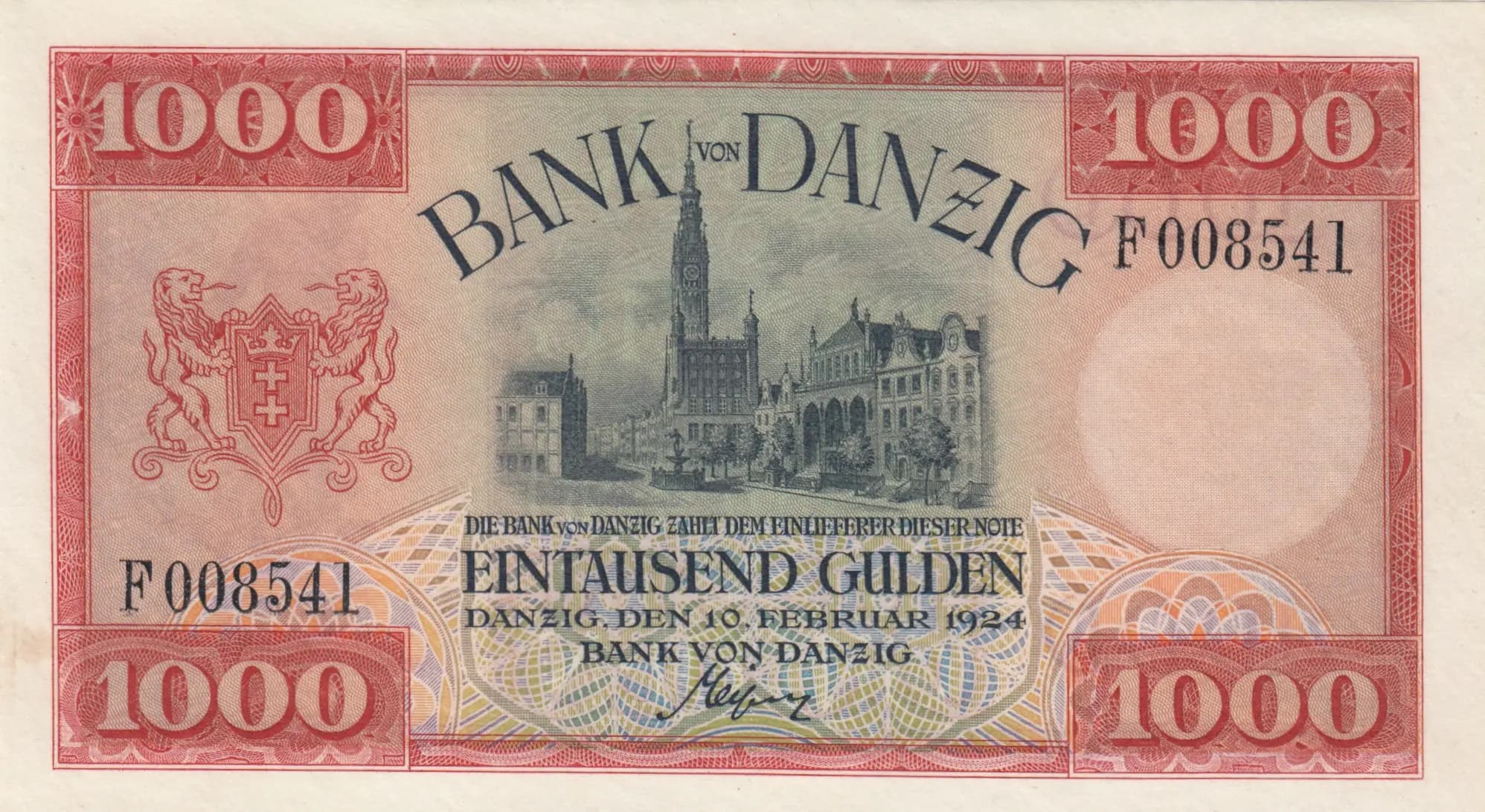
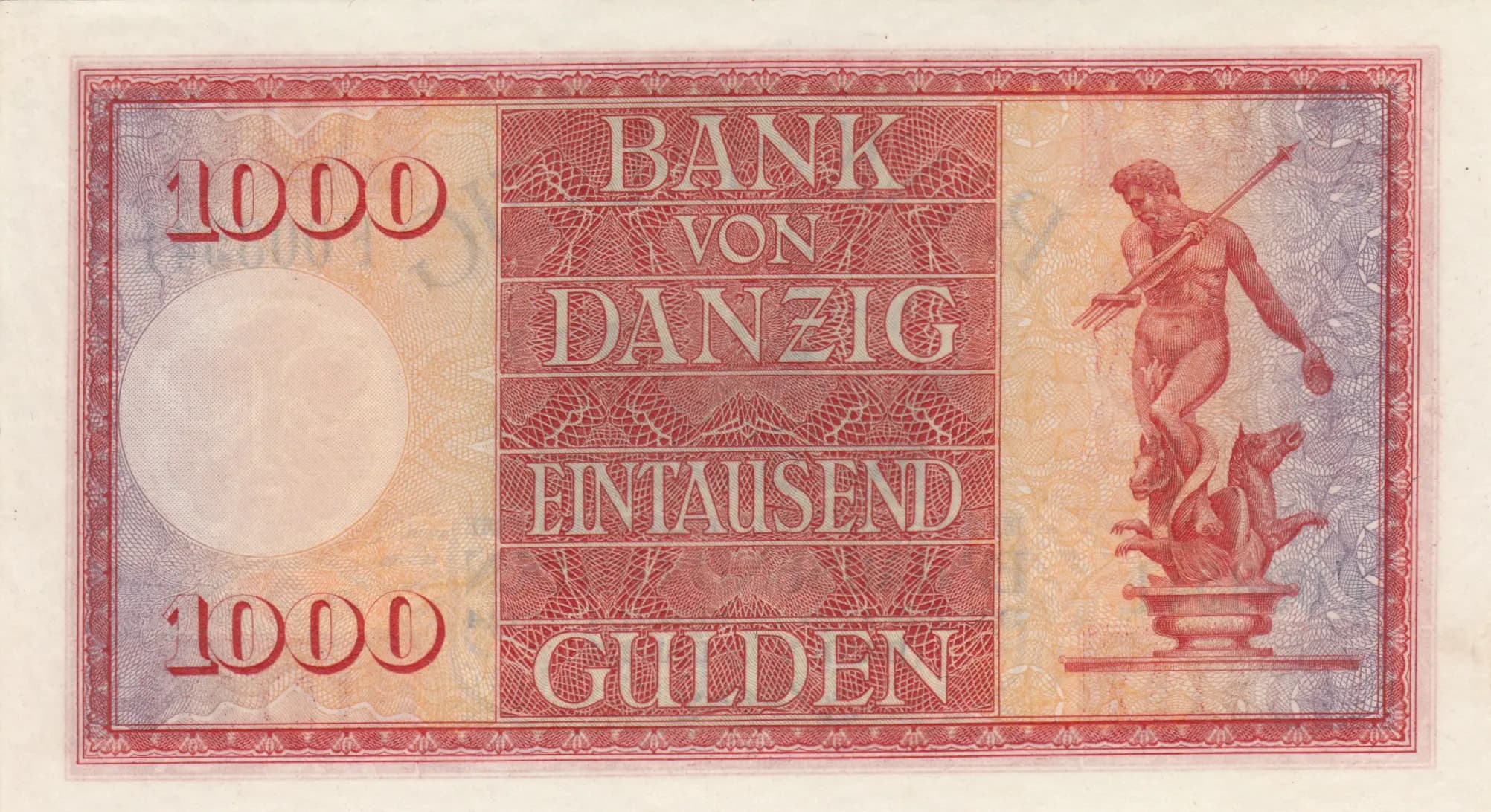
This 1000 Gulden note from the Bank von Danzig dated February 10, 1924, presents an exceptional example of Weimar-era German banknote design in uncirculated condition. The note features striking red-pink coloration with meticulously engraved imagery: the obverse displays Danzig's Gothic cathedral dominating a historic cityscape, while the reverse showcases a classical allegorical figure wielding a trident over a dragon. Sharp printing, crisp borders, and complete absence of wear indicate this is a premium specimen worthy of serious collectors.
Uncommon to scarce. While the Danzig 1000 Gulden is not excessively rare, UNC specimens command strong market prices ($2,500 USD catalog value, consistent with eBay sales data), indicating limited availability in pristine condition. The Free City of Danzig's brief independent existence (1920-1939) and subsequent currency recall limit surviving examples. Circulated specimens appear more frequently at lower valuations ($285-$298 USD), but uncirculated examples represent a small percentage of survivors, making this grade notably desirable.
This note was issued during a critical period for the Free City of Danzig (1920-1939), when the Bank von Danzig maintained independent currency authority following the Treaty of Versailles. The cathedral spire depicted on the obverse represents St. Mary's Church (Marienkirche), the dominant landmark of Danzig's medieval Old Town and a symbol of civic pride. The allegorical Neptune-like figure on the reverse, paired with a dragon motif, reflects Danzig's maritime heritage and historical significance as a Hanseatic League port city during the interwar period.
The obverse features a symmetrical composition centered on St. Mary's Church (Marienkirche) with its distinctive tall Gothic spire, surrounded by period merchant buildings characteristic of Danzig's 16th-17th century architecture. The heraldic coat of arms on the left displays two griffins or dragons as supporters flanking a shield with crosses, representing Danzig's civic heraldry. Ornamental rosette patterns and geometric borders frame the composition in red-pink tones over cream underprint. The reverse presents a classical allegorical figure, likely representing Neptune or maritime prosperity, rendered as a muscular putti holding a trident and standing triumphantly over a dragon or sea serpent upon a pedestal—symbolizing Danzig's mastery of maritime trade. A large circular element on the left may represent a watermark or security feature placeholder.
OBVERSE: 'BANK VON DANZIG' (Bank of Danzig); '1000' (denomination); 'EINTAUSEND GULDEN' (One Thousand Gulden); 'DIE BANK VON DANZIG ZAHLT DEM EINLIEFERER DIESER NOTE' (The Bank of Danzig pays the presenter of this note); 'DANZIG, DEN 10. FEBRUAR 1924' (Danzig, February 10, 1924); Serial number 'F 008541'. REVERSE: '1000' (denomination); 'BANK VON DANZIG' (Bank of Danzig); 'EINTAUSEND GULDEN' (One Thousand Gulden).
Intaglio engraving, the standard security printing method for banknotes of this era. The printer is identified in PMG records as BWC (Banknote Printing Company), which was the primary contractor for Bank von Danzig currency. The technique employed fine line work, complex ornamental borders, and multi-layered decorative elements serving both aesthetic and anti-counterfeiting purposes. The sharp, well-defined impressions visible throughout both sides demonstrate professional engraving quality characteristic of major banknote producers of the 1920s.
Pick catalog P-57 with four documented variants (P-57, P-57cts, P-57p1, P-57p2) in PMG records. This example exhibits serial number 'F 008541', suggesting the standard P-57 base variety. The date February 10, 1924 is consistent with the initial issue. No overprints or signature variants are apparent from the visual analysis. The 'F' prefix in the serial number may indicate a specific printing batch or series, though variant classification would require comparison against PMG grading records for definitive identification.