10 000 mark 1923
Market Prices
4 salesAbout This Note
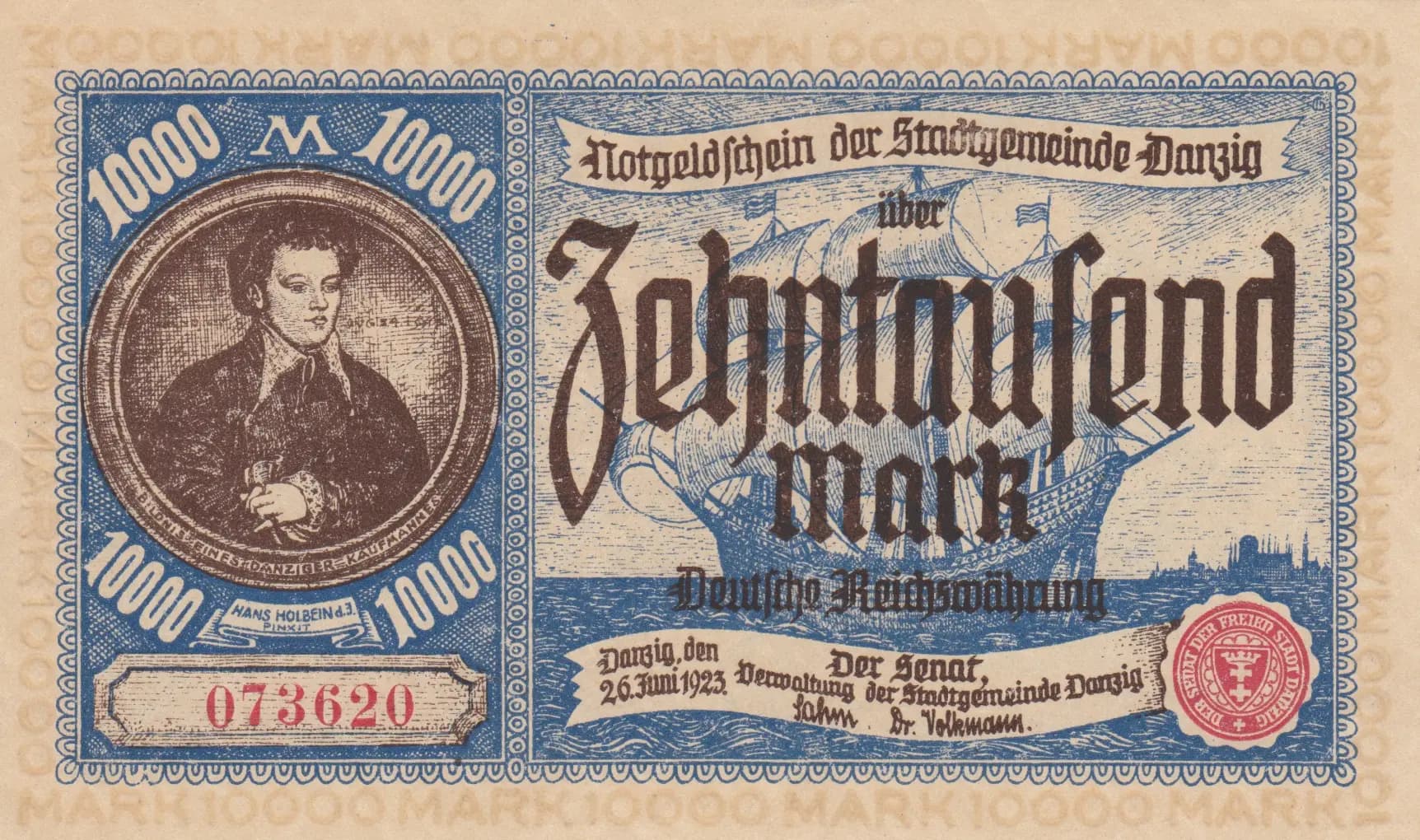
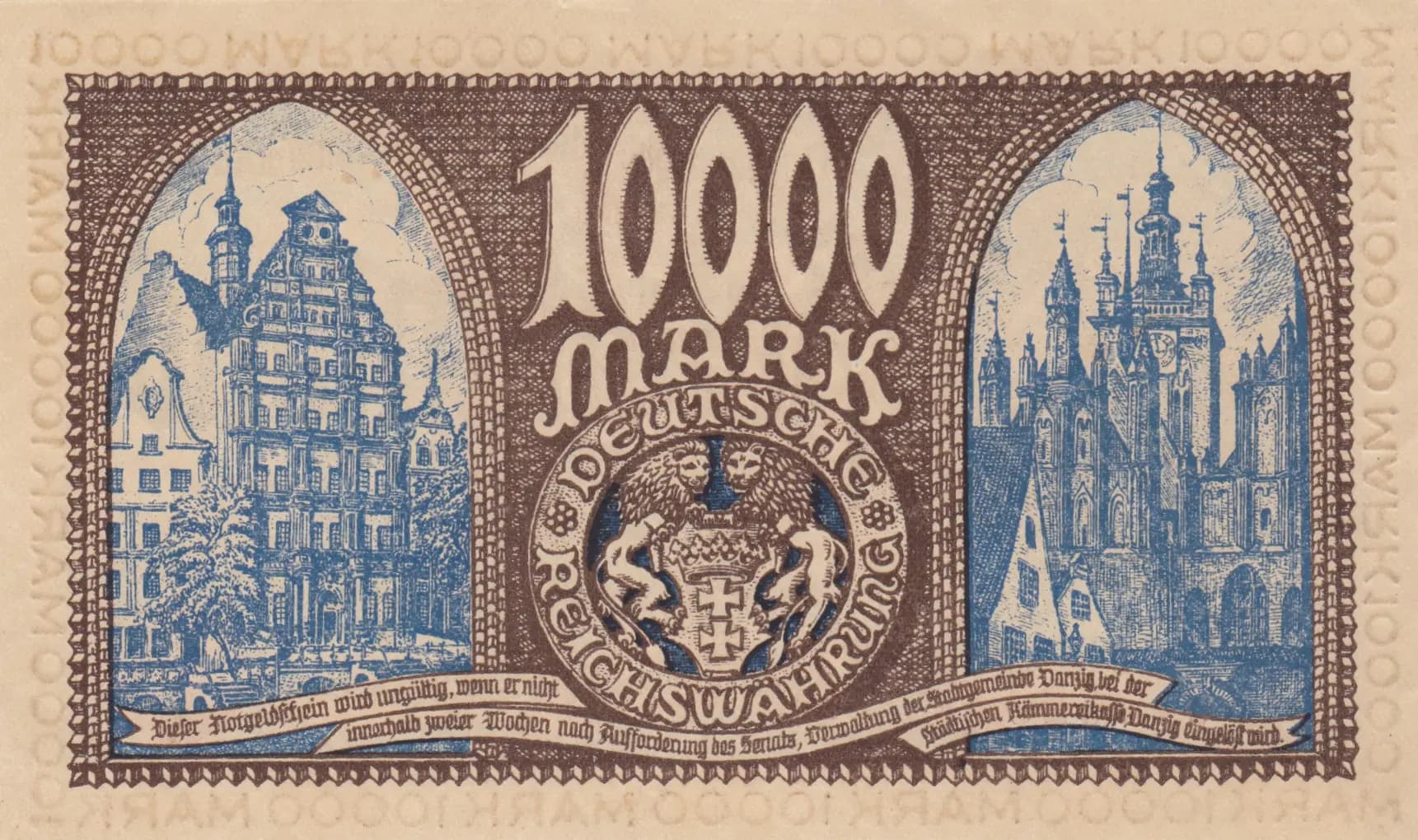
This AU-graded 10,000 Mark note from Danzig's emergency currency issue of June 1923 presents an exceptional example of interwar German hyperinflation-era scrip. The obverse features a finely rendered portrait of a Danzig merchant in a circular medallion with a dramatic sailing ship illustration, while the reverse displays the city's iconic architectural landmarks—the Town Hall and cathedral spires—flanking a heraldic coat of arms. The note exhibits minimal wear with crisp printing and clear inscriptions, characteristic of the high-quality production standards maintained by the Danzig Senate even during the economic chaos of 1923.
Common. While this is a specialized emergency currency issue from a defunct political entity (the Free City of Danzig), it was produced in sufficient quantities for circulation within Danzig during 1923. eBay market data shows consistent availability with F-VF specimens selling in the $60-$130 range as recently as 2016-2018, and catalog values (even for UNC grades at $500) indicate the note is obtainable for collectors at moderate cost. No evidence of limited print runs, recalled series, or extreme scarcity exists for this Pick number. The AU grade present in this specimen is desirable but not exceptionally rare for the type.
This note represents an extraordinary moment in economic history, issued during Germany's hyperinflation crisis when the Reichsmark collapsed in value—the denomination itself (10,000 Marks) reflects the astronomical price levels of mid-1923. Danzig, as the Free City under League of Nations administration, maintained its own monetary authority and issued this emergency currency (Notgeldschein) to facilitate commerce as the German currency became worthless. The prominent depiction of Danzig's maritime heritage (the sailing ship) and civic monuments underscores the city's proud mercantile tradition and independence during this period of German political and economic upheaval.
The obverse showcases a classical portrait of a Danzig merchant rendered in the style of Hans Holbein the Elder (referenced in the inscription), enclosed in an ornamental circular medallion with decorative borders in blue and cream tones. To the right is a detailed illustration of a multi-masted sailing ship, symbolizing Danzig's historic role as a major Baltic trading port. The reverse displays the Artus Court (Town Hall) on the left and the Cathedral of St. Mary on the right—two of Danzig's most recognizable civic structures—flanking a heraldic coat of arms featuring two lions and a cross, representing the city's sovereignty. The overall color scheme of brown, blue, cream, and red is consistently applied across both sides, with an ornamental border pattern unifying the design. A red official seal appears on the lower right of the obverse.
OBVERSE: '10000 M' (denomination); 'Notgeldschein der Stadtgemeinde Danzig' (Emergency currency note of the city municipality of Danzig); 'über Zehnhundertand Millionen Reichspfennig' (for approximately ten hundred million Reich-Pfennig); 'Danzig, den 26.Juni 1923' (Danzig, June 26, 1923); 'Der Senat Der Stadtgemeinde Danzig' (The Senate of the City Municipality of Danzig); 'Dr. Volkmann' (signature); 'HANS HOLBEIN D.Ä.' (Hans Holbein the Elder [artist attribution]); Serial number '073620'. REVERSE: '10000 MARK' (denomination); 'DEUTSCHES REICH' (German Reich); 'Dieser Notgeldschein wird ungültig, wenn er nicht innerhalb zweier Monate nach Auforderung des Senates, Verwaltung der Stadtgemeinde Danzig eingeleist wird' (This emergency currency note will become invalid if it is not redeemed within two months of the Senate's request, administration of the city municipality of Danzig).
The note exhibits characteristics of fine intaglio (engraved) printing combined with multicolor lithography, which was standard for German and Central European emergency currency of the 1920s. The crisp definition of fine details—particularly in the portrait medallion, architectural elements, and decorative borders—indicates professional die engraving. The precise multicolor registration and tonal gradation suggest work by a skilled security printer, though the specific printer for this Danzig Senate issue is not definitively documented in the visual analysis or standard references.
This specimen exhibits serial number 073620 with Dr. Volkmann signature. The note is dated June 26, 1923, representing the initial issue date for this denomination. PMG records indicate one primary variant for Pick 18, suggesting relatively consistent production without notable sub-varieties in terms of signatures, dates, or serial prefixes. No overprints or date variations are evident in this example.