50 pesos 1961 specimen
Market Prices
About This Note
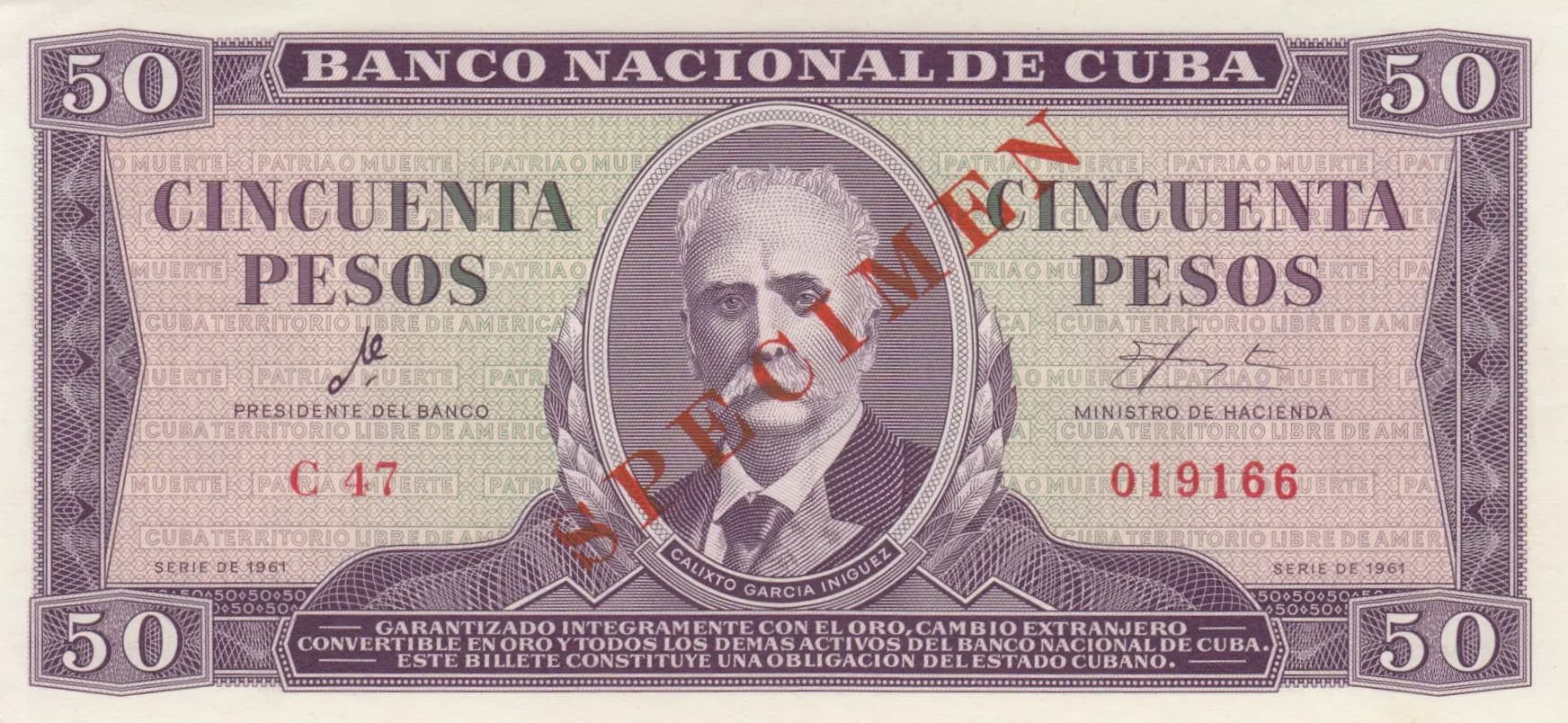
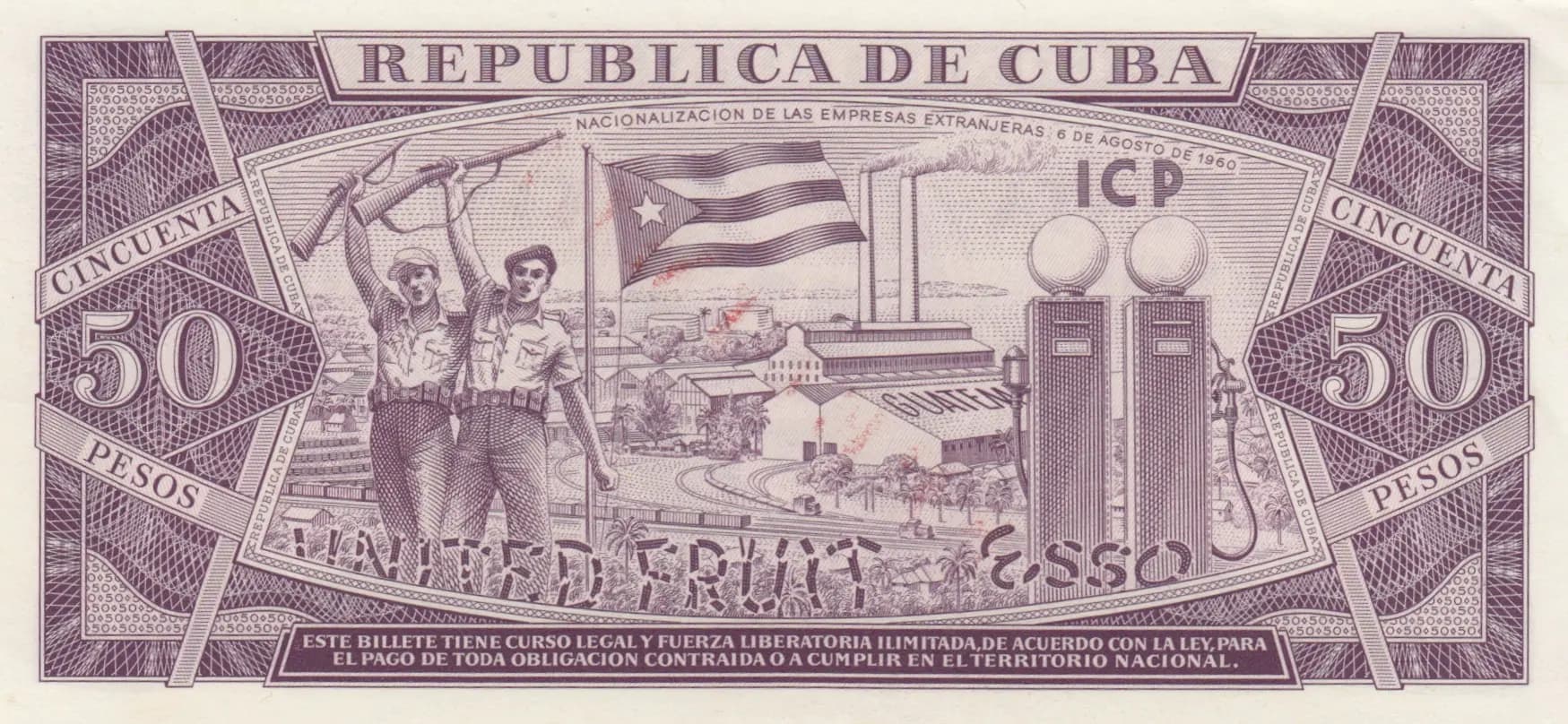
This is a Cuban 50 Pesos specimen note from 1961, graded UNC, featuring a striking portrait of revolutionary hero Calixto García Íñiguez on the obverse with vibrant purple and beige coloring. The reverse depicts the nationalization of foreign industries with industrial and agricultural imagery, two revolutionary figures with raised fists, and the Cuban flag, commemorating the August 6, 1960 nationalization decree. The note bears prominent red 'SPECIMEN' diagonal overprints and exhibits pristine condition with exceptional detail in its line engraving, making it a significant example of early post-revolutionary Cuban currency design.
Common. The 2019 catalog valuation of $50 UNC indicates this is a readily available specimen note in the secondary market. While specimen notes are generally less common than circulated issues, this particular Pick number does not appear to have had a severely restricted print run. The availability reflected in online pricing suggests adequate supply for collectors seeking this denomination and date.
Issued in 1961 by the Banco Nacional de Cuba under Fidel Castro's revolutionary government, this note commemorates the nationalization of foreign-owned industries that occurred on August 6, 1960, a pivotal moment in Cuba's post-revolutionary consolidation of power. The reverse imagery celebrating industrial and agricultural development reflects the regime's propaganda emphasizing national economic sovereignty and worker liberation. The inscription 'Cuba Territorio Libre de América' and the revolutionary motto 'Patria o Muerte' underscore the ideological positioning of Cuba as a liberated nation distinct from American influence during the height of Cold War tensions.
The obverse features a formal oval portrait of Calixto García Íñiguez, a 19th-century Cuban independence leader and general who fought against Spanish colonial rule, positioned centrally with flanking laurel wreaths symbolizing honor and victory. The denomination '50' appears in all four corners, with 'Cincuenta Pesos' spelled out below the portrait. Fine line engraving and decorative geometric borders frame the composition. The reverse depicts a revolutionary propaganda scene commemorating the August 6, 1960 nationalization decree, with two figures in military uniforms with raised fists standing before an industrial complex (marked 'ICP' — likely Instituto Cubano del Petróleo or similar state enterprise) and agricultural landscape with palm trees and storage facilities. The Cuban flag is prominently displayed. Both sides employ extensive parallel line engraving and cross-hatching in the background to prevent counterfeiting. Serial number prefix 'C 47' with sequential numbering '019166' indicates the series designation.
FRONT: 'Banco Nacional de Cuba' (National Bank of Cuba); 'Cincuenta Pesos' (Fifty Pesos); 'Calixto García Íñiguez' (portrait identification); 'Muerte Patria o Muerte' / 'Patria o Muerte' (Fatherland or Death — revolutionary motto); 'Cuba Territorio Libre de América' (Cuba Free Territory of America); 'Presidente del Banco' (President of the Bank); 'Ministro de Hacienda' (Minister of Finance); 'Serie de 1961' (Series of 1961); 'Garantizado íntegramente con el oro, cambio extranjero convertible en oro y todos los demás activos del Banco Nacional de Cuba. Este billete constituye una obligación del Estado Cubano.' (Fully guaranteed with gold, foreign exchange convertible into gold and all other assets of the National Bank of Cuba. This note constitutes an obligation of the Cuban State); 'Specimen' (English overprint). BACK: 'República de Cuba' (Republic of Cuba); 'Cincuenta Pesos' (Fifty Pesos); 'Nacionalización de las Empresas Extranjeras. 6 de Agosto de 1960' (Nationalization of Foreign Enterprises. August 6, 1960); 'Este billete tiene curso legal y fuerza liberatoria ilimitada de acuerdo con la ley para el pago de toda obligación contraída o a cumplir en el territorio nacional.' (This note has legal status and unlimited liberatory force in accordance with law for payment of all obligations contracted or to be fulfilled in national territory).
Intaglio line engraving by security printer STC-P (likely Sociedade de Tipografia Cubana or similar Cuban printer), characteristic of the period. The visual analysis confirms extensive fine line engraving throughout, with detailed parallel line patterns, cross-hatching, and ornamental geometric designs that are hallmarks of intaglio security printing. No imprint credit is visible on the note itself, consistent with the catalog notation 'without imprint.' The precision of the portrait engraving and the complexity of the reverse industrial scene demonstrate high-quality intaglio work typical of 1960s currency production.
This is identified as a specimen note (Pick P-98s) as opposed to the standard circulating issue (Pick P-98), denoted by the prominent red 'SPECIMEN' diagonal overprints visible across both sides. The series designation is 'C 47' with serial number '019166,' typical of the 1961 printing. No signature varieties or other known significant varieties for this Pick number have been identified from the visual analysis. The specimen marking confirms this note was never intended for circulation but rather served as a sample for the issuing authority or security printer.