50 centavos 1896
Market Prices
3 salesAbout This Note
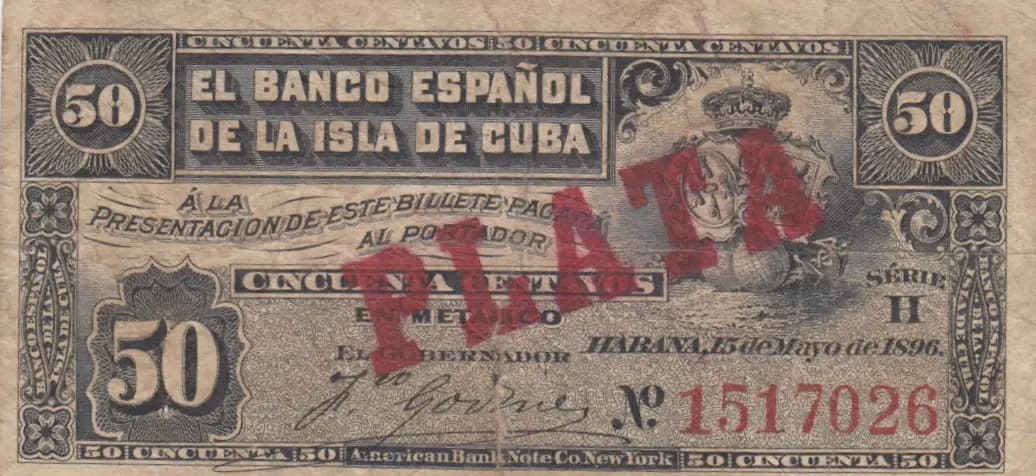
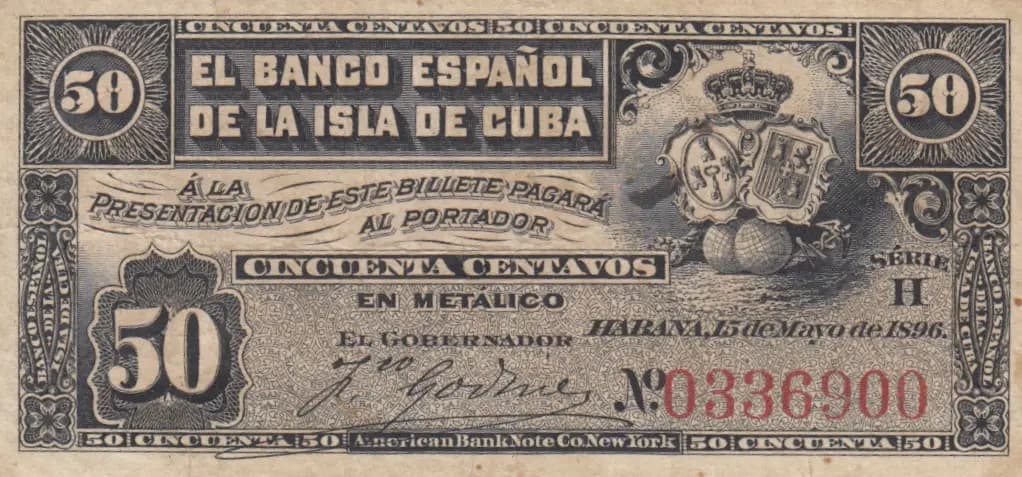
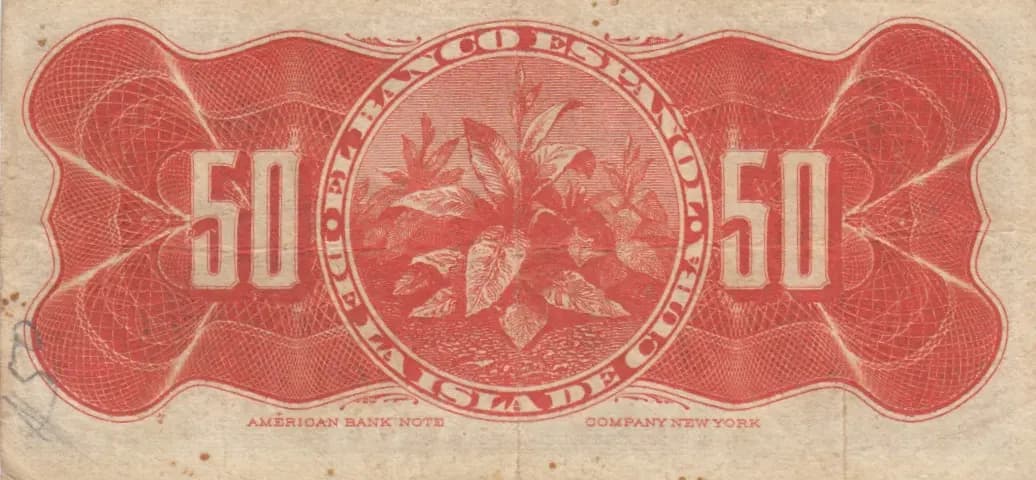
This is a Cuban 50 centavos banknote issued by El Banco Español de la Isla de Cuba in 1896, graded VF. The note exhibits the fine engraving characteristic of American Bank Note Company's work, with a formal front design featuring the Spanish royal coat of arms and a distinctive back design showcasing agricultural imagery (tobacco plant) in red ink. Despite over a century of age, the note displays excellent legibility with only natural yellowing and foxing typical of 19th-century currency paper, making it a well-preserved example of late colonial Cuban currency.
Common. This is a regular issue from a major colonial bank with likely substantial print runs. eBay market data shows these notes selling for $5-$10.50 in the mid-2010s in F-VF condition, with catalog values at $3 for VF grade (2016 data). These prices indicate a well-supplied market with no supply constraints typical of rare or scarce notes. The historical significance of the issuer and proximity to Cuban independence makes it collectible, but the denomination and issue type are standard.
This note represents the final years of Spanish colonial rule in Cuba, issued just months before the Spanish-American War (1898) would end Spanish sovereignty over the island. El Banco Español de la Isla de Cuba's 1896 issues symbolize the Spanish financial presence in their last colonial stronghold in the Americas, with the royal coat of arms prominently displayed affirming Spain's authority. The tobacco plant imagery on the reverse reflects Cuba's economic importance as a major tobacco producer, a commodity central to the island's colonial economy and trade.
The front features a formal, symmetrical design centered on the Spanish royal coat of arms with heraldic shields and a crown, representing sovereign authority over the island colony. Large circular '50' denominations appear in the upper corners. The text indicates this is a bearer note payable on demand in Havana. A decorative ornamental border with scrollwork frames the design. The back is printed in red ink and displays a prominent circular medallion containing botanical imagery of tobacco plants—Cuba's most valuable commodity—surrounded by symmetrical decorative wave and scroll patterns that echo the agricultural theme. The denomination '50' is repeated prominently on both sides of the reverse.
FRONT SIDE: 'EL BANCO ESPAÑOL DE LA ISLA DE CUBA' (The Spanish Bank of the Island of Cuba); 'A LA PRESENTACION DE ESTE BILLETE PAGARA AL PORTADOR' (At the presentation of this note it will be paid to the bearer); 'CINCUENTA CENTAVOS' (Fifty centavos); 'EN MEXICO' (In Mexico); 'EL GOBERNADOR' (The Governor); 'HABANA JULIO DE 1896' (Havana July 1896); 'SERIE H' (Series H); 'No°0336900' (Number 0336900); 'American Bank Note Co New York' (American Bank Note Co New York). BACK SIDE: '50' (numeric denomination); 'AMERICAN BANK NOTE COMPANY NEW YORK' (American Bank Note Company New York).
Steel engraving (intaglio printing) executed by American Bank Note Company, New York. The fine line work, detailed scrollwork, and crisp detail visible in both the front and back designs are characteristic of high-quality bank note engraving from this period. The front is printed in black and red inks, while the back is rendered primarily in red, demonstrating the company's multi-color intaglio capability. Serial numbers appear in red ink on the front.
This example is identified as Series H with serial number 0336900, printed in red ink. The date shown as 'JULIO DE 1896' (July 1896) on the front while the catalog reference indicates an official issue date of 15 May 1896 may reflect the date of this particular printing batch. Pick catalog designation P-46a indicates this is a recognized variety; the 'a' suffix typically denotes a specific signature, serial number series, or overprint variety. The note shows no evidence of overprints or additional authentication marks beyond the standard security features of the era.