10 centavos 1883
Market Prices
About This Note
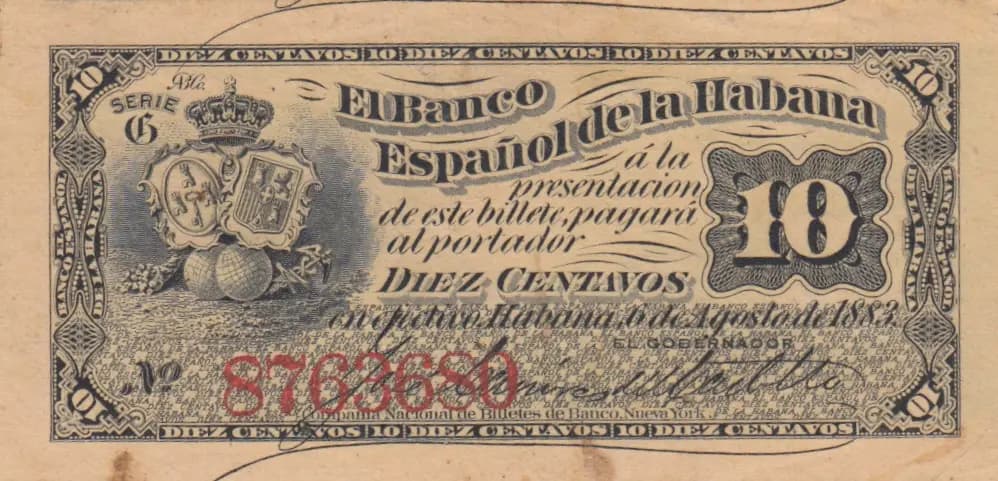
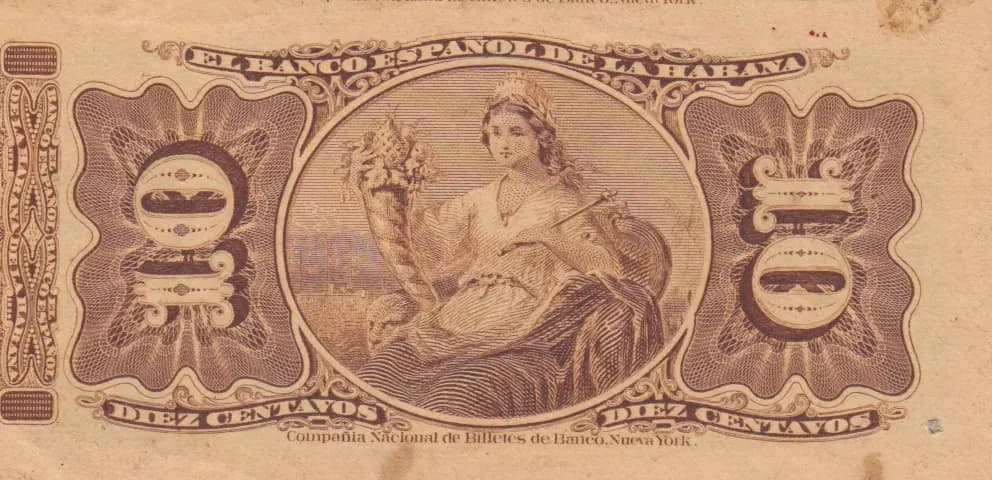
A well-preserved example of Cuba's 10 centavos note issued by El Banco Español de la Habana in 1883, printed by the prestigious National Bank Note Company of New York. The note displays the characteristic ornate Victorian-era design with a coat of arms on the obverse and an allegorical female figure representing commerce or prosperity on the reverse, both rendered in fine line engraving. Despite showing natural aging characteristics including foxing and paper darkening consistent with 140+ years of age, this VF specimen retains excellent clarity of the intricate decorative elements and maintains strong visual appeal for collectors of Cuban colonial currency.
Common. The catalog price references indicate this note trades in the $12-40 range depending on condition, which is typical for common banknotes from established colonial-era banks with substantial print runs. The Pick catalog listing for 1883 shows this as a regular issue from El Banco Español de la Habana, and no information suggests a limited mintage or recall. While the specific variety (serial number 876249) may be unique, the issue itself remains readily available in the numismatic market.
This banknote reflects Cuba's economic relationship with Spain during the late 19th century, when the island remained a Spanish colony and the Banco Español de la Habana maintained significant financial authority. The August 6, 1883 date marks a period when Spanish banking institutions actively circulated currency throughout Cuba, and the printing by New York's National Bank Note Company demonstrates the international collaboration typical of colonial-era finance. The allegorical imagery celebrating commerce and agricultural prosperity on the reverse symbolizes the sugar and agricultural wealth that defined Cuba's colonial economy during this period.
The obverse features a formal heraldic coat of arms with two shields surmounted by a crown, positioned in the upper left quadrant and enclosed within ornamental frames—this represents the Spanish royal authority backing the colonial currency. The denomination 'DIEZ CENTAVOS' appears prominently in elaborate frames on the right side. The entire note is bordered by repeating geometric patterns typical of 1880s security printing. The reverse presents a classical allegorical female figure (Ceres or Commerce) seated within a central oval medallion, holding wheat or grain stalks symbolic of agricultural prosperity and trade. Decorative circular emblems flank the central medallion on both sides, and the design maintains strict bilateral symmetry characteristic of high-security banknote aesthetics of the era.
FRONT: 'SERIE' (Series) | 'BANCO Español de la Habana' (Spanish Bank of Havana) | 'de este billete, garantiza al portador' (of this banknote, guarantees to the bearer) | 'DIEZ CENTAVOS' (Ten Centavos) - appears twice | 'en plata Habana, 6 de Agosto de 1883' (in silver Havana, August 6, 1883) | 'Compañía Nacional de Billetes de Banco, Nueva York' (National Company of Bank Banknotes, New York) | Serial number: 876249 | BACK: 'BANCO ESPAÑOL DE LA HABANA' (Spanish Bank of Havana) | 'DIEZ CENTAVOS' (Ten Centavos) - appears twice | 'Compañía Nacional de Billetes de Banco, Nueva York' (National Company of Bank Banknotes, New York)
Steel plate intaglio engraving (also called recess printing or copperplate printing), executed by the National Bank Note Company of New York. The fine line engraving is evident throughout both sides in the intricate border patterns, the detailed heraldic imagery, and the finely rendered allegorical figure. This was the premium security printing method of the 19th century, producing the sharp, precise lines and subtle tonal gradations visible in the preserved specimen. No color printing is evident—the note was produced in monochrome (brown/tan ink on aged paper).
This specimen is dated August 6, 1883, representing the 1883 issue of the Pick P-30 series. The serial number 876249 with the 'SERIE' designation suggests this is from an identified serial range of the 1883 printing. The catalog data indicates that this denomination was issued in three years (1872, 1876, and 1883), making the 1883 variety distinguishable by its explicit date notation 'Habana, 6 de Agosto de 1883.' No signature varieties are apparent from the visual analysis. The red stamp visible on the front may indicate a bank or archival mark rather than a collecting variety.